Streamlining the Future: How Temporian and TensorFlow Decision Forests Are Revolutionizing Temporal Data Engineering


In the rapidly evolving landscape of machine learning, the ability to interpret and act upon temporal data—information that fluctuates or holds meaning only at specific moments—has become the "holy grail" for data scientists. From tracking the volatile shifts in global market prices to analyzing the intricate patterns of network traffic for cybersecurity, time-dependent data is the heartbeat of modern predictive modeling.
To bridge the gap between raw, asynchronous transaction logs and high-performance machine learning models, Google, in collaboration with Tryolabs, has unveiled Temporian. This new open-source Python library is specifically engineered to simplify the complex, often grueling process of feature engineering for temporal data, providing a seamless pipeline that integrates directly with TensorFlow Decision Forests (TF-DF).

The Ubiquity and Challenge of Temporal Data
Temporal data is not merely a subset of machine learning; it is an omnipresent challenge. Whether it is the interval between two human heartbeats, which serves as a critical diagnostic tool for cardiologists, or the timestamped logs of a server cluster used to prevent data breaches, the value of data is often inextricably linked to when it was recorded.
Despite its importance, preprocessing this data has historically been a bottleneck. Real-world data is rarely "clean." It often arrives in non-synchronized streams, with irregular intervals, and in massive, unformatted datasets that require significant computational overhead to normalize. Traditional time-series approaches, which often rely on uniform sampling, frequently fail to capture the nuanced, event-driven nature of transactional data.

This is where the collaboration between Google and Tryolabs changes the paradigm. By introducing Temporian, the development team aims to provide a toolset that handles these "event sets"—multivariate, multi-index sequences—with the same ease as standard tabular data.
A Chronology of the Development
The development of Temporian represents a strategic response to the needs of the industrial AI community.

- Phase 1: Identification of the Bottleneck. Engineers at Google and Tryolabs identified that while model architectures (like Random Forests or Gradient Boosted Trees) were becoming increasingly sophisticated, the "plumbing"—the ingestion and feature engineering of raw logs—remained manual, error-prone, and slow.
- Phase 2: Defining the "Event Set" Primitive. Unlike traditional time-series libraries that force data into uniform time buckets, the team designed Temporian around the concept of "EventSets." This allows the library to process data at the frequency it actually occurs, preserving the integrity of the information.
- Phase 3: Integration with TF-DF. Recognizing that TensorFlow Decision Forests are uniquely capable of handling heterogeneous tabular data, the developers built native connectors, allowing users to move from raw CSVs to trained, production-ready models in a fraction of the time previously required.
- Phase 4: Open Source Release. By making Temporian available to the global community, the project aims to standardize how developers approach temporal feature engineering.
Supporting Data: From Transactional Logs to Predictive Insights
To illustrate the efficacy of this new workflow, let’s consider a common business use case: forecasting weekly sales for an online retailer.
Step 1: Ingestion and Visualization
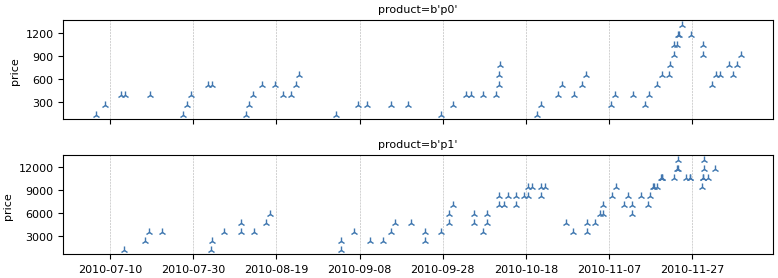
The process begins with raw transaction data. In a typical scenario, a CSV file contains a timestamp, a client ID, the product purchased, and the price. Using Temporian, this data is loaded into an EventSet. The library automatically recognizes the indices, allowing developers to visualize price trends across thousands of unique products simultaneously without complex data manipulation.

Step 2: Moving Averages and Aggregation
One of the most powerful features of Temporian is its suite of windowing operators. Calculating a 7-day moving sum—a common metric for sales forecasting—is reduced to a single line of code: sales["price"].moving_sum(tp.duration.days(7)). This operator works independently across different indices, meaning a developer can calculate moving sums for every product or every client simultaneously, regardless of when their individual transactions occurred.
Step 3: Bridging the Gap to Machine Learning
Before a model can be trained, the data must be prepared. Temporian allows for "sampling," which creates a uniform grid for the model to interpret. By using a daily tick, the irregular transaction data is aggregated into a structure that a Random Forest can consume. The code handles the complexity of "leaking" or shifting data to ensure that the model is predicting future values based on past information—a critical safeguard against data leakage.

Official Technical Perspectives
The development team, led by Mathieu Guillame-Bert, Richard Stotz, and a large team of contributors from Google and Tryolabs, emphasizes that Temporian is not just a preprocessing tool; it is a fundamental shift in data representation.
"Temporal data is highly discriminative," the team notes in their documentation. "By allowing developers to easily calculate features like moving averages, time-since-last-event, or calendar-based indicators (like day-of-week effects), we are effectively giving the model a better ‘memory’ of the past."

The integration with TensorFlow Decision Forests is equally intentional. While Deep Learning often requires massive amounts of data and compute, Decision Forests are highly efficient and interpretable. By combining Temporian’s feature engineering speed with TF-DF’s model efficiency, the project offers a "low-latency" path to building high-quality forecasting engines for SMEs and large enterprises alike.
Implications for the Industry
The release of Temporian carries significant implications for the field of Applied Machine Learning:
- Democratization of Complex Modeling: By abstracting away the mathematical complexity of handling irregular time intervals, Temporian lowers the barrier to entry for developers who are not experts in signal processing.
- Increased Model Interpretability: Because the system uses Random Forests as the primary model backend, the "Variable Importance" report provides clear insights. For instance, the sales forecasting model highlighted that the 28-day moving sum was the most critical factor, followed by the specific product ID and the day of the week. This provides stakeholders with actionable business intelligence.
- Efficiency and Performance: Manual feature engineering for time-series data is notoriously prone to "data leakage"—the accidental inclusion of future information in training data. Temporian’s internal logic is designed to prevent this by design, resulting in more robust, production-ready models.
- A Standardized Ecosystem: The move to integrate these tools into the broader TensorFlow ecosystem suggests a long-term commitment from Google to improve the "data-centric AI" workflow. Rather than focusing solely on new, experimental architectures, the industry is increasingly focused on how to make existing models more performant through better data handling.
The Future of Temporal Analysis
As we look toward the future, the integration of Temporian and TensorFlow Decision Forests will likely influence how companies handle real-time anomaly detection in IT infrastructure, predictive maintenance in manufacturing, and personalized recommendation engines in e-commerce.
For those looking to adopt these tools, the path forward is clear: start by exploring the provided tutorials, which cover diverse domains from finance to logistics. The ability to manipulate temporal data as a first-class citizen of the Python ecosystem is no longer a luxury—it is a necessity for any organization aiming to build accurate, time-sensitive predictive models.

By simplifying the most tedious aspects of data science, Google and Tryolabs are enabling developers to spend less time on data cleaning and more time on the true objective of machine learning: discovering the patterns that define the future. Whether you are forecasting sales or detecting a server intrusion, the tools are now in place to ensure that when it comes to temporal data, you are always ahead of the curve.