The New Frontier: Augmenting Recommendation Systems with Large Language Models
In the rapidly evolving landscape of machine learning, recommendation systems have long served as the silent engines driving digital engagement. From the curated "Watch Next" queues on streaming platforms to the personalized product feeds in e-commerce, these systems are ubiquitous. However, as the field shifts toward generative AI, a new paradigm is emerging: the integration of Large Language Models (LLMs) into the traditional recommendation pipeline. By leveraging tools like Google’s PaLM API, developers are now finding that the same technology powering conversational chatbots can profoundly enhance how machines predict user intent, refine rankings, and handle data cold starts.
Main Facts: The Intersection of LLMs and Recommenders
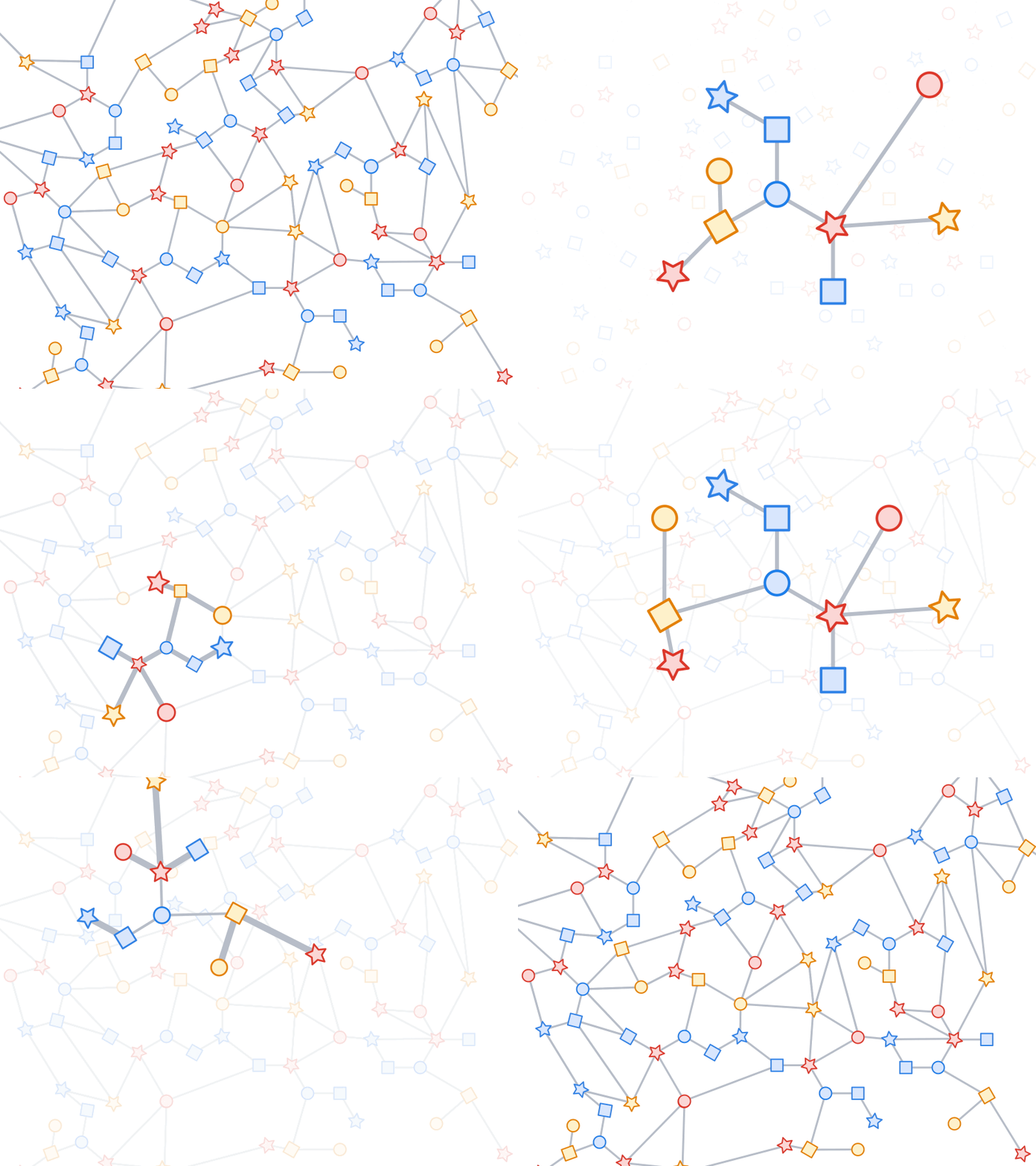
The core of modern recommendation systems relies on a "retrieval-ranking" architecture. This multi-stage process is designed to handle millions of items efficiently: first, a retrieval stage narrows down the vast inventory to a manageable set of candidates; then, a ranking stage applies a sophisticated machine learning model to order these candidates by their predicted utility to the user.
Traditionally, these systems have relied on collaborative filtering or basic content-based filtering. The introduction of LLMs—models trained on massive datasets to understand and generate human-like text—introduces a qualitative shift. LLMs bring deep semantic understanding to the table. Unlike traditional models that might only see a product as an ID number, an LLM perceives the item through its descriptive context, nuanced user reviews, and complex interaction patterns. This allows for a more fluid, context-aware, and personalized user experience.
Chronology of Development
The transition toward LLM-augmented systems began in earnest with the maturation of transformer-based architectures. While foundational research into neural recommendation systems has been ongoing for years, the release of high-performance APIs—specifically the PaLM API previewed at Google I/O 2023—marked a turning point for practical implementation.

- The Pre-Generative Era: Developers focused on static embeddings and matrix factorization, using libraries like TensorFlow Recommenders to model sequential user behavior based on click history.
- The API Expansion (Early 2023): With the arrival of the PaLM API, developers gained programmatic access to sophisticated text generation and embedding services, allowing for the integration of "reasoning" capabilities directly into recommendation pipelines.
- Current State: Today, the industry is moving toward "Hybrid Recommendation," where LLMs serve as intelligent wrappers or augmentative feature extractors for existing high-scale retrieval systems.
Supporting Data and Technical Implementation
Integrating LLMs into a production system requires a multi-pronged approach, moving beyond simple prompts into data-driven engineering.
Conversational Recommendations
LLMs excel at dialogue. By utilizing the PaLM API’s Chat service, developers can move away from rigid, keyword-based filters toward conversational discovery. For instance, a user can express a mood—"I’m looking for a gritty drama with an artistic flair"—and the model interprets the semantic nuance of that request, delivering a curated list. This turns a functional search into a guided shopping or viewing experience.
Sequential Reasoning
Sequential recommendation aims to predict the "next" item based on a specific order of past interactions. Previously, this required complex Recurrent Neural Networks (RNNs) or Transformer-based sequence models. Now, the PaLM API’s Text service can ingest a sequence of titles and infer the underlying user preference. By prompting the model with a history (e.g., Margin Call, The Big Short, Moneyball), the model identifies a pattern of "financial dramas" and suggests relevant follow-up content with high accuracy.
Rating Predictions and Ranking
In the ranking phase, LLMs function as evaluators. By providing the model with a user’s historical ratings and a target item, the model can predict a 1–5 score. This "pointwise" ranking allows for a final, high-fidelity refinement of the candidate list. Researchers have even explored "listwise" ranking, where the model is presented with the entire set of candidates and asked to return the optimal order, leveraging the model’s global context of the user’s preferences.
Embedding-Based Retrieval
Perhaps the most robust application for high-traffic systems is the use of text embeddings. By converting item descriptions or plot summaries into 768-dimensional vectors via the PaLM Embedding service, developers can perform "Nearest Neighbor" searches. Using libraries like TensorFlow and tools like Google’s ScaNN, systems can identify items that are semantically similar even if they have never been interacted with before. This effectively solves the "item cold start" problem—the difficulty of recommending new products that lack historical interaction data.
Implications for Developers and the Industry
The shift toward LLM-augmented recommenders carries significant implications for the future of digital software.
The Challenge of Latency and Cost
While the capabilities of LLMs are impressive, they are not a "silver bullet." The primary hurdle for production systems is latency. LLMs are computationally expensive and generally slower than the lean, high-throughput models currently used in top-tier retrieval systems. Consequently, the most viable path forward is a "cascading architecture": keep the fast, traditional models for the initial retrieval of thousands of items, and use the LLM only at the final stage to re-rank the top 20 or 50 candidates.
Semantic Enrichment
The use of LLM-generated embeddings as "side features" represents a major upgrade for existing models. By injecting semantic representations of item metadata into a standard TensorFlow Keras model, developers can provide their existing systems with a richer understanding of content, potentially increasing accuracy without discarding the infrastructure they have already built.

The Shift in User Experience
The most profound implication is the move toward "Human-in-the-loop" systems. Users are no longer just passive observers of a feed; they are participants in a conversation. As LLMs become more efficient and cost-effective, the distinction between a "search engine," a "recommender," and a "personal assistant" will continue to blur, leading to applications that feel less like algorithmic black boxes and more like intuitive, knowledgeable guides.
Conclusion and Future Outlook
The integration of Large Language Models into recommendation systems is no longer a theoretical exercise; it is an active area of development that is already delivering results in both conversational and retrieval-based applications. While issues surrounding computational cost and inference speed remain, the flexibility and semantic depth offered by models like PaLM are set to define the next generation of personalized digital experiences.
For developers looking to enter this space, the advice is clear: start by augmenting, not replacing. Use LLMs to handle the tasks that traditional models struggle with—specifically semantic understanding and cold-start scenarios—while maintaining the high-speed, reliable core of your existing retrieval pipelines.
As we look toward the future, the boundary between generative AI and recommendation engineering will continue to vanish. Whether through the use of embeddings to create smarter similarity searches or the deployment of conversational agents that understand user nuance, the tools for building more human-centric digital experiences are more accessible than ever. Organizations interested in this transition should continue to monitor developer summits and technical documentation to stay ahead of the curve as these LLM-powered architectures become the industry standard.