The New Frontier of Personalization: Integrating Large Language Models into Recommendation Systems
The digital landscape is currently undergoing a seismic shift driven by the rapid evolution and deployment of Large Language Models (LLMs). As these models demonstrate unprecedented capabilities in natural language understanding, creative generation, and contextual reasoning, developers are increasingly looking toward them as the next evolution for recommendation engines. By moving beyond traditional collaborative filtering, LLMs offer a path toward more fluid, intelligent, and highly personalized user experiences.
Main Facts: The Intersection of LLMs and Recommender Systems
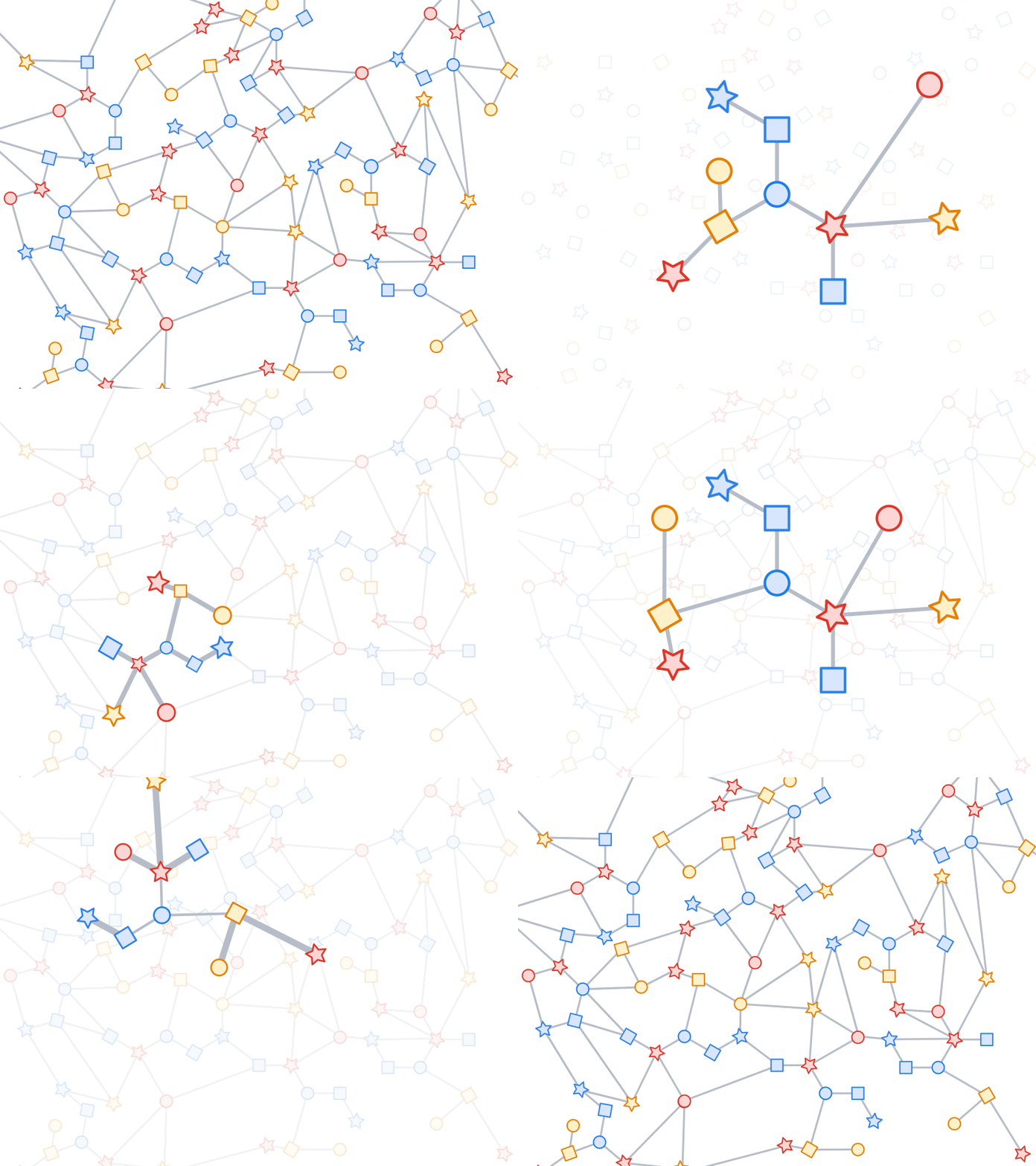
Modern recommendation engines typically rely on a proven "retrieval-ranking" architecture. This multi-stage pipeline is designed to filter millions of items down to a small, highly relevant set that maximizes user utility. Retrieval systems quickly narrow the field, while ranking models—often powered by deep learning frameworks like TensorFlow—predict the likelihood of user engagement with specific items.
The core premise of current research, spearheaded by Google’s recent developer initiatives, is that LLMs can serve as a powerful "augmentation layer" for these existing systems. Unlike static algorithms that depend heavily on historical clickstream data, LLMs provide a semantic understanding of content. Whether it is through the PaLM API’s chat, text, or embedding services, developers can now inject human-like reasoning into their applications, effectively turning rigid recommendation lists into interactive, conversational discovery tools.
Chronology of Development
The integration of LLMs into production-grade recommendation systems has been a rapid progression, marked by several key milestones:

- Early 2023: The rise of generative AI began to challenge the status quo of information retrieval. Developers started identifying that the reasoning capabilities of models like PaLM could solve the "cold start" problem—a common issue where new items lack enough interaction data to be recommended by traditional collaborative filtering.
- Google I/O 2023: A defining moment for the ecosystem, as Google released the PaLM API in public preview. This provided the infrastructure needed for developers to build generative capabilities directly into their existing software stacks.
- Mid-2023: The focus shifted from experimental chatbot interfaces to architectural integration. Engineers began exploring how to use text embeddings as feature inputs, allowing neural networks to understand the "meaning" of a product description or a movie plot rather than just its ID.
- Post-June 2023: With the inaugural Developer Summit on Recommendation Systems, the community solidified the transition from simple prompt-based recommendations to sophisticated, hybrid systems that combine traditional ranking metrics with semantic AI intelligence.
Supporting Data and Technical Applications
The versatility of LLMs allows them to be applied across the entire lifecycle of a recommendation pipeline.
Conversational Recommendations
The most visible application is the shift toward dialogue-based discovery. By leveraging the PaLM API Chat service, applications can act as virtual concierges. Instead of a user searching for "action movies," a conversational agent can interpret a nuanced request like, "I’m in the mood for a sci-fi film that deals with time paradoxes and has a philosophical tone." The LLM parses the user’s intent, generates a curated list, and facilitates iterative refinement, allowing the user to swap out recommendations in real-time.
Sequential Recommendations
User preference is rarely static; it follows a narrative or a progression. Sequential recommendation models analyze the order of past interactions to predict future interest. LLMs excel here because they are inherently capable of understanding sequence. By feeding a history of watched movies or purchased items into the PaLM API, the model identifies the "trajectory" of a user’s taste, providing recommendations that are contextually aware of the user’s current journey.
Rating Predictions and Pointwise Ranking
In the ranking phase, LLMs can replace or augment traditional regression models. By prompting a model with a user’s past ratings, developers can ask for a predicted score for a new candidate. This "pointwise" approach allows the system to sort candidates based on generated scores. Furthermore, as research continues, "pairwise" and "listwise" ranking strategies—where the model is asked to compare items or rank an entire set at once—are proving to be highly effective at capturing global user preferences.
The Power of Embeddings
Perhaps the most robust application for scale is the use of text embeddings. By converting product descriptions or item metadata into high-dimensional vectors, developers can perform "nearest neighbor" searches. If a user likes a specific news article, the system calculates the dot-product similarity between that article’s vector and others in the database. This allows for near-instant retrieval of related content, even for items that have zero historical engagement data.
Official Perspectives and Expert Insight
Developers and AI researchers at Google have emphasized that while LLMs represent a massive leap forward, they are not a "drop-in" replacement for the entire recommendation stack.
"The goal is augmentation," notes Wei Wei, a Developer Advocate at Google. "We are looking at how to combine the raw power of LLMs with the efficiency of existing TensorFlow infrastructure."
Experts caution that latency and cost remain the primary barriers to widespread adoption. While a simple chatbot prompt is inexpensive, running thousands of inference calls per second for a global user base requires careful architectural planning. Current best practices suggest using LLMs to enrich the candidate generation phase or as a re-ranking layer, rather than relying on them for every single step of the recommendation pipeline.

Implications for the Future
The shift toward LLM-powered recommendations has profound implications for both developers and consumers.
For Developers:
The barrier to entry for building intelligent, personalized experiences is lowering. Complex, custom-built models that previously required months of training on large datasets can now be augmented with pre-trained APIs. This allows smaller teams to compete with tech giants by building more intuitive, human-centric interfaces. Furthermore, the ability to use text embeddings as "side features" in traditional neural networks provides a massive boost to model accuracy, allowing systems to "read" the content they are recommending.
For Consumers:
The experience is becoming significantly more fluid. The "black box" of traditional algorithms—which often felt opaque or repetitive—is being replaced by systems that can explain their reasoning. If a user asks, "Why did you recommend this?", a generative model can theoretically provide a rationale based on the user’s history and the item’s attributes. This builds trust and increases user engagement.
Technical Challenges Ahead:
Despite the promise, the industry must still tackle significant hurdles. "Hallucinations"—where an LLM might recommend a movie that doesn’t exist—must be mitigated through grounding techniques and external knowledge bases. Additionally, the computational cost of large-scale LLM deployment is non-trivial. Developers must weigh the benefits of enhanced personalization against the infrastructure costs of high-throughput inference.

In conclusion, the integration of Large Language Models into recommendation systems is not just a passing trend but a fundamental upgrade to how we interact with digital content. As these models become faster, cheaper, and more precise, the line between a search engine, a recommendation engine, and a conversational partner will continue to blur, leading to a more personalized and intuitive digital future. The tools are ready, the frameworks are evolving, and the next generation of discovery is already beginning to take shape.