The Next Evolution of Distributed PostgreSQL: Spock 6 Enters Beta
The landscape of distributed database management has reached a new milestone with the release of Spock 6 into Beta. As pgEdge’s flagship multi-master replication extension, Spock has long been the engine behind highly available, globally distributed PostgreSQL clusters. With this release, the platform expands its reach, now supporting PostgreSQL versions 16, 17, 18, and 19.
Spock 6 represents a fundamental shift in architecture. While Spock 5 established the "hard work" of multi-master replication in production environments, version 6 refines that engine to be faster, more observable, and significantly more resilient. By moving away from traditional catalog-based tracking toward a shared-memory model, and introducing advanced spill-to-disk capabilities for replay queues, pgEdge is positioning Spock 6 as a robust solution for mission-critical, high-traffic PostgreSQL deployments.
The Architectural Shift: Moving Beyond the Catalog
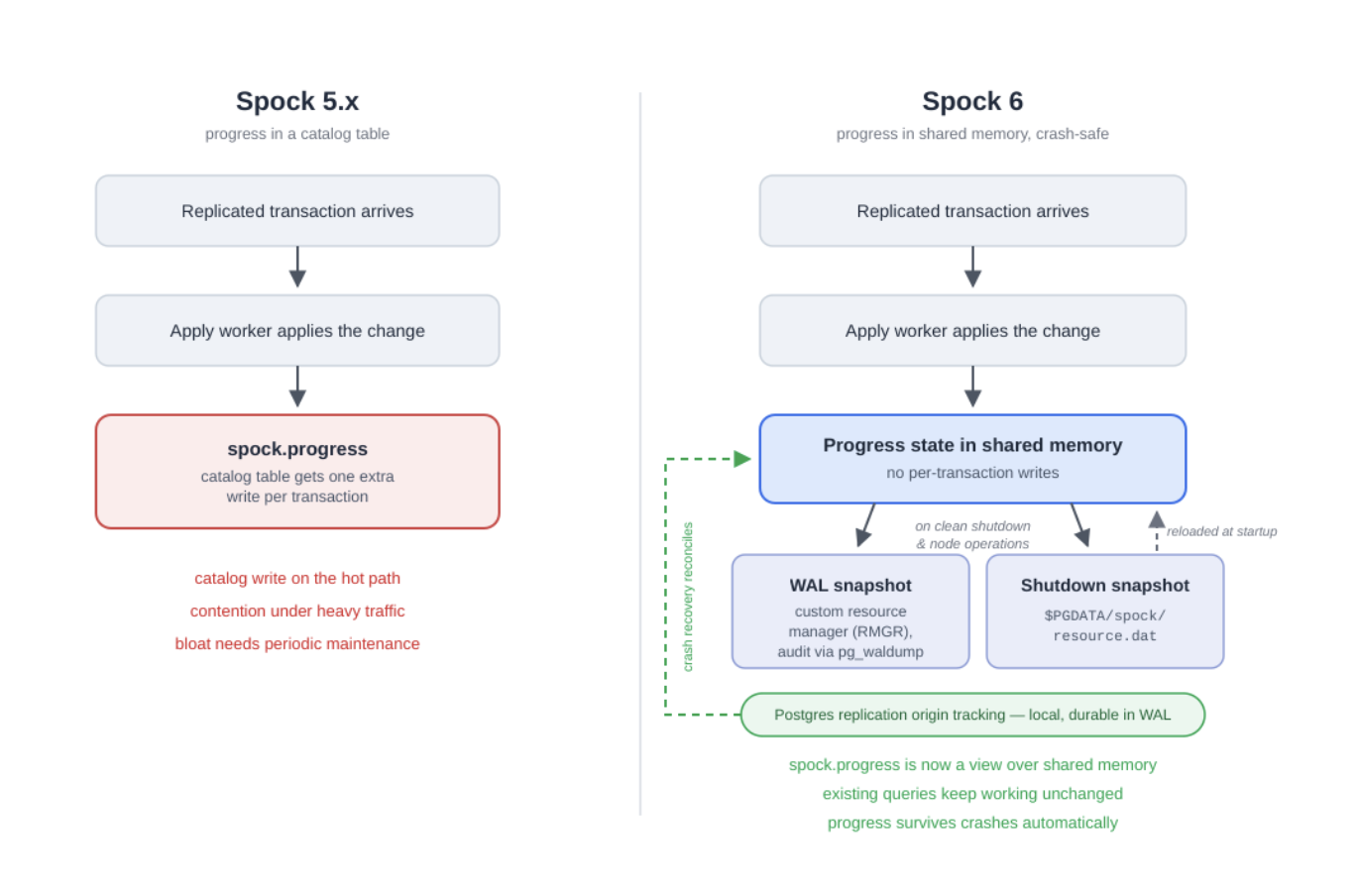
For years, the Achilles’ heel of many replication systems has been the reliance on catalog tables for tracking transaction progress. In previous iterations of Spock, every replicated transaction triggered a write to the spock.progress catalog table. While efficient under modest workloads, this approach introduced I/O contention and "bloat" in high-throughput, multi-node clusters, necessitating constant vacuuming and maintenance.
Rearchitecting the Hot Path
Spock 6 completely eliminates the catalog write from the "hot path." By implementing a custom WAL (Write-Ahead Logging) resource manager (RMGR), the extension now tracks progress in shared memory. This state is snapshotted to a dedicated file ($PGDATA/spock/resource.dat) during clean shutdowns.
For durability, Spock 6 aligns itself with PostgreSQL’s native replication origin tracking. If a node suffers a crash, the system reconciles its state against these native origins, ensuring that crash recovery is as reliable as the core PostgreSQL engine itself. This move reduces I/O pressure on subscribers while keeping the system inspectable via standard utilities like pg_waldump.
Protecting Against Silent Drift: The ACE Engine
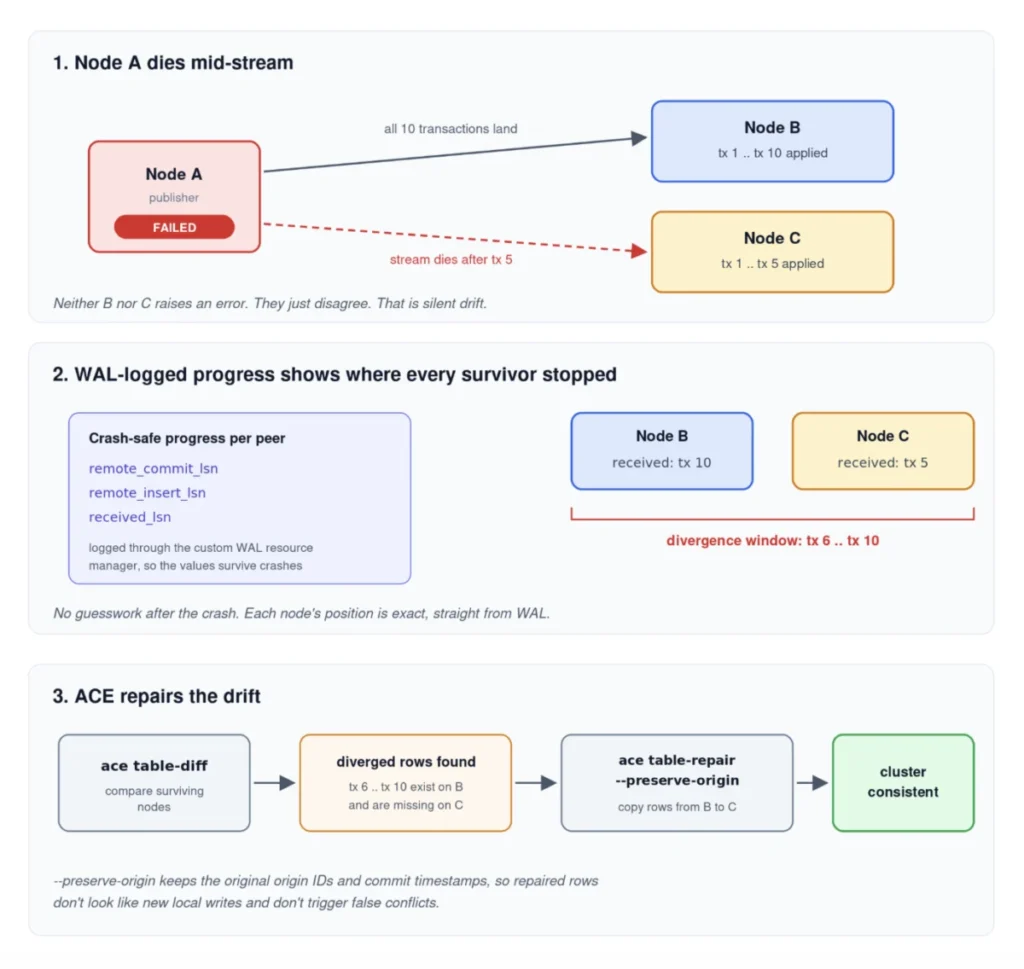
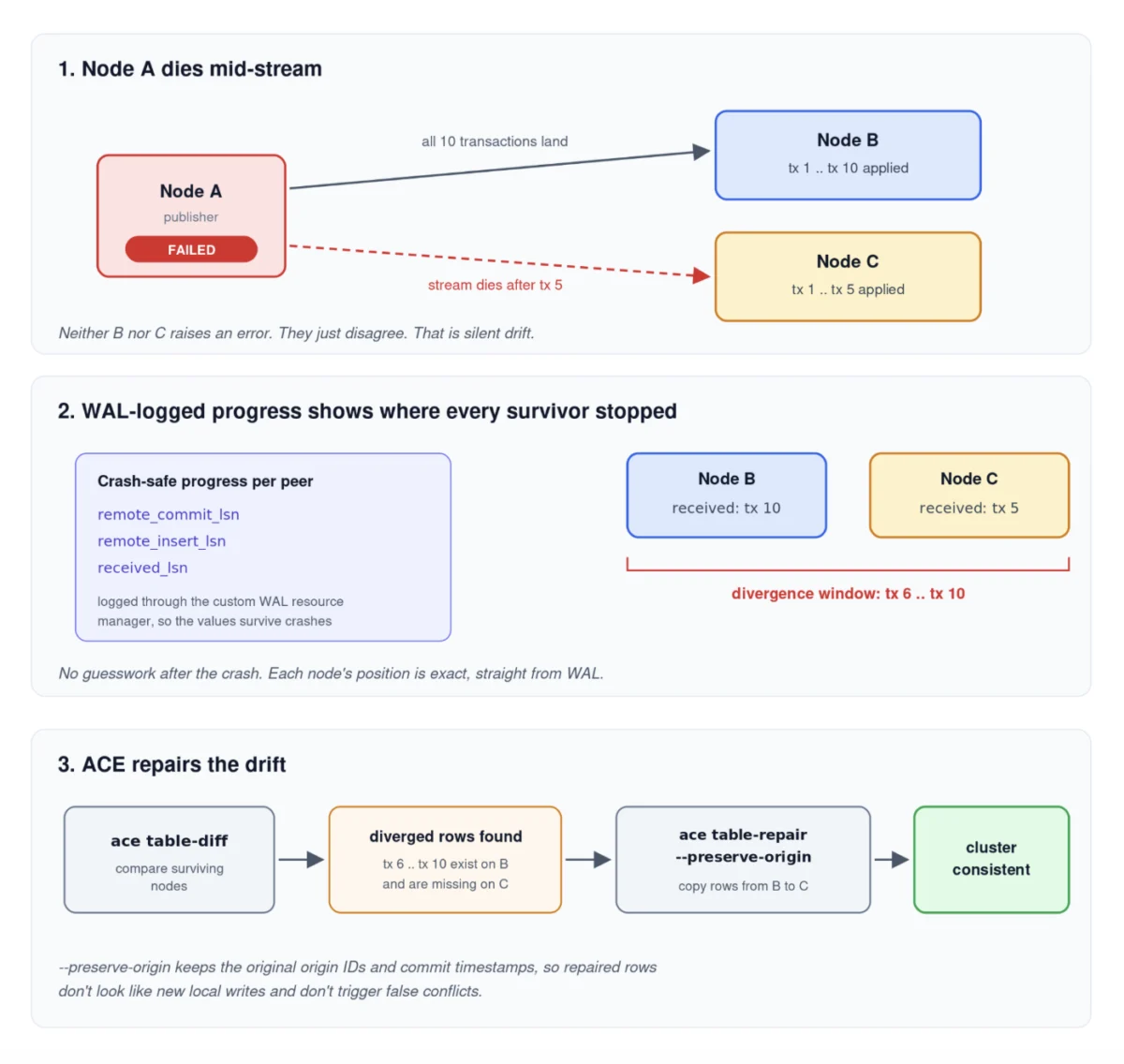
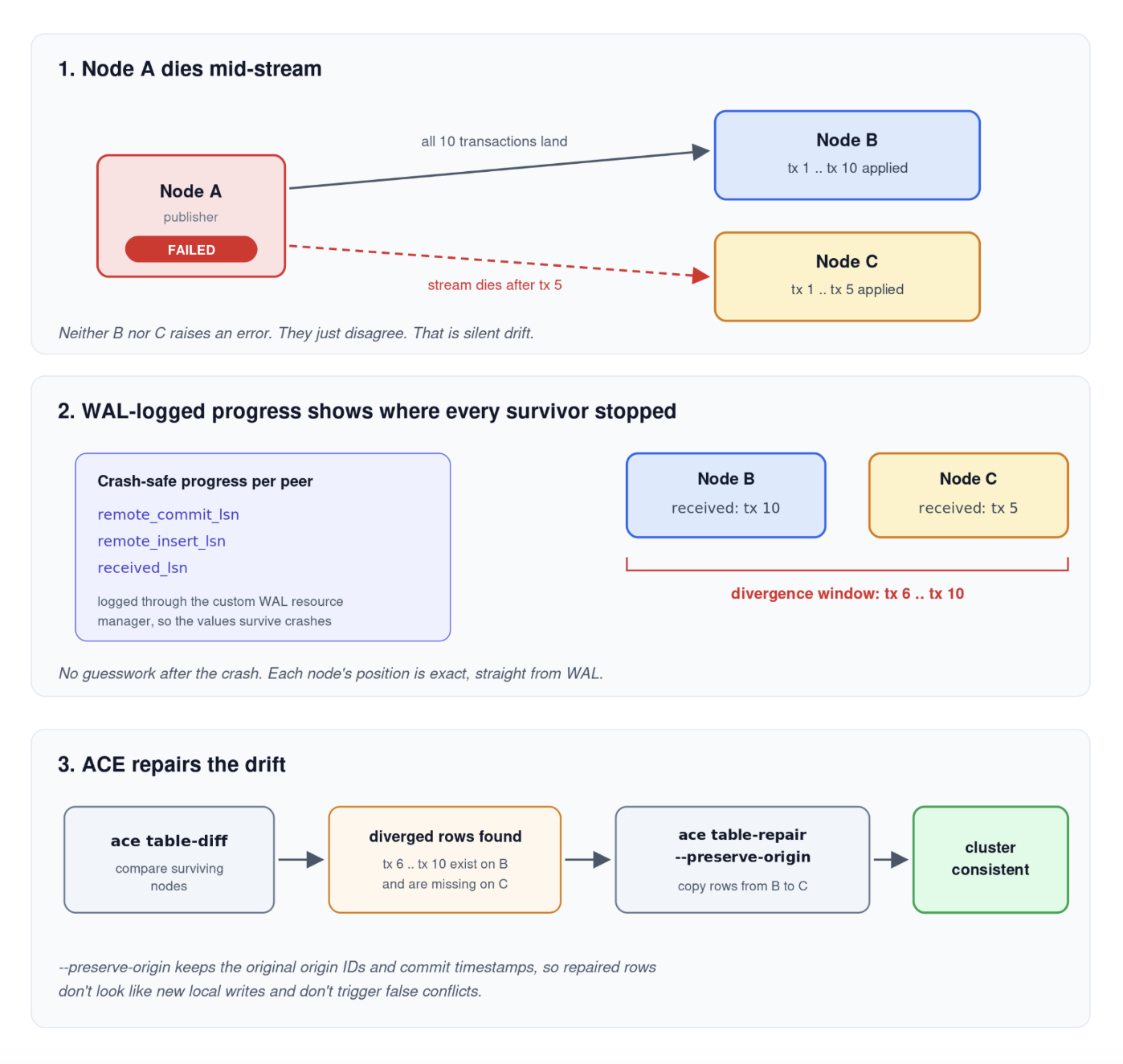
One of the most insidious threats in distributed systems is "silent drift"—where nodes diverge due to partial transaction receipt during a hard crash. Without a mechanism to detect these inconsistencies, database clusters can gradually lose integrity, leading to compounding data corruption.
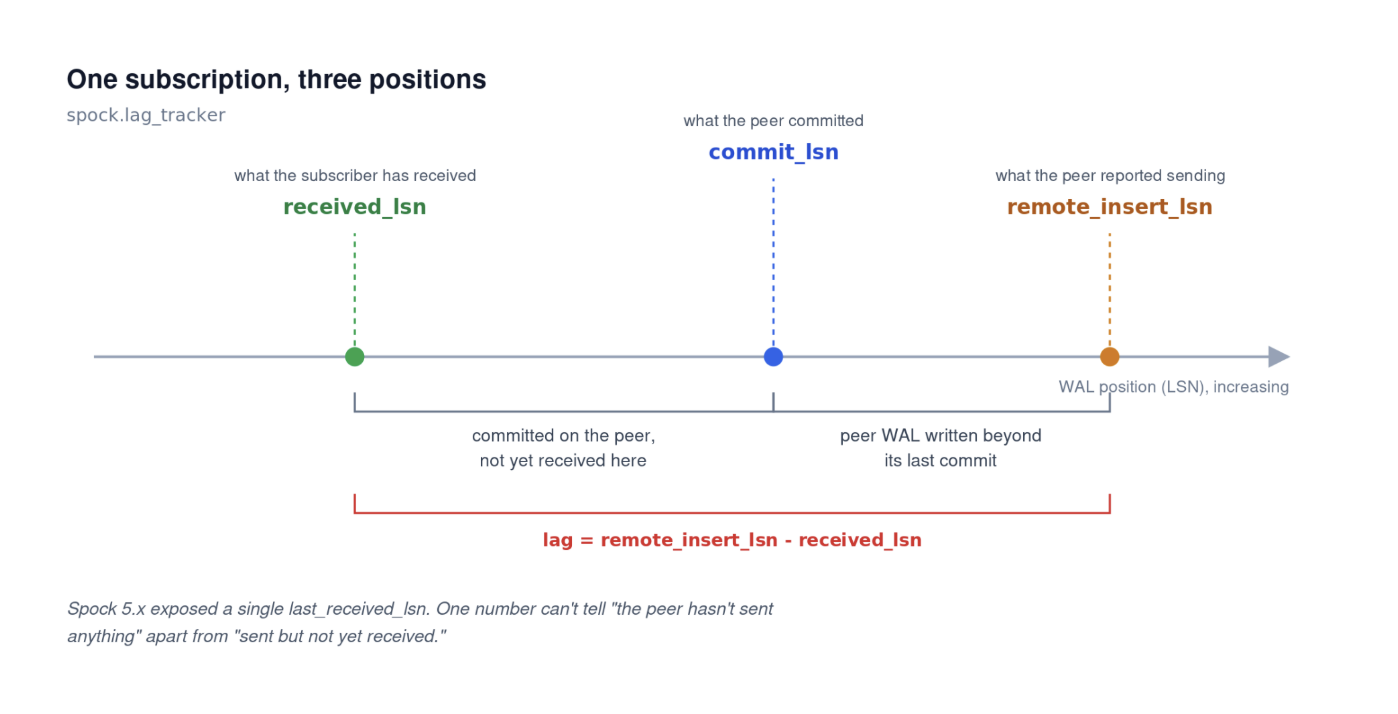
Spock 6 addresses this with the Active Consistency Engine (ACE). By maintaining three precise, crash-safe records—the remote commit LSN, the remote insert LSN, and the locally received LSN—Spock now has the forensic data required to identify exactly where a node’s replication stream halted.
Repair and Recovery
The repair process is equally sophisticated. Once table-diff identifies divergent rows, the table-repair command copies the necessary data between nodes. Crucially, Spock 6 introduces the --preserve-origin flag, which ensures that repaired rows retain their original replication origin IDs and timestamps. This prevents the "repaired" data from being perceived as new writes, which would otherwise trigger circular conflict loops in a multi-master environment.
Conflict Intelligence and Observability
As PostgreSQL matures, so too does its approach to conflict detection. Spock 6 aligns itself with the conventions introduced in PostgreSQL 18, adopting standardized naming for conflict types such as INSERT_EXISTS or UPDATE_MISSING.
Enhanced Analytics
New in Spock 6 is the ability to track conflict statistics per subscription. By leveraging the pgstat infrastructure, DBAs can now query spock.get_subscription_stats() to gain granular visibility into which parts of their schema are generating the most friction. This is complemented by new, JSON-based "apply change logging," which provides a comprehensive audit trail for every change processed by the replication worker.
Operational Reliability: Rolling Upgrades and ZODAN
A major requirement for modern infrastructure is the ability to upgrade without downtime. Spock 6 facilitates this through multi-protocol negotiation. Because the extension is backward compatible with the version 4 protocol, operators can perform a rolling upgrade of a multi-master cluster—replacing nodes one by one while the cluster continues to serve traffic.
ZODAN Improvements
The "Zero Downtime Add Node" (ZODAN) mechanism has received significant attention to resolve edge cases in real-world deployments. By pausing apply workers during slot creation, the system eliminates race conditions that previously risked the loss of the resume_lsn. Furthermore, the introduction of a configurable timeout_sec parameter ensures that operators have control over the node-addition process, even in environments with unpredictable network latency.
Implications for the PostgreSQL Ecosystem
The release of Spock 6 is not merely a feature update; it is a signal of the increasing sophistication of the PostgreSQL ecosystem. By removing the SPI-based apply path in favor of native heap manipulation, Spock 6 achieves lower latency and higher throughput. Furthermore, the removal of legacy components like the spockctrl CLI in favor of modern orchestration tools (Control Plane, HELM, Ansible) indicates a shift toward "infrastructure-as-code" native management.
Handling Large-Scale Transactions
The addition of spill-to-disk support for exception handling is a game-changer for large-scale migrations. Previously, transactions exceeding the memory cap of the replay queue would trigger a re-fetch from the remote node, putting significant pressure on the network and CPU. Now, the handover to temporary files is seamless and transparent to the user, allowing for multi-gigabyte transactions to be handled without memory pressure.
Official Stance and Future Roadmap
According to the development team, the primary goal of Spock 6 is to make the engine "considerably harder to kill." By hardening the crash recovery process, ensuring native compatibility with PostgreSQL 17-19, and streamlining the internal code—such as the refactoring of AutoDDL into a dedicated module—pgEdge is moving closer to a General Availability (GA) release that is highly resilient to the chaotic conditions of distributed networking.
The project is currently in a finalization phase, with internal testing focused on the integration of the Control Plane, HELM, and Cloud environments. Users are encouraged to test the Beta release, particularly those managing large-scale, multi-region clusters where silent drift and I/O contention have historically posed challenges.
Chronology and Migration Path
- Spock 5.x: Established the core multi-master engine and production-readiness.
- Migration: Direct upgrade path from 5.0.10 via
spock--5.0.10--6.0.0.sql. - Beta Phase: Currently ongoing; testing rolling upgrades and PostgreSQL 16-19 integration.
- GA Preparation: Finalizing Control Plane and cloud-native integrations.
Summary of Key Technical Changes
- Performance: Removal of the SPI apply path and catalog-based progress tracking.
- Scalability: Spill-to-disk replay queues and improved memory context management.
- Resilience: Native WAL-based progress tracking and ACE-driven table repair.
- Compatibility: Support for PostgreSQL 16 through 19 and native logical slot failover on PG17+.
- Observability: Standardized conflict naming and per-subscription statistics.
For organizations relying on PostgreSQL as their primary data store, Spock 6 offers a compelling reason to revisit their replication architecture. By moving the "heavy lifting" into the WAL and memory management layers, pgEdge has provided a pathway for PostgreSQL to operate more reliably in distributed environments than ever before. As the project moves toward GA, the focus remains clear: providing a transparent, performant, and, above all, stable multi-master replication experience for the global developer community.
Those interested in evaluating Spock 6 can access the source code on GitHub. The team emphasizes that feedback during this Beta period is essential to ensuring that the final GA release meets the high standards required for global production workloads.