The PostgreSQL 19 Delay and the AI Narrative: Separating Myth from Reality in Open-Source Development
By Tech & Infrastructure Desk
As the PostgreSQL community prepares for the rollout of Postgres 19, a debate has emerged regarding the state of open-source development in the era of artificial intelligence. Recent commentary from prominent industry observers has tied the release’s approximately one-month delay—and a string of late-stage feature reverts—to the rise of AI tools. According to this prevailing narrative, AI is uncovering extraordinarily complex bugs in complex patches right at the eleventh hour, forcing core maintainers to pull major features because the required fixes are too invasive for a mature development cycle.
However, a closer look at the actual code repositories, mailing list discussions, and historical git logs tells a very different story. While AI is undeniably altering the landscape of database engineering—most visibly through an unprecedented surge in security vulnerabilities—attributing the Postgres 19 feature reverts to automated bug-hunting models misidentifies the root causes. In doing so, it risks undermining the rigorous human review process that keeps enterprise-grade database infrastructure stable.
Main Facts: The Postgres 19 Timeline and Revert Realities
The release cycle for PostgreSQL 19 has faced noticeable headwinds. Even under optimal conditions for the remainder of its stabilization phase, the database management system is slated to debut roughly a month behind its original schedule. Over the final stretch of the development cycle, a series of high-profile features were unceremoniously stripped from the codebase and pushed to future versions.
The list of pulled features is extensive and affects core functionality. Among the most notable patches reverted in the months leading up to the release are:
- Online data checksum transitions
UPDATE/DELETE FOR PORTION OFstatements- Extended DDL utility functions including
pg_get_role_ddl(),pg_get_tablespace_ddl(), andpg_get_database_ddl() - Expanded object type support within
CREATE SCHEMA - Batching removal from RI (Referential Integrity) fast-path checks
- SQL Property Graph Queries (SQL/PGQ)
- Support for
ALTER TABLEmerge and split partition commands - The addition of
GROUP BY ALL - Non-text output formats for
pg_dumpall - Fast default enablement for domains featuring non-volatile constraints
- Database-specific logical replication snapshots
- The rejection of degenerate split partitions alongside default partitions
When external commentary—such as a widely circulated engineering blog post by Elizabeth Christensen of Snowflake—suggested that AI tools were driving these sweeping removals by uncovering massive, complex bugs, it struck a chord across the developer ecosystem. The narrative quickly gained traction: AI writes complex patches or finds deep-seated flaws that human reviewers miss, leading to massive stabilization bottlenecks.
Yet, a granular review of the mailing list threads and commit histories surrounding these specific 12 reverts reveals a starkly contrasting reality. Out of the dozen major pullbacks from Postgres 19, only four bear characteristics that could reasonably be categorized as "probably AI-influenced" or directly tied to AI-assisted workflows. The remaining eight features were flagged, debated, and ultimately reverted due to issues identified entirely through traditional, rigorous human code review and architectural debate.
Chronology: How the Development Cycle Unraveled
To understand how Postgres 19 arrived at this juncture, it is helpful to examine the traditional rhythm of PostgreSQL development alongside the anomalous timeline of the current release.
PostgreSQL development operates on a well-established annual cadence. The project typically forks the next major development branch at the end of June of the preceding year. For Postgres 19, this initial fork occurred on June 30, 2025—marking "Day 0" of the cycle. From this point forward, intense feature development commences, running for approximately nine months until the strict "feature freeze" takes effect at the beginning of April (roughly Day 275).
Following the feature freeze, the project enters a critical code stabilization window. This period is dedicated exclusively to rigorous testing, edge-case discovery, and bug fixing. Historically, general releases occur around Day 480.
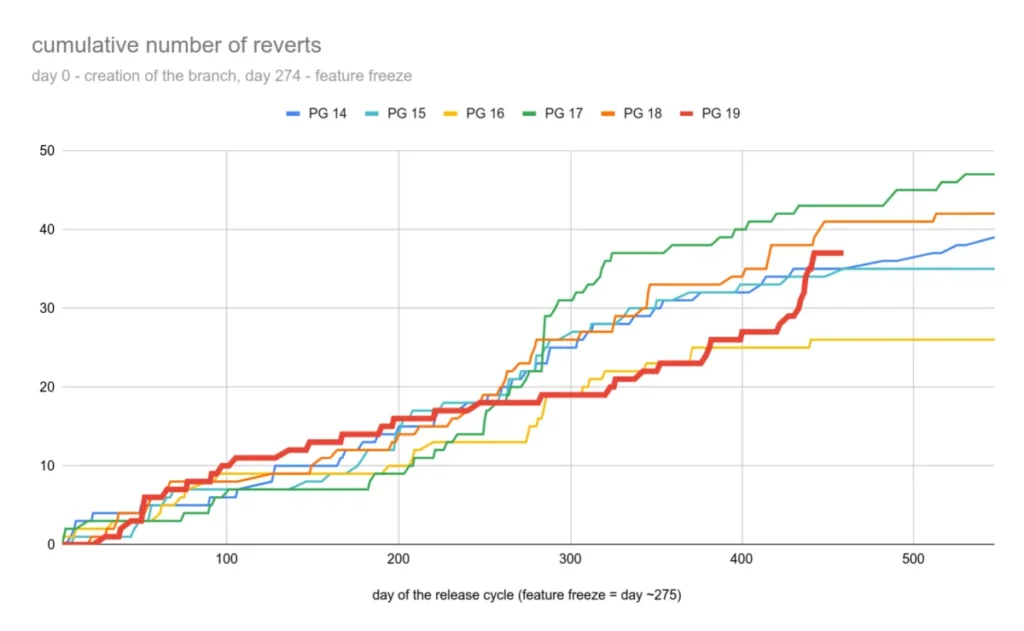
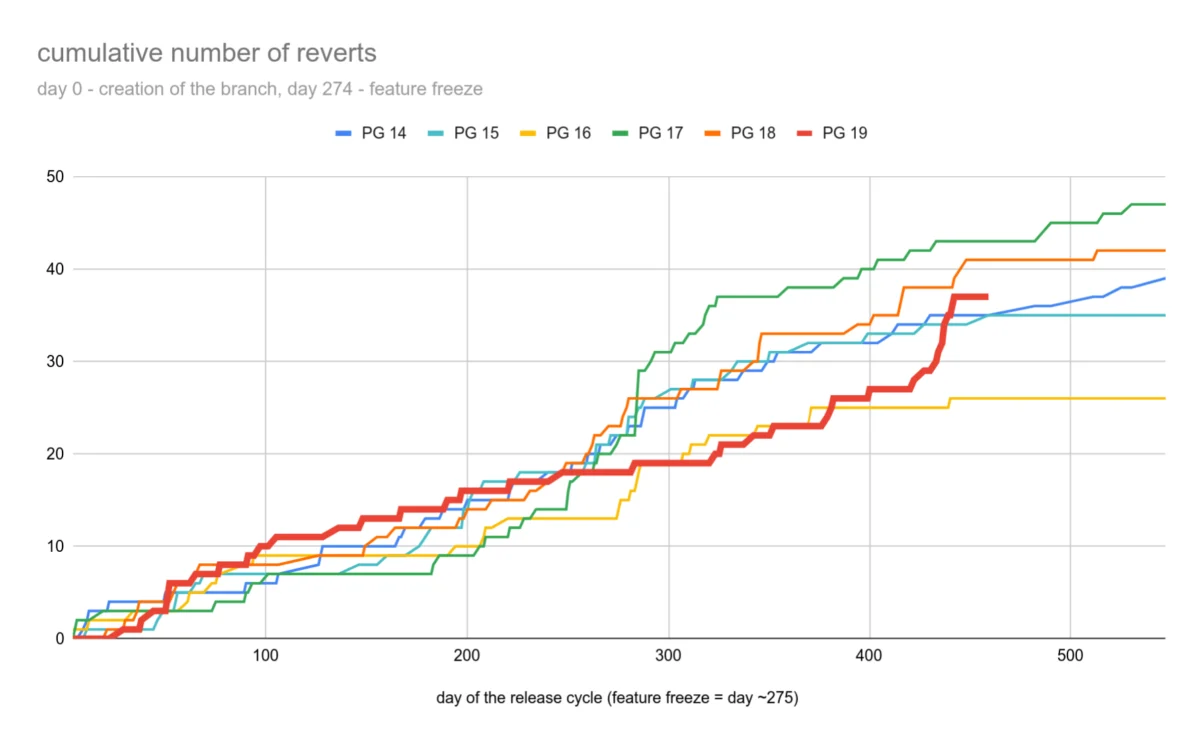
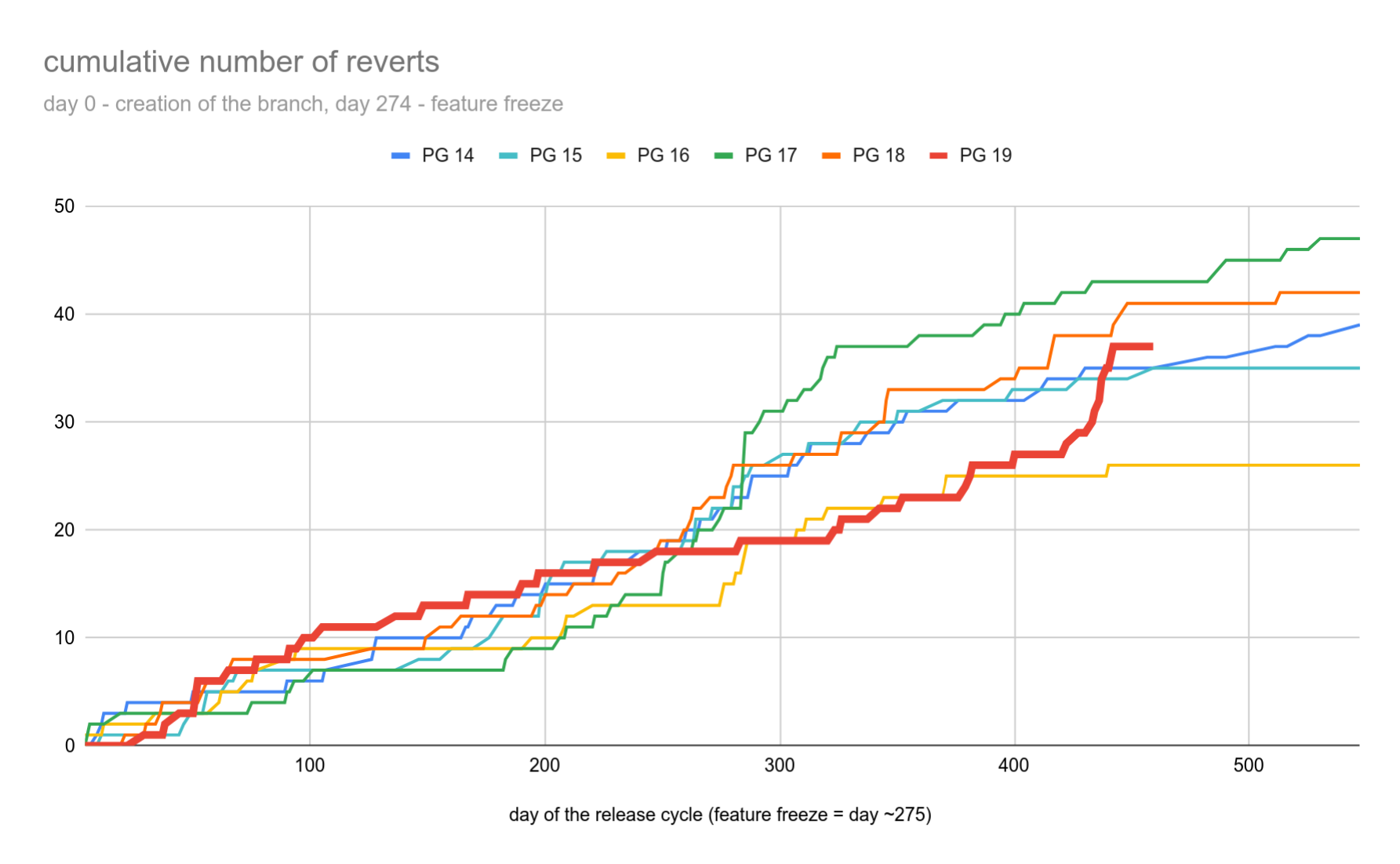
In a typical release cycle, the vast majority of feature reverts occur immediately following the feature freeze—clustered closely around Day 300. Developers and maintainers spend the weeks immediately after the freeze stress-testing the newly locked feature set, identifying performance regressions, architectural conflicts, or maintainability concerns, and cutting out what cannot safely make the cut.
For Postgres 19, however, this pattern broke down completely. Following the April feature freeze, the activity graph flatlined. There was an unusual absence of the expected post-freeze stabilization adjustments and early-stage reverts. Instead of active, continuous pruning during May, June, and July, development stagnated in terms of cleanup.
The reckoning arrived abruptly in late August and September 2026. Facing an accumulation of unresolved architectural debates—intensified by internal pressures such as the community’s rigorous "scary patch contest"—maintainers were forced into a late-stage triage. A concentrated wave of high-impact feature reverts swept through the repository in quick succession, culminating in the mid-September pulls that ultimately pushed the overall release timeline back by a month.
Supporting Data: Historical Trends and Commit Metrics
Critics of the current release cycle have argued that the volume of reverts seen in Postgres 19 is unprecedented, chaotic, or uniquely dysfunctional. However, historical data extracted directly from the project’s Git repository places these claims into proper perspective.
Comparing Postgres 19 against historical versions starting from Postgres 14 demonstrates that the total number of reverts is well within historical norms. While Postgres 16 enjoyed an unusually quiet cycle with exceptionally few reverts, Postgres 19 tracks closely with the baseline established across previous years.
Furthermore, total commit counts between forking and feature freeze show healthy project activity rather than bloat. Postgres 14 recorded roughly 1,700 commits during this window, whereas Postgres 19 scaled up to approximately 2,200 commits. Because the absolute volume of development grew while the fraction of reverted commits remained proportionally steady, the relative stability of the codebase has actually improved over the long term.
Analyzing the size of the reverts—measured via insertions and deletions in git diff statistics—yields a parallel conclusion. The code churn resulting from reverted patches in Postgres 19 mirrors past cycles up until the feature freeze. The anomaly lies not in the magnitude of the flawed code, but entirely in the timing of when the community caught and acted upon those flaws.
Official Responses and Changing Perspectives
While code contributors push back against the notion that AI is secretly writing or breaking core SQL features on a mass scale, prominent database architects acknowledge that artificial intelligence is fundamentally transforming the PostgreSQL project in other critical areas.
The most profound impact of AI is not found in feature implementation, but in the realm of security and vulnerability patching. As Snowflake’s Elizabeth Christensen noted in her analysis of the PostgreSQL deployment pipeline, the volume of CVEs (Common Vulnerabilities and Exposures) has exploded. Historically, PostgreSQL managed a modest average of a couple of CVEs per release cycle. In stark contrast, the August 2026 patch round for Postgres 18 alone addressed a staggering 28 CVEs. Across the current cycle, total CVE counts have already surged to 44.
This explosion in security reports—many of which are generated, surfaced, or accelerated by automated AI security scanners deployed by researchers and bad actors alike—has placed an unprecedented burden on the project’s core maintainers.
Many of the project’s most senior and experienced contributors, who would normally spearhead the deep architectural reviews and stabilization efforts during the post-feature-freeze window, have been forced to divert their attention away from feature integration to triage security advisories. Fixing dozens of incoming CVEs is non-negotiable; it demands immediate focus, exhaustive verification, and careful backporting. Consequently, the traditional human bandwidth available for standard patch stabilization evaporated during the summer months, directly contributing to the delayed realization that certain complex features could not safely ship in Postgres 19.
Implications for the Open-Source Ecosystem
The friction surrounding the Postgres 19 delay serves as a case study in what some researchers term "AI inversion"—the systemic, often hidden disruptions that advanced machine learning tools introduce into traditional human workflows.
The misconception that AI-generated bugs forced the late-stage feature reverts points to a broader communication gap within the tech industry. It is easier to point to AI as a catch-all explanation for development friction than to analyze the nuanced interplay between security maintenance overhead, volunteer burnout, and the strict quality gates of legacy enterprise software.
Attributing human-discovered bugs to AI tools risks doing a disservice to the meticulous code reviewers who spent countless hours analyzing complex edge cases, performance trade-offs, and architectural debt. Dismissing their work as the collateral damage of machine-generated code undervalues the vital, highly technical labor that sustains foundational open-source infrastructure.
At the same time, the PostgreSQL project faces a structural challenge that it has not yet fully solved. While the community has managed the influx of security reports thus far, the current trajectory is unsustainable without formalizing policies around AI-assisted contributions and expanding the core contributor pipeline. PostgreSQL currently lacks an official AI contribution policy, though community leadership is expected to introduce guidelines in the near future.
As open-source database engines navigate the remainder of the 2020s, the lesson of Postgres 19 is clear: AI is reshaping the ecosystem, but its primary vector of impact is not haphazard feature coding. Rather, it is the overwhelming tide of automated security auditing that shifts vital human capital away from innovation and toward defensive triage. Safeguarding the future of projects like PostgreSQL will require scaling developer resources and refining review pipelines to match the automated velocity of the modern software landscape.