The Sentient Sentry: John’s Raspberry Pi-Powered Nerf Turret Revolutionizes Garage Security
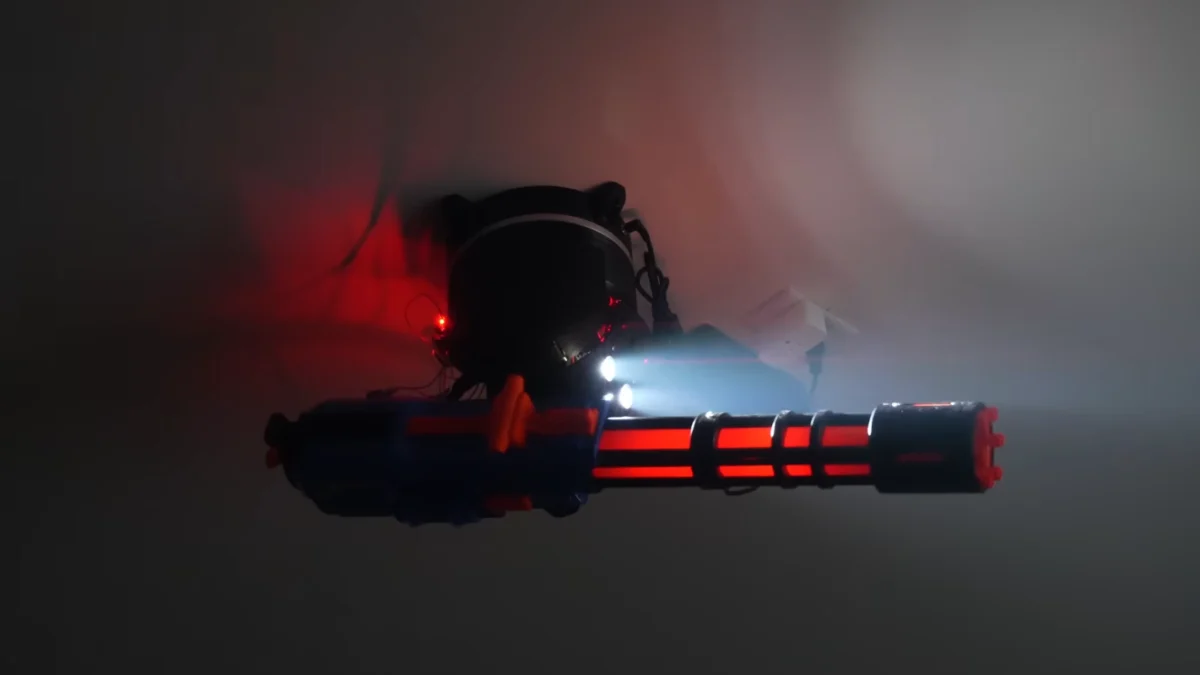
[City, State] – In a world increasingly reliant on smart technology for security, one innovator has taken a distinctly hands-on, and undeniably playful, approach to protecting his property. John, a self-described hobbyist and tech enthusiast, has unveiled an autonomous, Raspberry Pi-powered security system for his garage that not only monitors activity but can also actively deter intruders with a mounted Nerf machine gun, complete with laser sight and spotlights. Dubbed "WALTER" (as revealed in accompanying video documentation), this custom-built guardian represents a fascinating blend of DIY ingenuity, accessible technology, and a dash of whimsical deterrence, pushing the boundaries of what home security can be.
The project, which has garnered significant attention within the maker community, moves beyond the passive surveillance offered by conventional webcams. While most security cameras merely record events for later review, WALTER is designed to be an active participant in its own defense. Equipped with a custom pan-and-tilt mount, sophisticated computer vision, and a non-lethal projectile weapon, John’s creation stands as a testament to the power of open-source hardware and software in solving everyday problems with extraordinary solutions. The system operates autonomously, tracking objects and deploying its arsenal of noise and light, or can be controlled manually via an Android tablet, offering a dual layer of protection and engagement.
Main Facts: An Autonomous Guardian Takes Aim
John’s innovative security system, affectionately known as WALTER, is a sophisticated, custom-built apparatus designed to monitor and defend his garage. At its core is a Raspberry Pi, a credit card-sized single-board computer, which serves as the brain of the operation, orchestrating all its functions. The system’s primary objective is to provide enhanced security beyond mere video recording, incorporating active deterrence capabilities.
The physical manifestation of WALTER is an impressive, custom-fabricated pan-and-tilt mount. This motorized platform allows the embedded webcam to rotate freely, covering a wide field of view within the garage, eliminating blind spots that fixed cameras often possess. This dynamic surveillance capability is a significant upgrade, enabling comprehensive monitoring of the entire space.
What truly sets WALTER apart, however, are its defensive features. Mounted alongside the camera is a modified Nerf machine gun, a popular toy blaster known for firing foam darts. This non-lethal weapon is complemented by a laser sight for aiming and powerful LED spotlights, designed to disorient and draw attention. All these components—the camera, pan-and-tilt mechanism, Nerf gun, laser, and spotlights—are autonomously controlled by the Raspberry Pi.
The system’s intelligence is powered by custom software developed by John. This software incorporates advanced computer vision algorithms, allowing WALTER to detect, identify, and track various objects within its operational area. Upon detecting an unauthorized presence, the system can engage its defensive protocols, which include activating the spotlights, engaging the laser sight, and, crucially, firing the Nerf blaster. While the foam darts themselves are harmless, the sudden noise, movement, and visual disturbance are intended to startle and deter potential intruders.
Further enhancing its utility, WALTER is equipped with a speaker and microphone, facilitating two-way communication. This enables John to interact with the system using voice commands, activating or deactivating it with a verbal password. It also allows the system to communicate back, providing status updates or alerts. This blend of autonomous operation, manual override, non-lethal active deterrence, and interactive communication positions WALTER as a groundbreaking example of accessible, customizable home security. It highlights how readily available technology can be repurposed and integrated to create highly personalized and effective solutions, blurring the lines between security, hobbyist electronics, and a touch of playful innovation.
Chronology: From Simple Streams to Sentient Sentries
The journey toward sophisticated DIY security systems like WALTER is deeply rooted in the evolution of consumer-grade technology and the burgeoning maker movement.
The Genesis of Webcam Surveillance: Early Internet to Raspberry Pi Era
The concept of streaming video from a remote location is almost as old as the commercial internet itself. In the early days of the web, primitive webcams, often connected to desktop computers, offered rudimentary live feeds. These devices, while basic, laid the groundwork for remote monitoring, enabling individuals to share glimpses of their daily lives or keep an eye on a specific area. However, they were largely static, lacked advanced features, and required considerable technical know-how to set up and maintain.
The true democratization of DIY security began with the advent of compact, affordable microcontrollers and single-board computers. Projects utilizing platforms like Arduino paved the way for accessible electronics, but it was the introduction of the Raspberry Pi in 2012 that truly revolutionized the landscape of embedded vision and DIY security. With its dedicated camera slot, powerful processing capabilities for its size, and a thriving open-source community, the Raspberry Pi made it incredibly easy for hobbyists and professionals alike to build functional security cameras, motion detectors, and home automation systems at a fraction of the cost of commercial alternatives. This accessibility fueled a surge of innovation, allowing individuals to tailor security solutions precisely to their needs, rather than being confined by off-the-shelf products.
John’s Inspiration and Design Evolution: A Fusion of Fun and Function
For John, the inspiration for WALTER likely stemmed from a common dilemma: the desire for robust garage security coupled with an inherent interest in leveraging technology in creative ways. Garages are often vulnerable points of entry, making effective monitoring crucial. While traditional security cameras provide evidence after an incident, John sought a more proactive approach.
His initial concept likely centered around a standard Raspberry Pi camera setup. However, the limitation of a fixed field of view quickly became apparent. This led to the development of the custom pan-and-tilt mount, a critical design decision that vastly expanded the system’s surveillance capabilities. By allowing the camera to rotate and tilt, WALTER could monitor the entire garage, reacting to movement from any direction.
The pivotal moment, the "Aha!" that transformed a mere camera into an active deterrent, was the decision to integrate the Nerf machine gun. This wasn’t just about adding a weapon; it was about injecting an element of surprise and psychological deterrence. John, like many makers, probably saw the potential to combine the fun, customizable nature of toy blasters with the serious application of home security. The goal was not to inflict harm, but to create an unforgettable, disorienting experience for an unwelcome visitor. The addition of a laser sight and spotlights further amplified this effect, turning WALTER into a visually and audibly striking presence.
The development process involved several distinct phases:
- Ideation and Research: Months of planning, sketching designs, and researching suitable components, from the Raspberry Pi model to specific servo motors for the pan-and-tilt mechanism and the ideal Nerf blaster for modification.
- Hardware Prototyping and Fabrication: This involved designing and often 3D printing custom parts for the mount, integrating the camera, blaster, and other accessories, and ensuring stable power delivery. Precision in motor control and structural integrity was paramount.
- Software Development: This was arguably the most complex phase. John had to write custom code, likely in Python, to manage the Raspberry Pi’s interactions with all peripherals. This included:
- Camera Interface: Capturing video streams.
- Motor Control: Precise positioning for pan and tilt.
- Computer Vision: Implementing object detection and tracking algorithms (e.g., using libraries like OpenCV).
- Blaster Control: Activating the Nerf gun’s firing mechanism, laser, and spotlights.
- Network Communication: Enabling control via an Android tablet.
- Voice Interface: Integrating speech recognition and text-to-speech capabilities for voice control and feedback.
- Integration and Calibration: Bringing all hardware and software components together, meticulously calibrating the camera’s field of view, the pan-and-tilt limits, and the Nerf gun’s aiming mechanism relative to the laser sight. Testing the computer vision system against various scenarios was crucial to minimize false positives.
- Refinement and User Interface: Adding the speaker for two-way communication and voice control, fine-tuning the autonomous decision-making logic, and developing a user-friendly interface for the Android tablet. The naming of "WALTER" likely occurred during this phase, adding personality to the project.
This chronological progression showcases how a seemingly simple idea—a security camera—can evolve into a complex, multi-functional autonomous system through iterative design, problem-solving, and the creative application of readily available technology.
Supporting Data: The Technical Underpinnings of WALTER
WALTER is a testament to the versatility of modern maker technology, leveraging a combination of accessible hardware and sophisticated open-source software. Understanding its technical specifications and the theoretical basis of its deterrence capabilities provides deeper insight into its functionality and potential.
Hardware Architecture: A Symphony of Sensors and Actuators
The heart of WALTER is a Raspberry Pi, likely a model with sufficient processing power for real-time computer vision, such as a Raspberry Pi 4 Model B or even the newer Raspberry Pi 5. These boards offer robust performance, multiple GPIO pins for connecting peripherals, and Wi-Fi/Bluetooth connectivity.
- Camera Module: A high-resolution Raspberry Pi Camera Module (e.g., the Camera Module 3 with autofocus) is essential for clear image capture, feeding data to the computer vision system.
- Pan-and-Tilt Mechanism: This custom-built assembly relies on at least two high-torque servo motors (e.g., standard hobby servos like MG996R or similar) for precise rotational and vertical movement. The mount itself is likely fabricated from durable materials, potentially 3D-printed or machined acrylic/metal, to ensure stability during operation and firing.
- Nerf Blaster: The chosen Nerf machine gun is likely a motorized model from series like Nerf N-Strike Elite or Rival, known for their rapid-fire capabilities and ease of modification. The blaster’s internal trigger and firing motors are interfaced with the Raspberry Pi via relays or motor drivers, allowing for electronic control.
- Laser Sight & Spotlights: A low-power red or green laser module provides an aiming point and visual deterrent. Multiple high-luminosity LED spotlights, controlled via MOSFETs or relays, illuminate the target area and can disorient an intruder.
- Audio Interface: A USB microphone and speaker combination (or a dedicated HAT for the Raspberry Pi) facilitates two-way audio communication and voice control. This allows for speech recognition and text-to-speech capabilities.
- Power Supply: A robust 5V power supply, capable of delivering ample current, is crucial to power the Raspberry Pi, motors, LEDs, and the Nerf blaster’s motors simultaneously, especially during peak operation.
- Android Tablet: This serves as the manual control interface, connecting wirelessly to the Raspberry Pi via Wi-Fi. It displays the camera feed, allows for manual pan/tilt adjustments, and triggers the blaster or lights.
Software & Algorithms: The Intelligence Behind the Intercept
The entire system runs on Raspberry Pi OS (formerly Raspbian), a Debian-based Linux distribution optimized for the Raspberry Pi. The core logic is almost certainly programmed in Python, given its popularity in the maker community, extensive libraries for hardware interaction, and powerful machine learning frameworks.
- Computer Vision (CV):
- OpenCV (Open Source Computer Vision Library): This is the foundational library for image and video processing. It’s used for:
- Motion Detection: Identifying changes between successive video frames.
- Object Detection: Recognizing specific objects (e.g., human figures, vehicles) using pre-trained deep learning models (e.g., YOLO – You Only Look Once, MobileNet-SSD) or custom-trained classifiers. These models can run efficiently on the Raspberry Pi, especially when optimized for edge computing.
- Object Tracking: Once an object is detected, algorithms like KCF (Kernelized Correlation Filters) or CSRT (Channel and Spatial Reliability Tracking) maintain focus on the target as it moves within the frame, providing coordinates for the pan-and-tilt system.
- OpenCV (Open Source Computer Vision Library): This is the foundational library for image and video processing. It’s used for:
- Voice Control & Communication:
- Speech-to-Text (STT): Libraries or APIs like Google Cloud Speech-to-Text, AssemblyAI, or even local models like Vosk can convert spoken commands into text for the Raspberry Pi to process.
- Text-to-Speech (TTS): Libraries like
gTTS(Google Text-to-Speech) orespeakallow the Raspberry Pi to generate spoken responses or alerts.
- Control Logic: A sophisticated state machine governs WALTER’s autonomous operation:
- Idle State: Monitoring for motion or specific object detection.
- Alert State: Upon detection, activating spotlights and laser, initiating tracking.
- Engagement State: If threat criteria are met (e.g., sustained presence, unauthorized movement), triggering the Nerf blaster.
- Communication State: Responding to voice commands or issuing verbal warnings.
- Network Protocol: For communication between the Raspberry Pi and the Android tablet, protocols like MQTT (Message Queuing Telemetry Transport) or custom TCP/IP sockets are likely used, providing low-latency and reliable data exchange for control commands and video streams.
Effectiveness and Deterrence Theory: The Psychology of a Foam Dart
WALTER’s effectiveness as a deterrent hinges on psychological principles rather than physical force. The core idea is to create an unexpected, disorienting, and potentially embarrassing experience for an intruder, thereby discouraging them from proceeding.
- Surprise and Startle Response: Most burglars operate under the assumption of stealth and anonymity. The sudden activation of bright spotlights, a moving laser, and the unexpected noise of a Nerf blaster firing (especially if accompanied by a synthesized voice command) creates a powerful startle response. This immediate disruption can disorient an intruder, making them lose focus and creating a sense of being observed and targeted.
- Perceived Threat Escalation: While the Nerf gun is non-lethal, its appearance and action, combined with the laser sight, imply a more serious defensive system. An intruder might initially perceive it as a more dangerous weapon, leading them to reconsider their actions. The unknown nature of the system adds to its intimidating effect.
- Noise as a Deterrent: Burglars generally avoid confrontation and noise. The sound of the Nerf blaster, coupled with any verbal warnings from the speaker, is designed to draw attention, potentially alerting neighbors or other occupants, which is a significant deterrent for most criminals.
- Active vs. Passive Deterrence: Unlike passive systems (alarms that just sound, cameras that just record), WALTER offers active, albeit non-lethal, engagement. This kinetic interaction adds a layer of unpredictability and direct response that can be more effective than simply triggering an audible alarm.
- Data on Burglar Behavior: Studies consistently show that burglars prefer easy targets, avoid properties with visible security measures, and are highly deterred by unexpected noise, lights, or the perceived presence of an occupant. WALTER leverages all these elements.
Cost Analysis: DIY vs. Commercial Solutions
One of the significant advantages of a DIY project like WALTER is cost-effectiveness and customization.
- Estimated Component Costs:
- Raspberry Pi 4/5: $60 – $80
- Raspberry Pi Camera Module: $25 – $50
- Servo Motors (x2): $15 – $30
- Nerf Blaster (motorized): $20 – $50
- Laser Module, LEDs, Resistors: $10 – $20
- Microphone/Speaker: $15 – $30
- Miscellaneous (wires, breadboard, power supply, 3D printing filament/materials for mount): $50 – $100
- Total Estimated Hardware Cost: ~$200 – $360
- Software Cost: Largely free, utilizing open-source libraries and John’s own development time.
- Comparison to Commercial Systems: A comprehensive commercial security system with active deterrence (e.g., smart floodlights with sirens, advanced motion tracking cameras) can easily cost hundreds to thousands of dollars, often with recurring monthly monitoring fees. While commercial systems offer professional installation and monitoring, they lack the extreme customization and direct interactive deterrence that WALTER provides.
John’s project demonstrates that cutting-edge security, even with a touch of whimsy, can be achieved without breaking the bank, provided one has the technical skill and dedication.
Official Responses: Navigating the Legal and Ethical Landscape of DIY Defense
While John’s project is celebrated for its ingenuity and innovation within the maker community, the emergence of DIY active deterrents like WALTER raises important questions regarding legality, ethics, and public perception. There isn’t a specific "official response" to John’s creation from governmental bodies or law enforcement, but the broader implications of such systems touch upon established legal frameworks and spark ethical debates.
Legal Considerations: Proportionality and Liability
The legality of using any defensive system, even non-lethal ones, hinges on the principle of proportionality of force. In most jurisdictions, individuals are permitted to use reasonable and necessary force to defend themselves or their property from an imminent threat.
- Non-Lethal vs. Lethal Force: A Nerf blaster, by design, is a non-lethal toy. This is a critical distinction. Using a weapon designed to cause serious harm or death would fall under a different, much stricter set of self-defense laws, which often require a direct threat to life. WALTER’s design, aiming for deterrence through noise and surprise, largely avoids these more severe legal implications.
- Assault and Battery: Could firing a foam dart at an intruder constitute assault? While a foam dart is unlikely to cause physical injury, the act of intentionally firing a projectile at someone could, in theory, be interpreted as an assault, especially if it causes fear or apprehension. However, if the system is genuinely used to deter an active intruder on private property, many legal systems would likely view it as a reasonable, non-injurious deterrent. The key would be the intent and the actual harm caused.
- Property Damage: If the Nerf darts were to damage property (unlikely, but possible with certain modifications or scenarios), the homeowner could theoretically be held liable, though this would likely be a minor issue compared to personal injury.
- Liability for Misuse or Malfunction: A significant concern is what happens if WALTER malfunctions or is misused. What if it targets a neighbor’s child who wandered into the garage, or a delivery person? Who is liable for any distress, injury (however minor), or false accusations that might arise? As the designer and owner, John would almost certainly bear the primary responsibility. This highlights the need for robust testing, fail-safes, and clear boundaries for autonomous systems.
- Privacy Concerns: While WALTER is positioned within a private garage, any security camera, if positioned to view public spaces or neighboring properties, could raise privacy issues. John’s focus on internal garage security mitigates this, but it’s a general concern for all DIY surveillance.
Ethical Considerations: The Blurring Lines of Autonomous Defense
Beyond legality, WALTER sparks a rich ethical discussion about autonomous systems, property rights, and the nature of defense.
- The "Weaponization" of Toys: While Nerf blasters are toys, their integration into an automated security system, even for non-lethal deterrence, blurs the line between play and defense. This raises questions about the responsible development and application of technology, especially when it involves items traditionally associated with recreation.
- Human Oversight vs. Autonomous Action: WALTER can operate autonomously. Ethicists often debate the extent to which autonomous systems should be allowed to make decisions that impact humans, even non-lethally. The ability for John to manually override the system and its voice control features are important ethical safeguards, ensuring human accountability remains central.
- Escalation of Force: Could a non-lethal deterrent, intended to scare, inadvertently provoke a more aggressive response from an intruder? A startled burglar might react unpredictably, potentially escalating a situation that might otherwise have resulted in a quick retreat.
- The "Fun" Aspect vs. Serious Application: John describes WALTER as a "fun novelty." While this is true for the maker, the system operates in a serious context (property security). Balancing the playful nature of the build with its potential real-world implications is an ongoing ethical challenge.
Expert Opinions: A Spectrum of Views
- Law Enforcement (General Stance): Police typically advise against direct confrontation with intruders and prioritize de-escalation. While they might acknowledge the ingenuity, they would likely emphasize that such systems should not replace traditional security measures or professional intervention. Their primary concern would be public safety and ensuring no laws are broken.
- Security Industry Professionals: Many would view WALTER as an interesting proof-of-concept. They might commend the innovation but caution against reliance on unproven DIY solutions, citing concerns about reliability, professional monitoring, and liability. They would likely highlight the absence of professional backup in a DIY setup.
- Tech Ethicists: They would likely praise the technical achievement while initiating a broader dialogue about the responsible development of autonomous, active defense systems. Questions about biases in computer vision, the potential for misuse, and the societal implications of increasingly automated security would be central.
- The Maker Community: Enthusiastic support and admiration are common. WALTER exemplifies the spirit of the maker movement: innovative problem-solving, open-source collaboration (implied by the sharing on Hackaday), and pushing the boundaries of what’s possible with accessible technology.
In essence, while John’s WALTER is a remarkable display of personal innovation, its implications extend far beyond his garage, prompting a necessary conversation about the future of security in an increasingly automated world.
Implications: Shaping the Future of Home Security and DIY Innovation
John’s WALTER project, though seemingly a niche hobbyist endeavor, carries profound implications for the future of home security, the maker movement, and the broader societal integration of autonomous technologies. It showcases a paradigm shift from purely passive monitoring to active, intelligent deterrence, driven by individual ingenuity.
The Democratization and Customization of Home Security
One of the most significant implications is the continued democratization of security solutions. For decades, advanced security systems were the exclusive domain of commercial enterprises, often requiring professional installation and ongoing subscriptions. The rise of platforms like the Raspberry Pi, coupled with open-source software and affordable sensors, empowers individuals to design, build, and maintain highly customized security systems tailored precisely to their unique needs and concerns. WALTER exemplifies this by addressing a specific vulnerability (garage security) with a bespoke, multi-faceted solution that wouldn’t typically be found off-the-shelf. This trend suggests a future where homeowners are not just consumers of security technology but active creators and innovators.
This customization extends beyond mere functionality to the very nature of deterrence. Instead of generic alarms, systems like WALTER offer personalized responses, from verbal warnings in a familiar voice to the unexpected visual and auditory spectacle of a Nerf blaster. This level of personalization can potentially be more effective than uniform, impersonal security measures.
The Rise of Active, Intelligent Deterrence
WALTER represents a clear move towards active deterrence as opposed to passive monitoring. Traditional security cameras record events for post-incident analysis, and alarms merely signal a breach. WALTER, however, actively intervenes during an intrusion attempt. The combination of visual tracking, verbal communication, spotlights, and the Nerf blaster creates a multi-sensory deterrent designed to interrupt and disorient the intruder in real-time. This immediate, dynamic response could significantly reduce successful intrusions by making the target less appealing.
The integration of Artificial Intelligence (AI), specifically computer vision and object tracking, is central to this shift. As AI models become more sophisticated and accessible, future DIY systems could incorporate predictive analytics, identifying suspicious behavior before an intrusion occurs, or adapting their response based on the perceived threat level. This intelligent responsiveness moves beyond simple motion detection to contextual understanding.
The Enduring Power of the Maker Movement
John’s project is a shining example of the maker movement’s transformative power. It demonstrates how individuals, driven by curiosity, a desire to solve problems, and access to readily available tools and knowledge, can create cutting-edge technology. The sharing of such projects on platforms like Hackaday fosters a collaborative environment, inspiring others to learn, experiment, and contribute their own innovations.
The maker movement is not just about building gadgets; it’s about fostering critical thinking, problem-solving skills, and a deeper understanding of technology. Projects like WALTER serve as educational tools, encouraging engagement with STEM fields and demonstrating the practical application of concepts like robotics, programming, and computer vision.
Potential Challenges and Ethical Considerations Revisited
While the implications are largely positive, WALTER also highlights several critical challenges that need to be addressed as autonomous DIY security systems become more prevalent:
- False Positives and Reliability: The risk of false positives (e.g., targeting a pet, a family member, or even a leaf blowing in) is a key concern. While John has likely refined his system, ensuring robust detection and minimal false alarms is crucial for public acceptance and safety. The cat deterrent example cited in the original article underscores this perfectly – what’s amusing for a cat could be problematic for a human.
- Maintenance and Longevity: DIY systems, by their nature, require ongoing maintenance, calibration, and software updates. Unlike professionally installed systems with service contracts, the longevity and consistent performance of a DIY solution depend entirely on the owner’s commitment.
- Liability and Accountability: As discussed, the legal and ethical implications of a system causing unintended harm or distress remain significant. Clear guidelines and perhaps even specific insurance policies might be necessary as these systems proliferate.
- Weaponization Concerns: While WALTER uses a non-lethal toy, the underlying technology (autonomous tracking, aiming, and firing) could theoretically be adapted for more dangerous purposes. This necessitates a broader societal discussion about the ethical boundaries of DIY robotics and the responsible use of technology.
- Psychological Impact on Intruders: While intended as a deterrent, the sudden, aggressive (even if non-lethal) response from an autonomous system could have unpredictable psychological effects on an intruder, potentially leading to panic, increased aggression, or even an accident.
Broader Societal Impact
Ultimately, WALTER is more than just a garage security system; it’s a microcosm of the future. It forces us to consider:
- How will we balance personal security desires with privacy rights in an increasingly surveilled and automated world?
- What does the blurring of lines between toys, tools, and defensive systems mean for public perception and policy?
- How will the definition of a "smart home" continue to evolve, moving beyond convenience to active, intelligent interaction with its environment and inhabitants?
John’s inventive spirit, embodied in WALTER, serves as a powerful reminder that innovation often springs from unexpected places, challenging existing norms and paving the way for a future where security is not just monitored, but actively and intelligently maintained by systems born from the ingenuity of everyday people.