Taming the Technical Debt Crisis: AWS Launches Autonomous “Continuous Modernization” to Supercharge Engineering Productivity
In the high-stakes world of enterprise software, technical debt is often described as the silent tax on innovation. It is the accumulation of outdated libraries, deprecated frameworks, and aging runtime environments that slowly suffocates an organization’s ability to ship new features. Today, Amazon Web Services (AWS) has announced a significant evolution in its approach to this perennial problem with the preview launch of AWS Transform – Continuous Modernization.
This new capability, integrated into the existing AWS Transform suite, aims to move organizations away from fragmented, manual, and reactive maintenance cycles toward a future of autonomous, scalable, and continuous code health management.
The Core Challenge: Why Technical Debt is Spiraling
Engineering organizations currently dedicate an estimated 30% of their total IT budgets to maintenance and technical debt remediation. Historically, this has been a disjointed, manual slog. Engineering leaders typically rely on a patchwork of disconnected point tools: one for dependency scanning, another for vulnerability detection, and a third for static code analysis.
The result is a "death by a thousand cuts" scenario where visibility is obscured by siloed data. Leaders are frequently forced to rely on self-reported team status updates, which often lag behind reality and mask emerging regressions. The situation has only been exacerbated by the rise of AI-assisted coding agents. While these tools have dramatically accelerated the speed at which developers can write code, they have also accelerated the speed at which technical debt is introduced into the ecosystem.
"Customers need a capability that detects, prioritizes, and remediates tech debt continuously, autonomously, and at scale," AWS stated in its announcement. AWS Transform – Continuous Modernization seeks to fill this void by acting as a unified orchestrator that provides a single source of truth across thousands of repositories.
Chronology of a Modernization Revolution
The journey toward this release follows AWS’s long-standing history of assisting enterprises with large-scale migrations—from moving out of legacy data centers to modernizing monolithic Windows and mainframe applications.
- The Foundational Phase: AWS Transform established itself as a tool for handling the "undifferentiated heavy lifting" of software maintenance, such as updating Java versions and patching deprecated frameworks before they reach their end-of-life (EOL).
- The Integration Phase: Recognizing that these tasks were often project-based, AWS developers began engineering a system that could handle the recurring, day-to-day burden of keeping codebases compliant with modern standards.
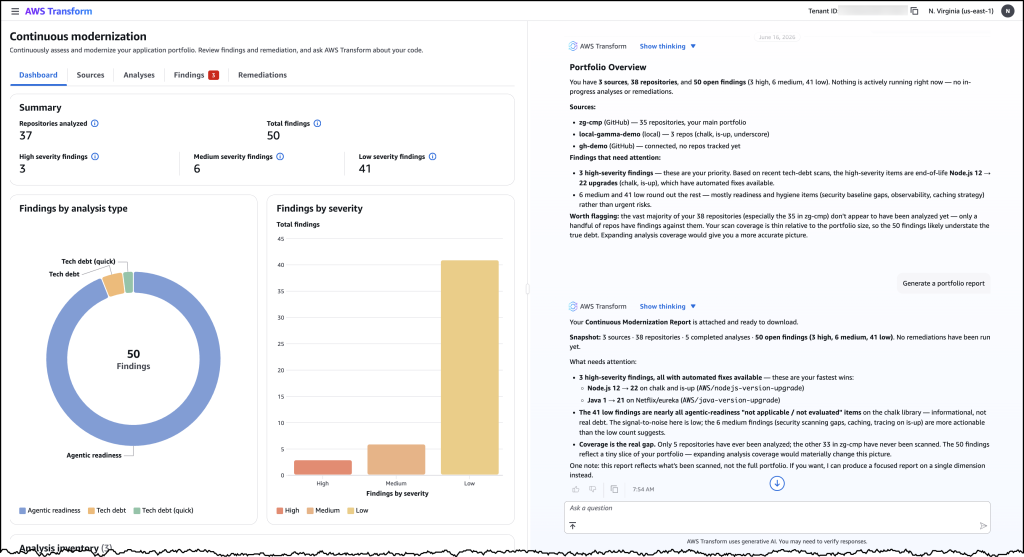
- The Launch: Today, the preview release integrates these capabilities into a centralized dashboard, offering automated scanning, policy-based prioritization, and autonomous remediation through pull requests.
Supporting Data and Operational Mechanics
The effectiveness of AWS Transform – Continuous Modernization lies in its two-pronged approach: Continuous Analysis and Autonomous Remediation.
1. Continuous Analysis: The "Always-On" Audit
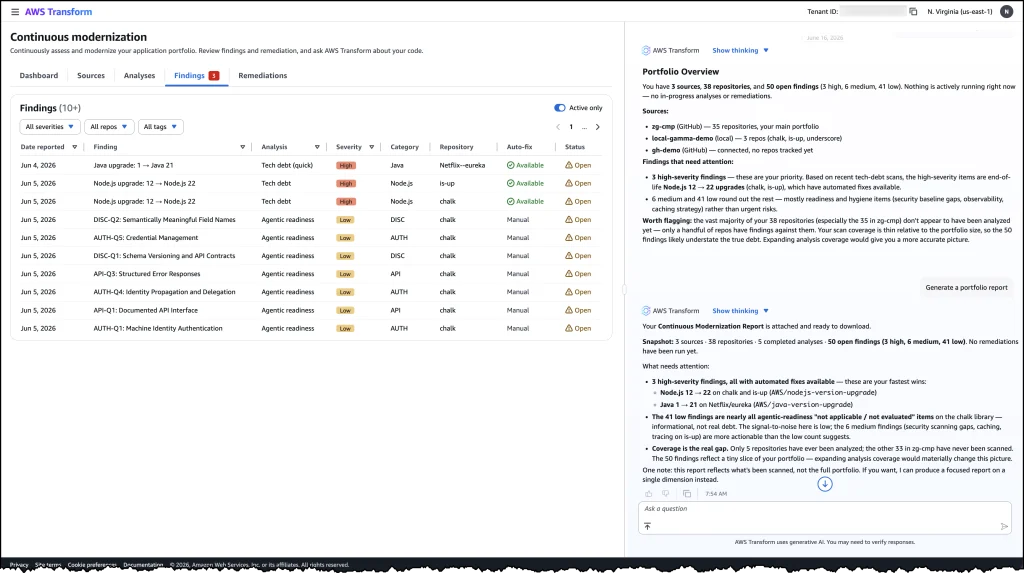
The system functions by scanning source repositories against configurable baselines. Unlike traditional periodic scans that might run once a month or once a quarter, this tool provides near-instant feedback. Within hours of connection, the system identifies where codebases diverge from organizational standards.

- Customizable Policies: Out-of-the-box, the tool tracks EOL dependencies and deprecated frameworks. However, its true power lies in extensibility. Organizations can codify internal requirements—such as mandated logging patterns, approved internal libraries, or specific security postures—into the system.
- Ground Truth: By eliminating the reliance on developer status reports, the tool provides platform teams with an empirical, real-time map of their technical debt landscape.
2. Autonomous Remediation: Closing the Loop
Once findings are generated, the system does not merely notify developers; it acts. Through a configured workflow, AWS Transform generates actionable pull requests (PRs) for affected repositories.
- Automated PR Generation: When a repository is identified as "behind," the tool creates a PR that contains the necessary changes. The owning team receives a notification: "This repository is behind on your organization’s baseline… Here’s a PR that resolves it."
- Closed-Loop Verification: The system tracks the PR status. Once a developer merges the fix, the continuous analysis module automatically updates its dashboard to reflect that the repository has returned to a state of compliance.
Implications for Engineering Leadership
The introduction of this capability signals a fundamental shift in the responsibilities of platform and DevOps teams.
Bridging the Security Gap
A critical feature of this release is its integration with AWS Security Agent. By funneling security vulnerabilities into the same prioritization and remediation workflow as standard technical debt, AWS is effectively blurring the line between "feature work," "maintenance," and "security patching." This creates a unified "health score" for any given codebase, allowing leaders to make data-driven decisions on where to allocate engineering resources.
A New Operating Model
AWS has outlined two distinct modes for code modernization, catering to different organizational needs:
- Continuous Mode: Designed for the day-to-day hygiene of an organization. This is the "background task" of keeping libraries updated and coding standards enforced.
- Campaign Mode: Targeted, project-based modernization. This is for the heavy lifting—such as moving from an older framework to a newer one across hundreds of applications simultaneously.
By providing both modes, AWS acknowledges that tech debt isn’t a monolith. Some of it is routine, while some of it requires a major, orchestrated effort.
Official Perspectives and Industry Impact
While the product is in preview, early indicators suggest that it will drastically alter the relationship between platform teams and individual development squads. By automating the "boring" work of version bumping and dependency management, developers are freed to focus on high-value feature development.
However, the shift to "autonomous" remediation is not without its challenges. The industry will be watching closely to see how organizations balance the speed of automated PRs with the need for rigorous testing. AWS appears to have accounted for this by keeping the human in the loop—the system generates the PR, but the owning team retains the final authority to review and merge.
Looking Ahead: How to Get Started
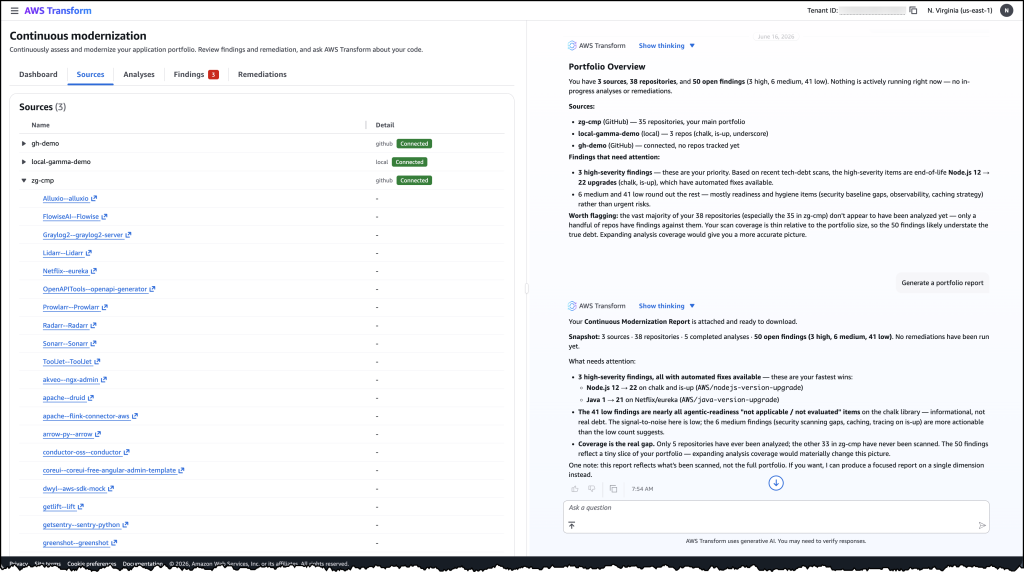
For organizations looking to pilot this technology, the barrier to entry is intentionally low. The AWS Transform web application provides a comprehensive dashboard that tracks the status of all connected repositories, whether they reside in GitHub or other source control environments.
The tool is accessible via:
- The AWS Transform Web Dashboard: Providing a high-level portfolio overview.
- AWS Transform Kiro Power: For CLI-driven interactions.
- MCP (Model Context Protocol) and AI Agents: Allowing for integration into existing coding agents, ensuring that even AI-written code remains compliant with company-wide modernization policies.
Conclusion: The Future of Code Maintenance
AWS Transform – Continuous Modernization represents a maturation of the DevOps lifecycle. For years, the industry has prioritized the velocity of code deployment. With this launch, AWS is shifting the focus toward the sustainability of code maintenance. By treating technical debt as a measurable, actionable, and autonomous metric, AWS is providing the infrastructure necessary for modern engineering teams to scale without collapsing under the weight of their own history.
As the preview progresses, the ultimate measure of success will be whether this tool can turn the "30% tax" of technical debt into a manageable, minor operational overhead, allowing engineering organizations to reclaim their most precious resource: developer time.
For more information on configuring your first policy or to explore the documentation, visit the official AWS Transform documentation portal.