Securing the Digital Perimeter: A Comprehensive Review of Acunetix Web Vulnerability Scanner
In an era where web applications serve as the primary gateway for global commerce, data exchange, and digital infrastructure, the security of the application layer has never been more critical. As cyber-attacks evolve in sophistication—shifting from simple defacements to complex, data-exfiltrating exploits—businesses are increasingly recognizing that perimeter defense is insufficient. Security must be baked into the software development life cycle (SDLC).

Among the tools leading the charge in automated security auditing is the Acunetix Web Vulnerability Scanner (WVS). Known for its ability to identify vulnerabilities such as SQL Injection (SQLi), Cross-Site Scripting (XSS), and a myriad of flaws listed in the OWASP Top 10, Acunetix has established itself as a cornerstone in the arsenal of security professionals and software developers alike.

Main Facts: What is Acunetix WVS?
Acunetix WVS is a robust, automated web application security testing tool designed to combat the rising tide of attacks targeting the web application layer. Unlike traditional static analysis tools that look solely at code, Acunetix operates primarily as a black-box scanner. This means it tests a website or application without any prior knowledge of the underlying source code or server configuration—effectively mirroring the methodology of a real-world attacker.

Key Capabilities:
- Automated Scanning: The platform automates the discovery of vulnerabilities, significantly reducing the time required for security audits.
- Remediation Guidance: Beyond merely flagging issues, the tool provides actionable intelligence, including explanations of the vulnerability, its potential impact, and clear instructions on how to mitigate the risk.
- Technology Agnostic: Whether a site is built on PHP, .NET, Ruby on Rails, or Java, or utilizes popular Content Management Systems (CMS) like WordPress, Acunetix adapts its testing suite to the specific technology stack.
- Integration: It supports integration with other industry-standard tools such as BurpSuite and Fiddler, allowing for a seamless workflow.
The Chronology of a Scan: A Hands-On Workflow
To understand the efficacy of Acunetix, one must examine its operational workflow. A typical audit follows a structured, logical sequence designed to minimize human error while maximizing coverage.

1. Initiation and Setup
The process begins with the Scan Wizard. Upon launching a "New Scan," the user inputs the target URL. The wizard acts as a guide, allowing for the configuration of "Scanning Profiles." These profiles are essentially a curated collection of tests. While a "Default" profile covers the entire spectrum of known vulnerabilities, users can create custom profiles to focus on high-risk alerts, thereby saving time during iterative testing.

2. Fine-Tuning and Crawling
For power users, the Scan Settings provide granular control. Users can configure proxy settings, exclude specific directories, or define custom crawl paths. Once the crawler identifies the site’s architecture, the tool begins its attack phase.

3. Handling Authentication
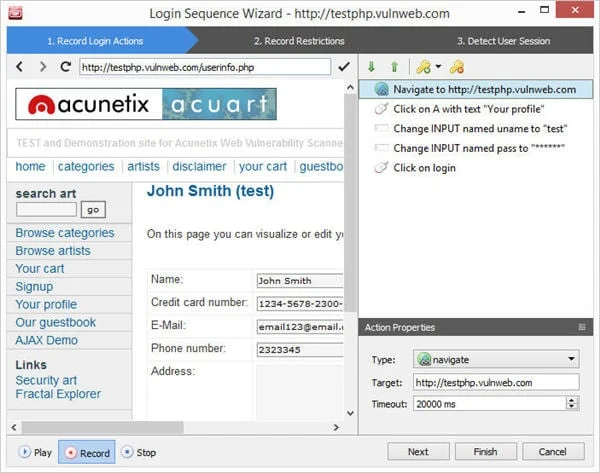
One of the most common hurdles in web security testing is the "password-protected area." Acunetix solves this through a Login Sequence Recorder. By interacting with the browser to perform a standard login, the tool captures the sequence of actions. It then replays this interaction during the scan to maintain an active session. The inclusion of a "Session Pattern" allows the scanner to recognize when it has been logged out, ensuring it can re-authenticate automatically without human intervention.

4. Analysis and Reporting
Once the scan concludes, the tool provides a categorized list of vulnerabilities. Each entry is clickable, offering a "drill-down" view that shows the vulnerable parameter and the specific attack vector used. The reporter module then generates documentation—ranging from executive summaries for stakeholders to highly detailed technical reports for developers—in formats such as PDF or HTML.

Supporting Data and Advanced Technologies
What sets Acunetix apart from entry-level scanners is its "intelligent" engine, designed to handle the complexities of the modern web.

DeepScan Engine
Modern web applications rely heavily on AJAX and JavaScript. Traditional crawlers often fail to interact with dynamic elements, leaving large portions of an application unindexed. The DeepScan engine integrates a fully functional headless browser, enabling the scanner to execute and interact with JavaScript-heavy pages. This is particularly effective in detecting DOM-based XSS, where the vulnerability exists entirely within the client-side code.

The Role of IAST: AcuSensor
While black-box testing is powerful, it has limitations regarding visibility into backend code. To bridge this gap, Acunetix offers AcuSensor, an optional IAST (Interactive Application Security Testing) component. By installing a sensor on the server-side, the scanner gains "insider" knowledge of the application’s behavior.

- Impact: It can pinpoint the exact line of code responsible for a vulnerability.
- Accuracy: It eliminates false positives and can identify vulnerabilities in deep, difficult-to-reach areas like
INSERTstatements in SQL databases.
Detecting Second-Order Vulnerabilities: AcuMonitor
Some of the most dangerous vulnerabilities are "blind" or "second-order," meaning the server does not immediately reflect the attack result. Examples include Blind XSS, SSRF (Server-Side Request Forgery), and Out-of-Band SQLi. AcuMonitor acts as an intermediary service that works in the background to catch these "out-of-band" responses, providing a safety net for vulnerabilities that would otherwise remain hidden from traditional scanners.

Official Responses and Industry Context
In the cybersecurity community, the adoption of automated scanning is no longer a luxury but a mandate for compliance. Industry standards like PCI-DSS and HIPAA require regular vulnerability assessments. Acunetix has tailored its reporting engine to meet these specific regulatory needs.

Official documentation and user feedback highlight that while no automated tool replaces a human penetration tester, Acunetix acts as a vital force multiplier. By offloading the "low-hanging fruit" of common vulnerabilities (like SQLi or outdated software versions) to the scanner, security teams can focus their manual efforts on complex business logic flaws and architectural weaknesses.

Implications for Modern Business
The implications of utilizing a tool like Acunetix are profound for three primary reasons:

1. Risk Mitigation
By catching vulnerabilities early in the development cycle, organizations avoid the catastrophic cost of a data breach. The ability to "retest" vulnerabilities with a single click after a fix has been applied ensures that the security loop is closed promptly, preventing regression.

2. Operational Efficiency
Development teams are often under pressure to release code quickly. Security tools that are difficult to use create friction. The intuitive interface of Acunetix, coupled with its ability to provide clear, actionable remediation advice, fosters a "security-first" culture among developers rather than a "security-as-a-blocker" mentality.

3. Compliance and Trust
For businesses, a security report is more than a list of bugs; it is a document of trust. Whether it is an OWASP Top 10 report or a specific compliance audit for a new client, the ability to generate professional, accurate, and up-to-date documentation is essential for business continuity and legal compliance.

Conclusion: The Path Forward
The digital landscape is inherently hostile, and the barrier to entry for malicious actors continues to drop. However, as the tools for attack evolve, so too must the tools for defense. Acunetix WVS provides a sophisticated, multi-layered approach to web application security. Through the combination of a powerful crawler, deep-dive IAST capabilities, and transparent reporting, it addresses the needs of modern, dynamic web applications.

For organizations looking to harden their infrastructure, the 14-day trial—whether via the on-premise version or the online OVS platform—serves as an excellent entry point. In the final analysis, the goal is not to eliminate risk entirely, but to manage it with such efficiency and foresight that the business remains resilient against the threats of tomorrow.

Have you integrated automated vulnerability scanning into your development pipeline? The shift toward DevSecOps requires constant vigilance. We encourage you to share your experiences, challenges, and successes in the comments below. Your feedback helps the broader security community refine its strategies against the ever-present threat of cyber exploitation.