Mastering the Time Dimension: Streamlining ML Workflows with TensorFlow Decision Forests and Temporian


In the fast-evolving landscape of artificial intelligence, temporal data—information indexed by time—stands as both a goldmine and a major technical hurdle. Whether it is the erratic fluctuation of stock market prices, the rhythmic pulse of network traffic logs, or the complex behavioral patterns within customer transaction histories, temporal data is the lifeblood of predictive modeling. Yet, until recently, the tooling required to prepare this data for machine learning (ML) has been fragmented, cumbersome, and prone to error.
A new collaboration between Google and the technical consultancy Tryolabs has introduced a powerful solution: Temporian. This open-source Python library, designed specifically for preprocessing and feature engineering, aims to demystify temporal data. When paired with TensorFlow Decision Forests (TF-DF), developers now have a cohesive pipeline to ingest, aggregate, and train sophisticated forecasting models, effectively bridging the gap between raw, messy transactional data and actionable insights.

Main Facts: The Intersection of Temporian and TensorFlow
The core challenge in modern machine learning is not just the algorithm itself, but the "data prep" pipeline. Temporal data is rarely clean; it is often non-synchronized, irregularly sampled, and sprawling across multiple sources.
Temporian functions as a specialized engine for this "event-based" data. Unlike traditional time-series libraries that demand uniformly sampled data points, Temporian treats data as a collection of "EventSets." This allows data scientists to work with transactional logs—where events occur at random, millisecond-precise intervals—without having to force-fit them into artificial buckets early in the process.

When this pre-processed data is funneled into TensorFlow Decision Forests, the result is a high-performance predictive model. Decision Forests are particularly adept at handling tabular data with complex relationships, making them a natural partner for the features extracted by Temporian. By leveraging this combination, teams can build models that are not only accurate but also highly interpretable, allowing stakeholders to see exactly which temporal features—such as 28-day rolling averages or day-of-week patterns—most influence their predictions.
Chronology: Building the Modern Temporal Pipeline
The development of this workflow represents a maturation of ML engineering. Historically, the process followed a tedious path:

- Raw Extraction: Pulling gigabytes of logs from SQL databases.
- Manual Resampling: Writing custom Python scripts (often using Pandas) to force irregular transactions into daily or hourly buckets, which frequently led to "data leakage" or information loss.
- Feature Engineering: Calculating moving averages and window-based metrics, a process often plagued by "look-ahead" bias.
- Model Training: Moving the data into a separate environment for training.
With the introduction of Temporian, this chronology has been flattened.
- Initial Loading: Using
tp.from_csvor database connectors, data enters the system as anEventSet. - Transformation: Using native operators like
moving_sumorcalendar_day_of_week, complex features are computed without leaving the Temporian ecosystem. - Integration: The
tp.to_tensorflow_datasetfunction allows for a seamless handoff to TF-DF, maintaining data integrity and ensuring that the temporal context is preserved for the model to "understand" the passage of time.
Supporting Data: The Power of Feature Engineering
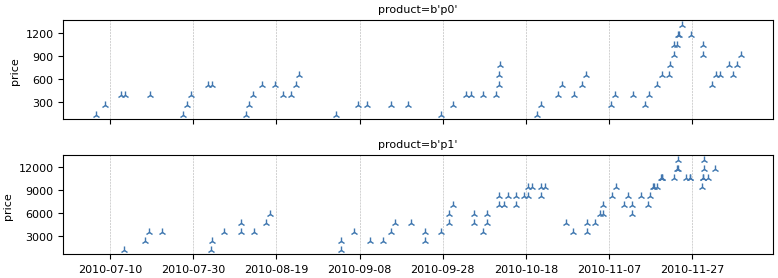
To understand the efficacy of this approach, consider a retail scenario where a shop needs to predict daily sales per product. Using raw transactions is difficult because the signal is noisy. By applying a moving sum over a 7-day window, Temporian smooths the volatility while keeping the trend intact.

The Impact of Indexing
One of the most powerful features of Temporian is its ability to handle "Multi-index time sequences." By running the command sales.add_index("product"), the library automatically segregates data by SKU. When a moving_sum operator is subsequently applied, it processes each product’s data stream independently. This prevents the "bleeding" of information between products, which is a common error in naive aggregation methods.
Variable Importance
Once the model is trained, the "Variable Importance" metrics from the Random Forest reveal the "why" behind the "what." In experimental tests, features like moving_sum_28 (the total sales over the last four weeks) consistently rank as top predictors. This confirms that the model is successfully identifying long-term consumer trends, while features like calendar_day_of_week capture the nuance of weekend versus weekday human behavior. The ability to visualize these trees allows developers to audit the logic, ensuring the model isn’t relying on spurious correlations.

Official Responses and Developer Perspectives
The team behind this integration—which includes Mathieu Guillame-Bert, Richard Stotz, and a deep roster of experts from Google and Tryolabs—emphasizes that the goal is to reduce "time-to-model."
In their joint documentation and blog post, they note that "Time series are the most commonly used representation for temporal data, but they are sometimes not sufficient." Their approach moves beyond the simple "uniformly sampled" paradigm, acknowledging that the real world is made of events, not just fixed-interval snapshots. By providing an API that feels natural to Python users but performs at the scale required for industrial ML, the team aims to lower the barrier for companies looking to implement anomaly detection, fraud identification, and supply chain forecasting.

Industry analysts have observed that this move signals a broader trend: the "commoditization" of feature engineering. As ML frameworks like TensorFlow become more integrated, the competitive edge shifts toward those who can most efficiently manipulate and interpret time-dependent data.
Implications: The Future of Temporal ML
The implications of this workflow are twofold: accessibility and performance.
1. Reducing Data Loss
By delaying the conversion of events into fixed time series, practitioners retain the "richness" of their data. When you aggregate too early, you lose the precise timing of events. Temporian’s ability to use a sampling argument—such as daily_sampling—only at the final stage of feature engineering ensures that information is preserved as long as possible before being structured for the model.
2. Enhancing Interpretability
The use of TensorFlow Decision Forests is a strategic choice. Deep learning models often act as "black boxes," making it difficult for businesses to trust predictions in high-stakes environments like finance or healthcare. Decision Forests provide a clear path to understanding the decision-making process through feature importance rankings and tree visualization, which is essential for compliance and debugging.

Moving Forward
For organizations looking to adopt this, the path forward is clear: start with small, manageable datasets using the provided tutorials. The transition from a Pandas-based workflow to an EventSet-based one requires a shift in mindset—moving from "tables" to "event streams"—but the payoff is a robust, scalable architecture that can handle the complexities of the modern, time-sensitive digital economy.
As we look toward the future of AI, the ability to effectively model time is perhaps the most critical skill for a data scientist. With Temporian and TensorFlow Decision Forests, that capability is now more attainable than ever before. Whether you are forecasting sales for a local business or monitoring global network security, the tools are now in place to turn the chaos of time into a structured, predictive advantage.