Scaling the Spectrum: TensorFlow Introduces Native Distributed Fast Fourier Transform Support
In the high-stakes arena of modern machine learning, the ability to process massive, high-dimensional datasets is the primary differentiator between state-of-the-art research and stagnant models. As neural networks grow in complexity—particularly those dealing with high-resolution imagery, complex audio signals, and scientific simulations—the limitations of single-device memory have become a significant bottleneck.
Google’s TensorFlow team has announced a critical milestone in addressing these hardware constraints: the integration of native Distributed Fast Fourier Transform (FFT) support within the TensorFlow v2 ecosystem. By leveraging the power of DTensor, developers can now scale signal processing operations across multiple accelerators, effectively breaking the "memory wall" that has long hindered large-scale Fourier analysis.
The Core Challenge: Why Distributed FFT Matters
The Fast Fourier Transform (FFT) is an indispensable mathematical algorithm in the digital age. From compressing JPEG images to extracting intricate features in audio processing and regularizing deep learning models to improve generalization, the FFT is a foundational tool.
However, as dataset sizes scale into the realm of terabytes or high-resolution 3D volumes, these operations encounter a physical reality: the memory capacity of a single GPU or TPU. When a tensor is too large to reside in the memory of one accelerator, the standard FFT operation fails. Historically, researchers have had to rely on cumbersome workarounds, custom libraries, or significant architectural compromises to partition these tasks.
The new implementation represents a shift from bespoke, legacy solutions—like the TensorFlow v1 library introduced in the 2021 research paper Large-Scale Discrete Fourier Transform on TPUs—to a seamless, native integration within the modern TensorFlow v2 API.
Chronology of Development: From Research to Production
The evolution of distributed signal processing in the TensorFlow ecosystem has been a multi-year journey of iterative refinement.

- Early Research (2021): The foundation was laid with the publication of Large-Scale Discrete Fourier Transform on TPUs by Tianjian Lu. This research demonstrated that it was possible to maintain high-performance signal processing at scale by distributing data across multiple processing units. However, it existed primarily as a specialized library for TensorFlow v1, creating a barrier for users of the more modern, eager-execution-focused TensorFlow v2.
- The DTensor Paradigm Shift: As Google pivoted toward the DTensor API, the focus shifted from managing individual shards of data manually to a Single Program, Multiple Data (SPMD) approach. This allowed the system to manage distribution automatically, providing a unified API for data and model parallelism.
- September 2024 Update: Google officially integrated the Distributed FFT into the core TensorFlow v2 distribution API. This move signals a transition from experimental research to a supported production feature, allowing developers to invoke distributed FFTs with the same simplicity as local operations.
The Mechanics: DTensor and the SPMD Approach
At the heart of this advancement is DTensor, an extension to TensorFlow that treats distributed computing as a first-class citizen. Unlike traditional parallel programming, which often requires complex orchestration of message passing and synchronization, DTensor utilizes the SPMD paradigm.
How it Works
The beauty of the new implementation lies in its transparency. The API for the distributed FFT is identical to the original, non-distributed FFT operations (such as tf.signal.fft2d). When a user passes a sharded tensor—a tensor that has been split across multiple devices—into the FFT function, DTensor handles the heavy lifting.
- Mesh Creation: Developers define a "mesh," which is a logical layout of the available hardware (CPUs, GPUs, or TPUs).
- Layout Definition: Using
dtensor.Layout, the programmer specifies how the data should be sharded across that mesh. - Automatic Execution: Once the input is sharded, calling
tf.signal.fft2dtriggers a distributed execution. DTensor automatically calculates the most efficient communication path to perform the FFT across the hardware, ensuring the output is also correctly sharded across the mesh.
Supporting Data: Performance and Trade-offs
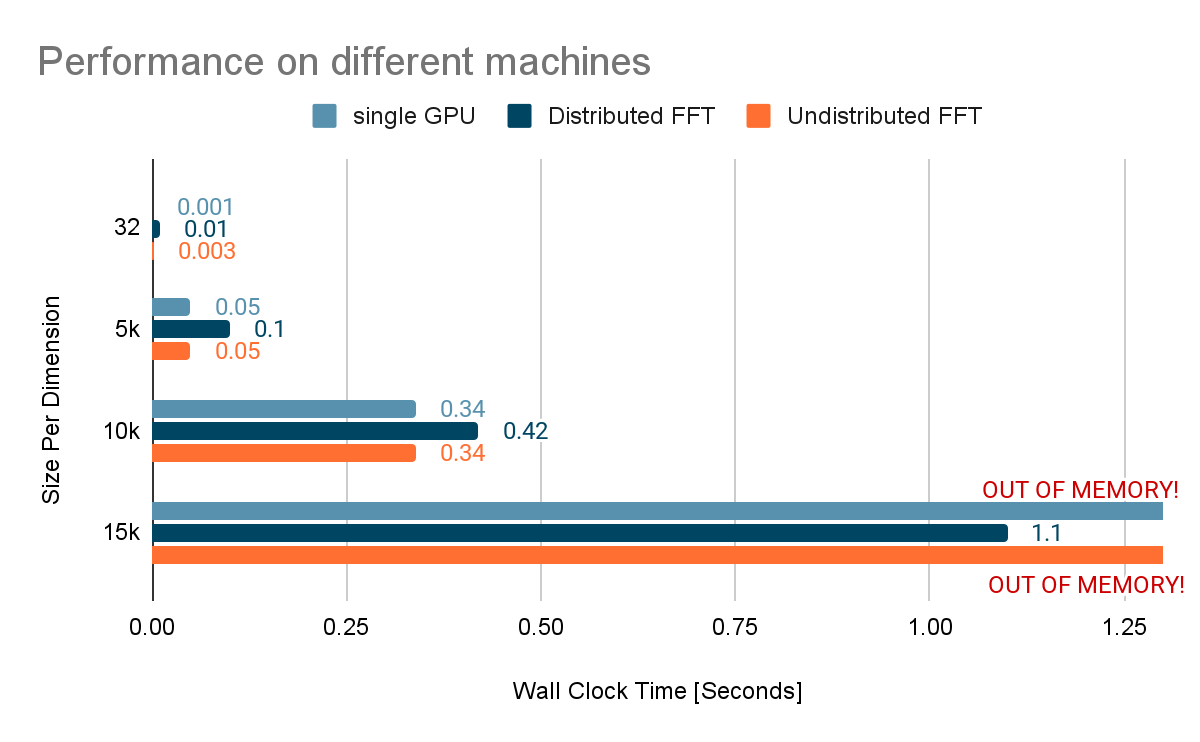
The integration is not without its costs. To gain the ability to process data that would otherwise be impossible to handle, developers must accept a trade-off in latency.
Communication vs. Computation
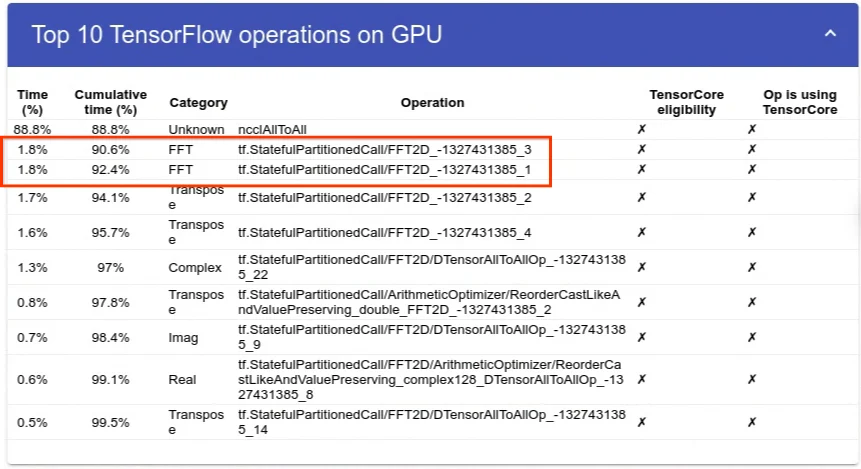
Profiling results conducted on an 8xV100 GPU system reveal the underlying dynamics of the distributed FFT. The algorithm follows a "shuffle-plus-local-FFT" approach—a strategy utilized by industry-standard libraries like FFTW and PFFT.
- Computational Efficiency: The actual local FFT operations are remarkably fast, accounting for only 3.6% (15ms) of the total execution time in a 10K*10K experiment.
- The Bottleneck: The majority of the wall-clock time is consumed by data movement. The
ncclAllToAlloperation, which shuffles data between GPUs to prepare it for the next stage of the transform, is the primary driver of execution time.
Despite this overhead, the capability is transformative. It allows for the processing of datasets that are physically impossible to compute on a single device, regardless of how fast that device’s local calculation speed might be. The performance analysis underscores that while Distributed FFT is not necessarily faster for small, memory-fit datasets, it is infinitely more capable for large-scale production workloads.
Official Responses and Developer Integration
The TensorFlow team, led by contributors such as Ruijiao Sun, has emphasized that this is merely the first iteration of the feature. By adopting a "simplest algorithm" approach, the team has prioritized stability and ease of integration over premature optimization.

"We have adopted a simplest distributed FFT algorithm," noted the team in the official release documentation. "We welcome your feedback on the TensorFlow Forum and look forward to working with you on improving the performance."
This "open-door" policy suggests that future updates will likely focus on optimizing the communication overhead, perhaps through more intelligent data-shuffling algorithms or better integration with high-bandwidth interconnects like NVLink.
Implications for Future Machine Learning Research
The implications of native Distributed FFT support are profound, particularly for domains that rely heavily on spectral methods.
1. High-Resolution Imaging and Medical AI
In fields like MRI reconstruction or satellite imagery, data dimensions often exceed the memory capacity of even the most powerful enterprise GPUs. Native distributed FFTs will allow researchers to perform spectral analysis on full-resolution, high-fidelity images without the need for downsampling, which often discards critical diagnostic information.
2. Scientific Computing and Simulations
Physics-informed neural networks (PINNs) and other scientific machine learning models often utilize Fourier transforms to solve partial differential equations (PDEs) in the frequency domain. As these simulations grow in grid resolution, the ability to distribute these calculations will enable researchers to model more complex physical phenomena with higher precision.
3. Generalization in Deep Learning
As the industry moves away from pure spatial-domain processing, spectral regularization has emerged as a powerful technique to combat overfitting. By making distributed FFTs accessible, TensorFlow is lowering the barrier for researchers to incorporate spectral-domain constraints into large-scale models, potentially leading to more robust and generalized AI architectures.
Next Steps and Looking Ahead
While the current implementation provides a robust foundation, the path forward is clearly defined by performance tuning. Potential areas for future development include:
- Communication Overlap: Implementing techniques to overlap the computation of local FFTs with the communication of sharded data, effectively hiding the latency of the
AllToAlloperations. - Layout Optimization: Enabling more sophisticated automatic layout strategies that minimize the number of shuffles required for specific hardware topologies.
- Hybrid Precision Support: Extending the library to support mixed-precision arithmetic, which could significantly reduce the memory footprint and bandwidth requirements during the shuffle phase.
For engineers and researchers currently struggling with "Out of Memory" (OOM) errors during large-scale signal processing, the recommendation is clear: migrate to the new DTensor-based implementation. By leveraging the collective power of multi-GPU clusters, the new native Distributed FFT in TensorFlow v2 transforms a hardware limitation into a scalable, production-ready pipeline.
As the TensorFlow community begins to adopt this feature, the feedback loop established on the official forums will be essential. In the coming months, we can expect a wave of optimizations that will likely make Distributed FFT a standard component of the deep learning toolkit, further blurring the line between local and distributed computing.