Accelerating the Cloud: AWS Launches CloudFormation Express Mode to Revolutionize Infrastructure Deployment
In a move set to transform the developer experience and optimize CI/CD pipelines, Amazon Web Services (AWS) has officially unveiled AWS CloudFormation Express mode. This new deployment architecture is designed to address one of the most common friction points in cloud engineering: the time spent waiting for "stabilization checks" during resource provisioning. By decoupling the application of configuration from the verification of resource health, AWS is enabling up to four times faster deployment cycles, catering specifically to the needs of rapid iterative development and AI-assisted infrastructure workflows.
The Core Innovation: Redefining Deployment Completion
For over a decade, AWS CloudFormation has been the gold standard for Infrastructure as Code (IaC) on the AWS platform. Traditionally, the service has prioritized safety and verification. When a developer triggers a stack update, CloudFormation doesn’t just create the resources; it monitors them until they reach a "stabilized" state—confirming they are fully operational and ready to accept traffic.
While this approach is indispensable for mission-critical production environments where absolute state consistency is required, it has become a bottleneck for developers engaged in rapid prototyping or automated CI/CD cycles.
How Express Mode Works
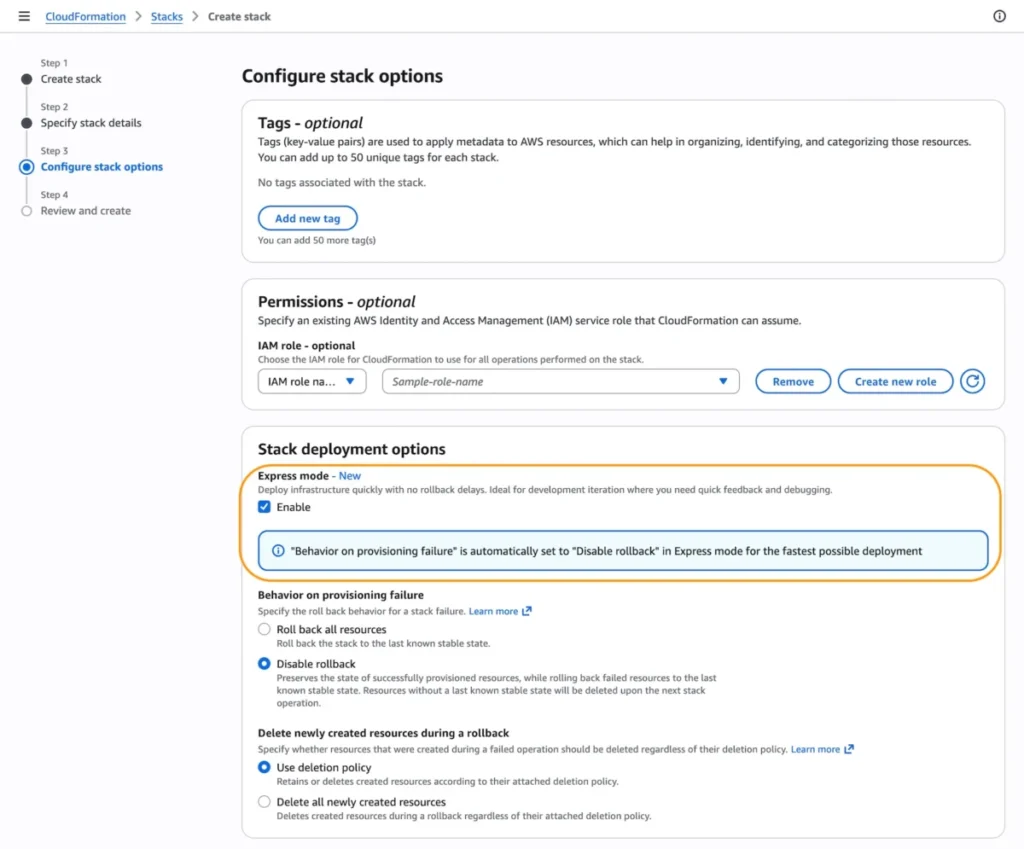
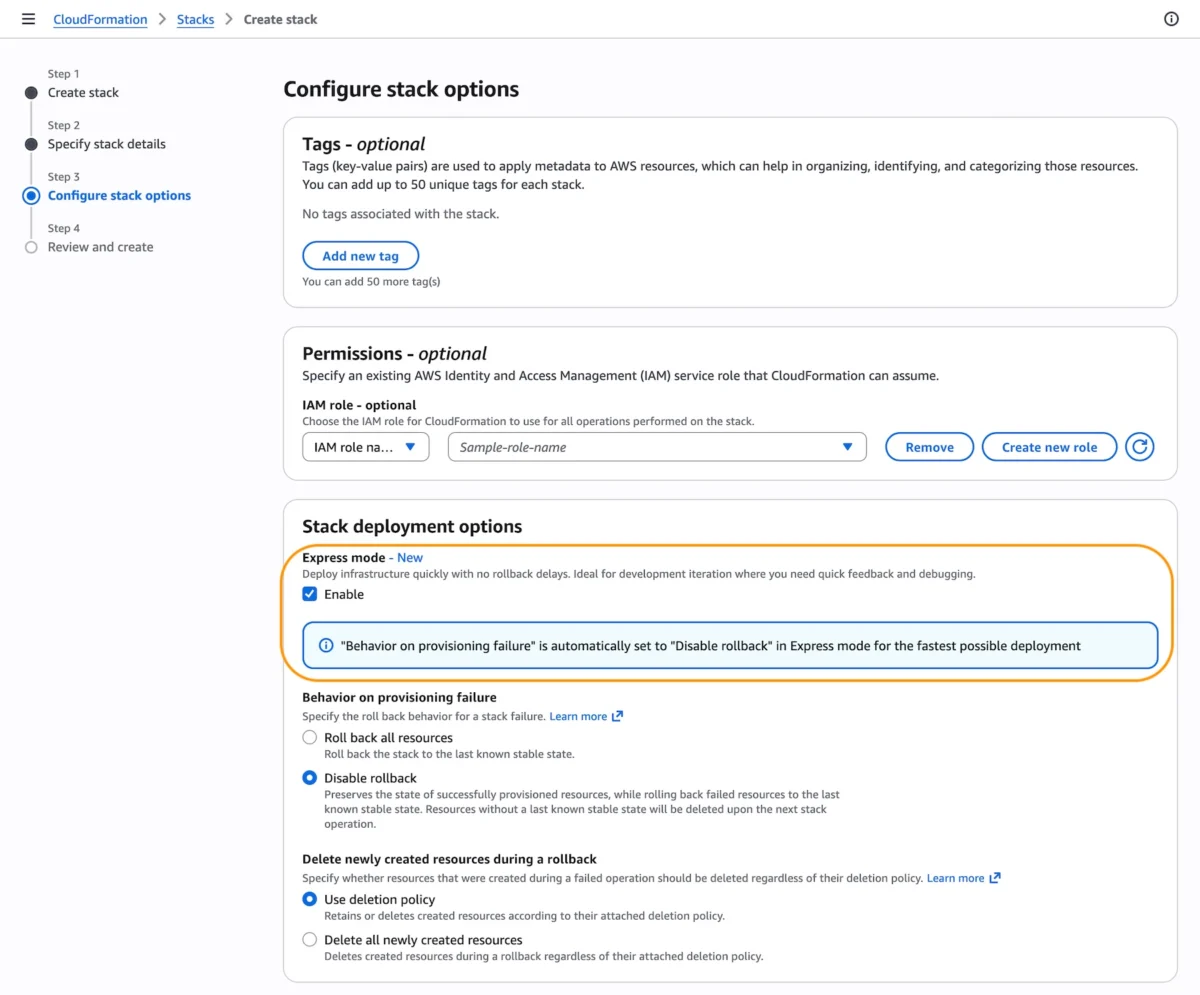
Express mode introduces a paradigm shift by changing when a deployment is considered complete. Instead of holding the deployment open until the AWS control plane confirms every resource is fully initialized and stable, Express mode signals completion as soon as the resource configuration has been successfully applied to the underlying service.
This does not mean the resources stop initializing; rather, they continue to stabilize in the background while the CloudFormation engine hands control back to the user. To maintain system integrity, AWS has built in a layer of "automatic resilience." If a dependent resource encounters a transient failure during this background stabilization, CloudFormation will automatically retry the operation, effectively managing the "timing gaps" that often plague complex, multi-resource stack deployments.
Chronology and Evolution of CloudFormation
The release of Express mode follows a long trajectory of AWS refining its IaC offerings. Since the inception of CloudFormation, AWS has progressively introduced features to lower the barrier to entry and increase speed, including:
- Initial Launch: Provided a declarative way to model infrastructure, moving away from imperative scripts.
- Drift Detection: Added the ability to detect manual changes to stack resources.
- StackSets: Enabled multi-account and multi-region deployment capabilities.
- Cloud Development Kit (CDK): Allowed developers to define infrastructure using familiar programming languages like TypeScript, Python, and Java.
- The "Express" Milestone: Today’s announcement represents the most significant shift in the execution speed of the CloudFormation engine itself, specifically targeting the feedback loop duration that developers face when working with AI coding assistants or localized test-driven development (TDD).
Supporting Data: Quantifiable Performance Gains
The efficiency of Express mode is not merely theoretical. Internal benchmarks shared by AWS highlight dramatic reductions in wait times, particularly for resources that traditionally take several minutes to stabilize.
- SQS Queue with Dead Letter Queue (DLQ): In standard operating mode, this process typically takes roughly 64 seconds. Under Express mode, the process concludes in as little as 10 seconds.
- Lambda Function Deletion (with Network Interface attachments): This is historically one of the most time-consuming operations due to the complexity of detaching and deleting network interfaces. Where standard mode might take 20 to 30 minutes to confirm deletion, Express mode completes the request in approximately 10 seconds.
These figures illustrate that for developers executing hundreds of small infrastructure updates per week, the cumulative time saved could amount to hours of regained productivity.
Implementation Strategies: A Low-Friction Transition
AWS has engineered Express mode to be backward compatible with existing templates. There is no requirement to refactor legacy YAML or JSON files.
Enabling via CLI and SDK
For automation engineers, enabling Express mode is as simple as updating the deployment configuration. By setting the --deployment-config parameter to EXPRESS, developers can instantly opt-in to the faster lifecycle.
aws cloudformation create-stack
   --stack-name my-app
   --template-body file://template.yaml
   --deployment-config '"mode": "EXPRESS", "disableRollback": true'
The Role of Rollbacks
A critical consideration for users is the default behavior regarding rollbacks. To maximize speed, Express mode disables automatic rollbacks by default. This is an intentional design choice for the iterative development phase. However, AWS provides the flexibility to re-enable this feature by setting disableRollback to false. For production-grade workloads where safety remains the primary concern, AWS recommends maintaining the default stabilization-heavy deployment method or strictly configuring monitoring and cleanup mechanisms alongside the Express deployment.
Integration with AI Tools
The rise of AI-assisted infrastructure generation—using tools like Kiro or Amazon Q—has necessitated faster feedback loops. When an AI generates a block of infrastructure code, the developer needs to see if it "works" immediately. Express mode effectively enables a "hot-reload" style experience for cloud infrastructure, allowing AI-powered development environments to iterate and troubleshoot configurations in sub-minute intervals.
Implications for Modern Software Engineering
The introduction of CloudFormation Express mode has profound implications for how organizations approach cloud operations (CloudOps).
1. Accelerating the "Inner Loop"
The "inner loop" of development refers to the cycle of writing code, deploying to a sandbox, and verifying the result. By collapsing this loop from minutes to seconds, developers can experiment with more complex architectures without the "context switching" tax incurred while waiting for a terminal to return control.

2. CI/CD Pipeline Optimization
In modern DevOps, time is the ultimate currency. If a CI pipeline triggers a CloudFormation stack update as part of its testing phase, the total pipeline duration is currently gated by the slowest stack deployment. By moving non-critical stabilization tasks to the background, pipeline engineers can ship updates to staging environments significantly faster, accelerating the overall release velocity of the organization.
3. The Future of State Management
Some industry analysts suggest that this move hints at a future where CloudFormation acts more as a "declarative orchestrator" rather than a "synchronous validator." As cloud resources become more ephemeral and distributed, the ability to "fire and forget" deployments—with the platform handling the reconciliation logic in the background—aligns with the industry trend toward serverless and event-driven architectures.
Official Guidance and Regional Availability
AWS has confirmed that CloudFormation Express mode is available immediately in all commercial AWS Regions. This global rollout ensures that teams, regardless of their geographical footprint, can begin testing the feature today.
For those looking to integrate this into their existing workflows, AWS suggests:
- Documentation: Review the updated CloudFormation User Guide for nuances regarding complex resource dependencies.
- Support: Engage with the
AWS re:Postcommunity to share experiences or report edge cases, particularly regarding complex stateful resources like RDS databases or Aurora clusters. - Tooling: Ensure that your local CLI and SDK versions are updated to support the new
deployment-configparameters.
Conclusion: A New Baseline for Cloud Development
The arrival of AWS CloudFormation Express mode is a clear signal that AWS is listening to the needs of the modern, rapid-deployment developer. By shifting from a "wait-for-verification" model to an "apply-and-verify-in-background" model, AWS is effectively removing the wait-state from the cloud engineering experience.
While the traditional, high-assurance stabilization mode remains the standard for production-hardened deployments, the addition of Express mode gives architects the flexibility to balance speed and safety based on the specific phase of their project lifecycle. As organizations continue to embrace AI-driven infrastructure and high-frequency deployment models, Express mode will likely become the default baseline for the next generation of cloud innovation.