Reawakening the Beast: Linux Breaths New Life into the Atari Jaguar, 30 Years On
MAIN FACTS
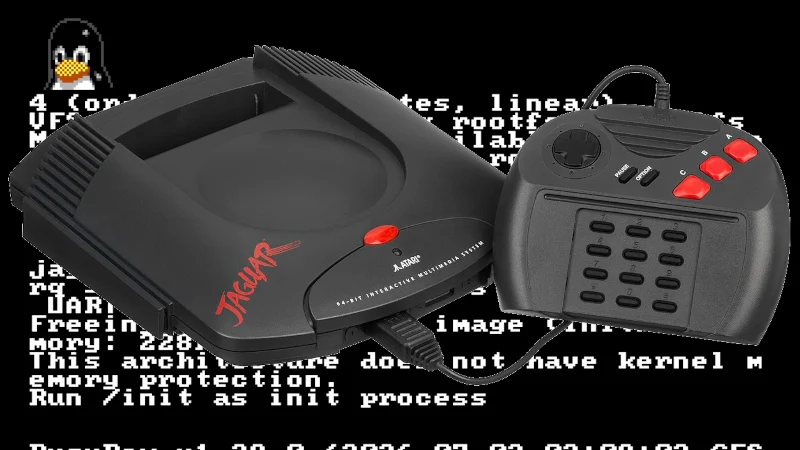
In a remarkable feat of reverse engineering and dedicated hobbyist work, a developer known as [Cakehonolulu] has successfully ported a functional Linux kernel to the Atari Jaguar, the iconic but commercially ill-fated "64-bit" console from the early 1990s. This achievement, coming three decades after the Jaguar’s original release, not only serves as a poignant testament to the console’s latent capabilities but also underscores the enduring versatility and portability of the Linux operating system.
The Atari Jaguar holds a unique, almost melancholic, place in the annals of video game history. Launched in 1993, it was Atari Corporation’s final, ambitious attempt to reclaim its former glory in the fiercely competitive console market. Despite its innovative "64-bit" architecture – a contentious marketing claim based on its dual 32-bit chips – and a powerful suite of custom processors, the Jaguar struggled against the dominance of Nintendo’s SNES and Sega’s Genesis/Mega Drive, and was ultimately overshadowed by the impending arrival of the PlayStation and Sega Saturn. It was, as famously quoted, a machine that "coulda been a contender."
Now, thanks to [Cakehonolulu]’s meticulous efforts, the Jaguar is experiencing an unexpected revival, albeit in a capacity far removed from its original gaming purpose. The project involves navigating significant hardware constraints: the console boasts a mere 2 megabytes of RAM and space for 8 megabytes of ROM. Its primary computational power comes from a 16-bit Motorola 68000 processor, a widely supported Linux architecture, albeit one requiring a specific -nommu flag during compilation due to the absence of a Memory Management Unit (MMU).
The "Jerry" DSP (Digital Signal Processor) chip, one of the Jaguar’s custom co-processors, proved instrumental, providing the necessary serial port and timer functions to boot the initial Linux kernel. Following intricate hackery to ensure the system jumps to the correct ROM location and navigating the intricacies of a flat executable file for the -nommu kernel, a basic but functional Linux environment boots. This includes a BusyBox userspace, offering a minimalist set of Unix utilities, and a custom-developed graphics driver for the "Tom" graphics chip, which renders a "chunky" on-screen console display. The code for this ambitious project has been made publicly available on a GitHub repository, inviting curious enthusiasts to explore the inner workings of this retro-futuristic endeavor.
This accomplishment is not an isolated incident but rather part of a burgeoning trend within the retro-computing community. In recent weeks, Linux has been demonstrated running on a Sega Mega Drive, and previous years have seen similar ports to the Nintendo 64 and, notably, the Sega Dreamcast, which boasted Linux support decades ago. These projects highlight a vibrant subculture of hardware hackers and software engineers dedicated to pushing the boundaries of legacy systems, preserving digital history, and showcasing the remarkable adaptability of the open-source Linux ecosystem.
CHRONOLOGY: THE ATARI JAGUAR’S TUMULTUOUS JOURNEY AND ITS LINUX REVIVAL
The story of the Atari Jaguar is one of grand ambition, technical innovation, and ultimately, commercial disappointment. To understand the significance of running Linux on this machine, it’s crucial to contextualize its place in computing history and the evolution of the video game industry.
Atari’s Final Roar: The Genesis of the Jaguar (Early 1990s)
The Atari Corporation that conceived the Jaguar was a different entity from the pioneering company that launched the Atari 2600. Under the leadership of Jack Tramiel, who acquired Atari’s consumer division from Warner Communications in 1984, the company had shifted its focus heavily towards personal computers, particularly with the successful Atari ST line. However, the lure of the console market, which was then dominated by Japanese giants Nintendo and Sega, proved irresistible.
Development for the Jaguar began in the early 1990s, aiming to create a system that would leapfrog the existing 16-bit generation (SNES, Genesis/Mega Drive) and establish Atari as a leader in the impending 32-bit era. The system was designed by Flare Technology and further developed by Atari. Its most distinguishing feature, and perhaps its biggest marketing gambit, was the "64-bit" claim. This was technically contentious; while the console featured a 64-bit data path between its custom chips and memory, its core processors – a 16-bit Motorola 68000 and two 32-bit custom chips ("Tom" and "Jerry") – were not true 64-bit in the sense that later systems would define it. Nevertheless, it was a powerful system for its time, incorporating dedicated chips for graphics, sound, and a general-purpose DSP.
The Jaguar launched in North America in November 1993, initially with a limited release in New York and San Francisco, before a wider rollout in 1994. Its launch price was around $250, positioning it as a premium device. Atari touted its advanced capabilities, hoping to attract both gamers and developers with its raw power.
The Road to Obsolescence: Challenges and Competition (Mid-1990s)
Despite its technical prowess, the Jaguar faced an uphill battle. Its complex architecture, featuring multiple co-processors, proved notoriously difficult for developers to program effectively. Many third-party studios struggled to harness the system’s full potential, leading to a library of games that, while occasionally impressive, often failed to showcase the console’s capabilities or were plagued by bugs and performance issues. This lack of developer support and a scarcity of "killer apps" — exclusive, high-quality games that could drive console sales — severely hampered its market penetration.
Atari’s marketing efforts also struggled to compete with the vast budgets and established brands of Nintendo and Sega. The company’s dwindling market share and previous missteps in the console space meant that consumer trust was low. Compounding these issues was the rapid advancement of technology and the impending arrival of truly next-generation systems.
The real nail in the coffin came with the launch of Sony’s PlayStation and Sega’s Saturn in 1994 (Japan) and 1995 (North America/Europe). These consoles offered superior development tools, more robust software support, and significantly stronger marketing campaigns. The PlayStation, in particular, with its CD-ROM format (allowing for larger games and full-motion video) and accessible development environment, quickly dominated the market. The Jaguar, reliant on more expensive cartridge-based media and perceived as difficult to work with, was quickly left behind.
By 1996, with less than 250,000 units sold worldwide, Atari officially ceased production of the Jaguar. The company itself, facing severe financial woes, was eventually acquired by JTS Corporation, and the Atari brand subsequently passed through several hands, eventually becoming Atari SA. The Jaguar became a symbol of a bygone era, a "might-have-been" that simply couldn’t compete.
The Linux Revival: 30 Years Later (2020s)
Fast forward three decades, and the Jaguar is experiencing an unexpected resurgence, not through new games, but through the determined efforts of retro-computing enthusiasts. The recent porting of Linux by [Cakehonolulu] marks a significant milestone in the console’s post-commercial life.
This achievement is part of a broader, ongoing trend within the hacker community to port modern operating systems, particularly Linux, to vintage hardware. This movement gained significant traction with earlier projects like Linux on the Sega Dreamcast (which boasted a much more powerful and developer-friendly architecture for its time, allowing for Linux ports decades ago), and more recently, Linux on the Nintendo 64 and the Sega Mega Drive. These projects showcase a collective desire to explore the limits of these old machines, preserve their heritage, and push the boundaries of embedded systems development. The Jaguar’s Linux port, therefore, is not just a standalone curiosity but a vibrant chapter in the continuing story of retro hardware reclamation.
SUPPORTING DATA: THE TECHNICAL UNDERPINNINGS OF JAGUAR LINUX
The success of porting Linux to the Atari Jaguar is a testament to sophisticated low-level programming and an intimate understanding of the console’s idiosyncratic hardware. The project by [Cakehonolulu] meticulously addresses the significant constraints and unique architecture of the Jaguar.
Navigating Hardware Constraints: RAM, ROM, and Processor Architecture
The Jaguar’s hardware specifications, while advanced for 1993, are incredibly modest by today’s standards, posing the primary challenge for an operating system as complex as Linux.
- Limited Memory: The console features only 2 megabytes of RAM. For context, even the simplest embedded Linux systems today often demand tens of megabytes, if not hundreds. Modern desktop operating systems require gigabytes. This scarcity necessitates a highly optimized and stripped-down kernel, along with a minimal userspace environment. The 8 megabytes of ROM space, while seemingly generous for a console of its era, also requires careful management for storing the kernel and essential boot files.
- The Motorola 68000 Processor: At the heart of the Jaguar’s control system is a 16-bit Motorola 68000 CPU, clocked at 13.295 MHz. This processor, while less powerful than the Jaguar’s custom "Tom" and "Jerry" chips, serves as the main general-purpose CPU. The 68000 family is historically significant, having powered iconic systems like the Apple Macintosh, Amiga, and the Sega Genesis/Mega Drive. Crucially, the 68k architecture is a supported target for the Linux kernel, meaning that the foundational code for this CPU family already exists within the Linux source tree, simplifying the initial porting effort.
- The Absence of an MMU (Memory Management Unit): A critical aspect of the 68000 in the Jaguar is its lack of a Memory Management Unit. An MMU is a hardware component that handles virtual memory and memory protection, allowing an operating system to manage memory for multiple processes efficiently and securely, isolating them from each other. Most modern operating systems, including standard Linux distributions, heavily rely on an MMU. Without it, the kernel cannot implement virtual memory, memory protection, or advanced process isolation. This necessitates compiling the Linux kernel with the
-nommuflag (orCONFIG_MMU=n). A-nommukernel operates in a simpler, flat memory model, where processes directly access physical memory. This limits the complexity of applications that can run and requires careful memory allocation to prevent conflicts, but it makes Linux viable on such constrained hardware.
The Bootstrapping Process: From ROM to BusyBox
Bringing Linux to life on the Jaguar is a multi-step process that involves intricate low-level programming and system configuration:
- Initial Boot and ROM Hackery: The Jaguar’s boot process is designed to load games from cartridges. To run Linux, [Cakehonolulu] had to devise a method to hijack this process, essentially "tricking" the system into loading the Linux kernel from a specific ROM location rather than a game. This involves writing a small bootloader or modifying existing boot routines to jump to the kernel’s entry point in ROM. The "Jerry" DSP chip plays a crucial role here, as it provides the necessary serial port for debug output and a timer for initial kernel scheduling, essential for the earliest stages of the boot process.
- The
-nommuKernel and Flat Executables: Once the kernel starts, it must initialize the system’s hardware and then launch the first user-space process, traditionallyinit. In a-nommuenvironment, the standardinitprocess, which relies on MMU features, cannot be used directly. Instead, the kernel is configured to execute a single "flat executable" file directly from ROM or RAM. This executable typically contains a minimal root filesystem and the necessary user-space programs. - BusyBox Userspace: To provide a functional command-line environment, [Cakehonolulu] integrated BusyBox. BusyBox is a collection of common Unix utilities (like
ls,cd,grep,vi,shfor a shell) packed into a single, extremely small executable. It’s often called "the Swiss Army Knife of embedded Linux" because it provides essential functionalities with a minimal footprint, making it ideal for resource-constrained devices like the Jaguar. With BusyBox, users can interact with the system via a command-line interface. - Graphics Driver for the "Tom" Chip: The "Tom" chip is the Jaguar’s primary graphics processor, responsible for rendering sprites, blitting, and managing the video output. [Cakehonolulu] developed a custom graphics driver specifically for this chip. This driver allows the Linux kernel to output text and graphics directly to the console display, presenting the user with a "chunky on-screen console." This is a significant achievement, as it means the system isn’t just running in the background but can actually display its output on a connected television or monitor, making it truly interactive.
The Developer’s Journey: [Cakehonolulu]’s Contribution
The project is a solo endeavor by [Cakehonolulu], demonstrating deep expertise in retro hardware, embedded systems, and Linux kernel development. The decision to publish the code on GitHub (https://github.com/cakehonolulu/linux_jag) is crucial. It adheres to the open-source ethos, allowing other enthusiasts, researchers, and developers to examine the code, understand the methodologies, contribute improvements, and potentially port Linux to other similar 68k-based systems. This collaborative aspect is a cornerstone of the retro-hacking community, fostering knowledge sharing and collective progress.
OFFICIAL RESPONSES AND INDUSTRY IMPLICATIONS
In the traditional sense of corporate "official responses," there will be none regarding [Cakehonolulu]’s achievement. The Atari Corporation that designed and manufactured the Jaguar ceased to exist in its original form decades ago. The current entity known as Atari SA is a different company, primarily focused on modern gaming and licensing its classic intellectual property. As such, a hobbyist project like porting Linux to a 30-year-old console holds no direct commercial or strategic interest for them. This project exists entirely within the realm of independent research, passion, and the open-source community.
However, the implications of such projects extend far beyond direct corporate engagement, offering valuable insights into computer science, engineering, and the broader technological landscape.
The Value to Computer Science and Engineering
- Demonstration of Low-Level Programming Expertise: Successfully porting an operating system to bare metal, especially on a unique and resource-constrained architecture like the Jaguar, demands an exceptional understanding of low-level programming. This includes assembly language, C programming for kernel development, interrupt handling, memory management (even in a
-nommucontext), and device driver development. These skills are fundamental to computer engineering but are often abstracted away in modern software development. - Operating System Internals: The project provides a practical, hands-on demonstration of how operating systems function at their core. Understanding kernel compilation, the boot process, scheduler implementation, and the intricacies of device drivers for custom hardware (like the Tom and Jerry chips) is invaluable for students and professionals in OS development and embedded systems.
- Reverse Engineering and Hardware Documentation: For many retro consoles, official hardware documentation is scarce, incomplete, or simply unavailable. Projects like this often involve significant reverse engineering – probing hardware, analyzing existing software, and deducing how components interact. This process is a critical skill in cybersecurity, hardware design, and legacy system maintenance.
- Educational Tool: The publicly available code and documentation can serve as an excellent educational resource. Aspiring engineers can study how a complex OS like Linux is adapted for minimal hardware, learning about optimization, resource management, and the architectural differences between modern and vintage systems.
The Open-Source Ethos in Action
- Linux’s Adaptability and Portability: The Jaguar Linux port is a powerful testament to the design philosophy of Linux. Its modular structure, support for a vast array of architectures (including less common ones like 68k -nommu), and the flexibility of its kernel configuration allow it to be adapted to virtually any computational device, from supercomputers to microcontrollers, and now, to forgotten game consoles.
- Community-Driven Development: The entire project thrives on the open-source model. [Cakehonolulu]’s decision to share the code on GitHub enables collaboration, peer review, and further development by the global community. This collective intelligence accelerates progress and ensures the longevity of such projects.
- Preservation of Computing History: By bringing a modern OS to vintage hardware, these projects effectively "resurrect" and preserve computing history. They allow for deeper interaction with these systems beyond their original commercial intent, making them subjects of active study and experimentation rather than mere museum pieces. This preservation effort is crucial for understanding the evolution of technology.
In essence, while there’s no official nod from Atari, the impact of projects like Linux on the Jaguar resonates deeply within the academic, engineering, and open-source communities, solidifying its place as more than just a nostalgic curiosity.
IMPLICATIONS: BEYOND A NOSTALGIC NOVELTY
The successful porting of Linux to the Atari Jaguar is undeniably a captivating piece of retro-computing nostalgia. However, its implications stretch beyond mere sentimentality, offering valuable insights into the future of embedded systems, hardware preservation, and the enduring spirit of technological exploration.
What Can You Actually Do with Linux on a Jaguar?
It’s important to manage expectations regarding the practical utility of Linux on a Jaguar. With only 2MB of RAM, a 16-bit 68000 processor, and no MMU, the system is severely constrained.
- Limitations: Realistically, the Jaguar running Linux will not be a daily driver or a powerful computing platform. It cannot run modern applications, web browsers (without significant, probably impossible, porting efforts), or complex graphical interfaces. Its primary output is a "chunky on-screen console," indicative of a command-line interface.
- Potential Functionalities (Theoretical):
- Basic Networking: If a network interface could be adapted or developed for the Jaguar (e.g., via a cartridge slot or expansion port) and appropriate drivers written, the system could potentially perform basic networking tasks like pinging, simple text-based web requests (using tools like
curlorwgetif compiled for-nommu), or even act as a very rudimentary server for extremely lightweight protocols. - Simple Text-Based Applications: Very old, compiled-for-68k, and text-based Unix utilities or games (e.g., a simple text editor, a calculator, or classic command-line adventure games) could theoretically run if adapted for the
-nommuenvironment and compiled against BusyBox’s libraries. - Educational Tool: Its most practical use might be as a learning platform for embedded systems development, low-level programming, and understanding Linux kernel internals on extremely constrained hardware.
- Demonstration Platform: It serves as a compelling proof-of-concept, showcasing the extreme portability of Linux and the ingenuity of the hacking community.
- Basic Networking: If a network interface could be adapted or developed for the Jaguar (e.g., via a cartridge slot or expansion port) and appropriate drivers written, the system could potentially perform basic networking tasks like pinging, simple text-based web requests (using tools like
Ultimately, the journey and the challenge of getting Linux to run are far more significant than the specific applications it can host. It’s a testament to what’s possible when creative minds push boundaries.
Pushing the Boundaries of Embedded Systems
The Jaguar Linux project offers relevant lessons for contemporary embedded systems development, particularly in the context of the Internet of Things (IoT) and highly resource-constrained devices.
- Optimizing for Minimal Resources: The techniques employed to get Linux running on 2MB of RAM – kernel stripping, minimalist userspaces like BusyBox, and
-nommucompilation – are directly applicable to modern embedded systems where power efficiency, cost, and a small footprint are paramount. Developers often face similar challenges when designing devices with limited memory and processing power. - Understanding Hardware-Software Co-design: The project highlights the critical interaction between hardware and software. The successful utilization of the Jerry DSP’s serial port and timer functions, and the custom graphics driver for the Tom chip, exemplify how deeply one must understand the underlying hardware to extract maximum functionality. This integrated approach is a cornerstone of effective embedded systems engineering.
- The Ongoing Relevance of Older Architectures: While the 68000 is a vintage processor, the principles of working with its architecture (e.g., interrupt handling, memory mapping) inform modern processor designs and system-on-a-chip (SoC) development. Studying these older systems can provide foundational knowledge for understanding newer, more complex architectures.
The Future of Retro Hacking and Preservation
The success of Linux on the Jaguar is part of a growing movement that promises an exciting future for retro hardware:
- What’s Next? The community will undoubtedly continue to explore other forgotten consoles and computers. The challenge might shift from simply booting Linux to enabling more advanced functionalities, such as networking, sound, or even rudimentary GUI environments, on these platforms. Each successful port inspires new projects and new ideas.
- The Role in Digital Heritage: Retro hacking plays a vital role in preserving digital heritage. As hardware ages and becomes obsolete, the knowledge of how these systems work can be lost. By actively engaging with these machines, documenting their internals, and developing new software for them, hackers ensure that this knowledge is retained and accessible for future generations. This grassroots preservation effort complements institutional archives and museums.
- Inspiring New Generations: Projects like this serve as powerful sources of inspiration. They demonstrate that technology is not a black box, but something that can be understood, manipulated, and reimagined. For aspiring engineers, computer scientists, and developers, seeing a modern OS run on a vintage console can ignite a passion for low-level exploration, problem-solving, and the creative application of technical skills.
In conclusion, the Atari Jaguar, once relegated to the status of a commercial failure, has found an unexpected second life as a platform for cutting-edge retro-computing. Its transformation into a Linux-capable machine is more than a mere curiosity; it’s a profound statement about the enduring power of open-source software, the dedication of the hacking community, and the timeless appeal of pushing technological boundaries. It ensures that the spirit of Atari’s final roar continues to echo, not as a lament, but as a testament to endless possibilities.