Scaling Security: AWS Revolutionizes Certificate Lifecycle Management with Native ACME Support
In an era where digital security is the bedrock of global infrastructure, the management of Transport Layer Security (TLS) certificates has transitioned from a routine administrative task to a critical operational challenge. As cyber threats evolve and regulatory bodies tighten requirements, the industry is witnessing a significant shift toward shorter certificate lifespans. Today, Amazon Web Services (AWS) has addressed this paradigm shift head-on by announcing native support for the Automatic Certificate Management Environment (ACME) protocol within AWS Certificate Manager (ACM).
This development marks a watershed moment for DevOps teams, security architects, and PKI (Public Key Infrastructure) administrators, providing a standardized, automated, and centralized solution for managing public TLS certificates at scale.

The Urgency of Automation: Why the Shift Matters
The landscape of web security is changing rapidly. The Certification Authority/Browser Forum (CA/B Forum), which sets the standards for the web’s trust infrastructure, has mandated a significant reduction in the maximum validity period for TLS certificates. Starting in March 2027, the maximum lifespan will be slashed to 100 days, with further reductions to 47 days by 2029.
For organizations relying on manual renewal processes, these timelines present a daunting operational cliff. Certificates that expire prematurely result in service outages, broken user experiences, and potential security vulnerabilities. Historically, the burden of manual oversight has led many teams to either over-provision or suffer from the "hidden certificate" problem—where certificates exist in various silos across a hybrid cloud environment, unmonitored and vulnerable to expiration.

The ACME protocol, originally popularized by the non-profit certificate authority Let’s Encrypt, provides a standardized, machine-to-machine language for requesting, validating, and renewing certificates. By integrating ACME directly into ACM, AWS is effectively enabling enterprise-grade automation for any application that supports ACMEv2-compatible clients.
Chronology: From Fragmented Management to Centralized Control
The journey to this integration reflects the broader evolution of cloud-native security. For years, organizations attempting to automate their certificate lifecycles often found themselves trapped between two worlds: using ACM for native AWS services and relying on external, third-party CAs to handle the automation needs of their containerized or on-premises workloads.
- Pre-2024: The "Fragmentation Era." Teams managed certificates through a patchwork of scripts, manual console updates, and external CA providers. Visibility was limited, and central governance was nearly impossible to enforce.
- Early 2026 Development: AWS focused on the architectural requirements for a managed ACME server endpoint, prioritizing the need for seamless integration with industry-standard clients like Certbot, cert-manager for Kubernetes, and acme.sh.
- June 2026: The Launch. AWS officially rolls out ACME support for ACM. This rollout allows organizations to issue public TLS certificates directly from Amazon Trust Services (ATS) using the ACME protocol, bridging the gap between automated issuance and centralized management.
Technical Deep Dive: How the Integration Works
The power of the new ACME-ACM integration lies in its "hub-and-spoke" architecture. PKI administrators are no longer forced to distribute sensitive DNS credentials to every application owner. Instead, they can establish a secure, managed endpoint that acts as a gatekeeper.
The Mechanism of External Account Binding (EAB)
The system utilizes External Account Binding (EAB), a security feature that allows the ACME client to securely register with the AWS-managed server. By issuing an EAB key pair (a Key ID and an HMAC key), administrators can grant specific applications the permission to request certificates without granting those applications full access to the underlying DNS infrastructure.
The Validation Workflow
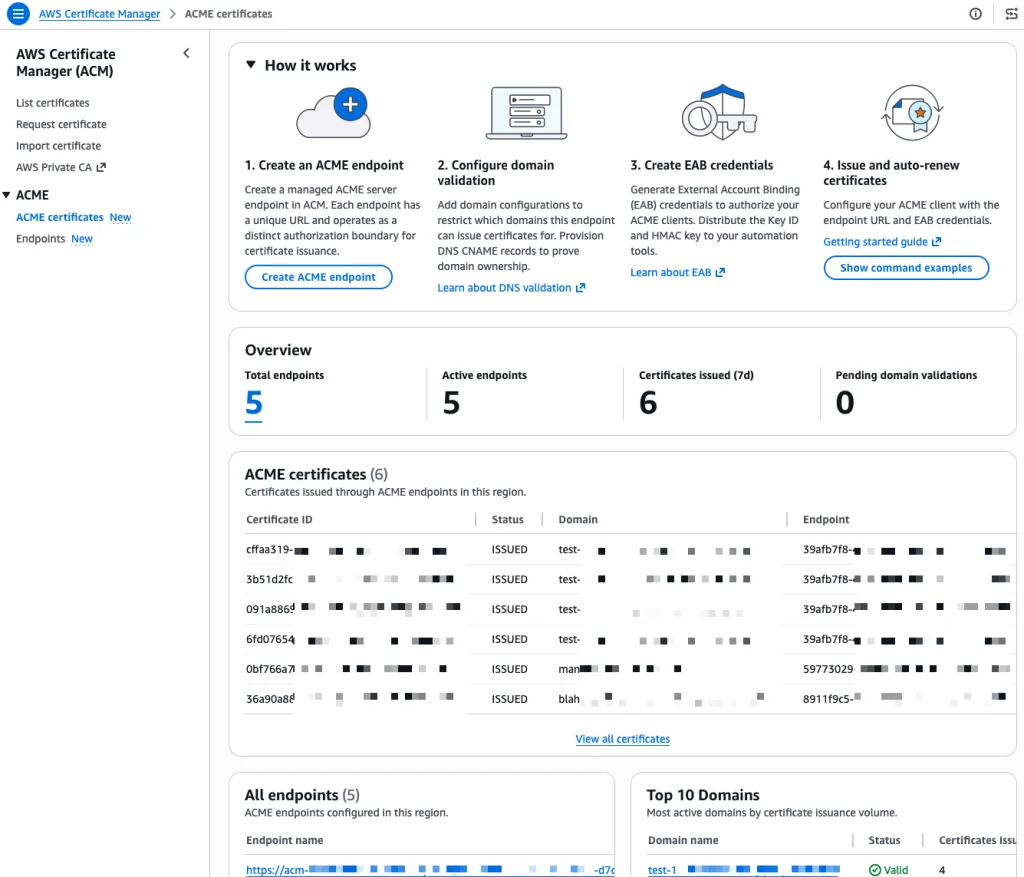
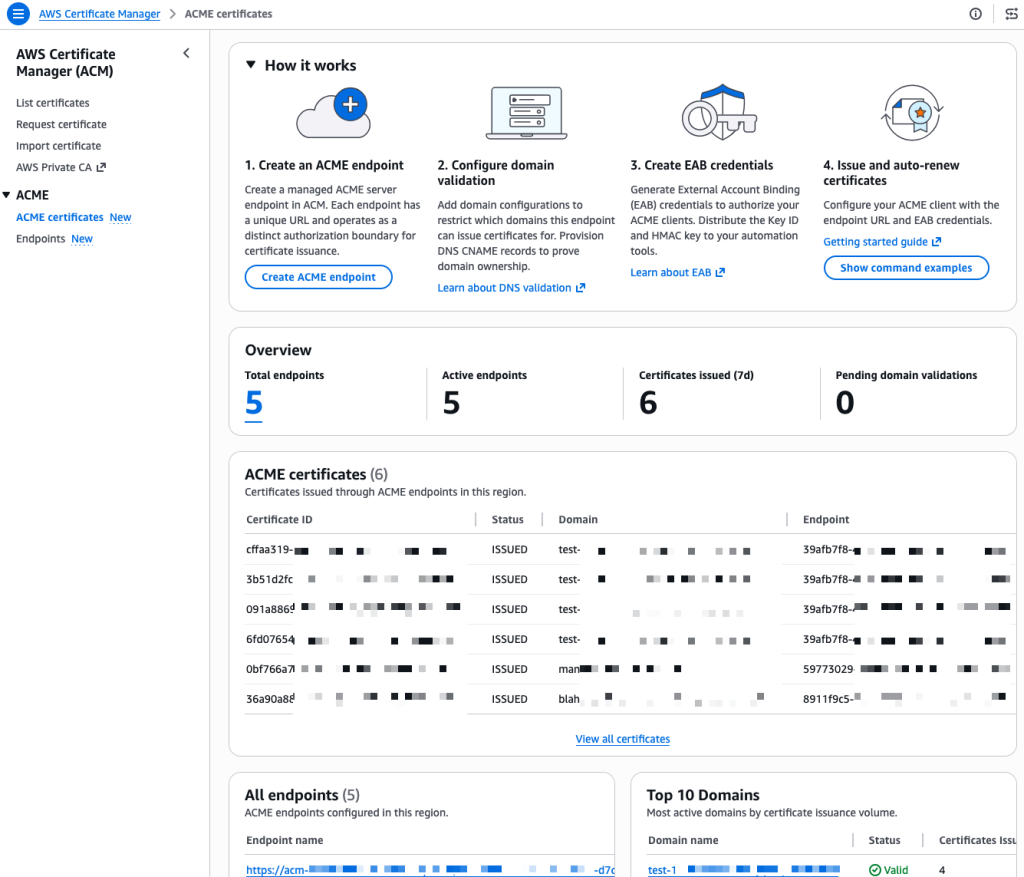
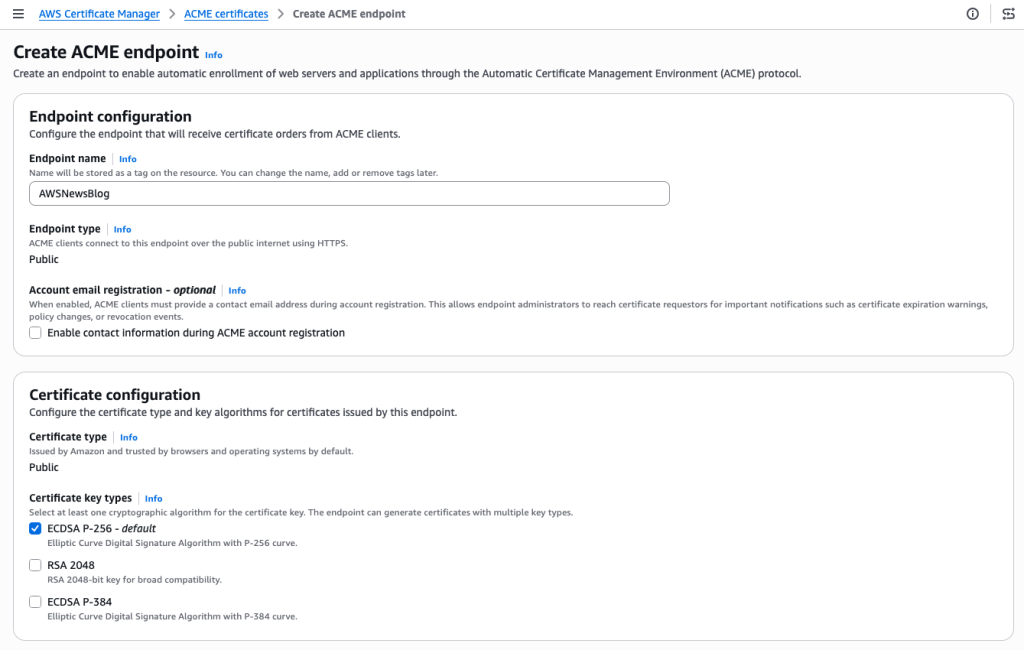
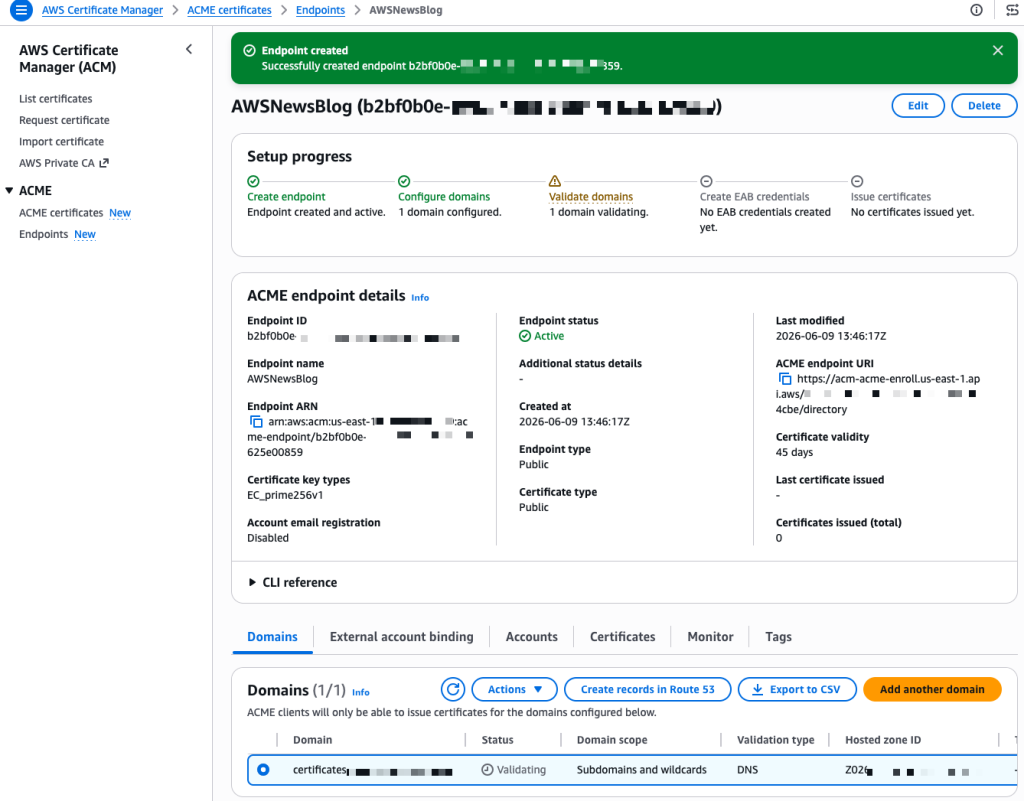
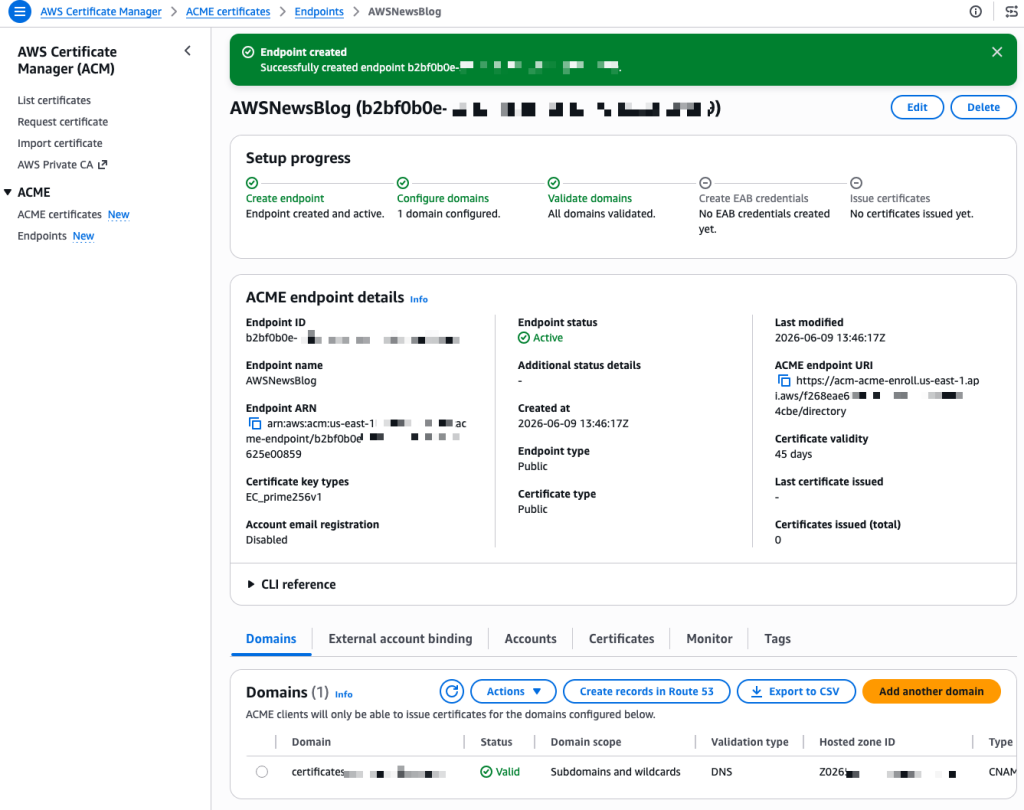
- Endpoint Creation: An administrator creates an ACME endpoint in the ACM console.
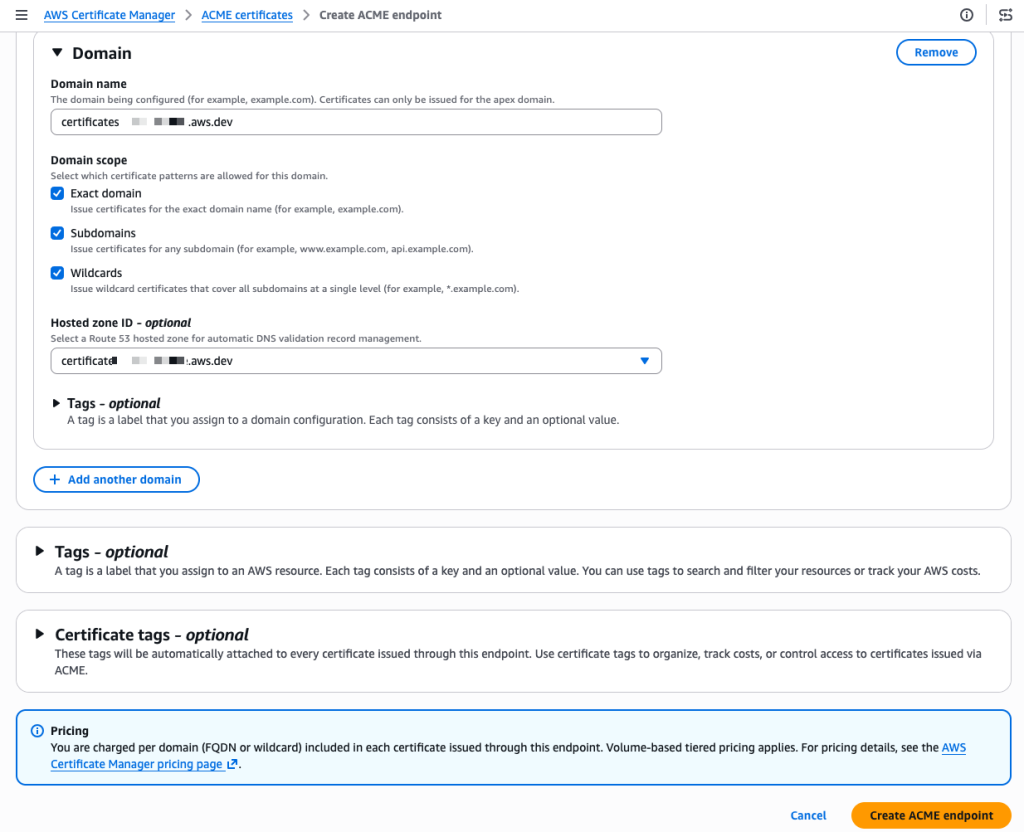
- Scope Definition: The administrator defines the domain scope, deciding whether the client can request certificates for specific domains, subdomains, or wildcards.
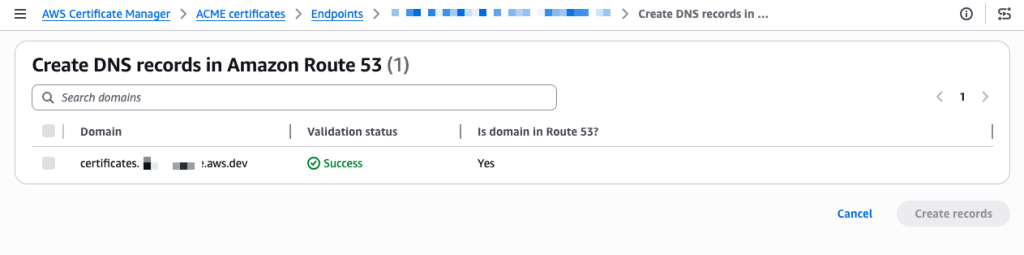
- DNS Verification: If using Amazon Route 53, ACM automates the creation of necessary CNAME records. If using an external DNS provider, the administrator creates a one-time CNAME record, decoupling DNS management from certificate request workflows.
- Client Configuration: The application-level ACME client (e.g., Certbot) uses the EAB credentials to request the certificate.
- Centralized Audit: Every request is logged in AWS CloudTrail and monitored via Amazon CloudWatch, ensuring total visibility for compliance teams.
Implications for the Enterprise
The move to native ACME support in ACM has profound implications for how organizations manage their digital footprint.
1. Enhanced Security Posture
By centralizing the issuance and validation process, security teams can now enforce consistent policies across the entire organization. If a security vulnerability is discovered, administrators can revoke and reissue certificates through the centralized ACM dashboard, regardless of whether the certificate was originally requested by a developer in a Kubernetes cluster or a legacy server on-premises.
2. Reduced Operational Overhead
The cost of "certificate blindness"—where teams lose track of expiring assets—is high. By removing the need for custom-built, brittle automation scripts, companies can reduce the engineering time spent on maintenance. The integration works with existing tools, meaning developers don’t have to overhaul their workflows to adopt a more secure standard.
3. Compliance and Auditability
For highly regulated industries, the "who, what, and when" of certificate issuance is a critical audit requirement. With the new integration, every certificate lifecycle event is automatically captured in AWS CloudTrail. This provides a single pane of glass for auditors, moving from a manual spreadsheet-based tracking system to an automated, cryptographically signed audit trail.
Official Perspective and Industry Response
In discussions surrounding the launch, AWS emphasized that this feature is a direct response to customer feedback regarding the complexity of certificate lifecycle management. "We wanted to provide a solution that didn’t require our customers to compromise on security or flexibility," stated an AWS representative during the initial briefing. "By embedding ACME into ACM, we are essentially making it ‘the’ way to handle certificates, regardless of the compute environment."
Industry analysts have noted that this move positions AWS as a leader in the broader trend of "Policy as Code" for security infrastructure. By allowing PKI administrators to define domain scopes and restrict wildcard issuance at the endpoint level, AWS is shifting the responsibility of compliance away from the application developer and into a hardened, managed service.
Supporting Data and Scaling Potential
The scalability of the system is designed to handle enterprise-level demand. Whether a company needs to issue five certificates or five thousand, the AWS infrastructure scales to meet the request volume.
- Pricing Structure: Pricing is based on the number of domains and the frequency of issuance, with volume tiers designed to encourage widespread adoption. This transparent pricing model replaces the opaque and often high costs associated with proprietary third-party certificate management platforms.
- Availability: As of the current release, the service is available in all commercial AWS regions. Future expansion into AWS GovCloud (US), China, and the AWS European Sovereign Cloud partitions will ensure that even the most security-sensitive and geographically restricted workloads can benefit from this automation.
Conclusion: The New Standard for Web Security
The integration of ACME into AWS Certificate Manager is not merely a feature update; it is a fundamental shift in how the cloud manages trust. As the industry moves toward 47-day certificate cycles, the era of manual, human-centric certificate management is effectively coming to an end.
By standardizing the process, AWS has empowered organizations to eliminate the risks associated with certificate expiration while simultaneously simplifying the lives of DevOps engineers. For the modern enterprise, this means less time spent "fighting fires" and more time focusing on the core business. As the digital world becomes more complex, these types of foundational, automated security tools will define the difference between resilient infrastructure and vulnerable systems.
Whether you are running a small startup or a massive global enterprise, the path forward is clear: automate your identity management, secure your endpoints, and leverage the power of the ACME protocol to keep your digital services trusted and available.