The "Undo" Button for Infrastructure: AWS Revolutionizes Kubernetes Stability with EKS Version Rollbacks
For nearly a decade, the Kubernetes community has operated under a single, daunting reality: upgrading the control plane is a "one-way door." Once a cluster is migrated to a newer version of Kubernetes, the path forward is fixed. There is no native, community-supported "undo" button. For enterprises managing hundreds of clusters—particularly those in highly regulated industries like finance, healthcare, and government—this technological constraint has historically necessitated months of preparation, agonizing "bake periods," and complex manual workarounds.
Today, Amazon Web Services (AWS) is fundamentally altering that landscape. The company has announced the general availability of Kubernetes version rollbacks for Amazon Elastic Kubernetes Service (EKS). This new capability provides cluster administrators with a seven-day window to reverse a version upgrade, effectively granting them a safety net that was previously nonexistent in the Kubernetes ecosystem.
Main Facts: Restoring Operational Confidence
The announcement, released via the official AWS News Blog, marks a significant departure from how Kubernetes infrastructure has been managed to date. Unlike experimental "emulated versions" discussed in KEP-4330, which keep clusters in a transitional state, the EKS rollback feature reverts the environment to a fully validated, production-proven version.
Key highlights of this feature include:
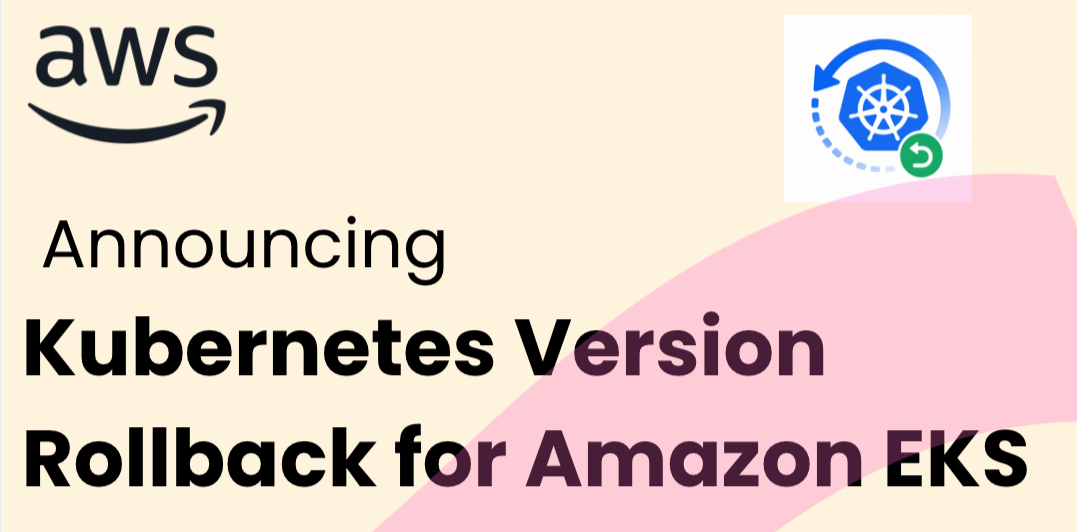
- A Seven-Day Window: Administrators can trigger a rollback within one week of an upgrade.
- True Reversion: The cluster returns to its exact previous state, not a simulation.
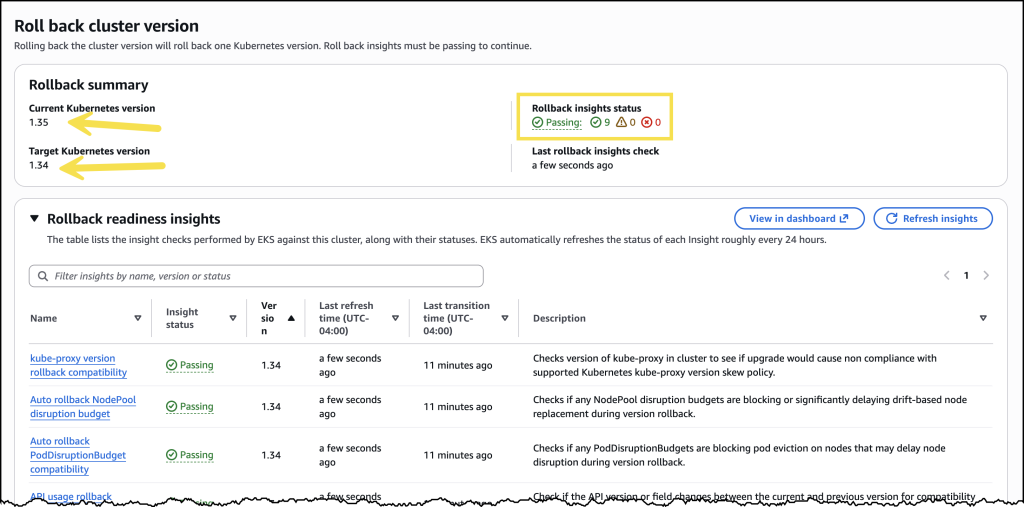
- Integrated Readiness Checks: Before a rollback begins, EKS utilizes "Cluster Insights" to analyze node compatibility and add-on dependencies, ensuring the process is safe.
- No Additional Cost: The feature is included as part of standard EKS pricing, with no surcharges for using the rollback capability.
- Full Coverage: The feature applies to all EKS clusters, including those utilizing self-managed nodes and those running on EKS Auto Mode.
Chronology: The Evolution of the "Upgrade Problem"
To understand the significance of this release, one must look at the evolution of Kubernetes management. When Kubernetes was first gaining traction, the pace of innovation was explosive, with the community pushing for rapid, frequent releases. However, the operational reality for SRE (Site Reliability Engineering) teams was far more conservative.
The "Stagnation Trap"
Because there was no path back, the risk of a "bricked" control plane during an upgrade was catastrophic. This led to a phenomenon known as "version stagnation." Organizations, paralyzed by the fear of post-upgrade incompatibility or breaking changes in APIs, would delay upgrades for as long as possible.
This delay created a secondary crisis: security vulnerability. Clusters left on older, unsupported versions became ticking time bombs, lacking critical security patches and eventually falling into extended support tiers that carry higher costs and higher risks.
The Path to Today
The conversation around rollback mechanisms began in earnest within the open-source community through KEP-4330 (Kubernetes Enhancement Proposal). While the community focused on the technical feasibility of emulated rollbacks, AWS took a different approach—focusing on the operational lifecycle of a production-grade cluster. By developing a mechanism that leverages the existing EKS orchestration layer, AWS has effectively bypassed the need for the community to solve this via core Kubernetes code, providing an immediate, enterprise-ready solution.

Supporting Data and Technical Implementation
The mechanism behind EKS rollbacks is designed to mirror the safety-first philosophy of the AWS cloud environment.
The EKS Auto Mode Integration
For customers utilizing EKS Auto Mode—AWS’s fully managed infrastructure offering—the rollback process is more comprehensive. Because EKS Auto Mode manages the compute, networking, and storage layers, a rollback is not just a control plane operation; it is a full stack reversion.
The process respects Pod Disruption Budgets (PDBs), which are critical for maintaining application uptime. If a rollback is initiated, EKS will not terminate pods in a way that violates defined availability requirements. AWS has also introduced a new "Cancel API," allowing administrators to halt a node rollback at any point if they determine that the process is taking too long or if business priorities shift during the reversion.
The Role of Cluster Insights
One of the most robust aspects of the new rollout is the proactive diagnostic layer. Before a user clicks "Rollback," EKS performs a pre-flight check. It scans the cluster for:
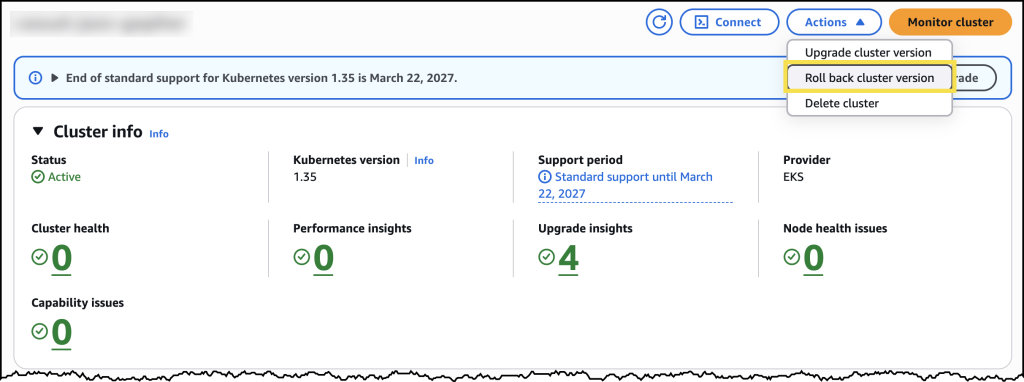
- Node Compatibility: Ensuring that the nodes can support the older version of the Kubernetes binary.
- Add-on Dependencies: Verifying that critical plugins (like VPC CNI, CoreDNS, or Kube-proxy) are compatible with the target version.
- Force Overrides: For teams with unique, highly customized environments, the
--forceflag is available for those who have performed their own manual verification, bypassing the automated safety gates.
Official Responses and Strategic Implications
"We are moving from a world where upgrades are a high-stress, ‘all-or-nothing’ event to a world where they are a manageable, reversible operational task," said an AWS spokesperson familiar with the rollout.
Industry analysts have noted that this move by AWS is a strategic play to solidify EKS as the premier destination for enterprise-grade Kubernetes. By removing the fear of the "one-way door," AWS is essentially encouraging faster adoption of newer Kubernetes versions.
Impact on Regulated Industries
For companies in the banking or healthcare sectors, where downtime is measured in thousands of dollars per second and compliance audits are frequent, the ability to "undo" a failed upgrade is a game changer. It transforms the upgrade process from a high-stakes, multi-month project into a routine, low-risk operational procedure. This is expected to significantly increase the frequency at which these enterprises perform updates, leading to a more secure and performant cloud ecosystem.
The Future of Kubernetes Management
The introduction of this feature may put pressure on other managed Kubernetes providers, such as Google Kubernetes Engine (GKE) and Azure Kubernetes Service (AKS), to offer similar, non-emulated rollback capabilities. While the open-source community continues to debate how to implement rollbacks at the core level, AWS has demonstrated that service providers can bridge the gap between "upstream" limitations and "downstream" customer requirements.
Implications for DevOps Teams: A New Paradigm
The shift toward reversible infrastructure has profound implications for DevOps culture.
- Reduction in "Bake Period" Overhead: Teams can now shorten their testing cycles. While rigorous testing remains a best practice, the "panic factor" is removed, allowing teams to move with greater velocity.
- Simplified Disaster Recovery: If an upgrade introduces a regression that only appears under specific load conditions, the seven-day window provides ample time to identify the issue and revert, rather than scrambling to patch the environment while the cluster is failing.
- Standardization: With a uniform rollback mechanism across all EKS clusters, organizations can standardize their upgrade playbooks, reducing the cognitive load on platform engineers.
Conclusion: The Finality of the "Undo"
The arrival of EKS version rollbacks signifies a maturation of cloud-native infrastructure. By providing a reliable, safe, and integrated way to reverse version upgrades, AWS has addressed one of the most persistent "pain points" in the Kubernetes community.
For the developer or platform administrator, the message is clear: infrastructure should be flexible. The ability to pivot when an upgrade fails is not just a safety feature; it is an essential component of modern, resilient software delivery. As teams begin to integrate this capability into their workflows, we can expect to see a marked improvement in the overall health of Kubernetes clusters globally—a win for security, stability, and the engineers tasked with keeping the digital world running.
To begin utilizing this feature, administrators are encouraged to review the updated Amazon EKS documentation and navigate to the EKS console, where the "Rollback" option is now available for all eligible clusters.