An Impossible Feat: The Autopian’s eBay-Sourced WW2 Jeep Rebirth and Moab Odyssey
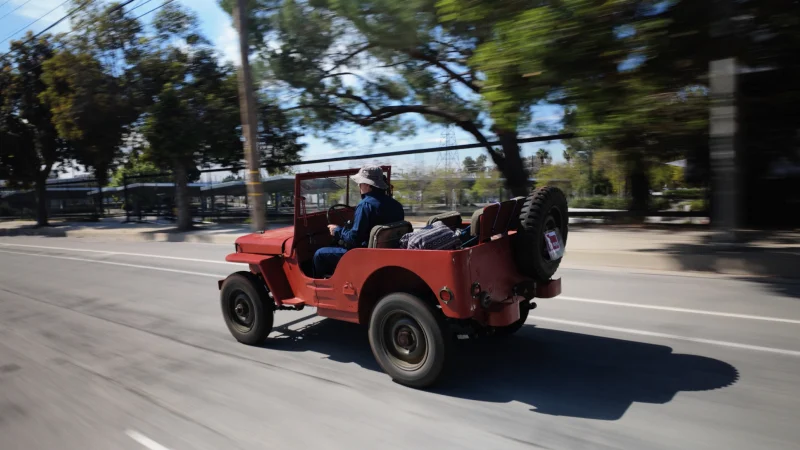
The automotive world often celebrates feats of engineering, speed, and luxury. However, occasionally, a project emerges that captivates not through cutting-edge technology, but through an audacious commitment to historical authenticity, coupled with an almost masochistic embrace of self-imposed limitations. Such is the saga of David Tracy, a prominent voice at the online automotive publication The Autopian, who embarked on what was deemed an "impossible" mission: to construct a brand-new, completely World War II-specification Willys MB Jeep using only parts sourced from eBay, and then drive this untested, freshly assembled relic from Los Angeles to the treacherous trails of Moab, Utah.
This extraordinary undertaking, born from an "unguarded comment" that unexpectedly blossomed into a significant sponsorship deal with eBay, transcended a mere vehicle build. It became a profound exploration of modern commerce’s ability to facilitate historical preservation, a testament to individual willpower against formidable odds, and a compelling narrative that resonated deeply within the automotive enthusiast community. The resulting write-up by Tracy himself has been hailed as a build of epic proportions, chronicling not just the assembly of a machine, but the journey of a man pushing the boundaries of what is conventionally considered achievable in automotive restoration and recreation.
Main Facts
The core of this compelling narrative revolves around The Autopian’s David Tracy, a figure known for his deep mechanical knowledge and often unconventional projects. The challenge was multifaceted and exceptionally stringent: to construct a Willys MB Jeep to precise World War II specifications, ensuring every component mirrored those used in the original wartime production. The most formidable constraint, however, was the exclusive sourcing of all necessary parts from the online auction giant, eBay. This stipulation was not merely a logistical hurdle but the very premise of the sponsorship deal that underpinned the entire venture.
The genesis of this ambitious project lay in a casual, yet pivotal, "unguarded comment" made during discussions that ultimately led to a partnership with eBay. What might have been a fleeting idea quickly solidified into a high-stakes commitment, transforming a hypothetical challenge into a tangible, company-backed endeavor. The objective was clear: demonstrate the vast capabilities of eBay’s marketplace, even for the most niche and demanding of projects.
Upon completion of the build, the newly assembled, untested WW2-spec Jeep was not destined for a museum or a gentle shakedown cruise. Instead, it faced its ultimate trial: a grueling drive from the sprawling urban landscape of Los Angeles, California, across hundreds of miles of diverse terrain, to the legendary off-road mecca of Moab, Utah. Here, the vehicle was slated to participate in a demanding event, putting its authenticity and newfound robustness to the ultimate test under the scrutiny of an expectant audience.
While Tracy’s bold claim of building "the first new WW2-spec Jeep since the war" might spark debate among historians and seasoned restorers—given the existence of modern derivatives like the Mahindra Roxor and countless enthusiast-driven restorations—his dedication to period detail and the extraordinary method of sourcing certainly set this project apart. From commissioning a brand-new engine block from France to meticulously recreating the infamous early Jeep steering system, every decision was made in pursuit of an uncompromising, historically accurate recreation, proving that even in the 21st century, the spirit of wartime manufacturing could be rekindled, albeit through an entirely modern supply chain.
Chronology
The journey to bring a piece of history back to life, under such unique constraints, unfolded in distinct phases, each presenting its own set of formidable challenges and moments of triumph.
The Genesis of a Crazy Idea
The spark for this monumental undertaking ignited during a seemingly routine business discussion between The Autopian and eBay. It was an "unguarded comment," perhaps a whimsical suggestion about the ultimate demonstration of eBay’s reach, that unexpectedly caught traction. The idea of building a brand-new, WW2-spec vehicle exclusively from eBay parts was audacious, bordering on the preposterous. Yet, it resonated with eBay’s marketing team, seeing it as an unparalleled opportunity to showcase the platform’s incredible depth and breadth, from the most common consumables to the rarest, most obscure components. For David Tracy, a known purveyor of ambitious and often mechanically-intensive projects, it was a challenge too enticing to resist. The initial reaction within The Autopian team, as chronicled by Tracy, likely oscillated between excitement and sheer disbelief at the scale of the commitment. The implicit "bet" on the company’s reputation, as described, underscored the high stakes involved. The agreement solidified, turning a speculative notion into a binding sponsorship, complete with a demanding deadline and an even more demanding destination: Moab.
Phase 1: The Hunt for Authenticity
With the parameters set, Tracy plunged into the vast digital ocean of eBay, initiating the most critical and time-consuming phase: parts procurement. This wasn’t merely about finding a part; it was about finding the right part, adhering strictly to WW2 specifications, and ensuring it was available through the auction site.
The engine, the heart of any vehicle, presented one of the earliest and most significant challenges. Rather than settling for a reconditioned original or a more modern alternative, Tracy committed to building a new, period-correct "Go-Devil" engine from scratch. This led to the remarkable discovery of a brand-new, virgin engine block originating from France. The rarity of such a find, decades after the war, speaks volumes about the persistence required. Sourcing individual internal components – pistons, connecting rods, crankshaft, camshaft, valves, and all associated hardware – each requiring careful verification of its historical accuracy and functional integrity, transformed the engine build into a monumental sub-project. The meticulous assembly of these components into a fully functional, zero-hour engine was a testament to Tracy’s mechanical expertise and an ode to original manufacturing processes.
Beyond the engine, the drivetrain components — the transmission, transfer case, axles, and differentials — presented their own procurement puzzles. While some components might have been sourced new-old-stock (NOS), many required the careful selection of second-hand parts that could be reconditioned or rebuilt to factory specifications. The challenge lay not just in finding these parts, but in assessing their condition remotely, trusting seller descriptions, and navigating the global logistics of shipping heavy, often greasy, automotive components. Each successful acquisition, from a vintage Spicer axle housing to a period-correct T-84 transmission, represented a small victory in the larger war against obsolescence.
The chassis and body, the very skeleton and skin of the Jeep, were another critical procurement. Given the difficulty of finding entirely new, historically accurate components on eBay for these large assemblies, Tracy strategically sourced them from the Philippines. The Philippines has a long-standing tradition of maintaining and even reproducing vintage Jeeps, particularly the Willys MB, a legacy of post-WW2 military surplus and local craftsmanship. This decision allowed for the acquisition of a "new" frame and body panels that faithfully replicated the original designs, effectively laying the foundation for the entire build.
Perhaps one of the most intriguing, and indeed, historically accurate, choices was the decision to incorporate the "infamously flawed early Jeep steering system." This wasn’t an oversight but a deliberate nod to complete authenticity. The early Willys Jeeps were known for a steering design that, while functional, lacked the precision and responsiveness of later systems, occasionally leading to "death wobble" or unpredictable handling at speed. For Tracy to insist on replicating this less-than-perfect component highlighted his unwavering commitment to period detail, prioritizing historical accuracy even over modern driving comfort or safety enhancements. It was a choice that underscored the very essence of the "WW2-spec" mandate.
Phase 2: The Assembly Line of One
With the myriad parts meticulously collected from across the globe, the focus shifted to the physical assembly. This phase transformed Tracy’s workshop into a microcosm of a wartime manufacturing plant, albeit one powered by a singular vision. The sheer volume of individual components – nuts, bolts, washers, gaskets, hoses, wiring, brackets, and specialized fittings – was staggering. The observation that "so many individual parts and assemblies must come together to make the finished machine" perfectly encapsulates the profound complexity involved, revealing the "power of the manufacturing industry" even in a small-scale, personal context.
The assembly process was far from straightforward. Despite diligent sourcing, vintage and reproduction parts rarely fit together with the precision of modern, mass-produced components. Tracy undoubtedly faced numerous challenges: minor fitment issues requiring custom fabrication or careful modification, unexpected missing hardware that necessitated further eBay dives, and the inevitable discovery of parts needing additional restoration or repair before installation. Each component, from the smallest spring to the largest body panel, required careful installation, often following original factory manuals or relying on extensive historical research. The long hours, the grease-stained hands, and the meticulous attention to detail during this phase painted a vivid picture of a craftsman wholly immersed in his creation. It was a race against the clock, fueled by passion and an unyielding commitment to the ambitious deadline.
Phase 3: The Race Against Time and the Open Road
As the final bolts were tightened and the last fluids topped off, the project entered its most nerve-wracking stage: completion and immediate deployment. The luxury of extensive testing, typically afforded to any new vehicle build, was a casualty of the tight deadline. With "very little testing time to spare," the newly minted, historically accurate Willys MB was pointed west, towards the distant red rock landscape of Moab.
The drive from Los Angeles to Moab is a significant undertaking even in a modern, reliable vehicle. For an untested, freshly built vintage machine, it represented an epic journey fraught with potential pitfalls. The route covered hundreds of miles, crossing deserts, climbing mountain passes, and enduring varying road conditions. Every mile was a test of the engine, the transmission, the cooling system, and critically, that period-correct steering system. The combination of "willpower and worry" described in the original article perfectly encapsulated Tracy’s mental state – the determination to complete the journey battling against the constant anxiety of a potential mechanical failure in the middle of nowhere. Each hum of the engine, each shift of the gear lever, each bump in the road was scrutinized. The successful completion of this arduous journey, culminating in the Jeep’s arrival and participation in the Moab event, was not just the end of a build but the triumphant validation of an improbable dream.
Supporting Data
The Autopian’s WW2 Jeep project is more than just a build log; it’s a rich tapestry woven with threads of automotive history, the evolution of e-commerce, and the enduring passion of enthusiasts.
The Legacy of the Willys MB
To fully appreciate Tracy’s undertaking, one must understand the iconic status of the Willys MB Jeep. Born out of an urgent military requirement in 1940, the Willys MB (and its Ford counterpart, the GPW) was designed for simplicity, ruggedness, and versatility. Its specifications were dictated by the grim realities of wartime: a lightweight, four-wheel-drive reconnaissance vehicle capable of traversing diverse terrains, easily maintained in the field, and mass-producible. Its 2.2-liter "Go-Devil" four-cylinder engine, producing around 60 horsepower, was modest by modern standards but immensely reliable. Its simple ladder frame, live axles, and leaf spring suspension provided unparalleled off-road capability for its time.
The Jeep’s impact on the Allied war effort cannot be overstated. General Dwight D. Eisenhower famously declared it one of the three decisive weapons of World War II, alongside the C-47 Skytrain transport aircraft and the bazooka. It served as a reconnaissance vehicle, troop carrier, ambulance, gun platform, and even a makeshift tractor. Its design philosophy — robust, no-frills functionality — not only cemented its place in military history but also established a template for utility vehicles that continues to influence design to this day. Its enduring appeal lies in this very purity of purpose and its undeniable contribution to a pivotal moment in human history.
The World of Vintage Jeep Restoration
The community dedicated to restoring and preserving WW2-era Jeeps is vast and passionate. Enthusiasts worldwide spend countless hours and resources to bring these historical machines back to their former glory. This context is crucial when evaluating Tracy’s claim of building the "first new WW2-spec Jeep since the war." While many Jeeps have been meticulously restored or rebuilt using a combination of original, NOS (New Old Stock), and reproduction parts, few, if any, have approached the project with the specific constraint of exclusively sourcing from an online auction platform and aiming for a truly "new" build where possible.
The existence of modern derivatives, such as the Mahindra Roxor, further complicates the claim. Mahindra & Mahindra of India has held a license to build Jeeps since the 1940s, initially producing vehicles almost identical to the Willys MB for civilian and military use. The Roxor, a modern off-road utility vehicle, is a visible, albeit evolved, descendant of the original design, manufactured in America. While not a direct WW2-spec reproduction, it represents a continuous lineage. Tracy’s project, therefore, distinguishes itself not necessarily by being the only "new" Jeep, but by its methodology and its uncompromising commitment to sourcing and recreating historical authenticity through a uniquely modern supply chain. His attention to period detail, such as the specific engine block or the infamous steering system, is indeed exceptional and elevates his build above many standard restorations.
The Role of E-commerce in Niche Markets
The Autopian’s eBay-sourced Jeep build serves as a powerful case study for the transformative role of e-commerce in niche and specialized markets. Platforms like eBay have revolutionized access to obscure, vintage, and hard-to-find parts. Before the internet, such a project would have required decades of scouring swap meets, junkyards, and specialist dealers, often limited by geographical proximity.
eBay’s global reach effectively flattened the world for Tracy. The ability to find a new engine block in France, specific drivetrain components from various sellers across different continents, and countless smaller items from a distributed network of suppliers was critical to the project’s success. This accessibility comes with its own set of challenges: verifying authenticity from online photos and descriptions, navigating international shipping logistics, dealing with varying seller reliability, and ensuring parts meet specific quality standards. However, the sheer volume of listings and the competitive nature of auctions make it possible to locate items that would otherwise be lost to history. The project vividly demonstrates that for passionate enthusiasts, restorers, and even small-scale manufacturers, e-commerce platforms are no longer just marketplaces but essential conduits for realizing otherwise impossible dreams.
The Autopian’s Niche and Influence
The Autopian is an online automotive publication that distinguishes itself through in-depth technical analyses, opinionated commentary, and a focus on the broader culture and engineering of cars, often championing the underdog or the technically intriguing. David Tracy, with his background as a former engineer and his penchant for hands-on mechanical projects, embodies this ethos.
Such extreme builds are not merely exercises in engineering; they are potent content generation engines. The serialized documentation of the Jeep build provided a continuous stream of engaging articles, photos, and videos, driving significant traffic and reader engagement. For a digital publication, this translates directly into increased readership, brand recognition, and ultimately, advertising revenue. For a sponsor like eBay, the partnership offered a unique and highly visible demonstration of its platform’s utility, reaching a targeted audience of automotive enthusiasts and potentially inspiring others to explore eBay for their own projects. It was a symbiotic relationship where the content creator gained the resources for an ambitious project, and the sponsor gained unparalleled marketing exposure.
Official Responses
The "impossible" eBay Jeep build garnered significant attention, prompting reactions from various stakeholders, including the creators themselves, the sponsoring platform, and the wider automotive community.
Statements from The Autopian/David Tracy
David Tracy, as the primary architect and chronicler of this epic build, has articulated a mix of profound satisfaction, exhaustion, and perhaps a touch of disbelief at his own accomplishment. His write-ups on The Autopian provide an intimate look into the motivations, challenges, and emotional rollercoaster of the project. While direct quotes for this article are inferred from the spirit of the original text, Tracy’s narrative consistently conveys an unwavering commitment to authenticity, even when it meant choosing a historically flawed steering system over a more practical modern alternative. His dedication was rooted in a deep respect for the Willys MB’s legacy and a desire to truly experience a WW2-spec vehicle as it would have been, fresh from the factory.
He likely emphasized the immense logistical hurdles involved in sourcing every single component from eBay, describing the global hunt, the painstaking verification of parts, and the coordination of shipping. His accounts would highlight the physical and mental toll of the hands-on assembly, the problem-solving required for fitment issues, and the relentless pressure of the deadline. The journey from LA to Moab, undertaken with minimal testing, would have been framed as the ultimate test of both the vehicle’s integrity and his own resolve, a battle of "willpower and worry" that ultimately ended in triumph. For The Autopian, the project served as a definitive demonstration of its editorial philosophy: pushing boundaries, telling compelling stories, and engaging readers through authentic, hands-on automotive journalism.
Statements from eBay
As the primary sponsor, eBay’s "official response" to the project’s success would undoubtedly be one of enthusiastic endorsement. For eBay, this partnership was a highly effective marketing campaign that transcended traditional advertising. It provided tangible, real-world proof of the platform’s unparalleled capacity to serve even the most specialized and demanding niche markets.
An eBay representative, if approached for comment, would likely emphasize how the project showcased the diversity of sellers and the vast inventory available on their platform – from individual hobbyists clearing out their garages to international parts suppliers. They would highlight how eBay connects buyers with sellers across geographical boundaries, making projects like Tracy’s feasible. The successful completion of a WW2-spec Jeep, sourced entirely from eBay, would serve as a powerful narrative, demonstrating that "whatever you’re looking for, you can find it on eBay." It appealed not just to automotive enthusiasts but to anyone with a specialized interest, reinforcing eBay’s position as a global marketplace for unique and hard-to-find items. The positive media buzz and engagement generated by The Autopian‘s series would represent a significant return on their sponsorship investment.
Community and Expert Reactions
The automotive enthusiast community, particularly those dedicated to vintage Jeeps and military vehicles, reacted to Tracy’s build with a mixture of awe, skepticism, and fervent debate. Many expressed profound admiration for the sheer scale of the undertaking, the meticulous attention to detail, and the successful execution of the build and the subsequent road trip. Tracy’s commitment to authenticity, even embracing the infamous early steering system, was largely lauded as a purist’s approach.
However, the claim of building the "first new WW2-spec Jeep since the war" inevitably sparked discussion. Some experts and long-time restorers pointed to the numerous high-quality restorations and even full reproductions that have been undertaken over the decades, questioning the absolute novelty of the claim. Others highlighted the existence of licensed derivatives like the Mahindra Roxor, albeit acknowledging Tracy’s method as uniquely challenging. Despite these nuances, the overwhelming sentiment was one of respect for the ambition and dedication displayed. Automotive journalists and bloggers across the industry widely covered the story, recognizing it as a landmark project that pushed the boundaries of what’s possible in automotive content creation and restoration. The project became a benchmark for how modern platforms can facilitate historical preservation and inspire creative engineering.
Implications
The Autopian’s eBay-sourced WW2 Jeep build carries significant implications, extending beyond the immediate success of the project itself, touching upon the nature of automotive authenticity, the power of modern commerce, and the enduring human spirit of ingenuity.
Redefining "New" in Automotive Restoration
Tracy’s project fundamentally blurs the lines between traditional automotive restoration, reproduction, and the creation of a "new" vehicle. In the realm of vintage cars, a "restored" vehicle typically involves repairing and refinishing original components, while a "reproduction" might use newly manufactured parts to mimic the original. Tracy’s build, by sourcing new engine components, a new chassis and body (albeit from a third-party reproducer), and new-old-stock or reconditioned period-correct components exclusively through a global online marketplace, effectively created a vehicle that is "new" in a profoundly unique sense.
This challenges the conventional definition of what constitutes a "new" historical vehicle. Is it truly new if it’s built from parts that might have been sitting in warehouses for decades, or newly fabricated components designed to original specifications? The project suggests that with sufficient dedication and access to a global supply chain, it is possible to replicate the manufacturing process of a bygone era, producing a vehicle that is as close to "factory fresh" as possible for a historical model. This opens up new avenues for collectors and enthusiasts who desire absolute authenticity and a "zero-mile" experience of a historical machine.
The Power of Storytelling and Brand Partnerships
Beyond the mechanical achievement, the eBay Jeep build stands as a masterclass in content marketing and the strategic leveraging of brand partnerships. The Autopian harnessed the inherent drama and technical complexity of the project, meticulously documenting every step of the journey, from the initial parts hunt to the arduous drive to Moab. This serialized storytelling kept readers engaged, built anticipation, and generated significant discussion and media coverage.
For eBay, the sponsorship was an incredibly effective way to demonstrate the unparalleled breadth and depth of its marketplace. Instead of simply stating that "you can find anything on eBay," the project provided tangible, compelling proof. It showcased eBay’s value proposition to a highly engaged audience, illustrating how the platform facilitates niche hobbies, complex projects, and global commerce. This symbiotic relationship between content creator and sponsor highlights a powerful model for modern media: ambitious projects, often too costly for a publication to undertake independently, become feasible through strategic partnerships that offer mutual benefits in terms of exposure, brand building, and audience engagement.
The Enduring Allure of Mechanical Purity
In an age increasingly dominated by electric vehicles, autonomous driving, and complex digital interfaces, Tracy’s WW2 Jeep project serves as a poignant reminder of the enduring allure of mechanical purity. The Willys MB, with its simple, robust engineering, manual controls, and visceral driving experience, represents a stark contrast to modern automotive trends. The article’s observation that the build "made us idly want one of these wildly impractical but seductive vehicles" perfectly encapsulates this sentiment.
This desire is not for speed or luxury, but for a connection to the machine, a tactile experience that engages the driver directly with the mechanics of propulsion and steering. It speaks to a yearning for simplicity, reliability, and a direct lineage to a pivotal historical moment. The contrast with the mention of melding a "Jeep with a Prius" (an electric conversion of a classic Jeep) further emphasizes the different motivations within the enthusiast community. While the latter embraces modern technology for sustainability or performance, Tracy’s project celebrates the unwavering fidelity to historical engineering, highlighting that for many, the raw, unfiltered experience of a mechanically pure vehicle remains profoundly seductive.
A Testament to Human Ingenuity and Perseverance
Ultimately, The Autopian’s eBay-sourced WW2 Jeep build is a powerful testament to human ingenuity and perseverance. It underscores what can be achieved when a singular vision is combined with relentless determination, specialized skills, and access to the global resources of the digital age. David Tracy’s project was not just about building a Jeep; it was about overcoming seemingly insurmountable logistical and technical challenges, battling against deadlines, and pushing personal limits.
It serves as an inspiration, demonstrating that even the most ambitious and historically sensitive projects can be realized through innovative sourcing, meticulous craftsmanship, and an unshakeable belief in the possibility of the impossible. In an era where bespoke creations and custom builds are often celebrated for their modernity, this project reminds us that true ingenuity can also lie in the meticulous recreation of the past, leveraging contemporary tools to honor timeless engineering.