Securing the Digital Frontier: A Comprehensive Evaluation of Acunetix Web Vulnerability Scanner (WVS)
Introduction: The Evolving Landscape of Web Application Security
In the contemporary digital economy, websites and web applications have evolved far beyond simple digital brochures; they are now the foundational infrastructure for enterprise operations, e-commerce, and customer data management. However, as the digital surface area expands, malicious actors have intensified their campaigns to exploit vulnerabilities at the application layer. SQL Injection (SQLi), Cross-Site Scripting (XSS), and the broader OWASP Top 10 vulnerabilities represent persistent, high-stakes threats to organizational integrity and data confidentiality.

To combat these evolving cyber threats, automated website vulnerability scanning has transitioned from an optional best practice to a mandatory component of the complete Software Testing Life Cycle (STLC). Among the tools engineered to address this challenge, the Acunetix Web Vulnerability Scanner (WVS) remains a notable standard for web application security auditing. This comprehensive review examines the architecture, practical utility, advanced features, and reporting mechanisms of Acunetix WVS.

Main Facts: Core Capabilities and Black-Box Architecture
Acunetix WVS is an automated web application security testing solution designed to audit website security by simulating real-world cyberattacks. Operating primarily as a black-box scanner, Acunetix WVS assesses websites and web applications without requiring prior knowledge of their internal source code or architecture—mirroring the exact methodology employed by external hackers.

Key Functional Highlights:
- Vulnerability Coverage: Specialized in detecting SQL Injection, Cross-Site Scripting (XSS), and the full spectrum of OWASP Top 10 vulnerabilities.
- Technology Agnostic: Capable of scanning any web application accessible via HTTP or HTTPS, irrespective of the underlying programming language or framework (including PHP, ASP.NET, Ruby on Rails, and Java frameworks, alongside Content Management Systems like WordPress).
- DeepScan Engine: Integrates a fully functional headless browser to parse, execute, and interact with complex HTML5, AJAX, and JavaScript-heavy applications, enabling precise detection of DOM-based XSS.
- Interactive Application Security Testing (IAST): Through the optional server-side component AcuSensor, the tool bridges the gap between black-box and white-box testing, identifying exact lines of vulnerable code.
Chronology: Step-by-Step Execution of an Acunetix WVS Security Audit
Conducting an assessment with Acunetix WVS follows a structured workflow designed to maximize scanning efficiency while providing deep analytical insights.

1. Initiating the Scan Wizard
The scanning process begins with the Scan Wizard, accessible via the main toolbar. Users specify the target URL—such as test environments provided by Acunetix (e.g., http://testphp.vulnweb.com)—and configure foundational parameters.

2. Selecting Scanning Profiles and Optimizations
Acunetix WVS utilizes Scanning Profiles to group tests logically. While the "Default" profile executes all available checks, users can customize profiles to target high-risk vulnerabilities exclusively. Furthermore, the scanner automatically fingerprints the target technology stack (e.g., identifying a PHP application to bypass irrelevant ASP.NET checks), thereby optimizing scan duration.

3. Navigating Password-Protected Areas
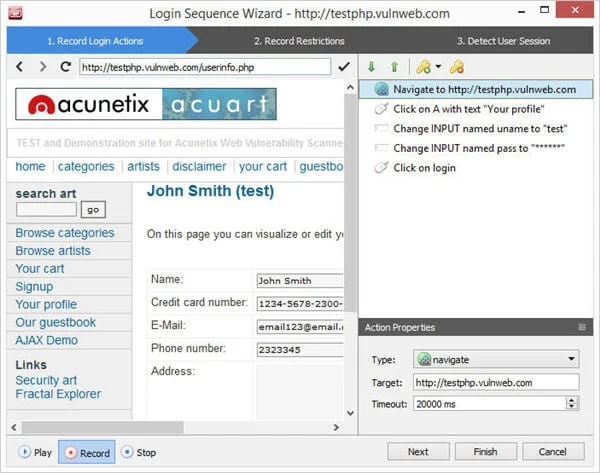
Scanning authenticated sections of a website traditionally presents bottlenecks for automated tools. Acunetix resolves this via the Login Sequence Recorder. Administrators record a standard login session, which the scanner replays during execution.

- Session Patterns: The recorder automatically detects unique indicators distinguishing logged-in states from logged-out states.
- Link Restrictions: Users can exclude specific endpoints—such as "Logout" buttons or single-use token links (nonces)—to ensure the scanner does not inadvertently terminate its own session.
4. Analysis, Results, and Retesting
Upon completion of the crawl and scan phases, Acunetix generates a detailed breakdown of identified high-severity vulnerabilities. For each finding, the tool outlines vulnerable input parameters, attack variations, potential business impact, and remediation steps.

Rather than restarting a full scan post-patching, security teams utilize the Retest feature. By right-clicking an alert and initiating a targeted retest, the scanner re-evaluates the specific vector, marking resolved vulnerabilities in a grey, strike-through font.

Supporting Data: Advanced Engines and Out-of-Band Detection
Acunetix WVS distinguishes itself from traditional scanners through advanced auxiliary engines that solve common limitations in automated web testing.

The DeepScan Engine for Modern Web Apps
Modern web applications rely heavily on client-side JavaScript, single-page application (SPA) frameworks, and asynchronous data loading (AJAX). Traditional crawlers frequently fail to map these applications accurately. The DeepScan Engine overcomes this by embedding a headless browser directly into the crawling mechanism. This allows Acunetix to render DOM structures, execute client-side scripts, and trace DOM-based XSS payloads through a comprehensive stack trace.

AcuSensor (IAST)
While black-box scanners observe applications strictly from the outside, they cannot always verify internal code behavior. Conversely, static source code analysis tools struggle to evaluate runtime execution. AcuSensor merges these methodologies via Interactive Application Security Testing (IAST). Installed on the server-side for PHP or .NET applications, AcuSensor communicates directly with the scanner to pinpoint exact files and lines of vulnerable code—particularly in complex areas like INSERT-statement SQL injections—without requiring code recompilation for .NET DLLs.

AcuMonitor for Second-Order Vulnerabilities
Certain vulnerabilities do not manifest immediate responses during testing. Known as "second-order" vulnerabilities, these include Blind XSS, XML External Entity Injection (XXE), Server-Side Request Forgery (SSRF), Host Header Attacks, and Out-of-Band SQL Injection. Acunetix addresses this through AcuMonitor, a background intermediary service controlled by the scanner that automatically captures and reports out-of-band communications, making complex vulnerability detection transparent to the user.

Official Responses and Reporting Mechanisms
Effective communication of security posture is vital for both technical developers and executive leadership. Acunetix WVS features a dedicated Reporter module capable of producing diverse, highly configurable documentation.

Report Categories:
- High-Level Executive Summaries: Designed for management stakeholders, offering concise overviews via Affected Items, Executive Summaries, and Quick Reports.
- Compliance Reporting: Automated documentation mapped directly to major regulatory and industry standards, including the OWASP Top 10, PCI-DSS, and HIPAA. These reports are periodically updated to reflect evolving compliance criteria.
- Developer Reports: Highly granular documents providing engineers with precise technical data, remediation guidelines, and external reference URLs. Reports can be exported seamlessly into PDF, HTML, and other standard formats.
Implications for Enterprise Security and Software Development
The integration of Acunetix WVS into enterprise software testing workflows carries profound implications for organizational security posture:

- Shift-Left Security: By incorporating automated vulnerability scanning and IAST tools (AcuSensor) earlier in the STLC, development teams can identify and remediate critical flaws before code reaches production, drastically reducing remediation costs.
- Streamlined Compliance: Automated mapping to regulatory frameworks like PCI-DSS and HIPAA simplifies the audit preparation process, ensuring organizations maintain continuous alignment with statutory requirements.
- Bridging the Skill Gap: Detailed remediation advice, exact code-line identification, and intuitive wizards lower the barrier to entry for junior developers and QA engineers, fostering a security-first culture across cross-functional technology teams.
Conclusion
Acunetix Web Vulnerability Scanner represents a robust, mature, and feature-rich solution for modern web application security audits. By combining a powerful black-box engine with advanced technologies like DeepScan, AcuSensor, and AcuMonitor, it delivers the depth of manual penetration testing at the speed of automation. Whether deployed online via Acunetix OVS or on-premise, the tool provides security professionals and developers with the actionable intelligence required to safeguard critical web assets against increasingly sophisticated cyber threats.