Developer Launches "Ticketpane" VS Code Extension to Fix Persistent Jira Authentication Woes
ALBUQUERQUE, N.M. — For software engineers working in modern enterprise environments, the context switch between writing code and tracking issue statuses has long been a minor tax on productivity. Keeping a browser tab pinned to Jira just to check ticket numbers, verify reproduction steps, or update a status is a daily ritual for millions of developers.
While official and community solutions have existed for years to bridge the gap between text editors and issue tracking systems, friction remains high. Entering the fray to solve this precise annoyance is developer Geary Works, a one-person indie software shop based in New Mexico, which has officially launched Ticketpane—a streamlined, sidebar-native Jira Cloud client built for VS Code, Cursor, and Windsurf.
Positioned as an antidote to bloated integrations and recurrent login prompts, Ticketpane’s defining feature is deceptively simple: it refuses to log users out.
Main Facts: What is Ticketpane?
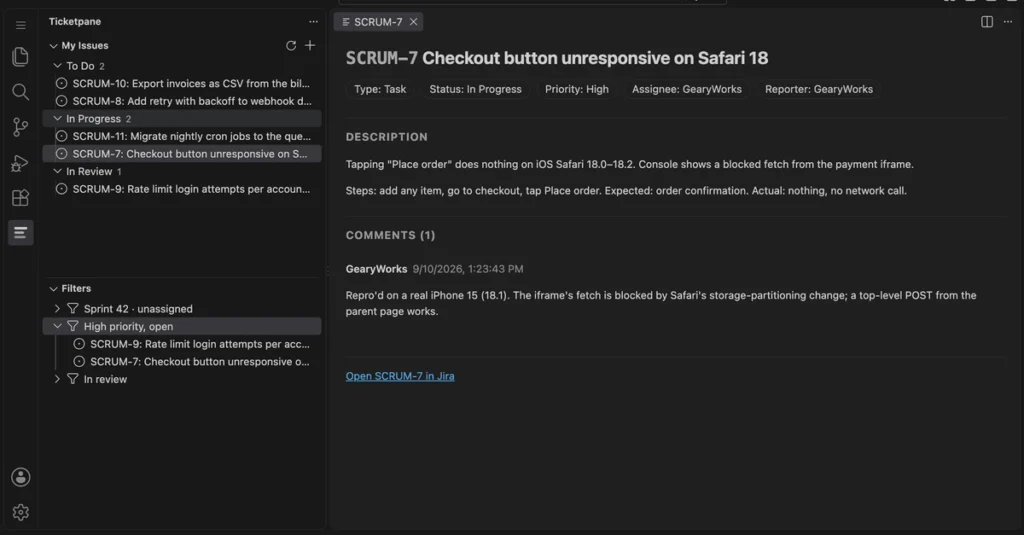
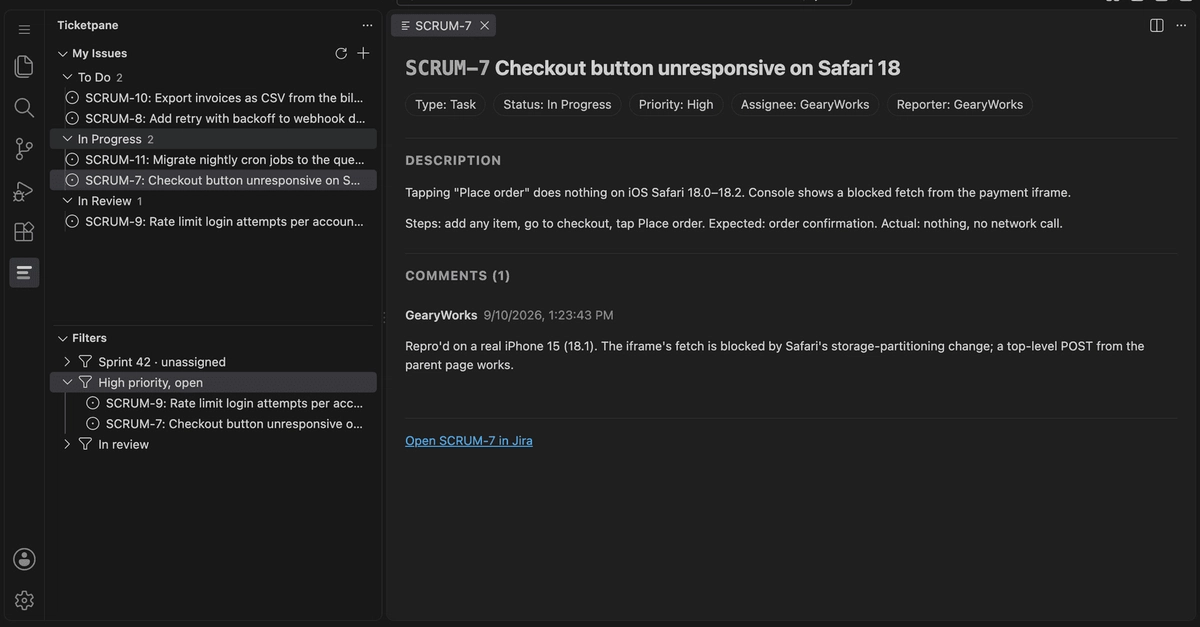
Ticketpane is a lightweight extension designed to live natively within the sidebars of popular developer environments, including Visual Studio Code, Cursor, and Windsurf. Rather than attempting to replicate the entire, sprawling web UI of Atlassian Jira, Ticketpane focuses intensely on the core daily workflows of developers: viewing assigned issues, tracking statuses, reading and writing comments, and inspecting reproduction steps without ever leaving the code editor.

The extension operates on a local-first architecture. Bypassing the complex, often fragile OAuth authorization flows that plague alternative tools, Ticketpane relies on a straightforward Atlassian API token input. Users generate a classic or scoped token via Atlassian, paste it into the extension once, and let the software handle the rest.
Crucially, Ticketpane utilizes the host editor’s built-in, encrypted secret storage system. This ensures that user credentials survive IDE restarts, the opening of new project directories, and multi-window workflows. Furthermore, because the extension does not route data through a proprietary intermediary backend, all credentials, comments, and issue data travel directly from the user’s editor to Atlassian’s servers and nowhere else.
Chronology: The Broken Bridge Between Editors and Issue Trackers
The friction of integrating Jira into developer toolchains is not a new problem. For years, Atlassian has maintained an official VS Code extension aimed at bridging the gap between code repositories and issue tracking. However, developer adoption has been mixed, and user sentiment in developer communities has steadily eroded due to reliability concerns.
- The Status Quo: Historically, developers relied heavily on browser-based workflows, constantly alt-tabbing between codebases and Jira dashboards.
- The Official Extension’s Struggles: Atlassian’s official VS Code extension accumulated over 3.3 million installs. Despite its massive reach, it has struggled with user satisfaction, hovering at a 2.55-star rating across more than 230 reviews on the Visual Studio Marketplace. Persistent complaints in its public issue tracker have centered heavily on recurrent disconnects with Jira and Bitbucket, alongside authentication loops requiring re-logins whenever a new workspace folder is opened.
- The Stagnant Alternatives: While various community-driven open-source projects attempted to solve the problem over the years, the most prominent alternatives had fallen into stagnation, with many receiving their last meaningful updates as far back as 2020.
- The Rise of AI-Assisted Development: Recognizing the shift toward AI-native environments like Cursor and Windsurf alongside traditional VS Code, solo developer Geary Works leveraged modern AI tooling—specifically noting the heavy assistance of Claude Code—to rapidly prototype and refine a streamlined, modern alternative.
- The Launch: Ticketpane officially entered the market, offering a freemium model backed by direct developer support and a strict focus on persistent authentication.
Supporting Data and Market Reception
To understand why a niche extension like Ticketpane has generated early interest among developers, one must look at the quantitative data surrounding developer tooling frustrations and the economics of the extension market.

The Pain Point in Numbers
- 3.3 Million: The approximate installation count of Atlassian’s official VS Code extension, demonstrating massive market demand for an in-editor Jira solution.
- 2.55 Stars: The average user rating of the official Atlassian extension on the Visual Studio Marketplace, driven largely by authentication and session persistence issues.
- 0 Servers: The number of third-party backend servers used by Ticketpane. By communicating exclusively between the IDE and Atlassian’s API, the extension eliminates common enterprise security and data privacy concerns associated with third-party SaaS middleware.
Pricing Structure
Geary Works has opted for a transparent, straightforward monetization strategy designed to lower the barrier to entry while capturing value from power users:
- Free Tier: Fully functional for basic day-to-day issue management, allowing developers to test the core value proposition without financial commitment.
- Pro Tier ($19 One-Time): A lifetime, perpetual license eliminating subscription fatigue. The one-time fee unlocks advanced features for heavy users, structured around the premise that saving a developer even a few minutes of context-switching per day easily justifies the cost.
Technical Architecture & Design Philosophy
The architectural decisions behind Ticketpane reflect a deep understanding of developer pain points regarding security and ergonomics. Many developer tools require complex OAuth redirects, web-server callbacks, and persistent session cookies that easily break under modern development conditions—such as switching VPNs, working offline intermittently, or opening isolated repository workspaces.
By bypassing OAuth in favor of standard Atlassian API tokens, Ticketpane sidesteps these vulnerabilities. The extension is robust enough to handle both classic API tokens and Atlassian’s newer, granular scoped tokens. If a user inputs a scoped token that only answers to specific endpoints on Atlassian’s API gateway, Ticketpane dynamically adapts rather than throwing a generic validation error.
Furthermore, the choice of local encrypted storage aligns with strict corporate IT policies. Because enterprises are often wary of installing extensions that route proprietary ticket data through unknown third-party proxy servers, Ticketpane’s zero-middleman architecture makes it a much easier sell for compliance and security teams.

What Ticketpane Doesn’t Do (Transparency Report)
In an era where software marketing often overpromises capabilities, Geary Works has taken an unusually candid approach by publishing a detailed breakdown of what Ticketpane cannot do. This radical transparency helps manage expectations and ensures users know its exact scope before investing time or money:
- No Complex Project Management Overhauls: Ticketpane is built for individual contributors, not Jira administrators. It does not attempt to replace advanced roadmap planning, complex workflow scheme configurations, or enterprise-level reporting dashboards.
- Focused Scope: The tool is tailored for engineers who need to see their active queue, update statuses, add comments, and read descriptions without leaving their code editor. If an action requires deep administrative configuration in Jira, users will still need to open the browser.
- Evolving Feature Set: As a product built by a solo developer, features are added based on direct user feedback rather than corporate roadmaps.
Implications for the Developer Tooling Ecosystem
The launch of Ticketpane highlights a broader, ongoing trend in software development: the renaissance of indie developer tools built to solve hyper-specific annoyances left unaddressed by tech giants.
Large enterprises like Atlassian build generalized, broad-market extensions that must cater to thousands of edge cases, spanning agile product managers, customer support reps, QA testers, and developers. Consequently, their official extensions often feel heavy, overly complex, and prone to maintenance bottlenecks.
In contrast, indie developers using advanced AI coding companions can now rapidly construct hyper-focused, beautifully designed tools tailored precisely to the ergonomic needs of developers. By obsessing over a single pain point—keeping a session alive in the sidebar—Ticketpane demonstrates that there is still ample room in the market for elegant, single-purpose software built by developers, for developers.

As Ticketpane gains traction in the VS Code marketplace, its success will likely depend on continued responsiveness to user feedback and its ability to maintain rock-solid reliability as Atlassian updates its API endpoints. For now, for developers weary of endless login prompts and browser tab fatigue, a $19 one-time fix may be a small price to pay for uninterrupted focus.