Scaling Autonomous Intelligence: AWS Introduces Runtime Instances for Amazon Bedrock AgentCore
As artificial intelligence moves decisively from isolated proof-of-concept experiments to heavy production workloads, engineering teams are running into the harsh limitations of stateless cloud infrastructure. AI agents are no longer just simple chatbots answering single-turn queries; they are orchestrating multi-step workflows that run for hours or even days. They need to persist state across complex lifecycles, collaborate in teams, share deep contextual information, and occasionally leverage heavy GPU acceleration for compute-bound operations like code compilation, security vulnerability scanning, and graphic user interface (GUI) automation.
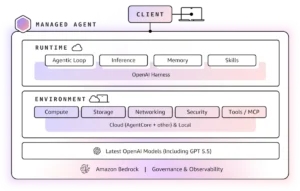
Addressing these foundational infrastructure pain points, Amazon Web Services (AWS) has announced the launch of runtime instances for Amazon Bedrock AgentCore Runtime. This powerful new complementary compute option equips developers with persistent, AWS-managed enterprise infrastructure purpose-built for complex, long-running agentic workloads.
Main Facts: What Are AgentCore Runtime Instances?
Until now, deploying AI agents that needed to remain active for days, utilize GPUs, or coordinate synchronously with other agents required developers to build and manage their own underlying infrastructure from scratch. Engineering teams had to manually provision Amazon Elastic Compute Cloud (EC2) instances, configure complex networking layers, design custom session management topologies, handle scaling events, and stitch together disparate observability and monitoring tools.
Runtime instances fundamentally change this paradigm by shifting the burden of infrastructure management to AWS.

+-----------------------------------------------------------------+
|                      Amazon Bedrock AgentCore                   |
|                                                                 |
|  +------------------------------+  +-------------------------+  |
|  |     Runtime MicroVMs         |  |    Runtime Instances    |  |
|  |  - Fast scaling / ephemeral  |  |  - AWS-managed EC2      |  |
|  |  - Up to 8-hour invocations  |  |  - Multi-day sessions   |  |
|  |  - Orchestration & routing   |  |  - GPU acceleration     |  |
|  |                              |  |  - Shared file systems  |  |
|  +--------------+---------------+  +------------+------------+  |
|                 |                               |               |
|                 +---------------+---------------+               |
|                                 |                               |
|                     [ Unified AgentCore APIs ]                  |
+-----------------------------------------------------------------+
Key features of the new capability include:
- AWS-Managed EC2 Infrastructure: Deploy multiple distinct agents onto a single runtime instance, each packaged with its own specialized dependencies, artifact types, and frameworks (such as CrewAI, LangGraph, LlamaIndex, or Strands).
- Extended Session Lifecycles: Sessions can now persist for up to 14 days, allowing complex, multi-day reasoning tasks to proceed uninterrupted.
- Cost-Saving Hibernation: Developers can stop and restart sessions during idle periods, preserving state while drastically cutting down on compute expenses.
- Hardware Acceleration: Full support for GPU-accelerated EC2 instances to power compute-intensive machine learning or automation tasks.
- Persistent Storage Integration: Seamlessly pairs with Amazon Elastic Block Store (Amazon EBS) and AgentCore Memory, ensuring long-term knowledge recall across distinct sessions and environments.
Chronology: The Evolution of Agentic Compute on AWS
The release of runtime instances represents the latest milestone in AWS’s continuous strategy to optimize generative AI architectures for production enterprise environments.
- The Prototype Era: Initially, developers deployed AI prototypes using standard serverless functions or ephemeral containers. These setups proved inadequate for multi-step autonomous loops, struggling with strict execution time limits and statelessness.
- The MicroVM Milestone: AWS introduced Amazon Bedrock AgentCore runtime microVMs, delivering a fully managed environment supporting invocations of up to 8 hours with stateful session storage. While ideal for many use cases, high-intensity workloads still hit barriers regarding operating system access and multi-day persistence.
- The Production Horizon: Recognizing the demand for heavy, collaborative, and long-form agent workflows, AWS developed runtime instances. This capability enables multi-agent cooperation on shared enterprise hosts, bridging the gap between lightweight serverless orchestrations and dedicated, long-running virtual machines.
Supporting Data & Technical Architecture: A Dual-Engine Approach
Runtime microVMs and runtime instances are not mutually exclusive; rather, they are designed as complementary compute options that operate together seamlessly through unified AgentCore APIs, identity controls, and observability tooling.
+-------------------------------------------------------------------+
|                       Collaborative Workflow                      |
|                                                                   |
|   [ User Prompt ]                                                 |
|          |                                                        |
|          v                                                        |
|   +--------------------------+                                    |
|   | Runtime MicroVM          | (Orchestration & Fast Routing)     |
|   +----------+---------------+                                    |
|              |                                                    |
|              +--------------------------+                         |
|                                         |                         |
|                                         v                         |
|                         +-------------------------------+         |
|                         | Runtime Instances (EC2)       |         |
|                         |  - Writer Agent               |         |
|                         |  - Reviewer Agent             |         |
|                         |  (Shared Session Filesystem)  |         |
|                         +-------------------------------+         |
+-------------------------------------------------------------------+
The Complementary Model in Practice
An architectural best practice involves deploying a lightweight orchestrator agent on a runtime microVM to handle API intake, task routing, and result aggregation. This orchestrator can then dispatch heavy lifting to specialized worker agents running on runtime instances, which execute compute-heavy operations like code compilation, security audits, or browser-based GUI automation requiring direct operating system access.
Hands-On Demonstration: Multi-Agent Collaboration
To showcase the power of runtime instances, consider a multi-agent software development pipeline consisting of two autonomous entities:
- The Code Writer Agent: Generates functional Python code from natural language prompts.
- The Code Reviewer Agent: Analyzes the written code for bugs, architectural style, and security flaws.
Crucially, both agents operate on the same underlying EC2 host within a shared session directory, allowing them to collaborate via a local file system without making external API calls to pass data back and forth.
1. The Code Writer Implementation
Using the Strands Agents framework, the writer agent accepts a task, executes it using an advanced language model (such as Anthropic Claude Sonnet), and writes the resulting script to a shared session directory:
from strands import Agent
from pathlib import Path

writer = Agent(
    model="us.anthropic.claude-sonnet-4-5-20250929-v1:0",
    system_prompt=(
        "You are a senior Python engineer. "
        "Given a task, return ONLY a single Python code block — no prose."
    ),
)

SHARED_DIR = Path("/tmp/agentcore-session")

@app.entrypoint
def handler(event, context):
    task = event.get("task") or event.get("prompt")
    session_id = getattr(context, "session_id", None) or event.get("session_id")
    session_dir = SHARED_DIR / session_id
    session_dir.mkdir(parents=True, exist_ok=True)

    code = str(writer(task))
    (session_dir / "code.py").write_text(code)

    return "agent": "writer", "wrote": str(session_dir / "code.py"), "code": code
2. The Code Reviewer Implementation
Running on the same host and tied to the exact same session_id, the reviewer agent reads the file produced by its peer and provides actionable feedback:
reviewer = Agent(
    model="us.anthropic.claude-sonnet-4-5-20250929-v1:0",
    system_prompt=(
        "You are a strict Python code reviewer. "
        "Given code, return 3 bullet points: bugs, style, suggestions."
    ),
)

@app.entrypoint
def handler(event, context):
    session_id = getattr(context, "session_id", None) or event.get("session_id")
    code_path = SHARED_DIR / session_id / "code.py"
    code = code_path.read_text()
    review = str(reviewer(f"Review this code:nncode"))

    return "agent": "reviewer", "read": str(code_path), "review": review
Step-by-Step Deployment Guide via AWS Management Console
Deploying multi-agent architectures on AgentCore runtime instances requires a streamlined, three-step process:
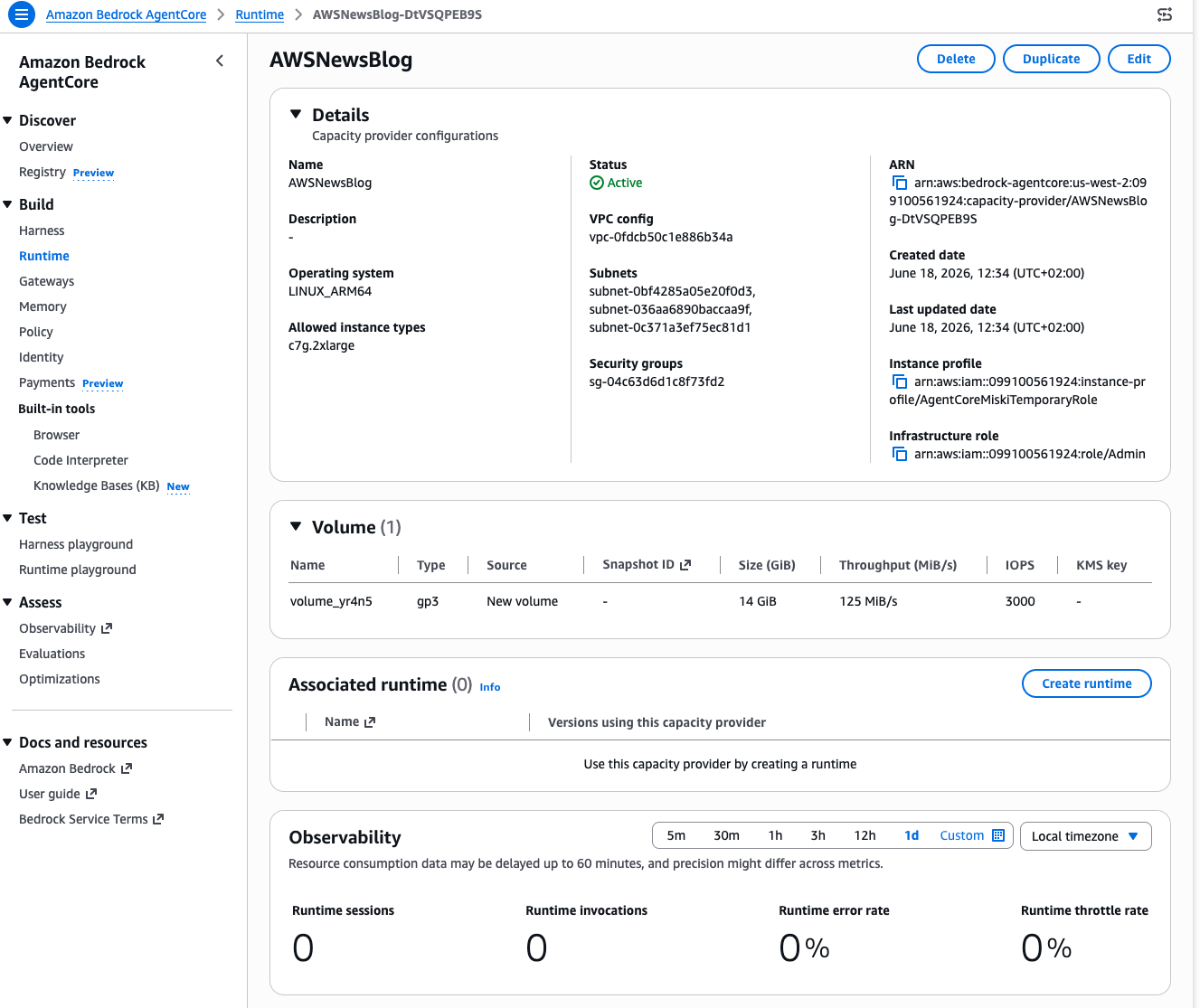
Step 1: Create a Capacity Provider
The capacity provider defines the foundational EC2 infrastructure that will host your agents.
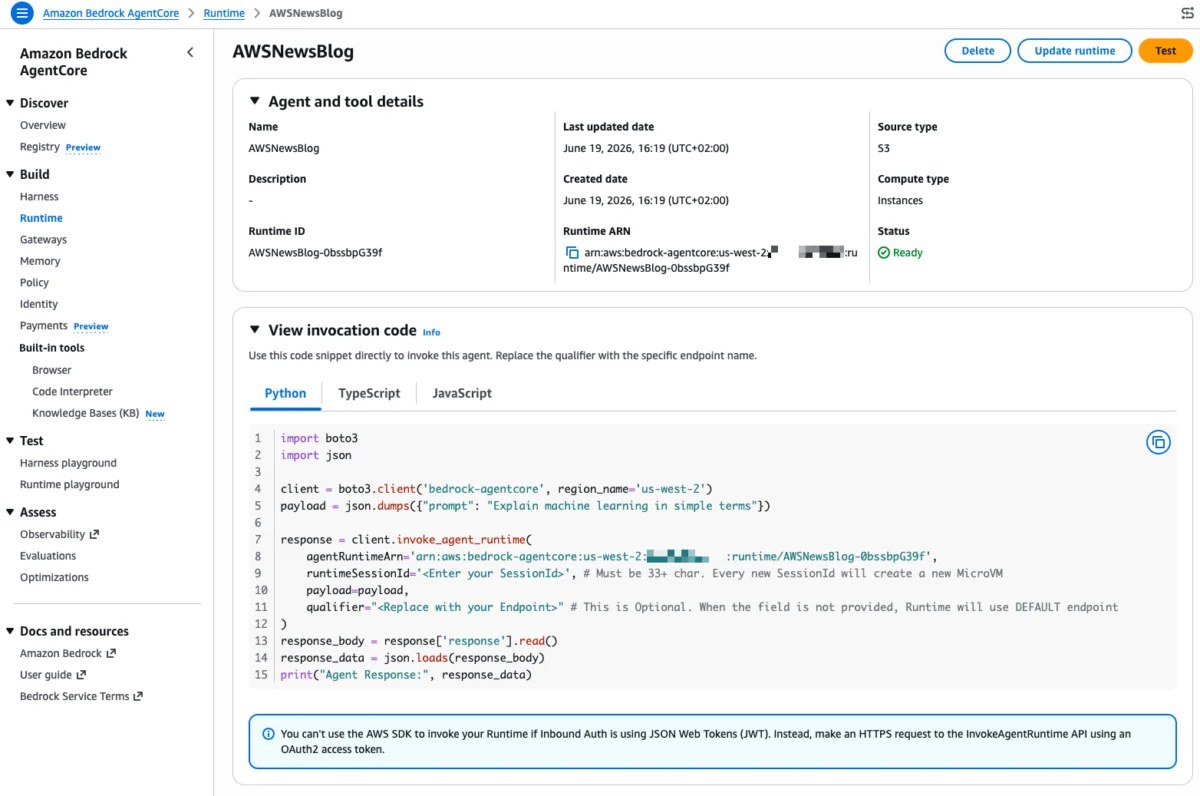
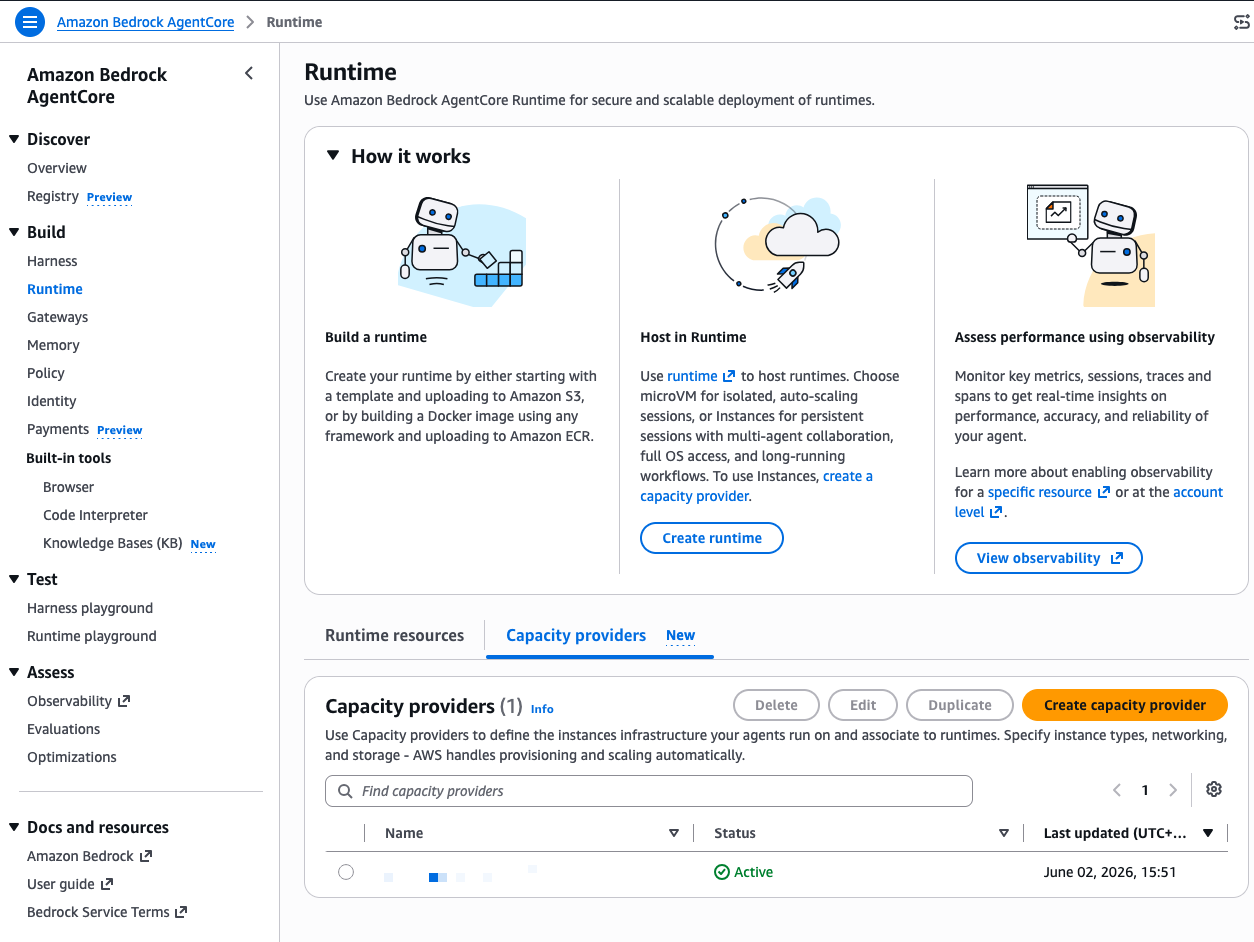
- Navigate to the Amazon Bedrock console, select Runtime in the sidebar, and open the Capacity providers tab.
- Click Create capacity provider.
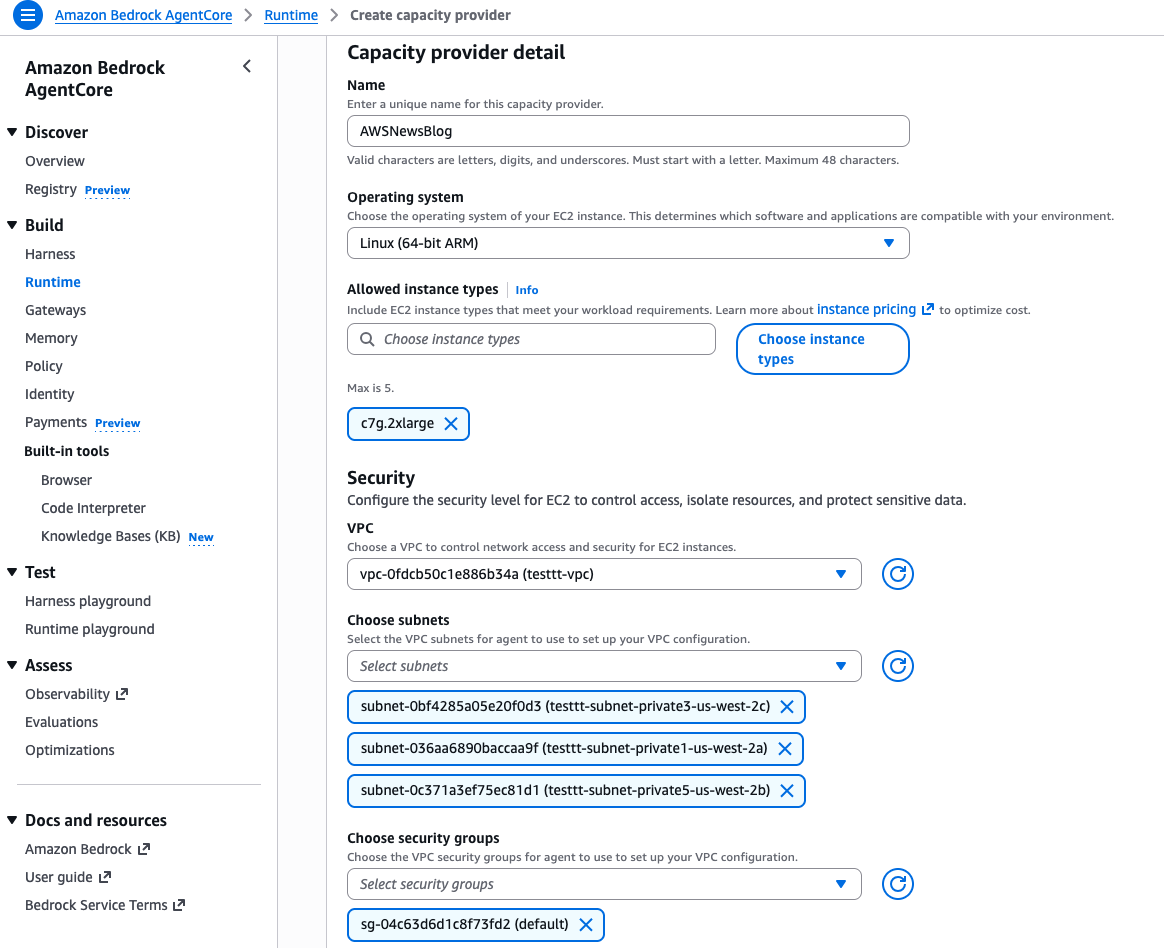
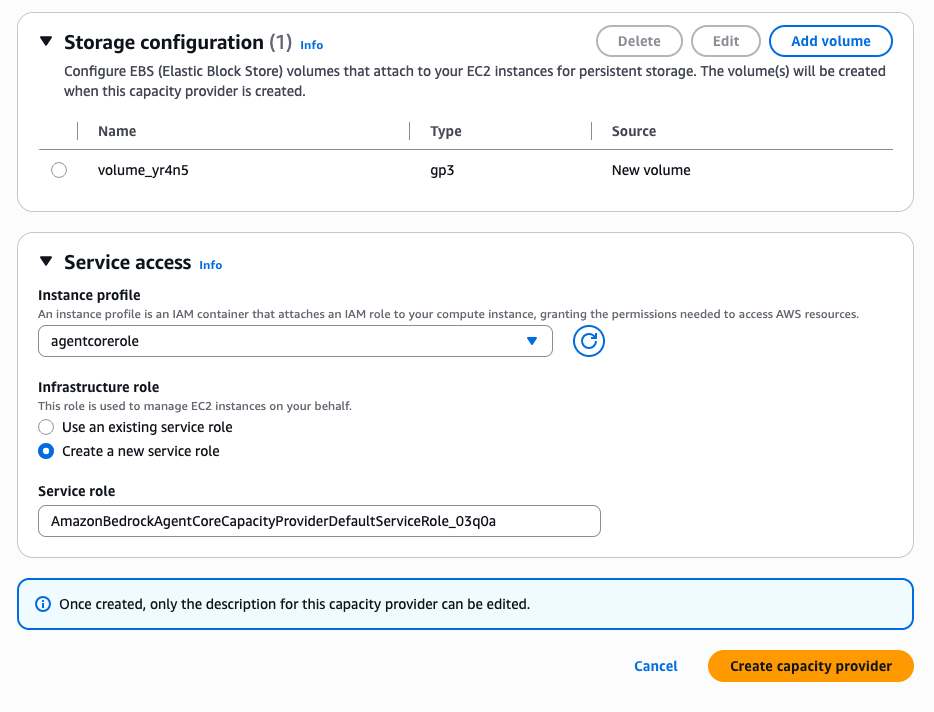
- Provide a unique name, select Linux (64-bit ARM) as the operating system, and choose an instance type (e.g.,
c7g.2xlarge, providing 8 vCPUs and 16 GiB of memory). - Configure your VPC, subnets, and security groups.
- Under service access, choose Create a new service role to allow AWS to manage the instances on your behalf, then finalize creation.
Step 2: Create Runtimes and Deploy Agents
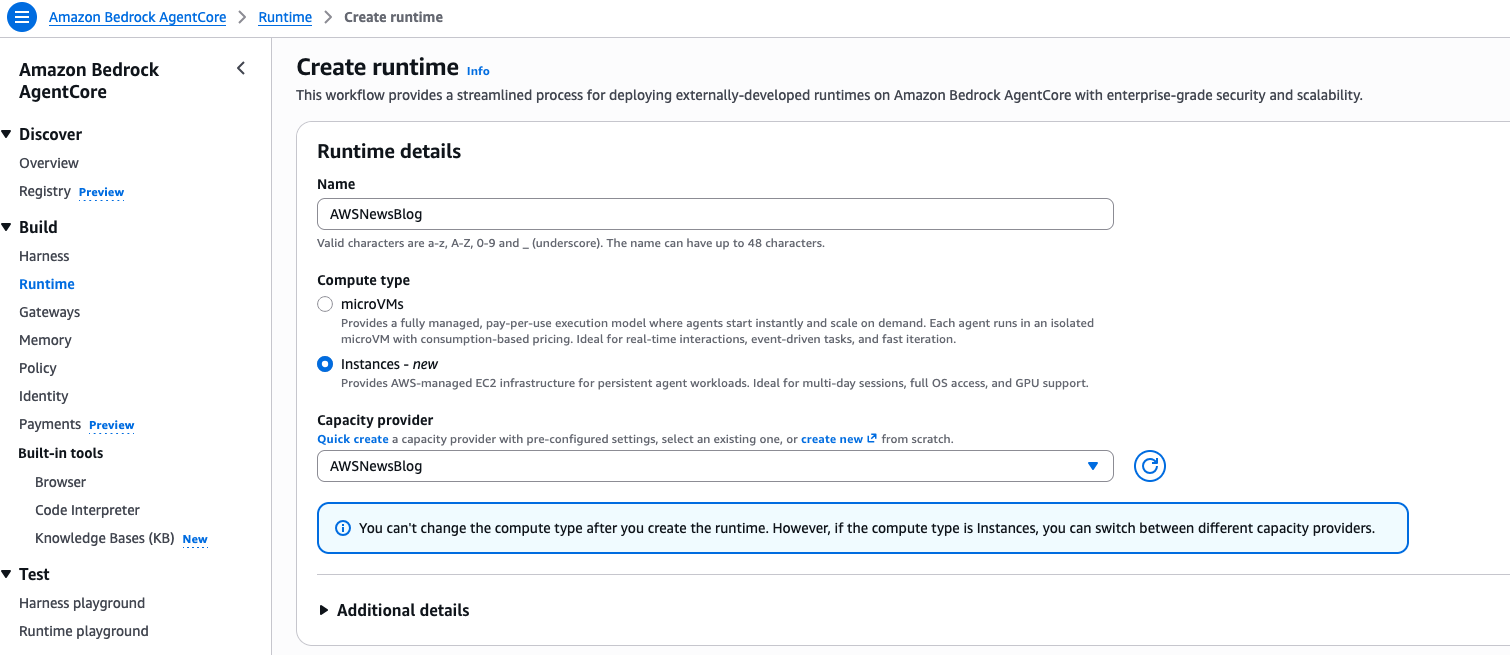
- Return to the Runtime dashboard and select Create runtime.
- Select Instances as the compute type and attach your newly created capacity provider.
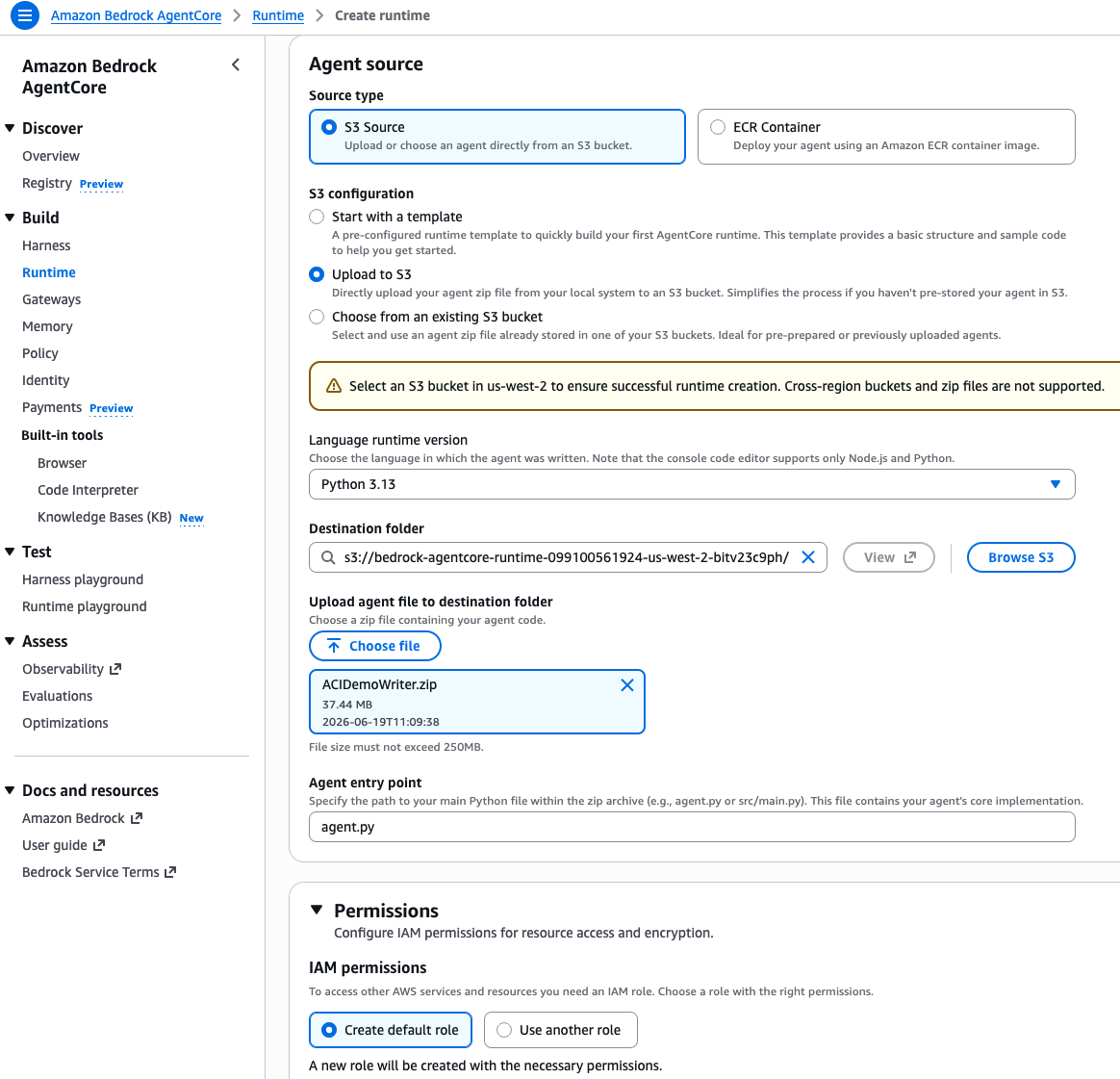
- Under agent source, upload your zipped agent deployment package (e.g.,
ACIDemoWriter.zip), specify your language runtime (e.g., Python 3.13), and designate the entry point file containing your@app.entrypointdecorator. - Repeat this process for secondary agents (such as the code reviewer), mapping them to the same underlying capacity provider so they share host infrastructure.
Step 3: Test and Observe Collaboration
Using the built-in Runtime Playground in the AWS Console:
- Invoke the writer agent with a prompt (e.g.,
"prompt": "write a fibonacci suite"). - Note the automatically generated Session ID displayed in the output path.
- Switch the runtime agent dropdown to your reviewer agent, supply the exact same Session ID, and submit a review request. The reviewer will instantly process the file generated by the writer on the shared local volume.
Official Responses and Industry Implications
AWS engineering leaders highlight that runtime instances mark a critical maturation point for enterprise generative AI development. By removing the undifferentiated heavy lifting of managing distributed EC2 infrastructure, session persistence, and multi-agent networking, developers can redirect their focus toward algorithm design and business logic.
Key Implications for Enterprise AI:
- Expanded Use Cases: Long-running workflows—such as automated software refactoring, continuous security auditing, synthetic data generation, and complex data pipeline orchestration—are now practical and stable in production environments.
- Reduced Latency and Cost: By leveraging local shared file systems within a single host instance, collaborating agents eliminate redundant inter-service API calls and data transfer overhead.
- Framework Flexibility: Teams are not locked into proprietary ecosystems; they retain total freedom to bring their preferred agent frameworks (CrewAI, LangGraph, LlamaIndex, Strands) and underlying foundational models.
- Optimized Resource Governance: Features like session hibernation and instance stop/restart ensure that enterprises pay strictly for active compute cycles, balancing high performance with strict fiscal discipline.
As organizations scale their reliance on autonomous software agents, innovations like Amazon Bedrock AgentCore runtime instances provide the robust, scalable backbone required to transition AI from experimental novelties to mission-critical operational pillars.