The Geometry of Time: Inside the OVODYO Mechanical Clock
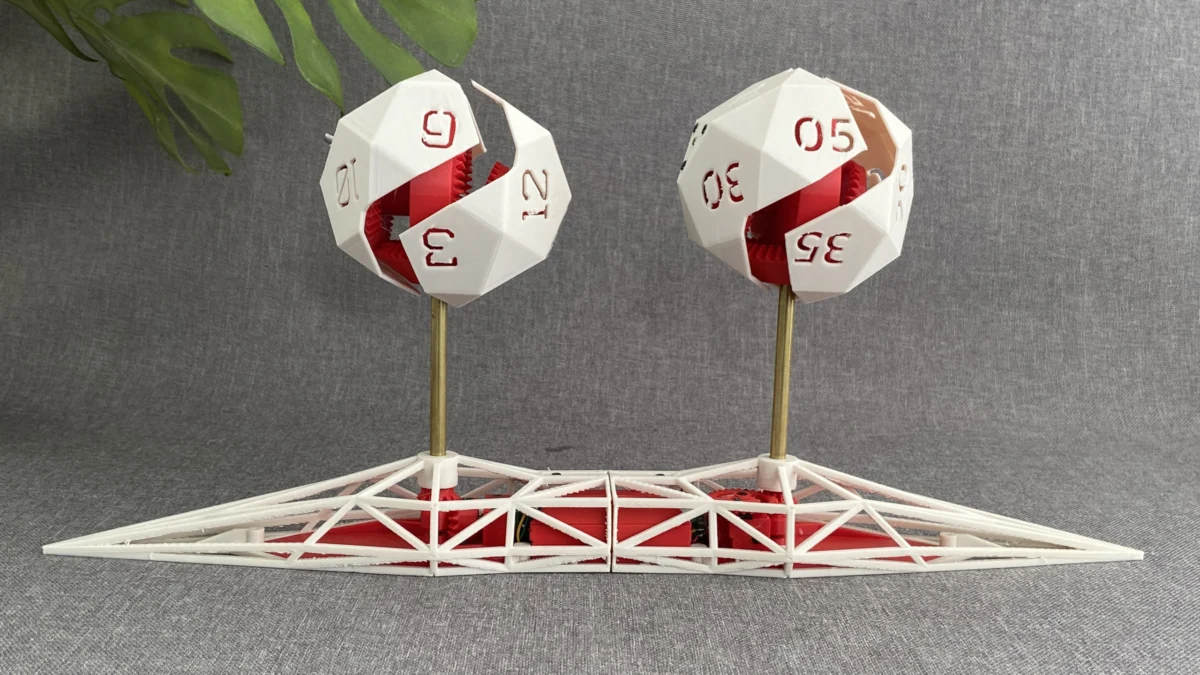
Clocks have long served as the ultimate canvas for the mechanical hacker. While their primary function—the tracking of temporal progression—is rigid and well-defined, the physical manifestation of that function is limited only by the designer’s imagination. From swinging pendulums to oscillating quartz crystals, the history of horology is a narrative of engineering ingenuity. Enter [ekaggrat singh kalsi], a designer whose latest project, the OVODYO, challenges our perception of timekeeping through the complex, hypnotic motion of icosahedral geometry.
Main Facts: The Anatomy of the OVODYO
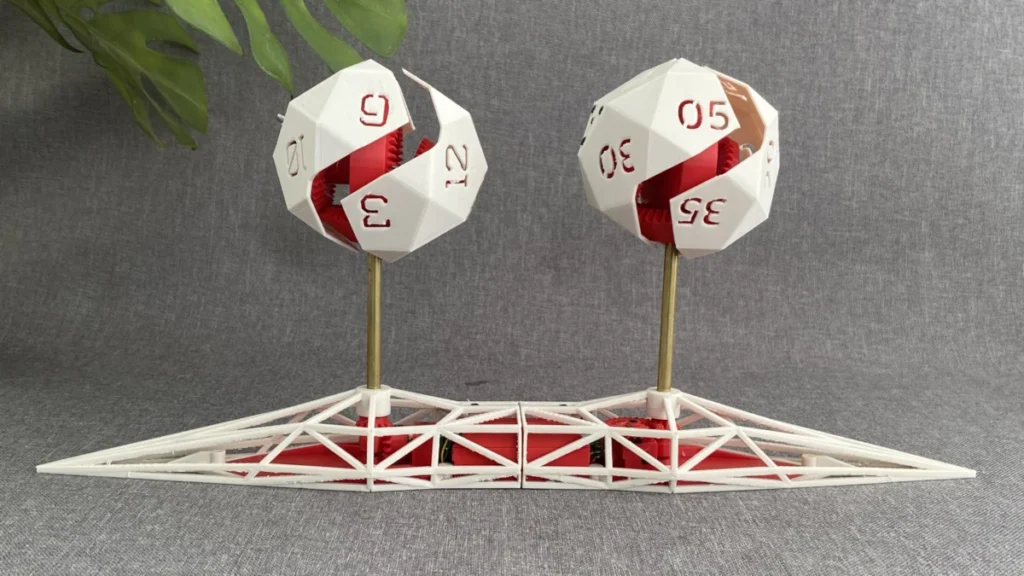
The OVODYO is not merely a timepiece; it is a kinetic sculpture that treats the passage of time as a series of fluid, geometric transformations. At its core, the device utilizes two 3D-printed icosahedra—twenty-sided polyhedra, though here adapted to house twelve distinct numerals—that serve as the primary indicators for hours and minutes.
Unlike traditional digital displays or analog hands, the OVODYO operates through a sophisticated dance of dual-axis rotation. Each icosahedron is mounted atop a brass support shaft. Housed within this shaft is a secondary drive mechanism that interfaces with a set of custom beveled gears. These gears allow the outer shells to tumble in a way that is both precise and visually arresting. As the icosahedra rotate, the numerals, which are cut directly into the faces of the 3D-printed shells, cycle until the correct time is displayed in an upright, readable orientation.
The design choice of an icosahedron is significant. By utilizing the symmetry of the shape, Kalsi has created a system where the orientation of the object itself dictates the legibility of the information. Only the numerals positioned at the correct "zenith" of the rotation appear upright, effectively filtering the visual noise of the other eleven faces.
Chronology of Development
The creation of the OVODYO did not occur in a vacuum; it is the culmination of years of iterative design and mechanical experimentation by [ekaggrat singh kalsi]. To understand the OVODYO, one must look at the timeline of Kalsi’s previous horological exploits, which have garnered a cult following in the maker community.
The Evolution of Kinetic Horology
- 2021: The Chain-Link Sculpture: Kalsi debuted a dynamic clock that utilized a continuous chain-link mechanism to drag time forward. This project established his interest in using industrial aesthetic elements to represent the relentless, linear flow of seconds.
- 2022: The Mechanical Seven-Segment Display: Moving toward more abstract representations, Kalsi built a flip-segment digital clock. This project was a miniature mechanical marvel, proving that he could replicate the functionality of a digital screen using entirely analog, moving parts.
- 2025: The Spring Clock: Prior to the OVODYO, Kalsi explored the utility of tension and elasticity, creating a timepiece that utilized hair-ties and springs to generate movement, showcasing a pivot toward using unconventional materials to solve traditional engineering problems.
- 2025 (Current): The OVODYO: The current project represents a synthesis of these past experiments. It combines the structural integrity of his earlier metalwork with the complex gear-train logic of his digital segment clocks. The development process involved months of CAD modeling, specifically to calculate the gear ratios required for the dual-axis tumble, and rigorous testing of the stepper motor synchronization.
Supporting Data and Technical Specifications
The "brain" of the OVODYO is a modest yet robust ATmega8 microcontroller. Despite its age in the rapidly evolving world of electronics, the ATmega8 is more than capable of handling the precise timing requirements of the clock.
Engineering Details
- Drive System: The clock utilizes two stepper motors, controlled by DRV8833 dual-bridge motor drivers. This hardware configuration allows for the fine-grained control necessary to stop the icosahedra at the exact degree required for legibility.
- Feedback Loops: To ensure the clock does not drift over time—a common failure point in mechanical-digital hybrids—Kalsi implemented a Hall effect sensor system. This sensor detects the absolute position of each icosahedron after every rotation, allowing the microcontroller to recalibrate the position of the gears if mechanical slippage occurs.
- The Minute Interval Challenge: Because the icosahedral minute dial is limited to twelve faces, it naturally tracks time in five-minute increments. To bridge the gap between "mechanical aesthetic" and "functional utility," Kalsi integrated an LED strip along the base of the clock. This strip provides a secondary, digital readout for the exact minute, ensuring that the device remains a practical timekeeper rather than just a kinetic curiosity.
- Materials: The icosahedra are 3D-printed using high-resolution resin, which allows for the crisp, clean edges of the sunk numerals. The supporting structure is machined brass, providing the necessary rigidity to handle the torque generated by the beveled gears during the rapid "tumbling" phase.
Official Responses and Community Impact
The release of the OVODYO project on platforms like Hackaday has triggered a wave of discourse within the maker community. Peers and engineering enthusiasts have lauded the project for its "mechanical elegance."
In community forums, Kalsi has been responsive to inquiries regarding the challenges of the build. He has noted that the most significant hurdle was not the programming of the ATmega8, but the mechanical friction inherent in the beveled gear assembly. "If the tolerance is off by even a fraction of a millimeter," Kalsi explained in project logs, "the entire icosahedron jitters during rotation."
The design has been highlighted as a quintessential example of "Open Hardware" philosophy. By documenting the gear ratios, the code, and the CAD files, Kalsi has invited others to iterate on the design. Several enthusiasts have already proposed variations, such as using larger icosahedra to track seconds or incorporating micro-servos for a quieter operation.
Implications for Future Horology
The OVODYO represents a broader trend in high-end DIY engineering: the move away from the "black box" of modern consumer electronics toward "transparent technology." In a world where our watches are increasingly sealed, glass-backed, and software-locked, the OVODYO reminds us that time is a physical, mechanical phenomenon.
The Aesthetic of Transparency
The "split path" design of the clock, which exposes the inner gearing while the outer shells rotate, serves a philosophical purpose. It forces the viewer to confront the labor of the machine. The OVODYO implies that if we are to understand the time, we must first understand the mechanism that defines it.
Engineering Sustainability
Furthermore, the use of modular, replaceable parts (steppers, sensors, and 3D-printed frames) suggests a sustainable path for hardware design. Unlike a mass-produced smart device that becomes e-waste once its internal battery or screen fails, the OVODYO is designed to be repaired. If a gear wears out, it can be reprinted. If a motor fails, it can be replaced with a standard off-the-shelf component.
The Intersection of Art and Utility
The OVODYO bridges the gap between the art installation and the functional appliance. It does not hide its gears, nor does it hide its errors. When the icosahedron tumbles to a new position, the sound of the stepper motor and the tactile click of the gears provide a sensory feedback loop that is entirely absent in modern digital devices.
As Kalsi continues to push the boundaries of what a clock can be, the OVODYO stands as a testament to the idea that complex problems—such as the representation of time—can be solved through the application of geometry and patience. Whether the project serves as an inspiration for the next generation of engineers or simply as a centerpiece for a desk, it proves that the art of clockmaking is far from dead; it is merely waiting for the next clever mind to find a new way to tumble the numbers.