Empowering Autonomous Intelligence: AWS Unveils S3 Annotations for Massive-Scale Data Context
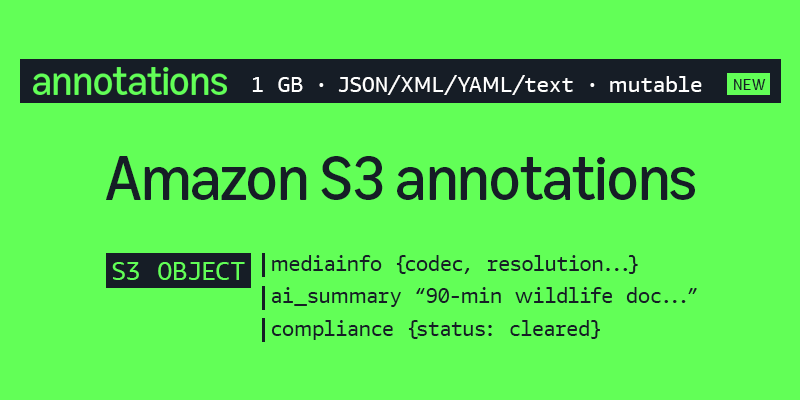
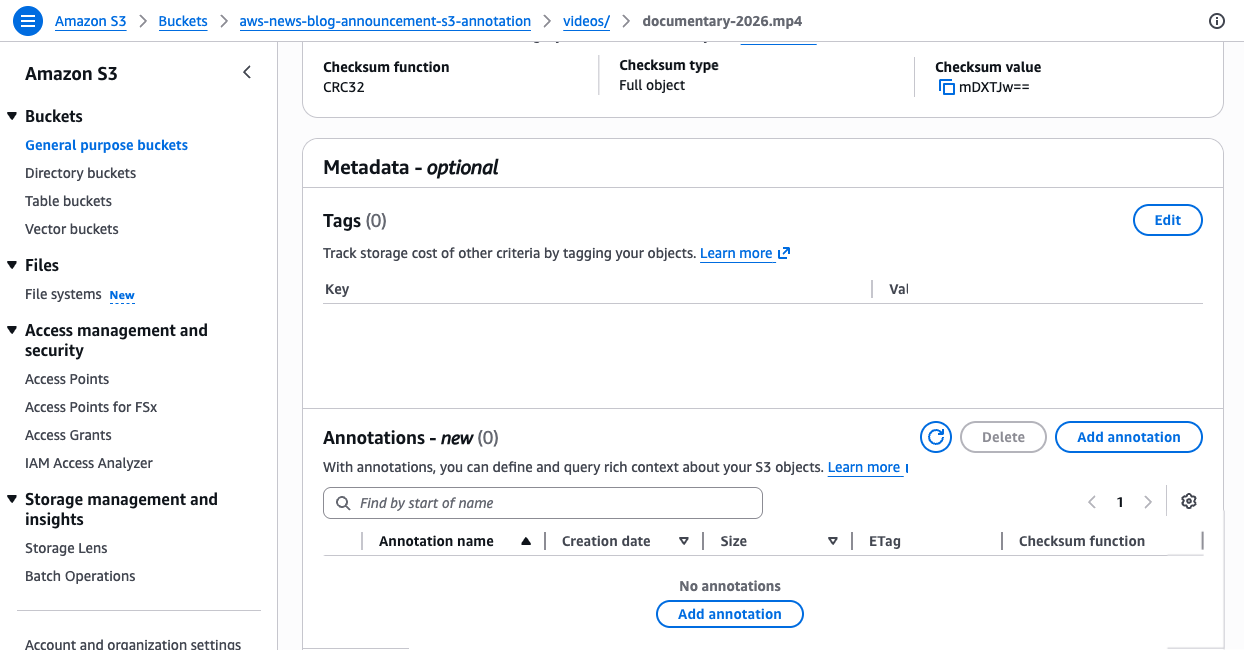
In a move set to redefine how enterprises manage, query, and utilize petabyte-scale data, Amazon Web Services (AWS) has announced the launch of "Annotations" for Amazon Simple Storage Service (S3). This transformative capability allows users to attach rich, mutable, and queryable metadata directly to S3 objects, effectively bridging the gap between raw cloud storage and the context-heavy requirements of modern artificial intelligence (AI) agents.
As organizations pivot toward autonomous workflows and AI-driven data processing, the traditional limitations of object storage—specifically regarding metadata management—have become a significant bottleneck. With S3 Annotations, AWS is providing a native solution that allows businesses to store up to 1 GB of context per object, formatted as JSON, XML, YAML, or plain text, without the need for complex, disconnected external databases.
Main Facts: A New Paradigm for Object Metadata
The introduction of S3 Annotations represents a departure from the rigid metadata structures that have defined cloud object storage for decades. Historically, developers were limited to system-defined metadata (such as timestamps and storage classes) or small user-defined headers. While object tags provided some operational utility, they were largely insufficient for the dense, descriptive context required by sophisticated machine learning models.
Key Capabilities of S3 Annotations:
- Scale: Each object can hold up to 1,000 distinct annotations, with each annotation capable of reaching 1 MB in size, totaling 1 GB of metadata per object.
- Flexibility: Supporting multiple formats including JSON, XML, and YAML, these annotations allow for structured or semi-structured data to exist directly alongside the raw asset.
- Mutability: Unlike previous metadata implementations that were often fixed at the time of upload, Annotations are fully mutable. Developers can update or delete context dynamically as business requirements evolve.
- Automatic Lifecycle Management: When an object is copied, replicated, or transferred across regions, its annotations travel with it automatically. Conversely, when the object is deleted, the associated annotations are purged, ensuring consistent data hygiene.
- Queryable Infrastructure: Perhaps most significantly, S3 Annotations integrate with S3 Metadata tables, enabling users to perform complex queries using Amazon Athena or other Apache Iceberg-compatible analytics engines.
The Chronology of Metadata Evolution
The journey to S3 Annotations is the result of years of feedback from AWS customers struggling with the "sidecar file" dilemma. For over a decade, companies managing massive media libraries or scientific datasets had to maintain separate SQL or NoSQL databases to track the "meaning" behind their S3 objects.
- The Early Era (2006–2015): AWS S3 launched with basic system-defined metadata. Users relied on manual tracking or external databases to map "business logic" to specific file paths.
- The Rise of Tags (2015–2020): With the introduction of Object Tags, customers gained a way to manage lifecycle policies and access control at scale. However, the 10-tag limit and character restrictions made these unsuitable for detailed content description.
- The AI Inflection Point (2020–2025): As GenAI and LLMs gained prominence, the demand for "ground truth" data exploded. Developers needed to store AI-generated summaries, sentiment scores, and technical specifications alongside objects.
- The Breakthrough (2026): AWS releases S3 Annotations, effectively consolidating the metadata layer into the storage layer. This removes the "synchronization tax"—the heavy cost and complexity of ensuring that an object’s database record matches the actual object in storage.
Supporting Data: Why Annotations Change the Game
The following table illustrates the stark contrast between traditional S3 metadata capabilities and the new Annotations feature:
| Capability | Max Size | Mutable? | Best Use Case |
|---|---|---|---|
| System Metadata | Fixed | No | File size, storage class, creation time |
| User Metadata | 2 KB | No | Small, static key-value pairs |
| Object Tags | 10 tags | Yes | Lifecycle, cost allocation, ACLs |
| Annotations | 1 GB | Yes | AI-generated summaries, technical specs |
The ability to store 1 GB of context per object is not merely a quantitative upgrade; it is a qualitative shift. Previously, if a media company needed to store a video’s frame rate, codec information, and a 5,000-word transcript, they were forced to build a secondary database. Now, that data exists inside the S3 bucket, fully indexed and ready for analytical processing via Athena.
Official Perspective: The "Agentic" Workflow
Daniel Abib, a key voice in the development of this feature, emphasizes that the primary driver for Annotations is the rise of autonomous AI agents. "Organizations are building AI agents that need to find, understand, and act on data without human intervention," Abib noted in the announcement.
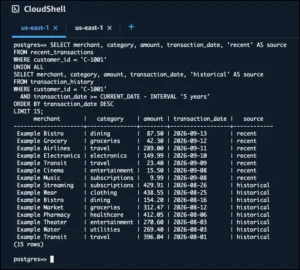
By leveraging the S3 Tables MCP (Model Context Protocol) server, these agents can now interact with storage as if it were a searchable knowledge base. Rather than "crawling" a bucket—a slow and expensive operation—the agent can query the annotation table, identify relevant files, and extract only the necessary context. This reduces latency from hours to seconds and significantly lowers compute costs associated with data retrieval.

Implications: A New Era for Data Architecture
The release of S3 Annotations has profound implications for several industry verticals:
Media and Entertainment
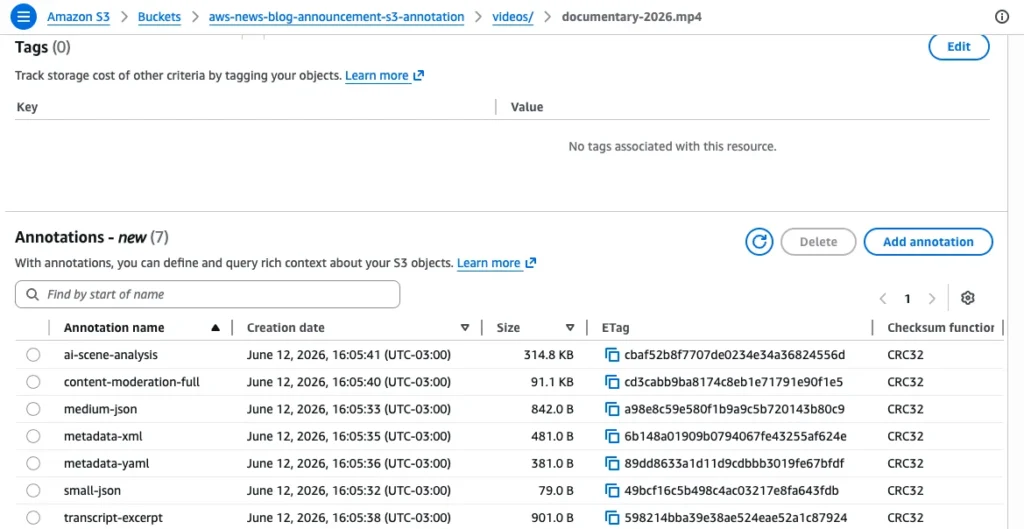
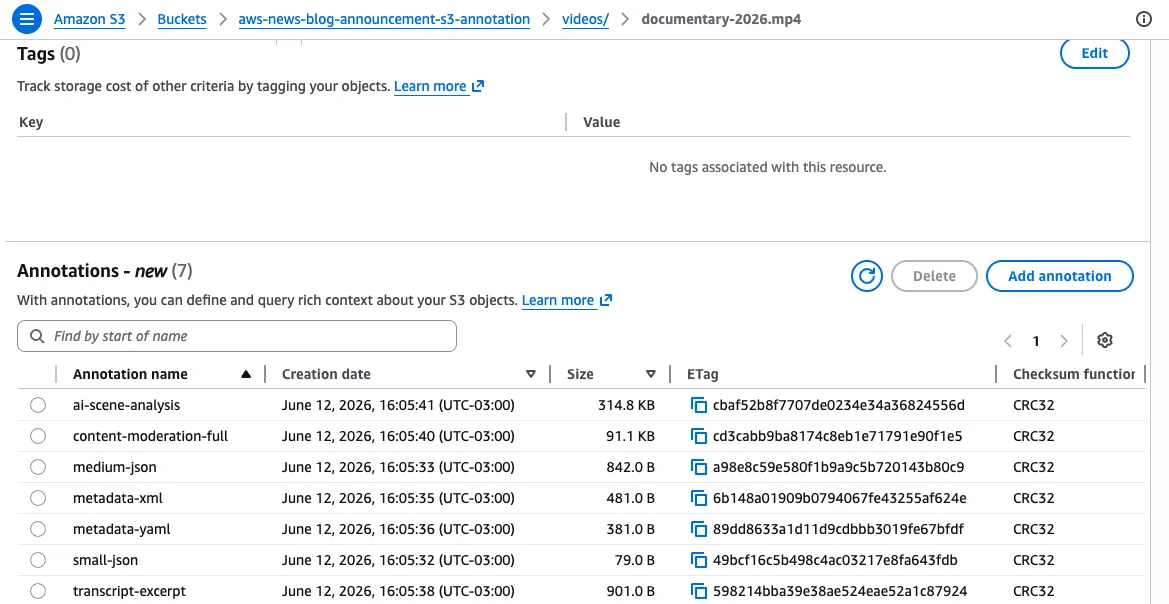
Large-scale media archives often contain millions of assets. With Annotations, a studio can attach complex JSON-formatted technical specs, subtitle files, and AI-generated scene descriptions directly to a movie file. This eliminates the need for separate media asset management (MAM) systems to perform basic lookups, as the data is queryable via standard SQL through Athena.
Compliance and Archival
For industries like healthcare or finance, maintaining audit trails is mandatory. Annotations allow organizations to store compliance metadata—such as PII (Personally Identifiable Information) flags or retention policies—directly with the record. If an auditor asks for all documents containing specific sensitivity tags, the query runs directly against the S3 metadata table, providing instantaneous results.
The Rise of Autonomous Agents
The most exciting implication lies in the "Agentic" future. As AI models become more adept at navigating cloud environments, they require a standardized way to "read" the data they are analyzing. S3 Annotations provide this standard. By using natural language to query an annotation table, an AI can perform complex tasks, such as "find all PG-rated videos with Spanish subtitles created in 2023," without needing a specialized developer to write a custom script.
Cost Efficiency
The financial implications are equally significant. Previously, querying objects often involved a "retrieval tax" where the user paid to fetch the object just to read its header. With Annotations, the metadata is stored in an optimized Apache Iceberg table. Querying this table incurs no object retrieval costs, making it a highly cost-effective way to manage large-scale data catalogs.
Getting Started: Implementation and Best Practices
For organizations looking to adopt this feature, the process is streamlined through the AWS CLI and SDKs.
- Enable Annotation Tables: Use the
CreateBucketMetadataConfigurationAPI to enable annotation tables. This triggers the background process that indexes your objects into an Iceberg table. - Define Your Schema: Since Annotations are flexible, teams should establish conventions for their JSON/YAML structures to ensure consistency across their organization.
- Grant Permissions: Ensure that IAM policies are updated to include
s3:PutObjectAnnotationands3:GetObjectAnnotation. - Integrate with Analytics: Connect your favorite business intelligence tool to the newly created S3 Metadata table to begin visualizing and acting on your data.
As AWS continues to push the boundaries of cloud storage, S3 Annotations stand as a testament to the platform’s commitment to evolving with the needs of modern AI. By moving context closer to the data, AWS is not only simplifying the developer experience but is also laying the foundational architecture for the next generation of autonomous, data-aware cloud applications. Whether you are a small startup building a single AI agent or a global enterprise managing petabytes of sensitive assets, S3 Annotations provide the necessary scale to turn raw storage into a dynamic, intelligent, and highly accessible business asset.