Navigating Modern Open-Source Engineering: Software Bill of Materials (SBOMs), Provenance, and the AI Coding Boom
Main Facts
The modern open-source software (OSS) ecosystem finds itself at a fascinating and complex crossroads. On one side, developers are grappling with rigorous supply chain security demands—ranging from Software Bills of Materials (SBOMs) to cryptographic provenance and build attestations. On the other side, the generative AI boom has lowered the barrier to entry for writing code, sparking a new wave of enthusiasm reminiscent of the early days of personal web publishing.
These twin forces collided recently in the evolution of CNPG-Extensions (formerly and humorously known as "Not-CNPG"). Originally conceived as a playful nod to the Cloud Native Computing Foundation’s (CNCF) restrictive licensing policies—which historically forbid hosting open-source software carrying GPL-style licenses—the project has matured into a serious endeavor.
Maintaining a secure, enterprise-ready repository for PostgreSQL extensions in Kubernetes via CloudNativePG requires deep technical commitments. Developers can no longer simply throw code onto a public repository and walk away. Modern compliance demands:
- SBOM Generation: Granular transparency into every dependency, down to deep sub-trees in languages like Rust (
pgrxextensions). - Provenance and Attestations: Verifiable cryptographic proof of how, where, and by whom a container image was built.
- Vulnerability Scanning Integration: Ensuring tools like Trivy can accurately flag security flaws (such as RUSTSEC vulnerabilities) buried deep within compiled binary dependency trees.
- Long-Term Maintenance & Trust: Establishing rigorous criteria for code contributions, trust models, and sustainable platform governance in an era where AI can generate code faster than humans can review it.
Chronology
The Genesis of "Not-CNPG"
The project started as a tongue-in-cheek reaction to licensing friction within the CNCF ecosystem. Developers working with specific open-source licenses frequently encountered administrative roadblocks. By rebranding the initiative to CNPG-Extensions, the maintainer pivoted from satirical commentary to building a production-grade infrastructure utility designed to integrate seamlessly with CloudNativePG.
The Security Deep-Dive (Past Few Weeks)
Over the preceding weeks, the project underwent a radical security overhaul. Recognizing that container images running in production demand rigorous auditing, the maintainer dove headfirst into modern software supply chain tooling:
- Renovate and Dependency Automation: Implementing automated dependency updates to prevent code rot.
- Provenance and Attestations: Configuring build pipelines to emit tamper-evident metadata detailing the exact build environment and steps.
- Rust and
pgrxIntegration: Expanding vulnerability scanning capabilities to parse complex Rust dependency graphs. This ensured that vulnerability scanners like Trivy could surface hidden security advisories (such as RUSTSEC flaws) within complex extension payloads.
Managing Parallel Work Streams
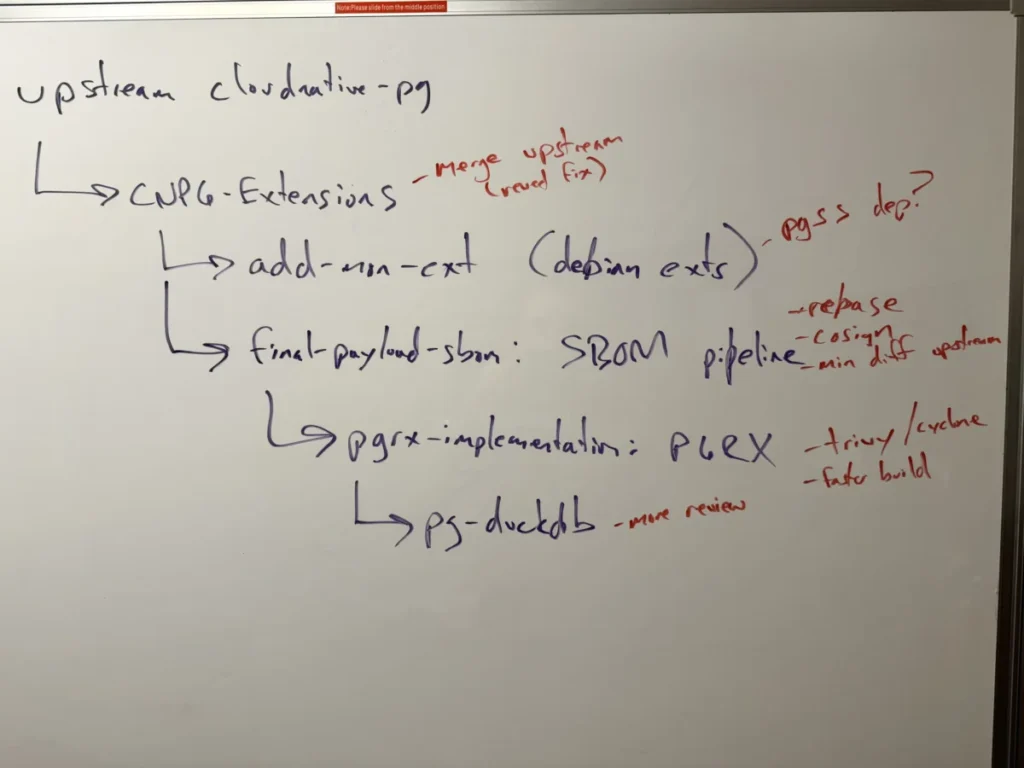
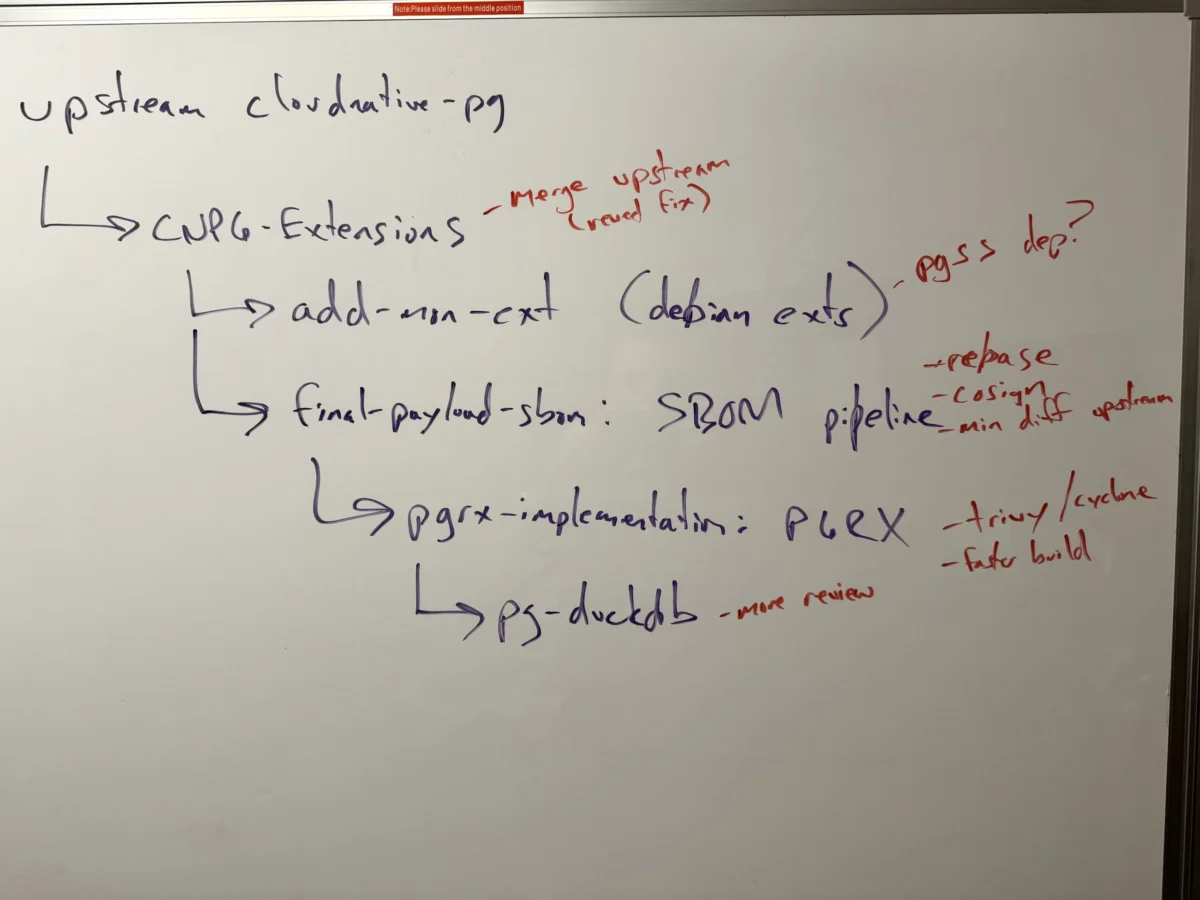
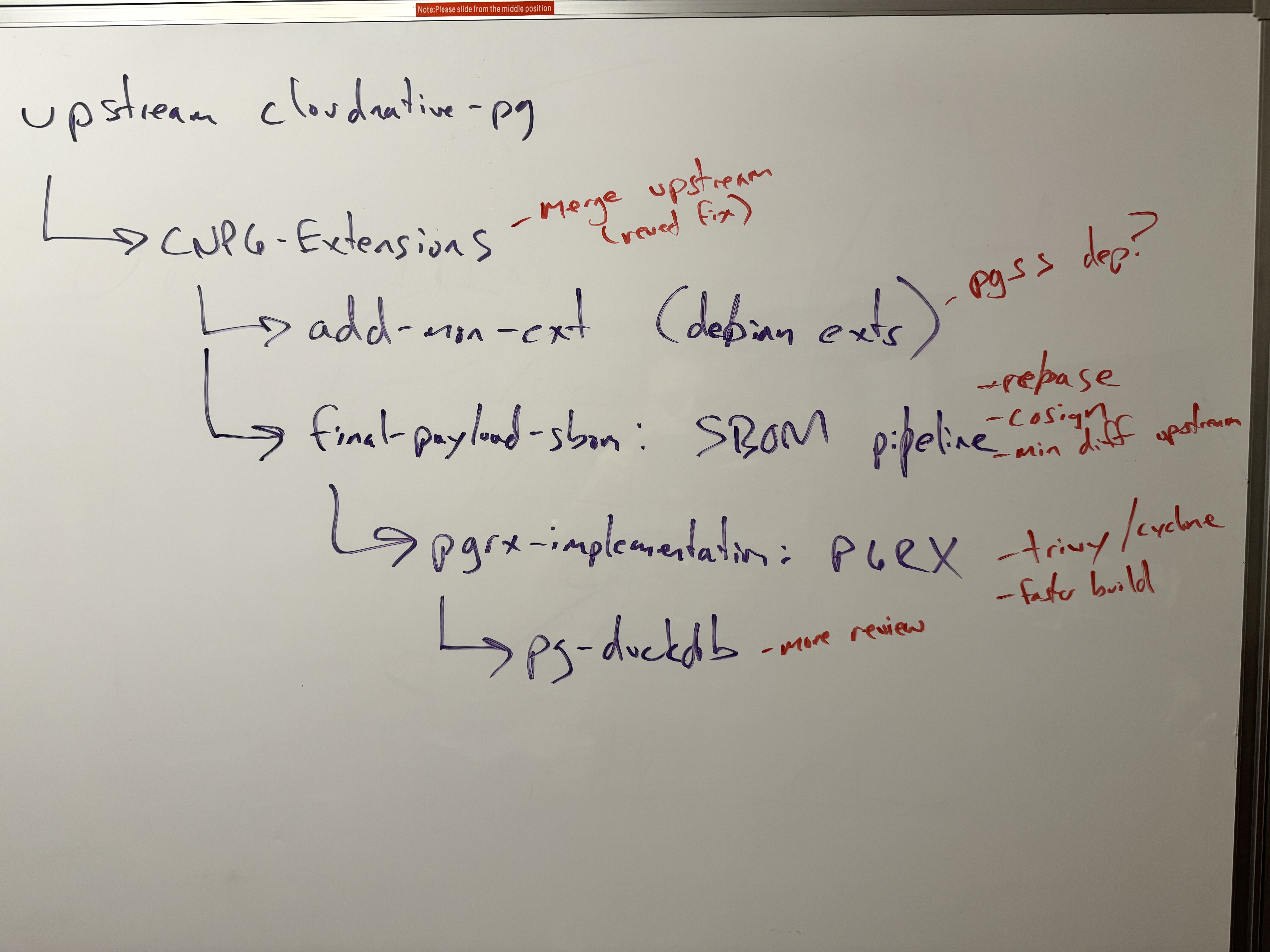
With the assistance of AI-driven coding agents, development velocity accelerated dramatically. However, this introduced a new organizational bottleneck. The maintainer documented a complex workflow involving a hierarchy of five simultaneous work streams. Each stream existed as a separate Git branch, cleanly forked from the branch immediately above it in the architecture. This structure required meticulous, ongoing rebasing whenever upstream changes occurred, highlighting the intense mental overhead of orchestrating automated multi-stream development cycles.
Supporting Data & Technical Implementation
Securing modern database extensions requires granular visibility into container contents. To demonstrate these capabilities, the project established concrete examples of vulnerability reporting using Trivy across different extension architectures.
1. Debian-Based Extensions
For traditional Debian-packaged extensions, SBOMs provide a foundational inventory of packages. However, trust remains a core variable. Packages sourced directly from official Debian or PostgreSQL Global Development Group (PGDG) repositories carry a baseline of institutional trust. Conversely, arbitrary Debian packages downloaded directly from ad-hoc GitHub repositories introduce opaque risks regarding their build pipeline integrity.
- Reference Implementation: Trivy SBOM Example for Debian-Based Extensions
2. Rust-Based pgrx Extensions
PostgreSQL extensions written in Rust via the pgrx framework introduce unique supply chain challenges. Because Rust applications frequently pull in extensive dependency trees via Cargo, traditional flat-file scanners often miss vulnerabilities residing deep within third-party crates. By constructing full Rust dependency graphs inside the SBOM, tools like Trivy can successfully flag deep-seated vulnerabilities.
- Reference Implementation: Trivy SBOM Example for pgrx-Based Extensions
3. OpenSSF Scorecard
To evaluate the health, security posture, and sustainability of open-source projects, the OpenSSF Scorecard has emerged as an industry-standard benchmark. It assesses codebases against automated security checks, such as branch protection, dependency update hygiene, and signed artifacts, providing an objective metric of maintainability.
Official Perspectives and Operational Dilemmas
As the CNPG-Extensions project matures, its maintainers face critical governance and architectural questions that resonate across the broader cloud-native ecosystem:
The Contribution Bar: Balancing Openness and Liability
How high should the barrier to entry be for incoming contributions? If a project lowers its bar to attract casual developers, it risks welcoming "drive-by" code contributions—large blocks of complex code dropped into the repository by transient contributors who have no intention of sticking around for long-term maintenance.
- The Liability Risk: Code without a committed maintainer becomes a technical debt liability. When a zero-day vulnerability like Log4Shell strikes years down the line, who will step up to rebuild, patch, and release the affected artifacts?
- Trust and Provenance: Can automated tooling replace human trust? While cryptographic provenance verifies how a binary was built, it does not guarantee that the human author wrote secure logic or will be available to remediate future bugs.
The AI Coding Revolution vs. The Reality of Platform Maintenance
Generative AI tools have electrified the developer community, enabling individuals to spin up complex applications, write entire microservices, or even refactor operating system environments with simple natural language prompts.
However, veterans of the software industry draw parallels to earlier technological shifts—such as the early days of self-hosted WordPress sites. Setting up a platform is exhilarating, and the learning curve fosters initial enthusiasm. Yet, after cleaning up repeated security breaches or managing endless maintenance cycles, many developers eventually realize they would rather delegate platform management to reliable, well-maintained commercial services or dedicated teams.
AI agents excel at generating syntax, writing boilerplate, and running long-duration asynchronous tests (allowing developers to review results 12 hours later). Nevertheless, AI cannot assume legal or operational responsibility for software security.
"Anybody can throw some code on the internet. That doesn’t mean anybody will maintain the code—ensuring that things are rebuilt after a crisis happens two years from now. AI is great at writing code, but you still better pay attention to what human is at the steering wheel."
Implications for the Future of Cloud-Native Software
The lessons learned from scaling CNPG-Extensions highlight several broader takeaways for enterprise software engineering:
- Supply Chain Security is Non-Negotiable: SBOMs, provenance attestations, and vulnerability scanners are no longer optional "nice-to-haves." As regulations tighten and threat vectors grow more sophisticated (particularly around compiled ecosystems like Rust and containerized databases), automated supply chain transparency is mandatory.
- AI Amplifies Productivity, Not Accountability: While coding agents dramatically increase output—allowing engineers to manage complex, multi-stream Git hierarchies and asynchronous test pipelines—they also increase the volume of code that requires human oversight. The cognitive load shifts from writing code to governing and auditing code.
- The Importance of Institutional Trust: The open-source community must continue defining frameworks—like the OpenSSF Scorecard and cryptographic attestation standards—to differentiate between ephemeral hobby projects and robust, production-ready platforms backed by accountable maintainers.
Ultimately, while artificial intelligence will continue to redefine how developers interact with their codebases, the fundamental laws of computing remain unchanged: software must be maintained, secured, and owned by humans who care about its long-term integrity.