Cracking the Charcoal: How a Maker Liberated the MasterBuilt Gravity 800 Grill with Open-Source ESP32 Firmware
By Technology & Hardware Desk
Published in Open Electronics
Main Facts: Breaking Free from the Walled Garden of Smart Appliances
In the modern era of the Internet of Things (IoT), appliances that were once wonderfully mechanical have been digitalized, cloud-connected, and locked behind proprietary walls. From smart refrigerators to connected thermostats, consumers frequently find themselves bound to manufacturer apps, rigid update lifecycles, and closed ecosystems. Barbecues and smokers have proven no exception.
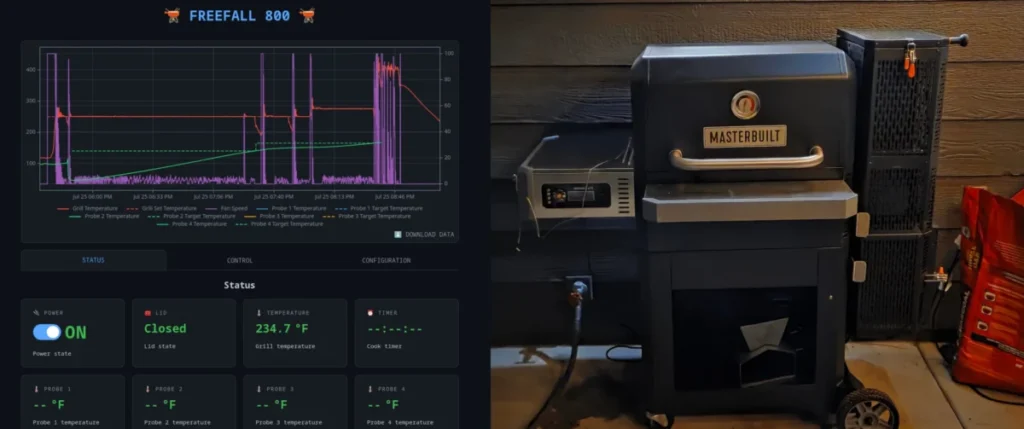
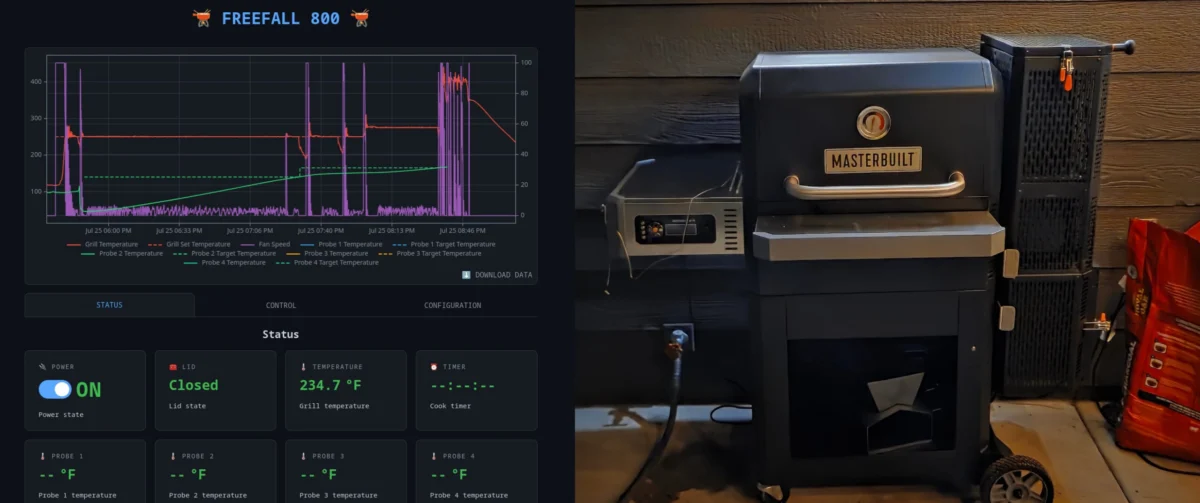
Enter maker and reverse-engineer PRBS23, who has successfully liberated the MasterBuilt Gravity 800 Grill controller from its proprietary software shackles. By swapping factory firmware for a custom, open-source alternative dubbed Freefall 800, PRBS23 has transformed a locked-down commercial appliance into an adaptable, highly precise open platform.
The breakthrough replaces factory limitations with sophisticated PID (Proportional-Integral-Derivative) temperature control, seamless Over-The-Air (OTA) firmware updates, and a responsive real-time web interface accessible from any browser-enabled device on the local network. Best of all, this powerhouse of features runs entirely on the existing hardware platform nestled inside the MasterBuilt controller housing: the ubiquitous Espressif ESP32 microcontroller.
This project serves as a masterclass in hardware hacking and reverse engineering, proving that everyday appliances can be reclaimed by their owners, optimized beyond factory specifications, and shielded against future manufacturer obsolescence.
Chronology: A Step-by-Step Breakdown of the Reverse Engineering Process
The path from a closed-source commercial grill to an open-source culinary machine was neither accidental nor easy. It required a meticulous, highly methodical approach to hardware inspection, binary analysis, and protocol decoding.
Phase 1: Physical Inspection and Hardware Identification
The journey began with the physical autopsy of the MasterBuilt Gravity 800 controller unit. Upon carefully opening the enclosure, PRBS23 discovered a clean, developer-friendly layout. At the heart of the board sat an ESP32 Wi-Fi and Bluetooth-enabled microcontroller, surrounded by support circuitry and—crucially—a clearly labeled programming header.
Finding an accessible programming header on a consumer appliance is akin to finding an open door on a guarded vault. It bypassed the need for complex, destructive desoldering techniques, allowing direct interfacing with the microcontroller’s flash memory.

Phase 2: Firmware Extraction and Analysis
With physical access secured, the next challenge was extracting the original firmware. Utilizing the espflash utility—a standard open-source command-line tool designed for Espressif chips—PRBS23 successfully dumped the binary contents of the ESP32’s flash memory.
Once the binary was safely on a desktop computer, the deep analysis began. Working through disassemblers and binary inspection tools yielded vital operational secrets:
- The ADC Correction Quirk: Standard microcontrollers read analog-to-digital converter (ADC) voltages linearly, but temperature probes often behave non-linearly across broad thermal ranges. The original firmware relied on a specialized, non-standard ADC correction function to translate raw electrical signals into accurate temperature readouts. Replicating this mathematical transformation was essential to ensure the grill didn’t miscalculate internal cooking temperatures.
- The 40-Degree Fahrenheit Offset: Further analysis uncovered a distinct operational offset baked into the original code. Specifically, a 40-degree Fahrenheit calibration offset had to be applied to align the raw sensor data with reality. Failing to include this offset in custom code would have resulted in wildly inaccurate thermometer readings, ruining long-smoke brisket sessions.
- Display Communication Protocols: The grill uses a built-in segmented LCD driven by a CS1621 controller chip. Without public documentation on how the factory firmware communicated with this specific driver, PRBS23 had to reverse-engineer the data stream. Deep packet/signal analysis revealed that communication with the CS1621 display runs at a steady 9600 baud rate, providing the missing puzzle piece needed to write a brand-new display driver from scratch.
Phase 3: Developing the Open-Source Alternative
Armed with the hardware blueprint, pinout maps, ADC offsets, and display communication protocols, PRBS23 began writing Freefall 800. Abandoning the crude on-off relay cycling of the factory software, the developer engineered a native PID control algorithm designed to pulse the combustion fan with mathematical precision, keeping fuel consumption low and pit temperatures rock-solid.
To eliminate the inconvenience of tethering a computer to the grill for future code tweaks, the developer integrated an OTA (Over-The-Air) update mechanism. Finally, a lightweight, responsive web interface was coded into the ESP32’s flash storage, allowing pitmasters to monitor ambient temperatures, meat probes, and target setpoints from smartphones, tablets, or desktop computers.
Supporting Data: Technical Architecture and Specifications
To understand why this project is such a resounding success, it helps to examine the underlying hardware and software parameters documented by PRBS23 in the official GitLab repository (https://gitlab.com/prbs23/freefall_800/).
Hardware Specifications of the MasterBuilt Controller
- Main Microcontroller: Espressif ESP32 (dual-core Tensilica Xtensa LX6 microprocessor, integrated Wi-Fi 802.11 b/g/n and Bluetooth v4.2 BR/EDR).
- Programming Interface: Exposed physical header pins (GND, RX, TX, 3.3V/5V, and GPIO0 for flash mode bootstrapping).
- Temperature Sensors: Utilizes industry-standard 10 kΩ NTC (Negative Temperature Coefficient) thermistors. The MasterBuilt Gravity 800 layout supports up to four probe inputs simultaneously (ambient pit temperature plus multiple meat probes).
- Display Interface: CS1621 segmented LCD driver IC operating over a serial communication bus at 9600 baud.
Comparative Feature Matrix: Factory Firmware vs. Freefall 800
| Feature | MasterBuilt Factory Firmware | Freefall 800 (Open Source) |
|---|---|---|
| Temperature Regulation | Basic hysteresis (On/Off relay cycling) | Advanced PID Control (Smooth, predictive fan modulation) |
| User Interface | On-device LCD + Bluetooth/Wi-Fi via proprietary cloud app | On-device LCD + Local Real-Time Web Interface (No cloud required) |
| Firmware Updates | Locked to manufacturer cloud release schedule | Over-The-Air (OTA) updates controlled entirely by the user |
| Data Privacy | Telemetry routed through third-party corporate servers | 100% local operation; zero cloud dependency |
| Customizability | None (Closed ecosystem) | Fully open source, documented code modifiable via standard ESP-IDF or Arduino IDE toolchains |
Official Responses and Community Impact
While MasterBuilt has not issued an official corporate statement specifically addressing PRBS23’s independent open-source firmware (as companies rarely endorse the un-siloing of their hardware), the reaction from the global maker, IoT, and BBQ communities has been overwhelmingly enthusiastic.
Open-source hardware and right-to-repair advocates have lauded the project as a textbook victory. For years, consumer advocacy groups have fought against "planned obsolescence" and the digital handcuffs placed on physical goods. When a manufacturer ceases server support for a connected appliance, it frequently transforms into an expensive paperweight or loses its core smart functionality. By decoupling the MasterBuilt Gravity 800 from external cloud servers, PRBS23 has effectively future-proofed the hardware. Even if MasterBuilt were to shut down its app servers tomorrow, grills running Freefall 800 will continue to operate indefinitely via local network web access.
Furthermore, culinary tech forums (such as Reddit’s r/smoking and various maker communities) have buzzed with hobbyists attempting to replicate the flashing process. The clear, well-commented code provided in the GitLab repository has lowered the barrier to entry, transforming what could have been an intimidating kernel hack into an accessible weekend project for intermediate electronics enthusiasts.

Implications: The Broader Meaning for IoT, Smart Homes, and the Right to Repair
The successful liberation of the MasterBuilt Gravity 800 extends far beyond the backyard patio; it touches upon critical debates currently raging across the technology landscape regarding ownership, security, and sustainability.
1. Reclaiming Ownership in an Era of "Rent-Lease" Hardware
When consumers purchase an appliance—whether it is a connected automobile, a smart thermostat, or an automatic charcoal smoker—they operate under the assumption that ownership grants full control. However, digital rights management (DRM) and proprietary firmware frequently reduce buyers to mere licensees of software operating on hardware they physically own. Projects like Freefall 800 reassert traditional notions of property: if you bought it, you should be able to modify, repair, and run it however you see fit.
2. Enhanced Security and Local Control
Cloud-connected IoT devices are frequent targets for cyberattacks, botnets, and data harvesting. By moving the control interface entirely local—translating telemetry directly to a local web server running on the ESP32 chip—users no longer expose their home networks to insecure third-party cloud infrastructure. There are no corporate servers to hack, no forced telemetry data collection, and no vulnerability to sudden service discontinuations.
3. Precision Engineering Outperforming Factory Defaults
Perhaps the most ironic takeaway from PRBS23’s endeavor is that open-source community development often results in superior performance compared to commercial engineering. Commercial products are frequently bound by tight manufacturing budgets, rushed development cycles, and corporate risk-aversion. By implementing a true PID temperature loop—which continuously adjusts fan speed rather than simply blasting air until a threshold is crossed—the open-source firmware actually makes the grill cook better, stabilizing internal temperatures with professional-grade accuracy.
4. A Blueprint for Future Hacking
PRBS23 has provided a replicable blueprint for dealing with closed IoT kitchen tech. The methodology—open the enclosure, locate the programming pins, dump the flash using standard tools (espflash), analyze ADC and communication protocols, and write clean, modular replacement code—can be applied to pellet grills, sous-vide cookers, smart smokers, and automated brewing systems.
Conclusion
The release of Freefall 800 is a watershed moment for smart culinary hardware. It proves that with a standard ESP32 development board, a handful of diagnostic tools, and deep analytical patience, closed commercial systems can be reclaimed and elevated.
For owners of the MasterBuilt Gravity 800 looking to escape the confines of corporate apps, unstable cloud connections, and rudimentary temperature swings, PRBS23 has provided the ultimate upgrade path. More broadly, it stands as a triumphant reminder that the maker ethos—openness, transparency, and community collaboration—remains the most effective antidote to the walled gardens of modern consumer technology.
To review the full documentation, schematic diagrams, and source code for the project, visit the official PRBS23 GitLab Repository.