Amazon DynamoDB Introduces Native Vector Search: A Paradigm Shift for Serverless Operational Data and AI Applications


Main Facts: Unifying Operational Data and AI at Scale
In a major development for cloud architecture and artificial intelligence infrastructure, Amazon Web Services (AWS) has announced the general availability of native vector search in Amazon DynamoDB. This launch eliminates a long-standing architectural friction point for developers: the need to replicate operational data into a separate, dedicated vector database to power semantic search, recommendation engines, and retrieval-augmented generation (RAG) applications.
With this release, developers can now store vector embeddings directly alongside their standard operational attributes within existing DynamoDB tables. The service executes similarity searches natively against this data, delivering single-digit millisecond latency with 99%+ recall rates. Designed to scale infinitely, the architecture supports trillions of vectors without requiring users to provision, patch, or manage servers. There are no software installations, version upgrades, or maintenance windows, and the capability maintains zero-downtime operations backed by DynamoDB’s established serverless, pay-per-request pricing model.
Key technical specifications of the new capability include:
- Dimensionality Support: Accommodates vectors of up to 4,096 dimensions.
- Distance Metrics: Supports Cosine, Euclidean, and Dot Product distance functions.
- Filtering Capabilities: Features robust inline filtering to narrow search results by specific non-vector attributes at query time.
- Horizontal Scalability: Vector indexes possess no storage limits and scale horizontally as underlying datasets expand.
- Regional Availability: Available globally across all commercial AWS Regions, including AWS GovCloud (US).
Chronology: The Evolution Toward Native Database AI Integration
The journey toward native vector search in DynamoDB reflects broader shifts in modern software development, where relational and non-relational operational databases are increasingly absorbing capabilities once reserved for specialized search engines and vector stores.
The Multi-Store Era (Pre-2026)
For years, building modern AI applications—such as semantic product search, personalized recommendations, or agentic memory systems—required a fragmented data architecture. Developers stored core operational data, such as product catalogs, user profiles, or transaction records, in high-performance NoSQL databases like DynamoDB. However, when those same applications required similarity search capabilities driven by machine learning embeddings, engineering teams were forced to implement a secondary, specialized vector database.

This multi-store setup introduced significant operational burdens. Teams had to construct and maintain complex synchronization pipelines (using change data capture tools like AWS Lambda and DynamoDB Streams) to keep the vector store updated whenever operational records changed. This pipeline overhead increased infrastructure costs, introduced synchronization lag, heightened the risk of data drift, and complicated latency management at scale.
The Convergence and General Availability
Recognizing these operational bottlenecks, AWS engineering teams prioritized the integration of vector indexing directly into the core DynamoDB engine. By leveraging DynamoDB’s existing list data types and serverless foundation, AWS avoided forcing developers to adopt entirely new database paradigms.
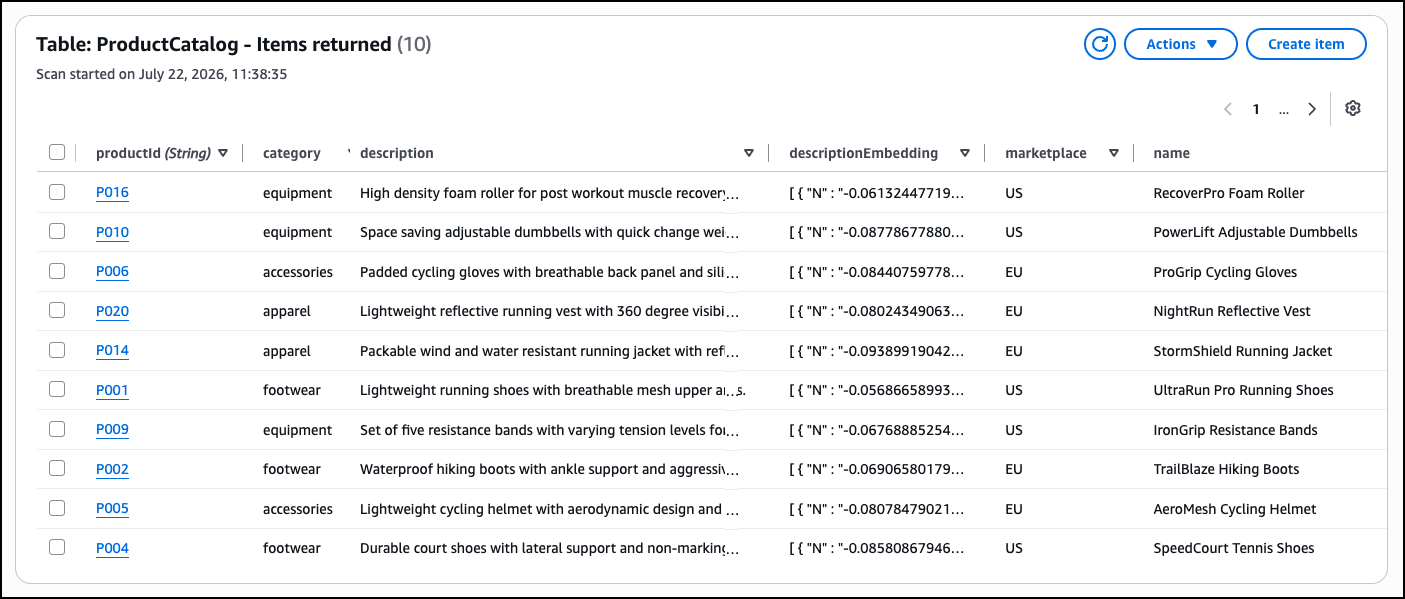
The rollout culminates in today’s general availability, making the feature accessible across all commercial regions. Developers can now upgrade existing tables instantly by generating embeddings via models like Amazon Bedrock Titan Text Embeddings, appending them to items via standard API calls, and provisioning vector indexes with minimal configuration.
Supporting Data: Architectural Efficiency and Performance Benchmarks
The integration of vector search into DynamoDB offers quantifiable advantages in infrastructure reduction, cost optimization, and query performance.
Infrastructure and Cost Reduction
By consolidating operational data and vector embeddings into a single datastore, enterprises eliminate several cost centers:

- Data Movement Costs: Eliminating synchronization pipelines stops the continuous egress and ingress traffic between operational databases and external vector stores.
- Licensing and Operational Overhead: Engineering teams no longer spend valuable hours maintaining separate database clusters, managing independent backup schedules, or troubleshooting replication failures.
- Pricing Alignment: Vectors and operational attributes share DynamoDB’s serverless pay-per-request model, ensuring organizations only pay for the storage and compute they actually consume, without over-provisioning idle vector clusters.
Performance and Scale Metrics
DynamoDB’s vector search is engineered to meet enterprise-grade performance SLAs under heavy workloads:
- Latency: Delivers responses in single-digit milliseconds, ensuring seamless integration into user-facing web and mobile applications.
- Recall Accuracy: Achieves 99%+ recall, ensuring that similarity search results are mathematically precise and relevant to user queries.
- Partitioning Mechanics: The vector index utilizes a configurable partition key (such as a
marketplaceorregionattribute). This scoping mechanism allows DynamoDB to distribute vector workloads evenly across partitions, ensuring that massive datasets maintain predictable low latencies without requiring full-index scans.
Official Guidance and Implementation Walkthrough
To illustrate the simplicity of adopting this feature, AWS provided a comprehensive reference implementation centered on an online sporting goods store utilizing a ProductCatalog table.
Step 1: Preparing the DynamoDB Table
Semantic search relies on vector embeddings—numerical representations of text generated by machine learning models that capture conceptual meaning. Two items with similar descriptions yield embeddings that sit close to one another in vector space.
Developers generate embeddings using models such as Amazon Bedrock Titan Text Embeddings, Cohere Embed, or OpenAI models. For an existing table, these embeddings are appended to each item as a list of floating-point numbers within a standard attribute (e.g., descriptionEmbedding) using an UpdateItem API call. Because DynamoDB stores vectors using its native List data type, no schema migrations or custom data types are required.
Step 2: Creating the Vector Index
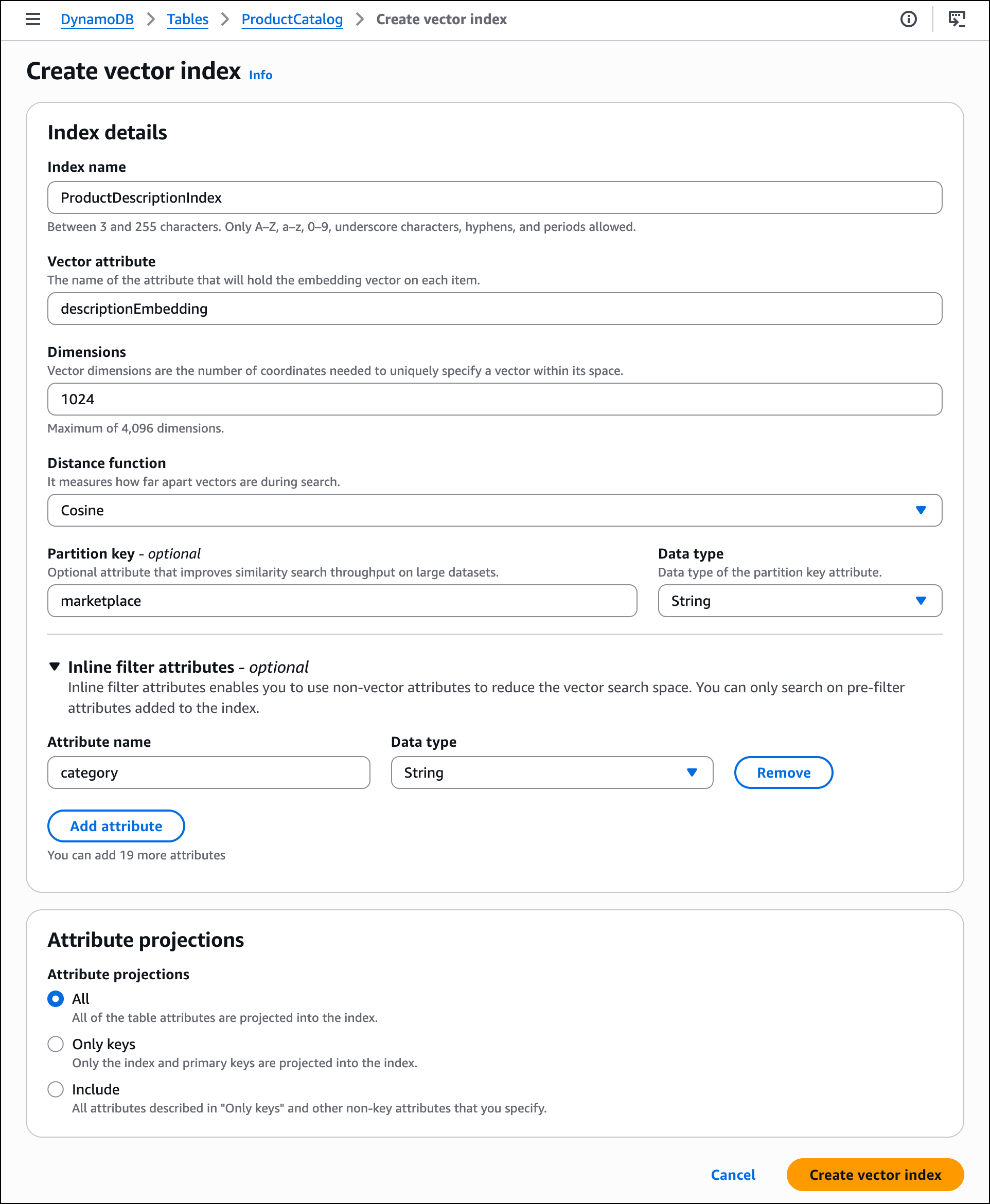
Through the AWS Management Console, AWS CLI, or Infrastructure-as-Code (IaC) tools like AWS CloudFormation, developers create a new vector index on the embedding attribute. Key parameters include:
- Index Name: A unique identifier (e.g.,
ProductDescriptionIndex). - Vector Attribute: The target attribute containing the embeddings (
descriptionEmbedding). - Dimensions: Set to match the exact output dimension count of the chosen embedding model.
- Distance Function: Configured as Cosine (ideal for comparing the semantic angle of text), Euclidean, or Dot Product.
- Partition Key: Optionally set to an attribute like
marketplaceto shard the index and optimize query performance. - Inline Filters: Non-vector attributes (such as
category) are designated as inline filters to enable strict, exact-match filtering at query time.
Step 3: Executing Vector Searches
Queries are executed via the new SearchVectors API. A natural language user query (e.g., "lightweight running shoes for summer") is transformed into a query vector using the same embedding model.
  "TableName": "ProductCatalog",
  "IndexName": "ProductDescriptionIndex",
  "SearchVector": [0.0123, -0.0456, 0.7890, "..."],
  "TopK": 5,
  "PartitionKeyValue": "US",
  "Filter":
    "category": "footwear"
DynamoDB processes the request, evaluates the similarity scores, applies the inline filters, and returns the top matching items—complete with their standard operational attributes (name, price, stock status)—in a single, unified response.
Scoring Mechanics Note: For Cosine and Euclidean distance functions, lower numerical scores denote higher similarity (where 0 represents an identical vector match). Conversely, for the Dot Product function, higher scores indicate greater similarity.
Implications: The Future of Serverless AI and Intelligent Applications
The introduction of native vector search in Amazon DynamoDB carries profound implications for software architecture, developer productivity, and the broader enterprise AI landscape.
Democratizing Advanced AI Capabilities
Historically, implementing sophisticated AI features like retrieval-augmented generation (RAG), semantic memory for autonomous AI agents, and hyper-personalized recommendation systems required specialized database knowledge and complex multi-tier infrastructure. By embedding vector search directly into one of the world’s most popular NoSQL databases, AWS lowers the barrier to entry. Mainstream application developers can now imbue traditional operational applications with cutting-edge natural language processing capabilities using standard AWS tooling and familiar APIs.
Streamlining Agentic Workflows and RAG
As organizations rapidly pivot toward generative AI agents that require long-term context and operational state management, the ability to co-locate operational memory and vector embeddings becomes paramount. Autonomous agents can now read and write state changes while simultaneously performing high-speed semantic lookups against historical logs, user preferences, and product inventories within the exact same database. This architecture eliminates consistency windows inherent in multi-database sync jobs, resulting in faster, more reliable agentic loops.
Setting a New Standard for Cloud Databases
This release underscores a broader industry trajectory: the boundary between operational databases and vector search engines is dissolving. As enterprises demand leaner architectures that minimize data movement and reduce total cost of ownership, database vendors must natively support multi-modal data types.
For current DynamoDB users, the upgrade path is frictionless. Teams can enhance existing applications with semantic search capabilities without architectural overhauls, expensive data migrations, or new operational paradigms. As AWS continues to expand its AI-adjacent cloud capabilities, DynamoDB’s evolution into a native vector datastore marks a definitive milestone in the maturation of serverless cloud infrastructure.