Seattle, WA — The Amazon Web Services (AWS) ecosystem is celebrating a major milestone this month as the AWS BuilderCenter officially marks its first anniversary. Launched initially on July 9, 2025, the platform has rapidly evolved from a foundational community hub featuring basic wishlist voting and profile management into an expansive, full-featured ecosystem. Today, the Builder Center integrates interactive sandbox environments, hands-on workshops, dedicated collaborative "Spaces," and a robust Builders’ Library, cementing its place as an indispensable digital home for cloud architects, developers, and technologists worldwide.
To commemorate the milestone, AWS leadership published extensive retrospectives detailing the platform’s meteoric rise. Rick Suttles released a comprehensive feature timeline outlining every major capability shipped over the past twelve months, while Chief Evangelist Jeff Barr shared a reflective overview capturing the community’s impressive quantitative and qualitative achievements.
As the platform steps into its second year, the introduction of friction-free Sandbox Environments stands out as a watershed moment for developer accessibility, lowering the barrier to entry for cloud experimentation and learning.
Main Facts: The Evolution and Current Scale of the Builder Center
In just one year, the AWS Builder Center has transcended traditional developer forums, morphing into a dynamic engine for technical knowledge sharing and hands-on capability building. The platform’s initial toolset—which included community profiles, a centralized toolbox, and Wishlist voting—has expanded drastically to support millions of interactions.
The platform’s current architecture boasts an impressive array of features designed to streamline the developer journey:
Global Capabilities Tracking: Users can now explore AWS Capabilities by Region, tracking more than 1,500 distinct services distributed across 37 global AWS Regions.
Community Spaces: Specialized, user-created groups that allow builders with niche interests to collaborate, share insights, and organize projects.
Curated Workshops: Hands-on learning modules equipped with advanced category and complexity filters, catering to everyone from absolute beginners to seasoned enterprise architects.
Gamification and Engagement: Introduction of a comprehensive badge and streak system (launched in March 2026), article view counts, saved items functionality, and dedicated student status tracking.
Flexible Authentication & Notifications: Seamless sign-in capabilities via GitHub and Amazon accounts, paired with granular availability notifications.
The crowning achievement of the anniversary week, however, is the rollout of Sandbox Environments—a feature engineered to eliminate the financial and administrative friction traditionally associated with testing cloud architectures.
Chronology: A Year of Rapid Iteration and Feature Deployment
Understanding the trajectory of the AWS Builder Center requires looking back at the strategic cadence of updates rolled out by the engineering and community teams since July 2025.
Phase 1: Foundation and Early Community Building (July – December 2025)
July 9, 2025: The AWS Builder Center goes live. Early iterations focus on establishing a centralized community hub where developers can vote on feature wishlists, set up developer profiles, and utilize a basic suite of developer tools.
Q3–Q4 2025: The platform begins onboarding early-adopter technical writers and thought leaders. Initial community-driven articles gain traction, establishing the Builder Center as a credible alternative to fragmented blogging platforms.
Phase 2: Expanding the Toolkit and Content Horizons (January – March 2026)
Early 2026: Integration of structured article series, advanced view-count metrics, and saved-item libraries. The platform introduces category- and complexity-filtered workshops to guide users through structured learning paths.
March 2026: The official Badge and Streak System goes live, driving a surge in daily active users and rewarding consistent community participation and content contribution.
Phase 3: Ecosystem Maturity and the One-Year Milestone (April – July 2026)
Spring 2026: Introduction of "Spaces" to foster micro-communities around specific AWS domains, alongside enhanced GitHub and Amazon sign-in integrations.
July 2026 (Anniversary Week): Rick Suttles publishes the full feature timeline, and Jeff Barr releases the one-year retrospective. Concurrently, AWS officially launches Sandbox Environments, marking the platform’s transition from an informational hub to an interactive, execution-ready cloud ecosystem.
Supporting Data: By the Numbers
The quantitative success of the AWS Builder Center over its first year defies initial projections, showcasing a deeply engaged and prolific global user base. According to official figures shared in Jeff Barr’s retrospective:
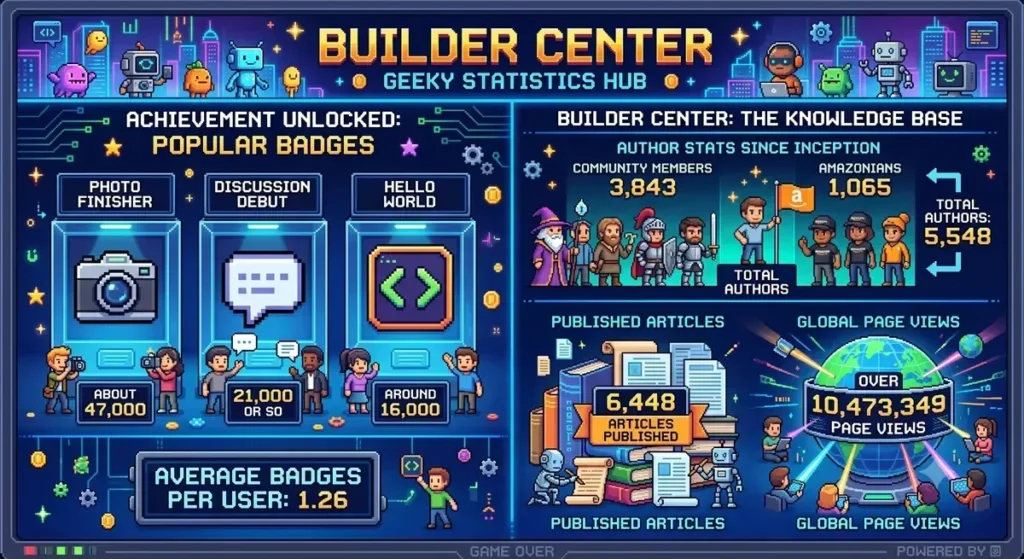
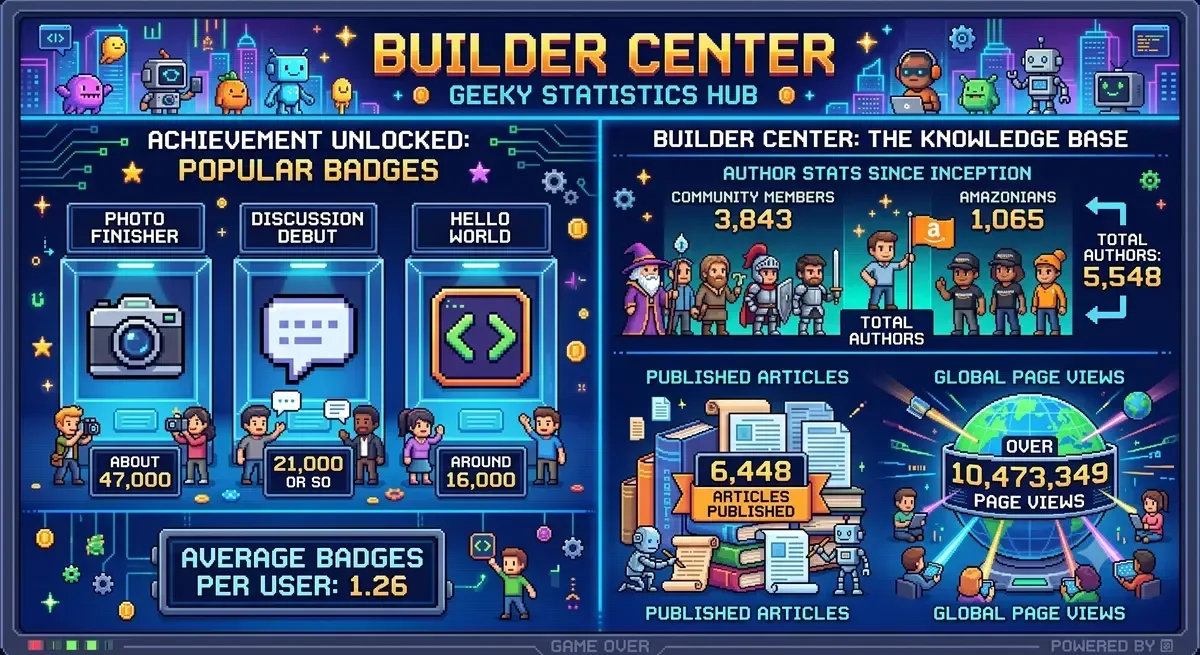
Publishing Volume: Exactly 5,548 unique authors have contributed to the platform, publishing a staggering 6,448 technical articles.
Traffic & Engagement: Collectively, these articles have generated more than 10.4 million page views, highlighting the immense appetite for peer-written, practical AWS documentation and guides.
Gamification Success: Since its introduction in March 2026, the badge system has distributed 99,226 badges to active platform participants.
Community Feedback Loop: Community members have submitted 565 official wishes via the platform’s feedback mechanism. Out of these, 10 features have already been fully shipped, while another 20 are actively sitting on the near-term product roadmap.
Top-Performing Community Articles
The platform’s top-tier articles have driven massive traffic, each breaking viewership milestones through highly specialized, cutting-edge technical tutorials:
"Building an AWS Study Buddy with MCP + Strands Agents SDK" by Dineshraj Dhanapathy — 50,000+ views. This deep dive into modern agentic workflows captured the imagination of developers looking to integrate Model Context Protocol (MCP) with AWS services.
"Migrating an EOL Linux Server to AWS in 8 Hours with Kiro" by Chris Miller — 45,000+ views. A high-utility, time-sensitive migration guide addressing enterprise challenges associated with End-of-Life operating systems.
"AIdeas: NeuroVoice – Multimodal AI for Early Screening of Neurological Diseases" by Yash Aggarwal — 38,000+ views. A groundbreaking exploration into healthcare-focused multimodal artificial intelligence applications built on AWS architecture.
Official Responses and Spotlight on Sandbox Environments
The standout announcement of the anniversary week is the official release of Sandbox Environments on AWS Builder Center, introduced by Rick Suttles. For years, one of the primary hurdles for nascent cloud learners and developers looking to test quick architectural hypotheses has been the friction of setting up dedicated personal accounts, managing billing alerts, attaching credit cards, and meticulously cleaning up resources to avoid unexpected charges.
How Sandbox Environments Work
The newly launched Sandbox feature completely reimagines the hands-on learning experience:
Zero Financial Risk: Users receive a completely free, pre-provisioned AWS account specifically tailored to complete workshop exercises and technical explorations.
Automated Lifespan: Each sandbox environment remains active for a strict duration of 8 hours. Once the window closes, the account and all associated resources are automatically, permanently de-provisioned.
Fair Usage Limits: To ensure equitable access across the global community, builders are permitted one active sandbox at a time and may request one new sandbox per week.
Absolute Simplicity: No personal AWS account credentials, credit card pre-authorizations, or manual resource cleanup scripts are required.
"Sandboxes eliminate the friction of getting your hands dirty with AWS," noted platform architects during the rollout. "Whether you’re following a workshop or testing a hunch from an article, you can spin up an environment, run your tests, walk away, and let automated de-provisioning handle the rest."
Implications: What This Means for Developers and the Cloud Industry
The maturation of the AWS Builder Center into an interactive ecosystem carries profound implications for the broader cloud computing landscape.
1. Democratizing Cloud Education
By coupling peer-reviewed technical articles and structured workshops with instant, free sandbox environments, AWS is effectively lowering the barrier to entry for enterprise-grade cloud architecture. Students, independent developers, and engineers transitioning from legacy systems no longer face financial barriers when attempting to upskill. The inclusion of student status tracking and specialized academic pathways further bridges the gap between theoretical computer science education and practical cloud implementation.
2. Strengthening the Developer Feedback Loop
The success of the Wishlist voting system—resulting in 10 shipped features and 20 more on the roadmap—signals a structural shift in how AWS prioritizes developer tooling. Rather than relying solely on top-down enterprise requests, AWS product teams are utilizing the Builder Center as an organic listening post, allowing grassroots developer sentiment to directly influence service roadmaps and regional capability rollouts.
3. Fostering a Decentralized Knowledge Economy
The millions of page views generated by authors like Dineshraj Dhanapathy, Chris Miller, and Yash Aggarwal prove that the developer community hungers for authentic, practitioner-led documentation. By providing a centralized stage complete with analytics, saved-item libraries, and collaborative Spaces, AWS has successfully cultivated a thriving internal knowledge economy. This ecosystem not only reduces the support burden on official documentation teams but also accelerates the discovery of innovative, unconventional architectural patterns.
Looking Ahead: Summer 2026 and Beyond
As Esra Kayabali noted in the anniversary week’s closing remarks, the platform is not resting on its laurels. With developers taking a brief seasonal pause—some traveling to cooler climates like Scandinavia to recharge—the engineering teams behind the Builder Center are already prepping the next wave of updates.
For developers eager to dive in, the directive is clear: visit the AWS Builder Center to explore the new Sandbox Environments, join community Spaces, and contribute solutions. As the platform embarks on its second year, it stands as a testament to what happens when community-driven knowledge meets frictionless cloud infrastructure.