Bridging the Chasm: Why Machine Learning Systems Engineering is AI’s Missing Foundation
By Jason Jabbour, Kai Kleinbard, and Vijay Janapa Reddi (Harvard University)
In the fast-evolving landscape of artificial intelligence, a colorful industry adage has captured a profound operational truth: "Everyone wants to do the modeling work, but no one wants to do the engineering." To use an interstellar analogy: if machine learning developers are the adventurous astronauts exploring uncharted frontiers, ML systems engineers are the meticulous rocket scientists designing, building, and stress-testing the engines that make those journeys possible. Without them, even the brightest algorithmic minds remain permanently grounded.
Introduction: The Looming Divide in Artificial Intelligence
The allure of artificial intelligence has historically centered on its magic. From computer vision models that diagnose diseases from medical imaging to massive generative transformers capable of drafting poetry, the spotlight invariably shines on the model. However, this fascination conceals a critical vulnerability in modern tech stacks: a glaring disparity between the glamorous world of algorithmic modeling and the grueling, highly technical realities of ML systems engineering.
Machine learning and systems engineering are inextricably linked. No matter how innovative a neural network might be, it remains computationally demanding, resource-intensive, and fundamentally dependent on hardware execution. With the explosive rise of generative AI, large language models (LLMs), and hyper-complex multi-modal architectures, understanding how underlying infrastructure scales is no longer optional—it is a core survival metric for modern enterprises. Ignoring system limitations during the model development phase is a recipe for operational failure, skyrocketing cloud bills, and sluggish inference times.

Yet, despite the critical nature of ML infrastructure, educational resources addressing the systems side of the equation have historically lagged far behind. While thousands of textbooks, university syllabi, and bootcamps focus on deep learning theory, optimization mathematics, and model architecture, there remains a stark deficit in materials detailing how to deploy, monitor, and optimize these models at scale. Critical industry questions—such as how to tailor models for specific hardware accelerators, manage distributed training clusters, and guarantee end-to-end system reliability—remain poorly understood by many practitioners.
This knowledge gap is rarely born of disinterest; rather, it reflects a historical silo between computer systems architecture and machine learning research. Fortunately, pioneering open-source educational initiatives, most notably MLSysBook.ai, are stepping forward to bridge this chasm, providing actionable blueprints for the next generation of AI builders.
Chronology and Evolution: From Academic Coursework to Global Open-Source Standard
The journey toward institutionalizing machine learning systems engineering as a distinct discipline is rooted in academic pragmatism.
The Harvard Origins (2023)
The foundation of MLSysBook.ai was laid within the halls of Harvard University as part of the CS249r Tiny Machine Learning (TinyML) course, spearheaded by Vijay Janapa Reddi and his research collaborators. Recognizing that students were exiting traditional computer science programs with brilliant theoretical knowledge of neural networks but little understanding of how those networks actually execute on resource-constrained physical hardware, the course sought to merge software design with hardware realities.

Expansion to Digital Platforms
Building upon the momentum of the physical classroom, the curriculum expanded to digital learners worldwide via the HarvardX TinyML Professional Certificate series on edX. As thousands of students enrolled, the limitations of static PDF textbooks and traditional lecture formats became apparent. The material required a living, breathing format capable of adapting to a fast-moving industry.
The Collaborative Evolution
What began as a localized university course note evolved into an open-source, collaborative textbook project. By inviting contributions from global engineers, researchers, and students, MLSysBook.ai transformed into a comprehensive resource covering the entire end-to-end machine learning lifecycle—from raw data ingestion and model quantization to real-world edge deployment and large-scale cloud inference.
Supporting Data and Technical Architecture: System-Level Thinking
To understand the core thesis of ML systems engineering, one must look beyond the abstract code of a neural network and examine the physical and computational pipeline required to keep it running. Whether designing for a battery-powered microcontroller on the edge or a massive server farm housing thousands of GPUs, the foundational lifecycle of an ML system remains remarkably consistent.
The End-to-End ML Lifecycle
- Data Engineering: The foundational bedrock of any AI system. Raw data must be gathered, cleaned, cataloged, and transformed into structured pipelines before a single weight can be updated.
- Model Development: The creation, training, and iterative refinement of neural network architectures designed to solve specific classification, regression, or generative tasks.
- Model Optimization: The critical phase where trained models are tuned to run efficiently under strict hardware constraints. Techniques such as quantization (e.g., converting 32-bit floating-point numbers to 8-bit integers) drastically reduce memory footprints without sacrificing predictive accuracy. Whether deploying INT8 arithmetic on tiny embedded devices or FP16 precision in massive data centers, optimization determines whether a model is economically viable at scale.
- Deployment & Scaling: Translating experimental code into production-grade environments. Models must integrate seamlessly with existing software infrastructure, handling fluctuating request loads with minimal latency.
- Monitoring and Maintenance: The lifecycle does not end at deployment. Continuous monitoring ensures that models adapt to concept drift, data shifts, and infrastructure degradation, guaranteeing long-term system health and reliability.
Bridging Theory to Ecosystems: The TensorFlow Mapping
While pedagogical resources like MLSysBook.ai focus heavily on agnostically teaching foundational principles rather than pushing specific proprietary tools, mapping these concepts to established industry ecosystems provides invaluable clarity.

For instance, within the TensorFlow ecosystem, specific tools align directly with the stages of the ML systems lifecycle:
- TensorFlow Data handles heavy-duty data engineering and pipeline optimization.
- Keras and core TensorFlow APIs support flexible model development.
- TensorFlow Lite and Model Optimization Toolkit handle quantization and hardware-specific compilation for edge devices.
- TensorFlow Serving and TFX (TensorFlow Extended) provide robust pipelines for production deployment, monitoring, and scaling.
This intersection illustrates how theoretical systems principles manifest in day-to-day enterprise engineering.
Official Perspectives and Innovative Pedagogies: Introducing SocratiQ
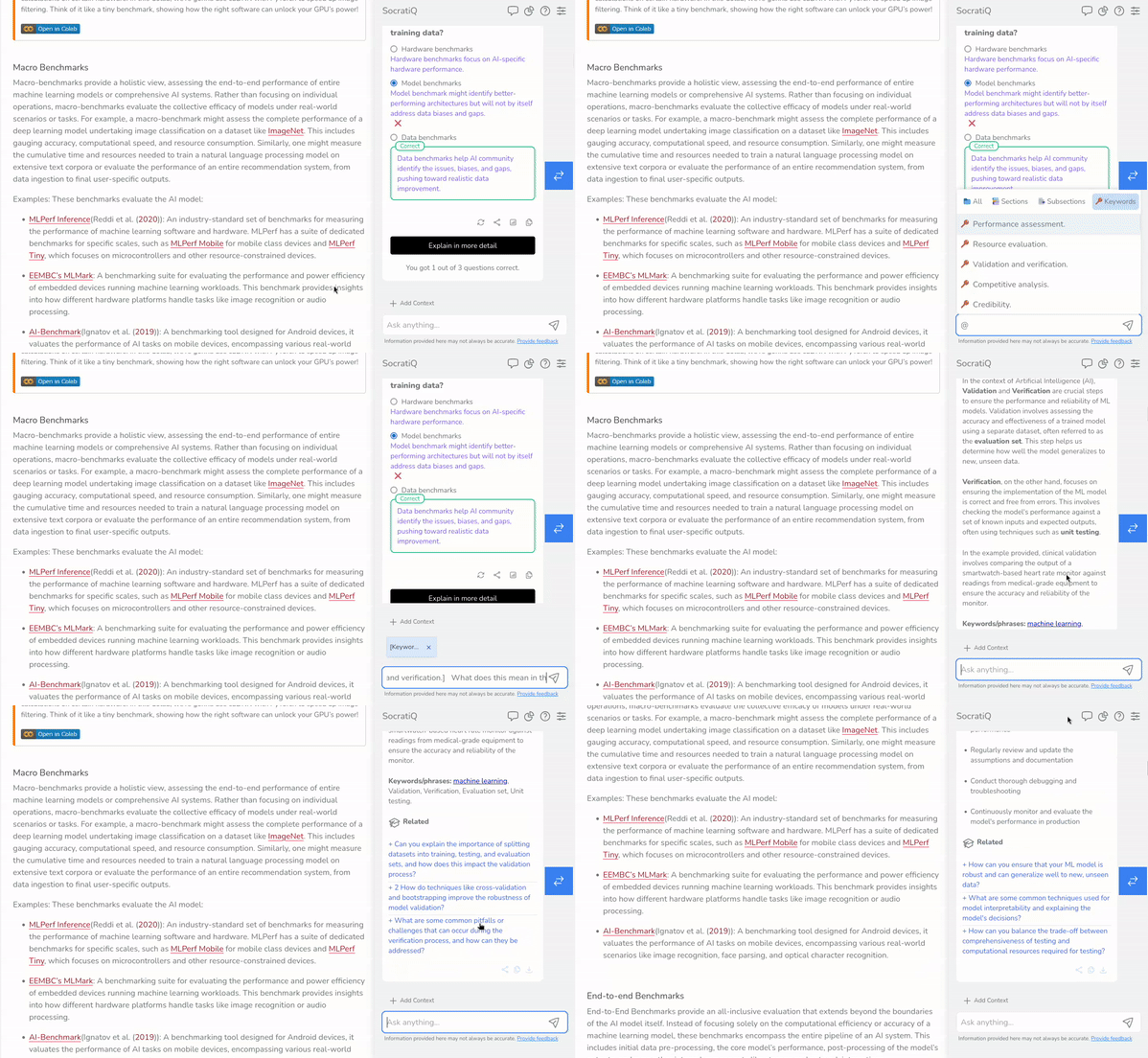
As educational content shifts online, passive reading is increasingly giving way to interactive, AI-assisted learning. To revolutionize how students absorb complex systems engineering concepts, the creators of MLSysBook.ai integrated a custom generative learning assistant known as SocratiQ.
Active vs. Passive Learning
Traditional technical textbooks suffer from a fundamental flaw: they are static. Readers often passively consume complex mathematical formulations or systems architecture diagrams without testing their comprehension. SocratiQ, powered by advanced Large Language Models (LLMs), flips this dynamic on its head.

How SocratiQ Enhances the Learning Journey
- Real-Time Interactive Quizzing: As readers progress through chapters on memory management, hardware acceleration, or distributed training, SocratiQ dynamically generates context-aware quizzes to verify understanding.
- Conversational Clarification: If a reader stumbles over a dense systems concept—such as cache locality or gradient checkpointing—they can engage in a real-time conversational dialogue with the AI assistant to unpack the terminology in simpler terms.
- Performance Dashboards: Learners can track their conceptual mastery over time via visual diagnostic dashboards, identifying weak spots in their understanding of the ML lifecycle.
- Invisible Integration: Crucially, SocratiQ is designed not to overwhelm the user. It operates as a subtle, unobtrusive guide, offering assistance, prompts, and deep-dives when summoned, then stepping back to let the reader remain immersed in the primary text.
Looking ahead, the development team plans to introduce research lookup integrations and real-world case studies into SocratiQ, turning MLSysBook.ai into a living educational environment that evolves alongside both the student and the broader AI industry.
Implications and Global Impact: Why Every Star Counts
The deficit of ML systems engineering talent has direct consequences for the global technology sector. Companies routinely invest millions of dollars into acquiring state-of-the-art models, only to watch deployments fail due to poor latency management, excessive cloud computing overhead, or an inability to scale under production traffic.
Addressing this shortfall requires a concerted global effort to elevate systems engineering to an equal footing with algorithmic research. Initiatives like MLSysBook.ai are not merely academic exercises; they are critical interventions designed to democratize access to high-level systems knowledge.
A Community-Driven Mission
To accelerate this educational mission, the project relies on open-source community engagement. The authors have tied a unique philanthropic incentive to their GitHub repository:

- Every "star" ⭐️ given to the MLSysBook.ai repository translates into direct financial sponsorships provided by project backers.
- These funds are channeled directly into supporting students and underrepresented minorities globally, funding research scholarships and empowering diverse innovators to drive the future of machine learning systems.
By simply clicking a button to star an open-source educational repository, developers around the world can directly contribute to training the next generation of infrastructure engineers.
Hosting these resources in open formats ensures that knowledge is widely accessible. For those interested in auditory learning alongside text, the team has even generated an introductory podcast via Google’s NotebookLM, offering another accessible entry point into the discipline.
Conclusion
The historical chasm between machine learning modeling and systems engineering is slowly closing, but the journey is far from complete. As artificial intelligence continues its relentless march into every facet of modern industry—from autonomous vehicles and healthcare diagnostics to enterprise automation—the demand for professionals who understand both algorithmic theory and hardware execution will skyrocket.
Investing time in mastering ML systems engineering is no longer a niche career specialization; it is an essential professional imperative. Whether you are a seasoned software architect or a university student taking your first steps into artificial intelligence, understanding how to build robust, scalable, and optimized systems will define the ultimate impact of your work.

As the AI community frequently reminds itself: even the most brilliant astronauts require world-class rocket scientists to build the engines that take them to the stars.
Acknowledgments:
The authors extend their gratitude to Josh Gordon for his valuable suggestions in initiating this discourse, and for sharing critical insights on how open educational resources can better serve the broader machine learning engineering community.