Securing the World’s Conversations: Inside WhatsApp’s Massive Transition to Passkeys
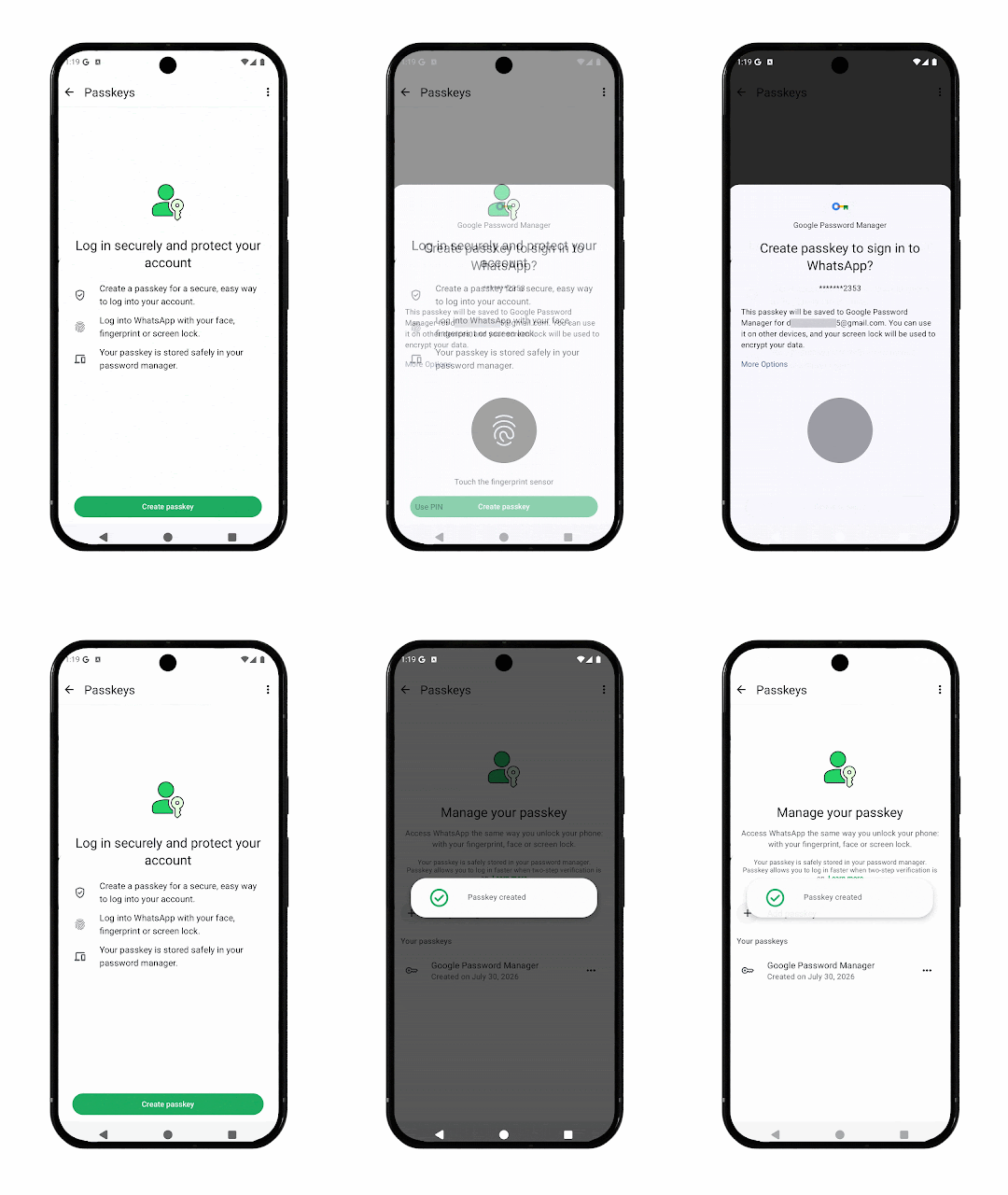
In the landscape of global digital communication, few platforms command the ubiquity of WhatsApp. Serving billions of users across vastly different socio-economic regions and technical environments, the platform acts as a critical lifeline for personal and professional interaction. However, this massive scale creates a significant security challenge: how do you protect billions of accounts from sophisticated phishing and credential theft while ensuring that access remains effortless for the average user?
The answer, as WhatsApp discovered in 2023, lies in the transition from traditional, friction-heavy authentication methods to the streamlined power of passkeys. By becoming one of the first major global applications to implement FIDO-certified passkey technology, WhatsApp has set a new industry benchmark for how consumer-facing platforms can balance high-level security with a frictionless user experience.
The Strategic Shift: Moving Beyond OTPs
For years, the gold standard for verifying identity on mobile platforms was the One-Time Password (OTP) sent via SMS. While ubiquitous, this method is fundamentally flawed. OTPs are susceptible to SIM-swapping, interception, and phishing attacks, and they often fail in regions with unstable network infrastructure.

Recognizing the need for a more robust solution, WhatsApp’s Registration and Access team began exploring passkeys. "What excites me most is the sheer scale of WhatsApp’s impact," explains Mayank Manuja, an Android Engineer at Meta who spearheaded the passkey implementation. "Even a small improvement to WhatsApp touches billions of users worldwide. By moving to passkeys, we aren’t just improving security; we are removing a significant barrier to entry for our users."
The transition was not merely a feature update—it was a foundational shift in how the app handles identity. Passkeys leverage public-private key cryptography, allowing users to authenticate using familiar biometric gestures—like a fingerprint scan or a face unlock—or their device’s screen lock. This eliminates the need for manual code entry, drastically reducing the time required to sign in while providing a cryptographic shield that is inherently phishing-resistant.
Chronology of a Security Revolution
The journey to universal passkey adoption was marked by careful planning, iterative design, and deep technical collaboration between Meta and Google.

- Early 2023: Exploration and Concept Testing. WhatsApp identified the potential of passkeys as a means to mitigate account takeover (ATO) attacks. Because no established UI patterns existed for passkey creation at the time, the team began extensive A/B testing to determine how to introduce the feature without overwhelming users.
- Mid-2023: Technical Integration. The engineering teams utilized the Credential Manager API, a unified Android interface that abstracts the complexity of different credential providers. By mapping out the "happy path"—the ideal user journey—the team began building the framework for both registration and authentication.
- Late 2023: The Rollout. WhatsApp officially began rolling out passkey support. The team navigated the complexities of diverse Android ecosystems, managing edge cases across thousands of OEM devices, varied Android OS versions, and disparate user digital literacy levels.
- 2024–Present: Scaling and Refinement. Following the successful launch, WhatsApp refined the UI into a single-screen, frictionless experience. The team shifted focus toward backend optimization, ensuring the server-side architecture could handle the massive throughput required for billions of active accounts.
Technical Infrastructure: The Erlang-Rust Pipeline
To support a global user base, WhatsApp’s backend architecture had to be exceptionally efficient. The server-side implementation is built primarily in Erlang, a language renowned for its ability to handle massive concurrency. To manage the cryptographic heavy lifting, the team utilized the webauthn-rs library, which allows the server to perform secure signature verification and credential parsing.
The server architecture is divided into two primary ceremonies: Registration and Authentication.
Registration Flow
When a user decides to create a passkey, the server issues creation options to the client. The Erlang backend handles the "Begin" phase by generating a unique challenge and ensuring the user’s device is prepared to store the credential. Once the client returns the attestation, the "Finish" phase verifies the signature and maps the credential ID to the user’s account. By using a multi-passkey approach, WhatsApp allows users to maintain access across different devices without sacrificing security.

Authentication Flow
During sign-in, the server orchestrates a similar request-response pattern. The system verifies the user’s assertion against the stored public key. If the authentication succeeds, the server grants access. Crucially, the system is designed to be dynamic; if WebAuthn signals that a credential needs a refresh, the backend automatically updates the stored data, ensuring the user experience remains uninterrupted.
Overcoming Global Edge Cases
Building for "the next billion users" requires accounting for the unexpected. The collaboration between WhatsApp and Google revealed that a "one-size-fits-all" approach to authentication would fail.
The development team encountered several significant hurdles:

- Device Fragmentation: Users on older Android versions or devices without biometric sensors required fallback mechanisms. The team had to ensure that the transition from PINs to biometrics remained seamless.
- Network Inconsistency: In regions with poor connectivity, traditional auth flows often timed out. Passkeys, being locally handled on the device, proved to be far more resilient.
- Cross-Platform Synchronization: Rather than relying on fragile Bluetooth-based cross-device transfers, WhatsApp opted for a native-first approach. Users can generate fresh passkeys when migrating platforms (e.g., from Android to iOS), ensuring that security is never dependent on a third-party transport layer that might be confusing or unreliable.
Official Perspective: The Human Element
The success of this project is largely attributed to the synergy between product design and engineering. Tracy Agyemang, a Product Marketing Manager at Google, noted that the key to adoption was simplicity. "We didn’t want to explain the ‘how’ of cryptography to the user," she explained. "We wanted them to feel the ‘why’—which is the speed and the peace of mind that comes with knowing their account is locked to their physical device."
The design philosophy focused on reducing the "cognitive load" of the login process. By using a single-screen setup and utilizing the Android OS’s native UI, WhatsApp ensured that the passkey prompt felt like a natural extension of the operating system rather than an intrusive third-party request.
Implications for the Future of Identity
The implications of WhatsApp’s move to passkeys extend far beyond the app itself. By demonstrating that a massive, global-scale platform can successfully move away from SMS-based OTPs, WhatsApp has provided a roadmap for other industries—such as banking, healthcare, and e-commerce—to follow.

1. The Death of Phishing
Because passkeys are bound to the origin of the website or app, they are immune to phishing. Even if a user is tricked into visiting a malicious site, that site cannot request or obtain a valid passkey signature, effectively neutralizing the most common vector for account takeovers.
2. Enhanced In-App Security
WhatsApp is now looking to expand the utility of passkeys beyond the initial sign-in. Future iterations may include using biometric passkey prompts to authorize sensitive actions, such as restoring encrypted cloud backups or changing critical account settings. This creates a "tiered" security model where the most sensitive actions require the highest level of cryptographic proof.
3. Industry Standardization
As more developers adopt the Credential Manager API, the "fragmented" nature of Android authentication will begin to coalesce. The work done by the WhatsApp team—documenting their edge cases, refining their UI, and optimizing their backend—serves as a template for other developers to bypass the "trial and error" phase of implementation.

Recommendations for Developers
For teams looking to integrate passkeys at a similar scale, the WhatsApp team offers three core recommendations:
- Prioritize Contextual Prompts: Do not force passkey creation on every user immediately. Instead, target users during high-intent moments, such as after a successful manual login or when they have demonstrated an interest in account security.
- Abstract Complexity: Utilize native platform APIs (like Android’s Credential Manager) rather than building custom wrappers. This ensures better compatibility with future OS updates and reduces technical debt.
- Focus on Recovery: Always ensure that if a user loses their primary device, there is a clear, secure path to regain account access. Passkeys should complement, not replace, a robust account recovery strategy.
Conclusion
WhatsApp’s implementation of passkeys represents a watershed moment in the history of mobile security. By successfully migrating one of the world’s most complex user bases to a system that is simultaneously more secure and easier to use, the platform has proven that security does not have to come at the cost of convenience. As the industry continues to move toward a "passwordless" future, the lessons learned by the teams at Meta and Google will serve as the foundation for the next generation of digital identity.
For developers ready to begin their own journey, the tools are already available. Through the Credential Manager API and a commitment to user-centric design, the goal of a secure, phishing-free internet is no longer a distant ideal—it is a reality that is already in the hands of billions.