A Paradigm Shift in Rust: The Next-Generation Trait Solver Enters Nightly
After nearly four years of intensive, high-stakes engineering, the Rust project has reached a monumental milestone. The "next-generation trait solver"—the most significant internal architectural overhaul of the Rust compiler since its initial release—is now enabled by default in the nightly build. This transition marks the beginning of the final stabilization push, signaling a transformative era for the language’s type system.
As the compiler team prepares to fully integrate this change in the coming months, the community is being called upon to test, validate, and report on the stability of this new core engine.
The Magnitude of the Change
At its core, the Rust compiler is a complex engine that must prove that every line of code satisfies the language’s strict type-safety rules. This process, known as "trait solving," is the engine room of the compiler. It is responsible for evaluating where-clauses, normalizing associated types, and ensuring that complex generic code remains sound.
The new solver completely replaces the legacy implementation. This is not a mere refactor; it is a fundamental architectural rewrite that changes how the compiler "thinks." By replacing the aging, hard-to-maintain logic with a modern, modular design, the Rust team is finally addressing the limitations that have constrained the language’s type system for years.
Chronology: Four Years in the Making
The path to this moment has been long and deliberate. The project, often referred to within the compiler team as the "next-solver," was born out of a realization that the existing implementation had reached its technical ceiling.
- Initial Conception (2021-2022): The design phase focused on identifying the architectural bottlenecks of the original solver. Developers recognized that the old system struggled with complex "higher-ranked" types and edge cases in trait resolution that often led to compiler hangs or opaque error messages.
- Development and Prototyping (2023-2024): The team began building a new, logic-based solver architecture. This phase was characterized by "dogfooding," where the new solver was tested against smaller parts of the compiler’s internal logic to ensure it could handle the massive complexity of the Rust standard library.
- The Performance Push (Late 2024-Present): As the solver matured, the focus shifted to performance. Early prototypes were significantly slower than the legacy system, sometimes by orders of magnitude. The last several months have been defined by a relentless optimization effort, involving a core group of contributors who systematically identified and resolved quadratic and exponential time complexity bottlenecks.
Supporting Data: Testing the Limits
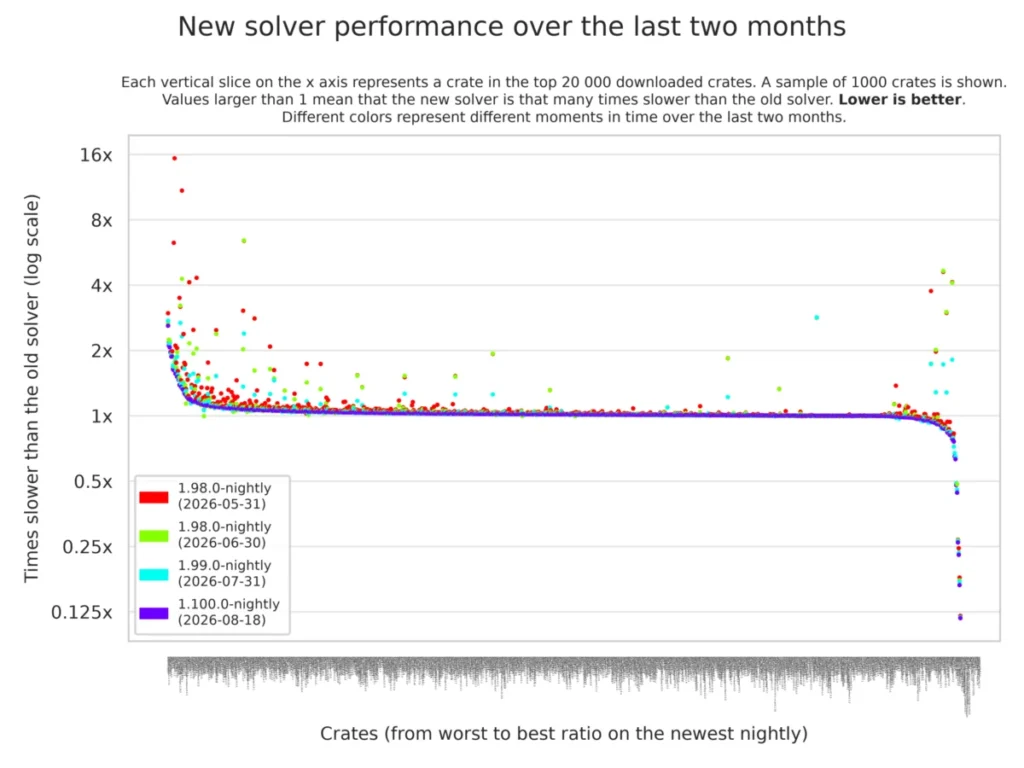
The transition to the new solver has been supported by rigorous data analysis. Rémy Rakic, a key contributor, conducted a massive performance audit across the top 20,000 crates on crates.io. The resulting data provided a clear roadmap for the final optimization phase.
The performance metrics, visualized in recent internal reports, demonstrate that while the new solver initially showed regressions in specific edge cases, the current nightly build has brought the vast majority of crates to performance parity with the old system. More impressively, the team has identified "outlier" crates—projects that previously struggled or outright failed to compile due to the complexity of their trait logic—that are now compiling significantly faster.
For instance, a notable stress test—a chess engine implemented entirely within Rust’s type system—was previously unable to complete its compilation process using the old solver. With the new engine, the same code compiles in approximately one minute. Similarly, major ecosystem players like datafusion have reported compilation speed-ups of up to 8x. These benchmarks serve as evidence that the investment in the new solver will pay dividends in long-term developer productivity.
Official Responses and Collaborative Effort
The development of the new solver has been a collaborative triumph. While many have contributed, the team specifically credits Nick Nethercote, jana, Rémy Rakic, and mira for their exhaustive work on compiler diagnostics and performance tuning.
"We’ve spent a lot of time on the compile-time performance of the next-generation trait solver," notes the compiler team in their latest announcement. "There have been many cases where it performed quadratically or even exponentially slower than the old solver. Especially the last few weeks were mainly spent on improving performance… our work has made a few of them actually compile faster than with the old solver."

The project leads emphasize that the transition is not without friction. They acknowledge that the new solver will cause a "non-trivial amount of breakage" for some projects, particularly those that relied on undefined or buggy behaviors in the old type system. These breakages are, in many cases, considered intentional improvements in type inference.
Implications: Unlocking the Future of Rust
The primary benefit of the new solver is not merely the current performance gains, but the technical debt it clears to make room for future language features. By removing the old, rigid implementation, the team has unblocked several highly requested capabilities:
Type Alias Impl Trait (TAIT) and Return Type Notation (RTN)
These features, which have been in a state of purgatory for years, require a robust and predictable type solver to function. The new engine provides the stability necessary to finally move these features toward stabilization, allowing for more ergonomic and flexible API designs.
Implicit Default Trait Bounds
The new solver enables the implementation of advanced traits like Move and Forget. These traits are essential for better control over memory ownership and destruction, providing developers with more granular tools to manage resource lifecycles—a critical requirement for systems programming.
Fixing Unsoundness
Perhaps most importantly, the new solver allows the team to address the "remaining type system unsoundnesses." These are deep-seated bugs in how the compiler verifies code that could potentially lead to memory safety issues in extreme edge cases. With the new engine, the compiler is significantly more precise, ensuring that Rust’s promise of "fearless concurrency" and memory safety remains absolute.
How to Participate
The Rust project is now calling for community-wide testing. Because the new solver handles some type-checking scenarios differently, developers are encouraged to update their nightly toolchain using rustup update nightly and build their projects.
What to look for:
- Compile-time performance regressions: If a project takes significantly longer to build, it is a high-priority bug.
- Diagnostic quality: The team has acknowledged that error messages for the new solver are still in their infancy. Users are encouraged to report any "poor" or confusing error messages.
- Regression bugs: If code that previously compiled no longer does, the team wants to know.
Users are advised to check the official pinned GitHub issue before reporting, as many known breakages are already being tracked. For projects that need to temporarily revert to the legacy solver to maintain production readiness, the compiler provides a simple escape hatch via the -Znext-solver=coherence flag.
Conclusion
The move to the next-generation trait solver is a defining moment for Rust. It is a rare example of a language project choosing to undertake a massive, risky, and multi-year overhaul to ensure the long-term health and capability of its core technology. While the immediate transition will require effort from the community to resolve lingering edge cases, the result will be a more performant, more consistent, and more powerful Rust. As the compiler team works toward the final stabilization, the message is clear: the future of Rust’s type system is here, and it is ready to be battle-tested.