Amazon DynamoDB Introduces Native Vector Search: A Paradigm Shift for Serverless Operational Databases
SEATTLE — In a major development for cloud database architecture, Amazon Web Services (AWS) has announced the general availability of native vector search in Amazon DynamoDB. The release enables developers and enterprises to store high-dimensional vector embeddings directly alongside their standard operational data within DynamoDB tables, executing high-speed similarity searches without the traditional requirement of replicating data to specialized vector databases.
The announcement eliminates one of the most persistent architectural friction points in modern application development: maintaining decoupled data silos for transactional records and machine learning embeddings. By embedding vector capabilities natively into its serverless architecture, AWS is positioning DynamoDB as a unified store capable of handling both heavy-duty transactional workloads and real-time semantic retrieval at web scale.
Main Facts: What Native Vector Search Means for DynamoDB
The integration of vector search into Amazon DynamoDB brings enterprise-grade machine learning retrieval directly to the world’s most popular fully managed NoSQL database service.
- Performance and Scale: The service delivers single-digit millisecond latency while maintaining a recall rate of 99% or higher. It is engineered to scale horizontally with no storage limits, capable of supporting workloads containing trillions of vectors.
- Serverless Architecture: True to DynamoDB’s core identity, the new vector search feature is completely serverless. There are no servers to provision, patch, or manage, and no software to install or operate. It features zero-downtime maintenance and operates on DynamoDB’s familiar pay-per-request pricing model.
- Technical Specifications: The feature supports vectors with up to 4,096 dimensions. It incorporates three primary distance functions—Cosine, Euclidean, and Dot product—giving developers mathematical flexibility based on their specific machine learning use cases.
- Hybrid Operations: Developers can perform inline filtering at query time, combining vector similarity metrics with exact-match operational attributes (such as category or region) within a single API call (
SearchVectors).
Chronology: The Journey to Native NoSQL Semantic Search
The path to integrating vector search directly into DynamoDB reflects the broader industry-wide transition toward generative AI and semantic retrieval architectures.
Phase 1: The Multi-Database Era (Pre-2023)
For years, developers building modern AI applications—such as Retrieval-Augmented Generation (RAG) pipelines, recommendation engines, and agentic memory systems—faced a fragmented architectural reality. While operational data lived in transactional engines like DynamoDB, vector embeddings had to be stored in dedicated, standalone vector databases.

This separation forced engineering teams to build, test, and maintain complex data synchronization pipelines. These pipelines introduced latency, increased operational overhead, drove up data movement and licensing costs, and struggled to maintain predictable, low-latency performance under massive scale.
Phase 2: Architectural Convergence (2023–2025)
As generative AI moved rapidly from experimentation to mission-critical enterprise production, the industry recognized the urgent need for database consolidation. Enterprises grew fatigued by the operational burden of managing multi-store architectures. AWS responded by evaluating how to integrate vector indices directly into its flagship database lines, aiming to combine the millisecond response times of NoSQL operational stores with the mathematical proximity searching required by modern AI models.
Phase 3: General Availability and Immediate Deployment (Today)
With today’s announcement, native vector search in DynamoDB is generally available across all commercial AWS Regions, including AWS GovCloud (US) Regions. Developers can immediately begin implementing semantic search capabilities using standard AWS management tools, software development kits (SDKs), and infrastructure-as-code (IaC) frameworks.
Supporting Data & Technical Mechanics
To understand the engineering breakthrough behind DynamoDB’s vector search, it is helpful to examine how data is structured, indexed, and queried under the hood.
Data Storage without Schema Changes
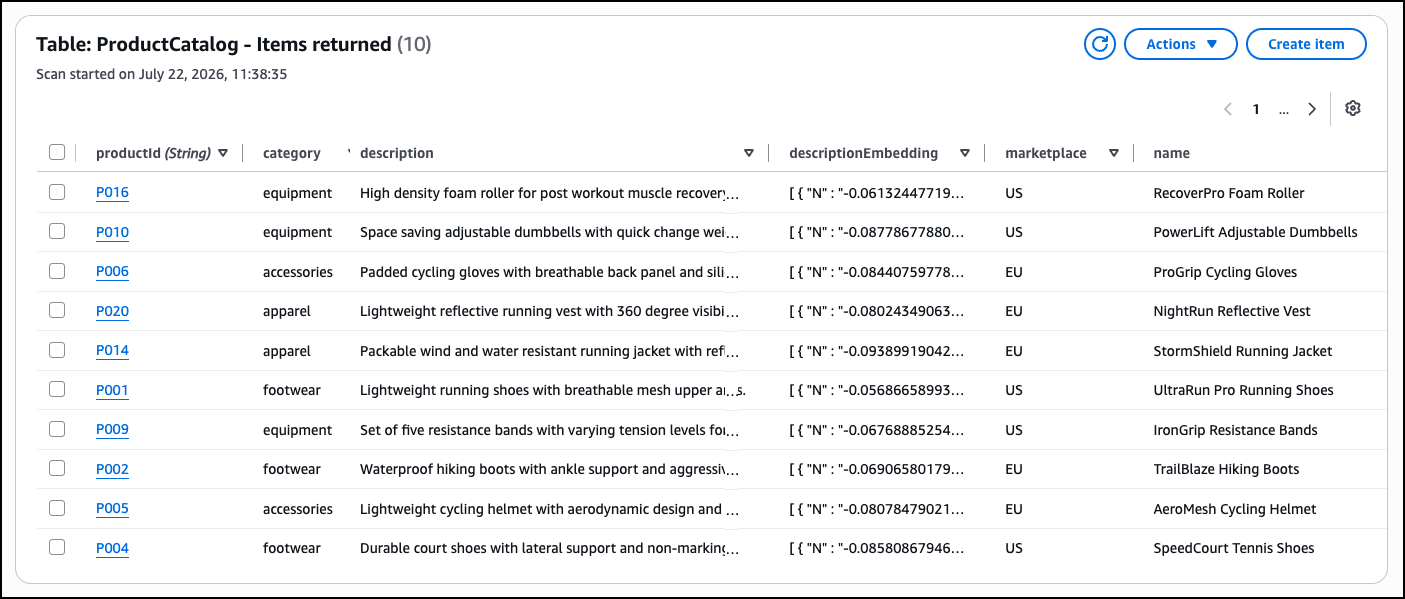
In DynamoDB, vector embeddings are stored using the database’s existing native List data type. Each element within the list is a Number representing an individual floating-point value of the embedding vector.

For instance, if an enterprise has an existing table named ProductCatalog, developers can generate vector embeddings using models such as Amazon Bedrock Titan Text Embeddings, Cohere Embed, or OpenAI text-embedding models. These embeddings are then added to existing items as a new attribute (e.g., descriptionEmbedding) via a standard UpdateItem API call. This eliminates the need for radical schema redesigns or custom data ingestion wrappers.
Indexing and Partition Keys
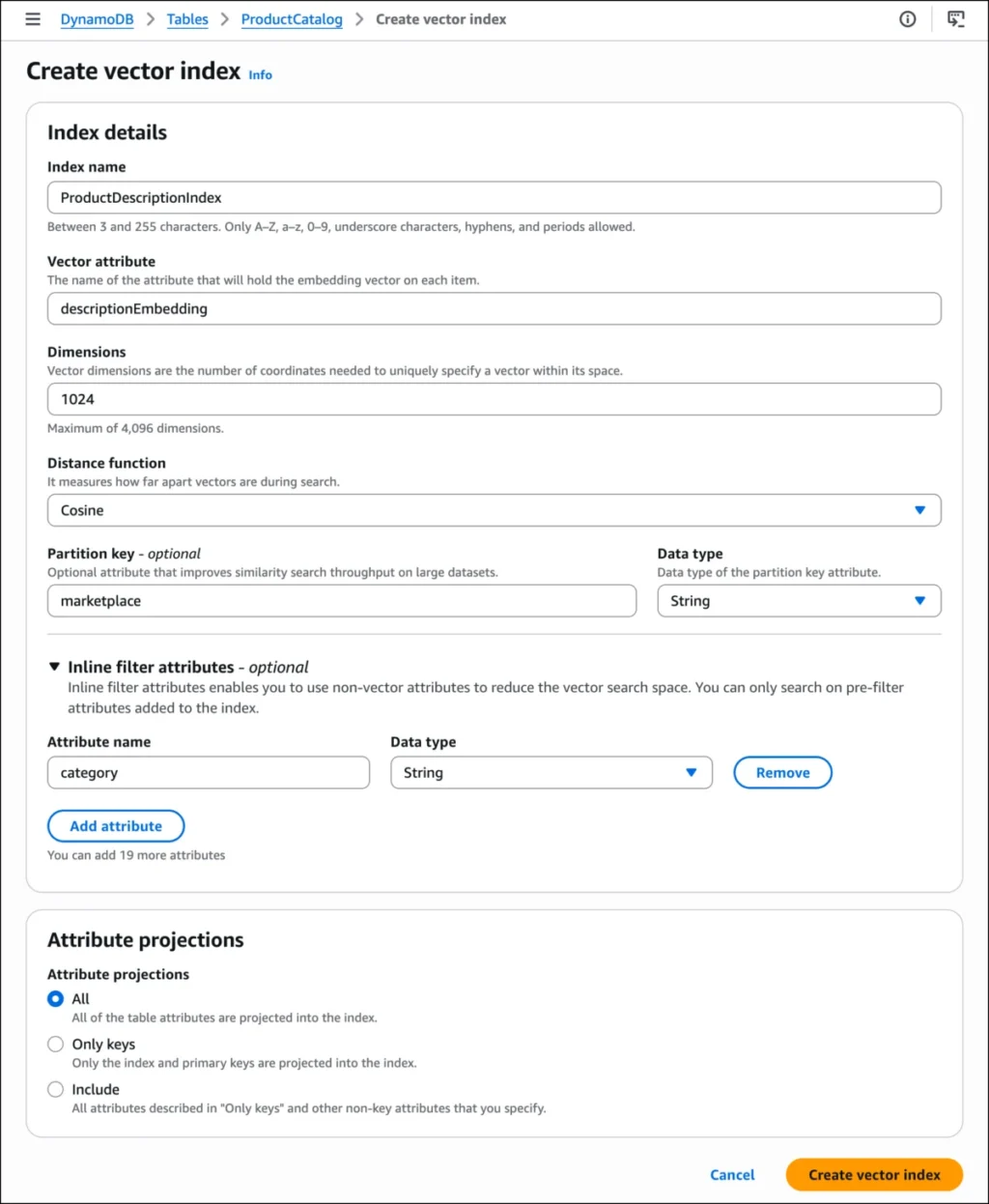
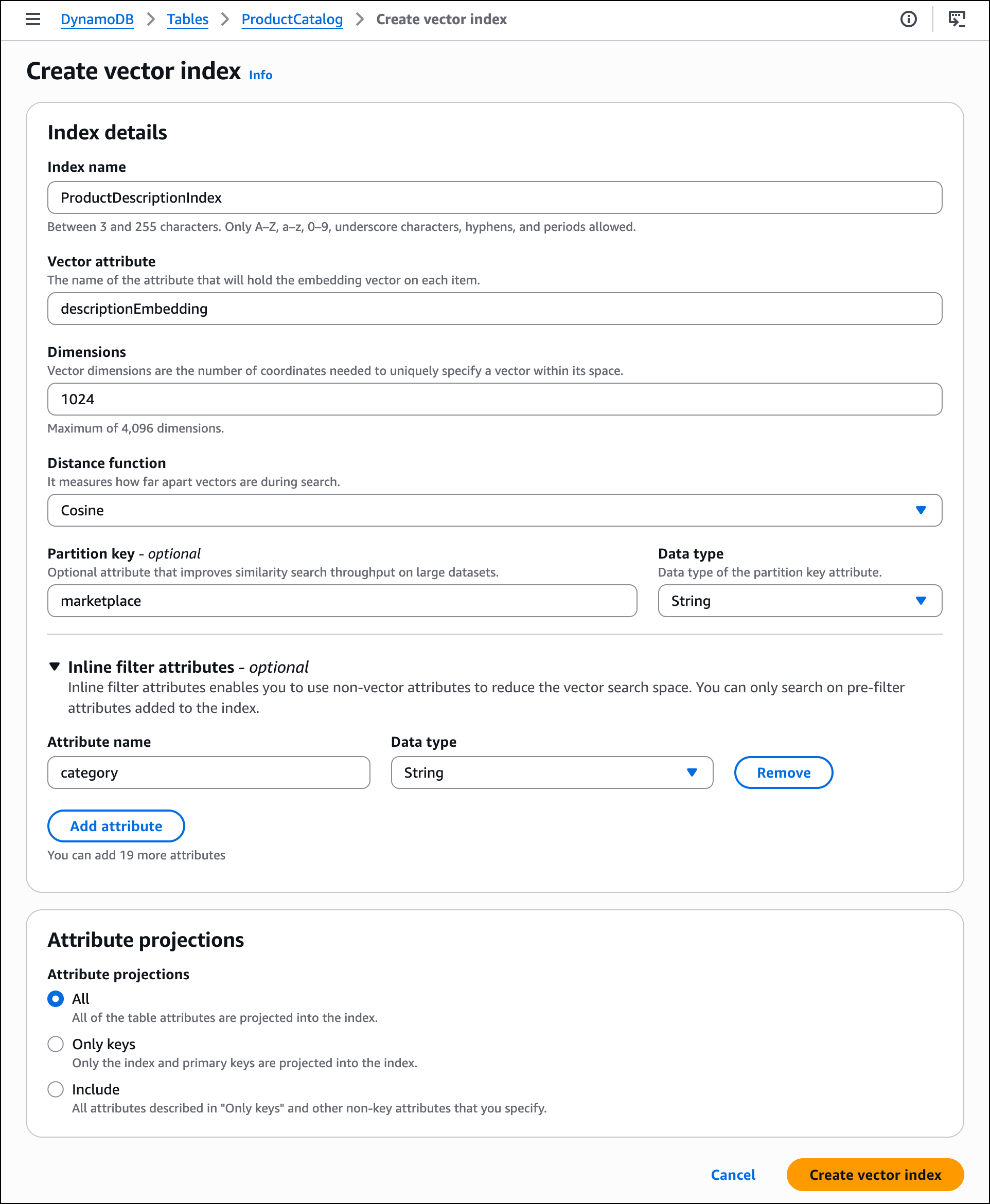
Once embeddings are populated, developers create a dedicated vector index on the attribute via the DynamoDB console or AWS CLI. Key configuration parameters include:
- Dimensions: Must match the exact output dimension of the underlying machine learning model (up to 4,096 dimensions).
- Distance Function: Selection between Cosine (measuring the angle between vectors for semantic text comparison), Euclidean (straight-line distance), or Dot product.
- Partition Key: Highly recommended for large datasets with high query throughput. The partition key controls how vectors are distributed across partitions, allowing the index to scale out horizontally while restricting searches to a specific subset of data (such as a single marketplace or geographic region) without scanning the entire index.
- Inline Filters: Allows developers to specify non-vector attributes (such as
category = "footwear") to narrow down result sets at query time.
Query Execution
When a user submits a natural language query—such as "lightweight running shoes for summer"—the application converts the phrase into a query vector using the same embedding model. The SearchVectors API then accepts this query vector, a Top K parameter (retrieving up to the 100 most similar results), and optional inline filter conditions.
The database returns a ranked list of items ordered by similarity score, alongside all standard operational attributes (like pricing and inventory identifiers) in a single, cohesive response.
Official Responses and Strategic Vision
AWS engineers and product leaders emphasize that the launch of native vector search represents a fundamental philosophy of database design: reducing operational friction by keeping data unified.
"If your application already uses DynamoDB, adding vector search previously required copying data into a dedicated vector database while maintaining a synchronization pipeline between the two services," noted Esra Kayabali in the official AWS release documentation. "With vector search built into DynamoDB, your vectors and operational data share the same serverless infrastructure and the same pay-per-request pricing model."
Industry analysts point out that this release directly challenges the market positioning of standalone vector database startups. By removing the technical tax of data synchronization, AWS makes it frictionless for the millions of existing DynamoDB users to upgrade their applications with artificial intelligence capabilities. Developers can now build sophisticated AI systems—including agentic memory loops, real-time personalization, and semantic search—using the exact same infrastructure they already trust for mission-critical transactional workloads.
Implications for Developers and Enterprise Architecture
The arrival of native vector search in DynamoDB carries profound implications for software engineering teams, system architects, and enterprise budgeting.
1. Simplified System Architecture
By collapsing operational storage and vector indexing into a single database service, engineering teams can eliminate entire categories of infrastructure code. Message queues, change data capture (CDC) pipelines, and cross-database reconciliation scripts are no longer needed simply to keep semantic search indexes fresh. This drastically reduces the surface area for software bugs, security vulnerabilities, and pipeline failures.
2. Predictable Cost Structures
Managing separate database engines often incurs redundant licensing fees, over-provisioned idle capacity, and complex data transfer costs. DynamoDB’s serverless, pay-per-request pricing model now extends seamlessly to vector workloads. Enterprises pay strictly for the storage consumed and the read/write request units utilized, ensuring that infrastructure costs scale linearly with actual business usage.
3. Accelerated Time-to-Market for AI Features
Features that once required months of multi-database integration work—such as context-aware product recommendations, advanced anomaly detection in financial logs, and intelligent conversational search interfaces—can now be prototyped and deployed in hours. Because developers can interact with DynamoDB vector search using familiar AWS SDKs and tools like the AWS MCP Server for AI coding assistants, development velocity is significantly enhanced.
Summary
Amazon DynamoDB’s native vector search bridges the gap between high-speed NoSQL operational processing and modern machine learning requirements. By offering serverless scaling, single-digit millisecond latencies, and zero-downtime maintenance for high-dimensional data, AWS has set a new benchmark for what developers should expect from enterprise cloud databases in the era of generative artificial intelligence.