Jetpack Compose 1.12: A Paradigm Shift in Android UI Development
The landscape of Android development has undergone a significant transformation with the official release of Jetpack Compose 1.12, a milestone update that reaffirms Google’s commitment to a declarative, high-performance UI toolkit. Unveiled as the stable August ’26 release, version 1.12 arrives with a robust suite of tools designed to push the boundaries of visual fidelity, architectural efficiency, and developer productivity. By integrating advanced graphics capabilities, refined state management, and seamless platform interoperability, this release bridges the gap between sophisticated design and technical execution.
Main Facts: The Core of the 1.12 Release
At its foundation, Jetpack Compose 1.12, distributed through the Compose Bill of Materials (BOM) version 2026.08.00, represents a comprehensive overhaul of how developers interact with the Android UI layer. The update focuses on four key pillars: Visual Fidelity, Layout Flexibility, Runtime Efficiency, and Tooling Robustness.
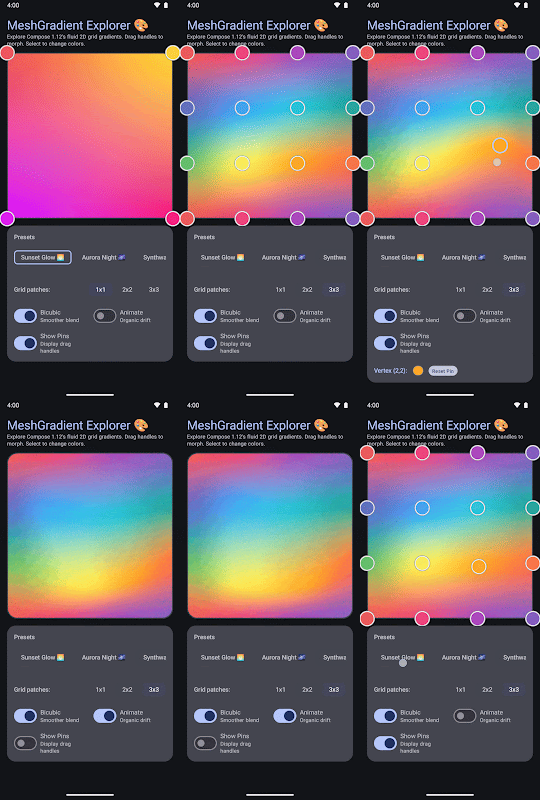
The standout addition is the introduction of the MeshGradientPainter, a powerful API that allows for complex, multi-point, organic color gradients—a feature previously reserved for lower-level graphics engines. Simultaneously, the framework now supports wide color gamut (P3) and High Dynamic Range (HDR) rendering, ensuring that modern displays are fully utilized. For developers managing complex layouts, the experimental Grid component now features "Named Areas," a long-requested feature that moves away from cumbersome index-based positioning in favor of semantic, readable layout design.
Beyond the visuals, version 1.12 streamlines the integration with Android’s Credential Manager, simplifying the authentication flow for end-users while providing developers with a unified way to handle passkeys and saved credentials directly within text inputs.

Chronology: The Road to Stability
The journey toward the August ’26 stable release was marked by a steady cadence of incremental updates and feedback loops initiated at Google I/O. The evolution of the Styles API, which remains in an experimental phase, serves as a testament to the methodical approach Google is taking toward long-term architecture. By keeping the API experimental, the engineering team has allowed the community to experiment with design system integration while retaining the flexibility to implement breaking changes that ensure type safety and performance.
Throughout early 2026, the focus shifted from experimental prototyping to rigorous optimization. The integration of Keyed SideEffect overloads and the graduation of DeferredTargetAnimation out of experimental status were final pieces of a puzzle designed to stabilize the framework before the August launch. These changes were not merely additive; they were subtractive in complexity, removing the need for boilerplate code in common UI patterns like predictive back gestures.
Supporting Data: Benchmarking and Performance
Perhaps the most compelling argument for the adoption of Compose 1.12 lies in its performance metrics. The Android team has long faced skepticism regarding the overhead of a declarative UI compared to the traditional View-based system. However, the data released alongside this update paints a different picture.
Time to Initial Display (TTID)
Internal benchmarking confirms that Compose 1.12 has achieved a Time to Initial Display that is functionally equivalent to the legacy View system. By optimizing the runtime, the team has managed to reduce the overhead associated with the first frame render, a critical metric for user-perceived performance.

Efficiency Gains in Runtime
The new SideEffect overload provides a tangible performance boost for state-heavy applications. By firing one-shot side effects based on specific keys rather than relying on the heavier LaunchedEffect or DisposableEffect patterns, developers can achieve performance improvements of up to 90% in specific scenarios.
- SideEffect vs. LaunchedEffect: Up to 90% faster.
- SideEffect vs. DisposableEffect: Approximately 20% faster.
These metrics are essential for developers managing high-frequency state updates, such as in complex dashboard animations or real-time data visualizations.
Official Perspectives and Technical Implications
Breaking Changes: The Cost of Progress
Every major release carries the weight of necessary deprecations. Compose 1.12 is no exception, requiring a transition to compileSdk 37 and a minimum Android Gradle Plugin (AGP) version of 9.1.1.
Most notably, the deprecation of Modifier.onFirstVisible() in favor of Modifier.onVisibilityChanged() underscores a shift toward more precise visibility threshold tracking. This change is not just syntactic; it is structural. By providing more granularity in how components track their visibility, the framework empowers developers to pause resource-intensive tasks (like video playback or complex animations) more accurately, thereby extending battery life and improving thermal performance.

The Rise of Predictive Back and Two-Stage Transitions
The introduction of DeferredAnimatedContent and DeferredAnimatedVisibility marks a major advancement in user experience. These APIs allow for "predictive" transitions, where UI elements respond in real-time to user gestures—such as a back swipe—before a navigation event is fully committed. The ability to manually manipulate properties like scale and offset during this "deferred" phase creates a fluid, high-end feel that was previously difficult to achieve without significant custom implementation.
Implications for Modern Android Applications
The integration of Credential Manager directly into BasicTextField via the credentialRequest semantics property is a significant step forward for security and UX. By treating identity as a first-class citizen of the text input field, Google is signaling that the future of Android is passwordless. Developers no longer need to jump through hoops to connect input fields to the system’s credential provider; it is now a native property of the UI component.
Furthermore, the new SelectionState API offers unprecedented control over text interaction. By allowing developers to programmatically trigger selections or observe text ranges, apps can offer features like contextual translation, AI-driven summarization, or advanced editing tools with much lower development overhead.
Addressing the Design System Gap
The Styles API, while still experimental, represents the next frontier. By defining a unified, performant way to style components, Google is providing a roadmap for enterprise-level applications to build their own proprietary design systems on top of Compose. The emphasis on "predictable correctness" suggests that the Android team is aiming to eliminate the "style soup" that often plagues large-scale applications as they grow.

Conclusion: A Future-Proof Framework
Jetpack Compose 1.12 is more than just a collection of new APIs; it is a mature framework that has finally reached a state of "performance parity" with its legacy predecessors. For developers, this release removes many of the friction points that hindered the adoption of declarative UI in highly complex, high-performance applications.
The shift toward mesh gradients and wide color gamut support indicates that the framework is ready to compete with the high-end visual requirements of creative and media-centric apps. Meanwhile, the focus on test synchronization and performance benchmarking proves that Google is listening to the core concerns of the professional developer community: stability, speed, and predictability.
As the industry moves toward more fluid, gesture-driven, and AI-augmented interfaces, Compose 1.12 provides the essential building blocks to meet those demands. Developers are encouraged to update their BOM to 2026.08.00 and begin the transition, keeping a close eye on the deprecation warnings and the evolving documentation. As always, the Android team continues to solicit feedback via the issue tracker, ensuring that the next iteration of Jetpack Compose remains as responsive to the needs of the developer community as it is to the hardware it runs on.
For those building the next generation of Android experiences, the tools provided in this release are not just enhancements—they are the new standard for professional-grade mobile development.