Renesas Expands RZ/G Series with Power-Efficient 64-Bit MPUs for Advanced HMI and IoT Edge Applications
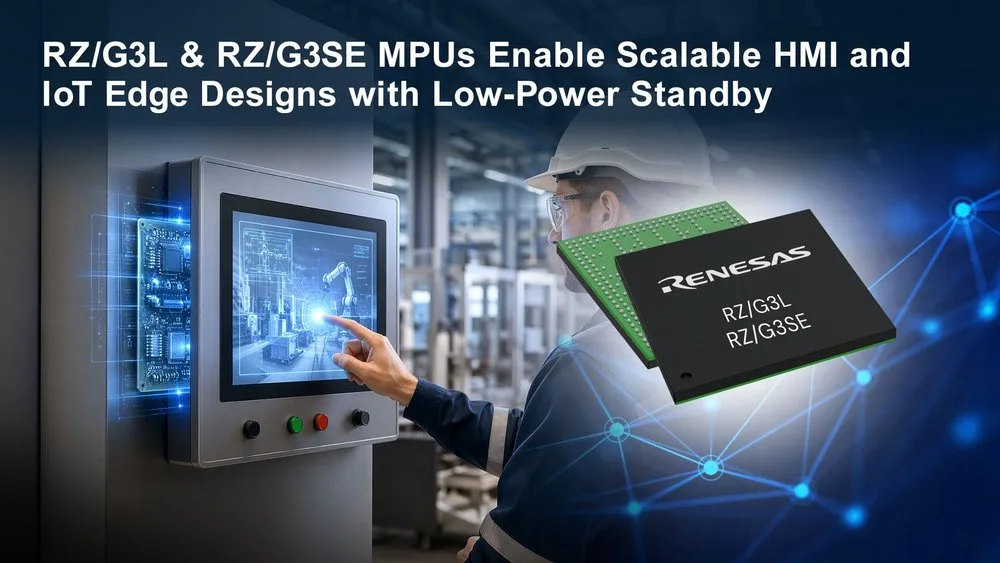
TOKYO, JAPAN — In a strategic move to address the escalating demands of smart industrial and consumer ecosystems, Renesas Electronics Corporation has announced the global rollout of its expanded RZ/G series. The newest additions—the 64-bit general-purpose microprocessors (MPUs) designated as the RZ/G3L and RZ/G3SE—are engineered specifically to power sophisticated Human Machine Interface (HMI) systems, IoT edge gateways, and next-generation connected machinery.
Combining high-performance multi-core processing, ultra-low standby power consumption, and robust high-speed connectivity, the new silicon solutions promise to streamline hardware design cycles while offering developers unprecedented scalability across diverse product portfolios.
Main Facts: Power, Efficiency, and Scalability at the Edge
The introduction of the RZ/G3L and RZ/G3SE microprocessors marks a significant milestone in Renesas’ embedded processing strategy. At their core, both devices harness a high-performance processing cluster comprising up to four Arm® Cortex®-A55 cores running at clock speeds of up to 1.2 GHz, supplemented by a dedicated Arm Cortex-M33 real-time coprocessor operating at 200 MHz.
Despite this substantial computational muscle, the third-generation RZ/G architecture introduces an advanced, proprietary power management scheme. This innovation enables the processors to achieve standby power consumption in the order of a mere 1 milliwatt (mW) while maintaining the Linux operating system state active in system memory. Such capability allows devices to drop into deep sleep states and resume operations almost instantaneously—a vital trait for "always-on" industrial nodes and remote IoT deployments.
The two variants cater to distinct graphical and functional requirements within the embedded space:
- The RZ/G3L: Integrates an advanced Graphics Processing Unit (GPU) capable of rendering complex 3D graphics alongside a hardware-accelerated H.264 video codec. This makes it ideally suited for advanced smart retail terminals, medical devices featuring rich graphical interfaces, and high-end automation panels.
- The RZ/G3SE: Tailored for applications with less demanding visual requirements. It targets devices such as electric vehicle (EV) charging wallboxes, industrial gateways, and basic infrastructure control panels that require simple status indicators, telemetry displays, and configuration screens.
Crucially, both processors are pin-compatible, allowing hardware design engineers to implement a single printed circuit board (PCB) layout that can accommodate either the RZ/G3L or the RZ/G3SE depending on the target product tier. This architectural choice radically reduces development costs, minimizes bill-of-materials (BOM) complexity, and accelerates time-to-market.
Chronology of Development and Market Evolution
The launch of the RZ/G3L and RZ/G3SE represents the culmination of years of iterative evolution within Renesas’ embedded processing division.

- The Foundations: Renesas initially established the RZ/G series to bridge the gap between high-powered application processors and low-power microcontrollers, providing reliable Linux-based platforms for industrial use.
- The Shift Toward Edge AI and Low Power: As industrial IoT (IIoT) evolved, the market witnessed a paradigm shift. Designers were no longer merely looking for raw computing power; they required intelligent energy management, real-time networking capabilities, and modular scalability to cope with fragmented communication protocols.
- The Third-Generation Breakthrough: Addressing these industry shifts, Renesas developed its third-generation RZ/G architecture. By integrating ultra-low-power standby modes (around 1 mW) directly alongside high-speed industrial interfaces like PCIe and Time-Sensitive Networking (TSN), the company positioned the new MPUs to address the convergence of IT and OT (Information Technology and Operational Technology).
- Commercial Availability: Following rigorous validation, the RZ/G3L and RZ/G3SE devices are commercially available today. Alongside the raw silicon, Renesas has released comprehensive evaluation kits consisting of an SMARC v2.1 module board paired with a flexible carrier board, enabling immediate prototyping for early adopters.
Supporting Data and Technical Specifications
To truly understand the capability of the RZ/G3L and RZ/G3SE processors, one must examine the underlying hardware specifications and architectural ecosystem.
Core Processing Architecture
- Main Application CPU: Up to 4x Arm Cortex-A55 cores clocked at up to 1.2 GHz.
- Real-Time Coprocessor: Arm Cortex-M33 core operating at 200 MHz, facilitating deterministic real-time control tasks independent of the primary Linux OS.
- Graphics & Video (RZ/G3L only): Integrated 3D GPU and H.264 video encoding/decoding hardware blocks.
Power Management Performance
- Deep Standby Mode: Approximately 1 mW power consumption.
- State Retention: Capable of maintaining system RAM states during deep standby for ultra-fast wake-up execution.
High-Speed Connectivity Interfaces
- PCI Express (PCIe): Enables seamless integration of high-bandwidth external peripherals, including 5G cellular communication modems, Wi-Fi 6 wireless modules, and dedicated external AI processing accelerators.
- Gigabit Ethernet with TSN: Provides deterministic, low-latency, and highly reliable networking essential for modern industrial automation networks where microsecond-level timing precision is mandatory.
- USB and Serial Interfaces: Comprehensive peripheral support for legacy and modern industrial communication standards.
Comprehensive Ecosystem Support
To ease software fragmentation—historically a major bottleneck in Linux-based embedded developments—Renesas has rolled out an expansive partner and software ecosystem comprising ten core solution pillars. This includes pre-validated GUI development frameworks, real-time operating systems (RTOS), complete software stacks, and System-on-Modules (SoMs) developed in collaboration with the extensive global network listed via the Renesas Partner Program.
Official Responses and Industry Perspectives
Industry leaders have underscored the strategic importance of balancing computational throughput with energy efficiency as edge devices become increasingly autonomous and distributed.
Hari Pendurty, Vice President of the EP Edge AI & Application Processors Business Division at Renesas, highlighted the core design philosophy driving the new product line:
"The growing sophistication of industrial and IoT devices requires solutions able to balance high performance, low power consumption, advanced connectivity, and platform scalability. RZ/G3L and RZ/G3SE were developed to help customers meet these constantly evolving requirements and to build product families more efficiently, leveraging a common hardware platform for different applications."
By focusing on hardware reuse and simplified ecosystem integration, Renesas aims to alleviate engineering shortages and design bottlenecks that currently afflict product development teams across the globe.
Implications for Industry Segments and "Winning Combinations"
The introduction of the RZ/G3L and RZ/G3SE carries profound implications across multiple verticals, notably smart infrastructure, industrial automation, and consumer-facing IoT environments.

1. Automotive Infrastructure and EV Charging
As electric vehicles gain mainstream adoption, the infrastructure supporting them must scale intelligently. Renesas has highlighted its Mode 3 AC EV Charger Wallbox reference design as a prime example of a "Winning Combination." Built around the RZ/G3L microprocessor, this solution incorporates high-level Power Line Communication (PLC) and advanced user interface capabilities, allowing charging stations to handle secure billing, smart grid load balancing, and intuitive driver interaction seamlessly.
2. Smart Home and Industrial Security
For security and building automation, the complexity of edge processing is on the rise. Renesas has paired the RZ/G3SE with its AI-Enabled Smart Home Security Hub reference architecture. This combination allows developers to deploy cost-effective edge nodes capable of processing inputs from multiple local cameras, high-fidelity microphones, and environmental sensors, while simultaneously maintaining secure cloud connectivity for remote telemetry and automated alerts.
3. Simplifying Industrial Supply Chains
From a broader economic perspective, the pin-compatibility between the RZ/G3L and RZ/G3SE acts as a hedge against supply chain volatility and fluctuating feature requirements. Manufacturers can design a single flagship PCB layout equipped for high-end graphical tasks (using the RZ/G3L) or strip it back for cost-sensitive, basic applications (using the RZ/G3SE) without redesigning the underlying electronic infrastructure. This modularity drastically cuts down NRE (Non-Recurring Engineering) costs and shields OEMs from prolonged redesign cycles.
Conclusion and Next Steps
Renesas’ expansion of the RZ/G series with the RZ/G3L and RZ/G3SE MPUs represents a mature, highly calculated response to the real-world challenges faced by embedded systems engineers today. By marrying high-density Arm processing cores with an ultra-low 1 mW standby profile, high-speed PCIe and TSN-enabled Ethernet connectivity, and an expansive ready-to-use software ecosystem, Renesas has set a formidable benchmark for HMI and IoT Edge design.
Engineers and system architects wishing to evaluate the new processors can procure the SMARC v2.1 evaluation kit immediately. Detailed documentation, software packages, and comprehensive reference designs are currently accessible through the official Renesas portal and the Renesas Partner Program network.