AI-Powered Ultrasound: How Google Research and TensorFlow Lite Are Expanding Global Access to Maternal Healthcare
Main Facts: Bringing Advanced Diagnostics to Underserved Communities
Every year, an estimated 287,000 women die from complications related to pregnancy and childbirth, alongside 2.4 million neonatal deaths worldwide. Up to 95% of these tragedies occur in under-resourced settings where access to advanced medical diagnostics is severely restricted. Obstetric ultrasounds—essential for determining gestational age, monitoring fetal development, and identifying fetal presentation issues—have traditionally required years of specialized training and expensive, bulky machinery. As a result, roughly two-thirds of pregnant individuals in rural and resource-limited regions never receive a single ultrasound screening during pregnancy.
To bridge this critical healthcare gap, Google Research has developed a groundbreaking mobile-optimized artificial intelligence system designed to empower non-expert healthcare workers. By leveraging TensorFlow Lite, Google’s open-source framework for on-device machine learning, researchers have created lightweight AI models that run directly on standard smartphones linked to portable, modern ultrasound probes.
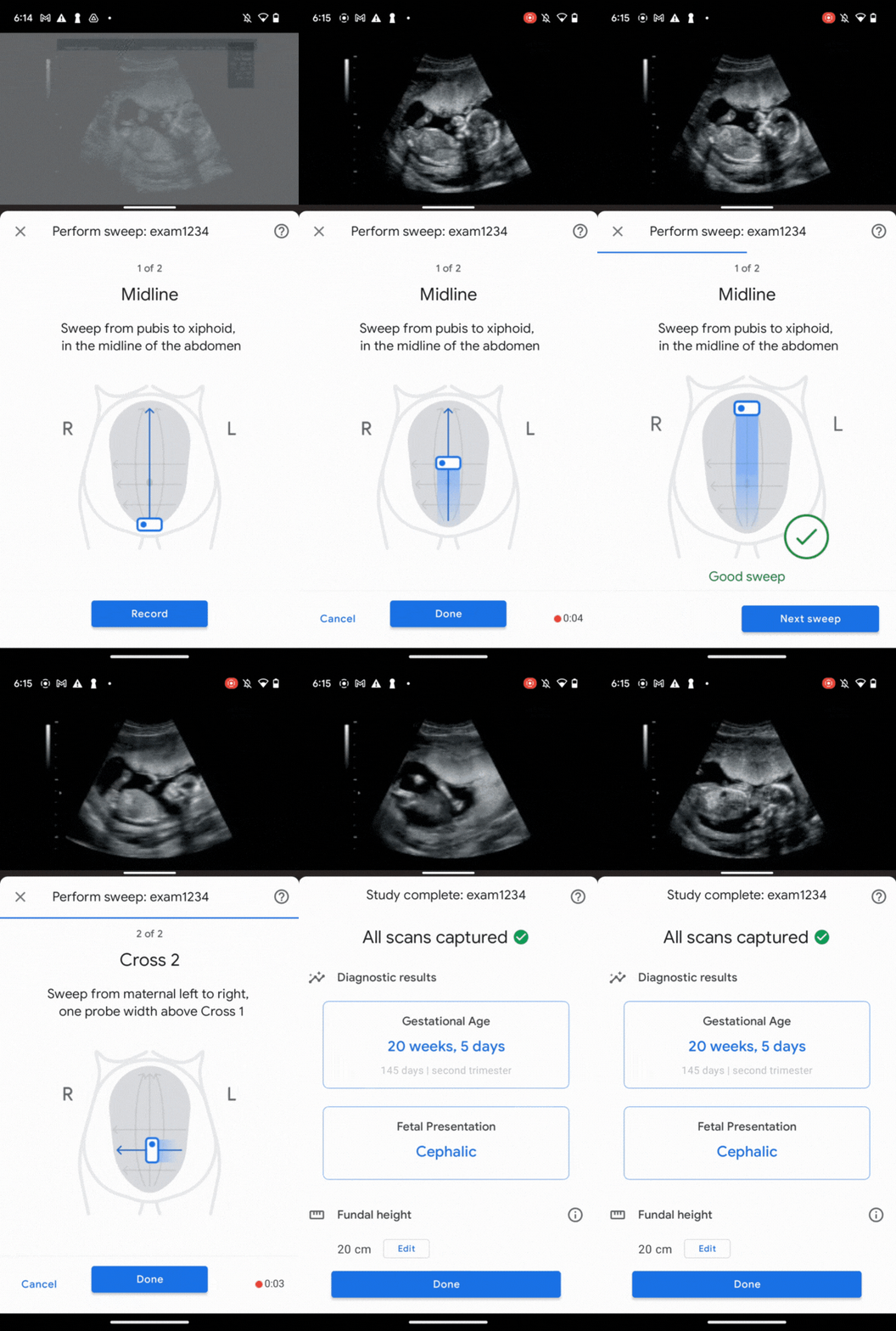
Through an intuitive, easy-to-learn diagnostic procedure known as a "blind sweep," local health workers with minimal training can now capture clinically actionable ultrasound videos. The on-device AI processes these video feeds in real-time, matching the diagnostic performance of traditional clinical standards managed by expert sonographers. This innovation eliminates the need for reliable internet connectivity or expensive cloud infrastructure, promising to fundamentally transform prenatal care delivery in marginalized communities across the globe.
Chronology: From Concept to Clinical Validation
The journey toward mobile-optimized, AI-driven fetal ultrasound assessment represents a multi-year collaborative effort spanning academic research, deep learning innovation, and real-world clinical validation.

Phase 1: Identifying the Technological and Clinical Gap
Recognizing the global shortage of trained ultrasonographers, Google Research’s Health AI Team set out to determine whether artificial intelligence could interpret low-skill ultrasound inputs. While advancements in sensor technology had made ultrasound probes smaller and more affordable, the interpretation barrier remained exceptionally high. The team hypothesized that simplifying the data acquisition process—moving away from precise, static anatomical framing toward a continuous "blind sweep" motion—could make ultrasound data collection accessible to everyday community health workers.
Phase 2: Model Architecture and Optimization
To make these complex algorithms functional in the field, engineers had to design models that could operate on low-power mobile devices. Moving away from heavy, cloud-reliant architectures, the team engineered a grouped convolutional Long Short-Term Memory (LSTM) network utilizing MobileNetV2 for rapid frame-by-frame feature extraction.
The integration of TensorFlow Lite proved pivotal during this phase. By converting the models via the TensorFlow Lite converter API and employing post-training quantization alongside GPU delegate configurations, the research team achieved a staggering 2x improvement in execution speed. This optimization enabled real-time processing of more than 30 frames per second on standard Pixel devices running parallel models without sacrificing diagnostic accuracy.
Phase 3: Scientific Publication and Clinical Validation
The culmination of this research was detailed in a landmark paper published in Nature Communications Medicine titled "A mobile-optimized artificial intelligence system for gestational age and fetal malpresentation assessment." Tested across diverse cohorts involving hundreds of participants, the study proved that non-experts utilizing blind-sweep protocols combined with the AI framework could successfully achieve standard-of-care accuracy in predicting gestational age and identifying fetal malpresentation.

Phase 4: Field Testing and Global Partnerships
Transitioning from theoretical models to practical application, Google Research developed a dedicated mobile evaluation application. This tool allows health workers to receive immediate, on-device feedback regarding the quality of their ultrasound sweeps. Building on these milestones, Google established vital institutional partnerships—collaborating with Northwestern Medicine in the United States and Jacaranda Health in Kenya, alongside academic inputs from the University of Zambia and the University of North Carolina—to pilot and refine the technology in real-world clinical environments.
Supporting Data: Understanding the Impact and Performance
The efficacy of Google’s AI-driven ultrasound framework is backed by rigorous empirical testing and data-driven optimization.
The Scale of the Crisis
- 287,000: Annual global maternal deaths due to pregnancy and childbirth complications.
- 2.4 million: Annual neonatal deaths worldwide.
- 95%: The proportion of these deaths that occur in under-resourced regions.
- ~66%: The estimated fraction of pregnant individuals in underserved settings who receive zero ultrasound scans throughout their pregnancy.
Technical Performance Metrics
The system’s dual focus on gestational age regression and fetal malpresentation classification relies on sophisticated data aggregation:
- Gestational Age Estimation: Individual clip-level predictions extracted from the video frames are aggregated using inverse variance weighting. This mathematical approach generates a robust final case-level prediction alongside a model confidence estimate representing the predicted variance in fetal age.
- Fetal Malpresentation Classification: Using Receiver Operating Characteristic (ROC) curve evaluations, the malpresentation model demonstrated high sensitivity and specificity, performing comparably whether data sweeps were captured by certified expert sonographers or trained novices.
- Inference Speed: Leveraging the TensorFlow Lite GPU delegate, the mobile application achieves sustained real-time inference exceeding 30 frames per second, allowing simultaneous execution of both gestational age and malpresentation models on standard mobile hardware.
Official Responses and Expert Perspectives
The intersection of artificial intelligence and global maternal health has drawn widespread attention from researchers, clinicians, and technology leaders committed to equitable healthcare delivery.

The interdisciplinary team behind the initiative—comprising over a dozen prominent Google Research scientists including Ryan G. Gomes, Chace Lee, Angelica Willis, Marcin Sieniek, Shravya Shetty, and Dr. Lily Peng—emphasized the profound humanitarian potential of edge computing in healthcare.
"Our vision is to enable safer pregnancy journeys using AI-driven ultrasound that could broaden access globally," members of the Health AI Team noted. "We want to be thoughtful and responsible in how we develop our AI to maximize positive benefits and address challenges, guided by our core AI Principles. TensorFlow Lite has helped enable our research team to explore, prototype, and de-risk impactful care-delivery strategies designed with the needs of lower-resource communities in mind."
Medical partners have similarly underscored the necessity of collaborative scaling. Institutional alliances with organizations like Jacaranda Health in Kenya and academic medical centers in Zambia and North Carolina are designed to ground the technology in local clinical workflows. Public health experts note that empowering local health workers with automated risk assessments removes traditional bottlenecks, ensuring that expectant mothers receive timely, life-saving interventions before complications escalate.
Implications: The Future of On-Device AI in Global Health
The successful deployment of mobile-optimized fetal ultrasound assessment models via TensorFlow Lite marks a significant paradigm shift in how artificial intelligence can address systemic global health disparities.

1. Privacy, Security, and Offline Usability
By prioritizing on-device machine learning over cloud-based processing, Google’s architecture addresses critical data privacy concerns. Sensitive biometric and medical video data never need to leave the local device, ensuring patient confidentiality. Furthermore, because the application relies entirely on local edge computing, it remains fully functional in remote regions characterized by intermittent, low-bandwidth, or nonexistent internet connectivity.
2. Immediate Quality Feedback Loops
One of the most profound operational implications of achieving real-time, high-speed inference is the ability to provide instant feedback to the user. When a community health worker performs a blind sweep, the underlying model instantly calculates confidence estimates. If a sweep is deemed suboptimal due to insufficient contact, poor angle, or lack of acoustic gel, the application immediately prompts the user with corrective tips and encourages a retake. This transforms the smartphone into an interactive teaching tool, shortening the learning curve for novice practitioners from years to mere hours.
3. Regulatory and Ethical Considerations
While the technological implications are vast, researchers and developers maintain a cautious approach. Google explicitly notes that TensorFlow Lite has not been certified or validated for clinical, medical, or diagnostic purposes. Developers utilizing the framework bear sole responsibility for ensuring independent validation and regulatory compliance within their specific jurisdictions. Nonetheless, as a research prototype and clinical exploration tool, the framework establishes a powerful blueprint for responsible AI development.
Looking Ahead
As Google Research continues to expand its partnerships with international health organizations, the roadmap for AI-enhanced prenatal care points toward broader clinical trials, expanded diagnostic indicators, and wider deployment across developing healthcare ecosystems. By lowering financial, geographical, and educational barriers to essential diagnostics, this initiative points toward a future where geography no longer dictates the safety and survival of mothers and newborns.