The Persistence of Vision: How a Modern "Mechanical TV" Brings 3D Holography to the Desktop
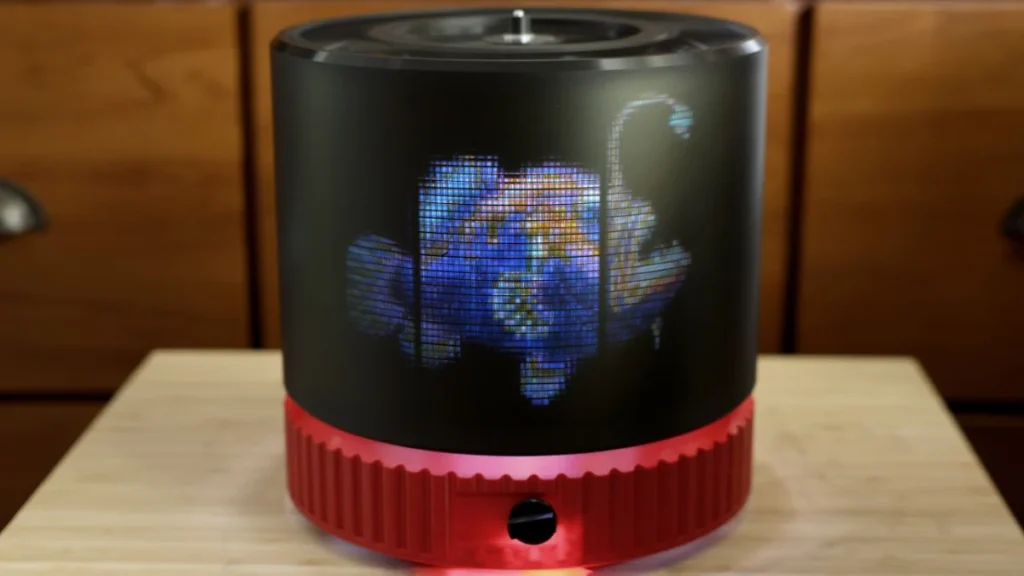
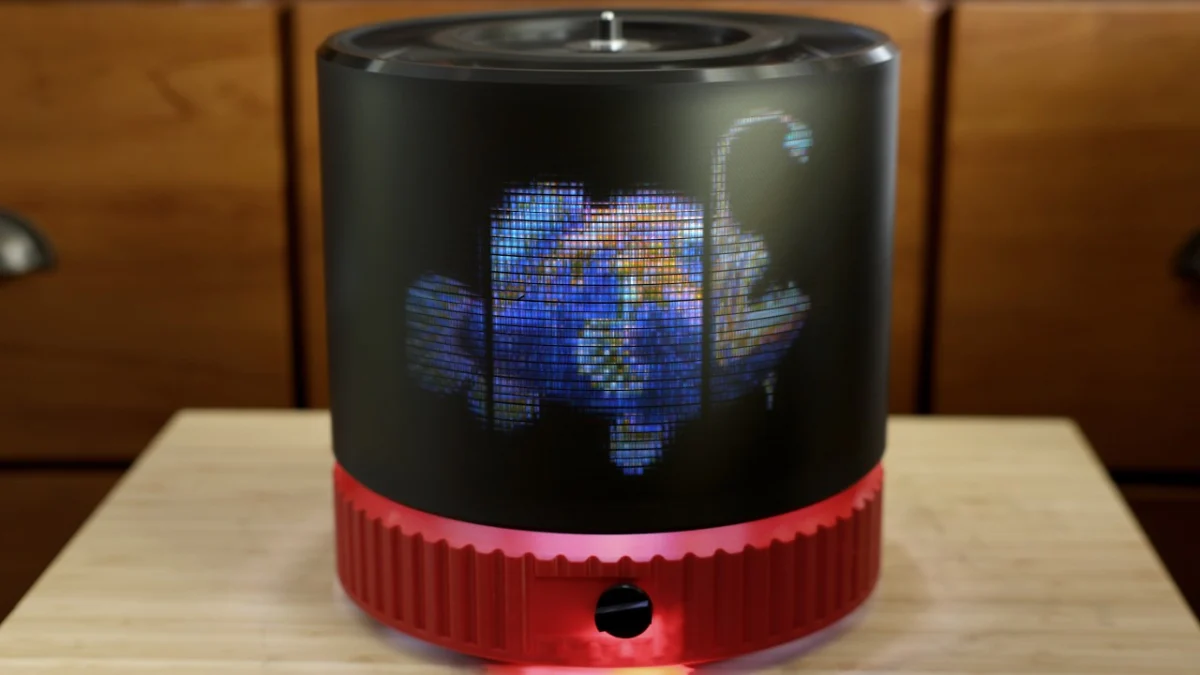
For decades, the concept of a "volumetric display"—a screen that creates a true three-dimensional image floating in space—has been the holy grail of science fiction. From the holographic chessboards of Star Wars to the data-dense displays of Iron Man, we have long dreamed of ditching the flat, two-dimensional rectangles that currently dominate our digital lives. While modern consumer tech focuses on AR/VR headsets that trick the brain through binocular disparity, an innovator known as [AncientJames] has taken a radically different, tactile approach: he has built a mechanical, light-field volumetric display that renders 3D images using nothing more than spinning components and the raw physics of persistence of vision.
Main Facts: Engineering the Light Field
At its core, the device functions as a mechanical evolution of the 1920s-era Nipkow disk television. Where a traditional mechanical TV uses a spinning disk with holes to create a 2D raster scan, [AncientJames] has pivoted to a cylindrical architecture. By utilizing a rapidly spinning drum perforated with precisely placed apertures, he has created a light-field projection system that allows for multiple viewing angles simultaneously.
Instead of a single modulated light source, the system employs an array of high-speed LED matrix displays (32×64 pixels each). These stationary screens are positioned inside the rotating drum. As the drum spins, the holes act as dynamic "windows," projecting the light from the matrices outward at specific angles. By splitting a 3D model into a light field—essentially calculating what each "hole" should see from its specific position—the system constructs a coherent 3D object that changes perspective as the viewer walks around it.
While the current prototype uses three matrix displays arranged in a partial hexagonal prism, the result is a functional 3D rendering. With an effective resolution of approximately 100×48 pixels per eye, the display is surprisingly capable, even managing to render the seminal first-person shooter DOOM in a volumetric space.
Chronology: A Trajectory of Volumetric Obsession
The journey to this mechanical light-field display was not an overnight success but the culmination of a multi-year deep dive into the intersection of light, motion, and digital rendering.
- September 2024: [AncientJames] first captured the tech community’s attention by demonstrating DOOM on a volumetric display. This initial experiment established the proof-of-concept that classic gaming could be ported to non-traditional, hardware-heavy displays.
- December 2025: The project evolved into more complex territory, utilizing laser projection and "bubbly glass" refraction techniques to manipulate light. This period focused on the challenges of scattering and light density.
- April 2026: Further experimentation with mist, mirrors, and multi-view projections pushed the boundaries of how light could be captured in mid-air.
- Present Day: The current iteration represents a significant departure from previous, laser-heavy designs. By moving to a stationary LED array and a mechanical drum, the project has traded the high-cost, high-complexity of lasers for a robust, accessible, and purely mechanical method that bridges the gap between early 20th-century television technology and 21st-century 3D rendering.
Supporting Data: The Physics of Perception
To understand why this device works, one must understand the biological constraint known as "persistence of vision." The human eye retains an image for roughly 1/25th of a second. If light pulses are delivered faster than this threshold, the brain perceives a continuous, flicker-free stream of motion.
The mechanical drum functions at high RPMs to exploit this threshold. Because the drum is rotating, the light passing through each aperture is effectively "smeared" across the viewer’s field of vision in a way that creates a horizontal sweep.
Technical Specifications of the Prototype:
- Imaging Element: 3x LED Matrix Displays (32×64 resolution).
- Scanning Mechanism: Perforated mechanical drum (rotational).
- Effective Resolution: ~100×48 pixels per eye.
- Display Logic: Light-field decomposition (angular pixel projection).
- Construction: Open-frame chassis, high-speed motor assembly.
The "light field" approach is critical here. Unlike a standard monitor, which projects the same image to both eyes regardless of position, this display projects different slices of the object based on the viewer’s physical location relative to the drum. It is, essentially, a real-world approximation of a hologram, requiring significant computational overhead to pre-render or live-render the object into the necessary light-field format.
Official Responses and Peer Observations
The maker community has met the development with a mixture of awe and practical concern. Experts in the field of volumetric display technology note that the primary hurdle for this specific design is the "scaling problem." To move from a 100×48 pixel resolution to something approaching "Retina" quality would require an exponential increase in both the rotational speed of the drum and the refresh rate of the LED matrices.
"The brilliance of this design is its accessibility," notes a hardware engineer familiar with the project. "Most volumetric displays today are either laser-based, which are dangerous and prohibitively expensive, or rely on proprietary high-speed projectors. [AncientJames] has democratized the concept by using standard, off-the-shelf LED matrices. It’s a masterclass in ‘low-tech’ solving a ‘high-tech’ problem."
However, there are safety considerations. The developer himself has been transparent about the physical nature of the device: the drum is a spinning mechanical component that poses a kinetic risk to the user. Unlike a static monitor, this is a machine that requires a degree of caution—hence the recurring warning to "watch your fingers."
Implications: The Future of Mechanical Displays
Why spend time building a complex, spinning drum to play a game from 1993? The implications of this work extend far beyond retro gaming.
1. The Death of the "Black Box" Monitor
This technology points toward a future where our screens are not flat planes but ambient, spatial objects. If a home-built mechanical device can achieve a rudimentary light-field effect, it suggests that the industry may have over-indexed on OLED and LCD panels. There is a path toward displays that exist as physical objects, allowing for shared, collaborative viewing without the need for cumbersome headsets or glasses.
2. Education and Open-Source Hardware
The project serves as an invaluable educational tool. By stripping away the "black box" of modern consumer electronics, [AncientJames] exposes the raw physics of light, optics, and data processing. It encourages a new generation of engineers to look at legacy technology (the Nipkow disk) not as obsolete, but as a foundation for future breakthroughs.
3. Computational Geometry
The software side of this project is just as impressive as the hardware. Creating the light-field data required to drive the LEDs correctly is a massive computational task. As this project matures, it provides a blueprint for how we might render 3D assets in real-time for volumetric environments, a sector of the software industry that remains in its infancy.
Conclusion
While the spinning drum of [AncientJames] is unlikely to replace the 4K monitors on our desks tomorrow, it stands as a defiant testament to human ingenuity. It proves that we do not necessarily need more pixels or more complex silicon to achieve the future we were promised; sometimes, we just need a better understanding of the physics that have been around for a century. By blending the mechanical simplicity of early television with the high-speed data processing of the modern era, this project reminds us that the "magic" of technology is often found in the space between the mechanical and the digital.
As we look toward the next iteration of this display, the question remains: if we can play DOOM on a spinning cylinder of LEDs, what else can we bring to life in the empty air of our rooms? For now, we wait—and keep our fingers at a safe distance from the spinning drum.