Beyond the Database: Why AI Sales Assistants Need Contextual Memory, Not Just Storage
In the fast-evolving landscape of enterprise artificial intelligence, a striking paradox has emerged. Modern Large Language Models (LLMs) can synthesize complex data, draft hyper-personalized emails, summarize hour-long meetings into concise bullet points, and adopt an empathetic tone—all within seconds. Yet, despite these advanced capabilities, most AI sales assistants suffer from a form of digital amnesia. They do not truly remember customer relationships.
Consider a typical sales cycle. A prospective client named Rahul mentions a critical requirement during a discovery call: "Our primary concern moving forward is ensuring absolute SOC 2 compliance." Three weeks later, the account executive prompts their AI assistant to prepare briefing materials for a follow-up call. Unless that specific piece of compliance data happens to reside in the immediate prompt context, the AI starts from ground zero.
For a tool designed to foster and manage high-value human relationships, this limitation represents a fundamental architectural flaw. To bridge this gap, developers and engineers are beginning to rethink how artificial intelligence interacts with historical data. Enter DealMind, an experimental AI sales assistant designed around a singular, transformative premise: What if every customer had their own persistent, context-aware AI memory?
The Core Dilemma: Knowing Versus Remembering
To understand the innovation behind tools like DealMind, one must first draw a sharp distinction between data storage and cognitive memory.

Traditional Customer Relationship Management (CRM) platforms are exceptional at recording facts. They can track that a meeting occurred on Tuesday, log a phone call duration, and store structured attributes such as deal size, stage, and contact info. However, knowing what happened is fundamentally different from remembering what matters.
A traditional CRM database can store a transcript mentioning Rahul’s concerns about SOC 2 compliance. But an intelligent sales agent requires a higher-order capability: it must be able to evaluate an old piece of information and determine whether it is relevant to the active task at hand.
This realization led to the architectural separation of application storage from AI memory. In conventional software design, developers often route all application data through a primary database like PostgreSQL or SQLite and label it as "AI memory." While simple, this approach conflates two entirely different paradigms.
- Databases are optimized to answer: What happened?
- Memories are optimized to answer: What is worth retaining, and what is relevant right now?
Architecture of DealMind: Giving Every Customer a Memory Bank
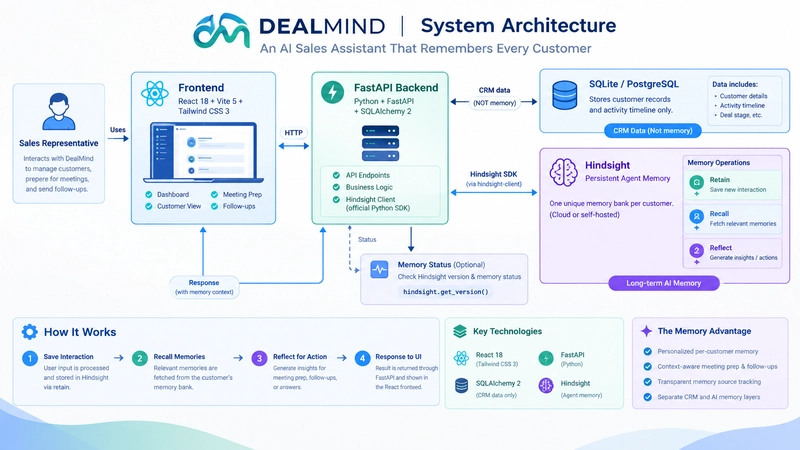
To solve the context-loss problem, DealMind introduces an isolated memory architecture. Instead of dumping every historical interaction into one massive, unstructured pool of data, the system assigns an independent memory bank to each customer—utilizing specialized memory infrastructure such as Vectorize’s Hindsight.

When Rahul states his compliance concerns during a call, that interaction is captured, processed, and written directly into his dedicated long-term memory stream.
Customer Interaction
        │
        ▼
   Retain (Write Path)
        │
        ▼
Customer-Specific Memory Bank
        ┌──────────────┴──────────────┐
        ▼                             ▼
     Recall                       Reflect
        │                             │
        └──────────────┬──────────────┘
                       ▼
               Relevant Context
This decoupled approach ensures that when a salesperson triggers a follow-up or prepares for a new meeting, the AI does not flood the prompt window with an exhaustive, unedited timeline of every past utterance. Instead, it queries the customer’s isolated memory bank for precise, task-relevant context.
Recall Versus Reflection: Redefining AI Context
One of the most compelling insights to emerge from the development of DealMind is the deliberate separation of two cognitive functions: Recall and Reflection.
In naive Retrieval-Augmented Generation (RAG) implementations, memory is often treated as a blunt instrument—a database search that simply retrieves every matching record. DealMind establishes a clear boundary between these operations:

- Recall: What does the system remember about this customer?
- Reflection: Given what the system remembers, what does that mean for what I should do next?
When an agent prepares for a meeting with a defined goal—such as agreeing on an evaluation plan—it does not need the customer’s entire historical record. It requires filtered, synthesized context. By passing parameters that instruct the model to leverage its memory bank while targeting a specific objective, the system bridges historical facts with forward-looking strategy.
The resulting follow-up communications transcend generic AI outputs. When DealMind drafts an email proposing a Thursday check-in, the message is intrinsically tied to prior commitments, open feature requests, or voiced hesitations. The context successfully follows the relationship across its lifecycle.
The Imperative of Observability and Context Provenance
As generative AI penetrates deeper into enterprise workflows, a troubling pattern has emerged: "hallucinated confidence." An AI model can deliver a completely fabricated or unsupported statement with the same smooth conviction as a verified fact.
To combat this, DealMind implements strict observability standards regarding context provenance. The application is designed never to fake a memory layer. If the underlying memory bank is unavailable or contains no relevant records, the system refuses to quietly synthesize a plausible-sounding response.

Instead, the architecture exposes structured metadata for every interaction:
  "answer": "...",
  "memory_used": true,
  "source": "hindsight",
  "memories": [...]
This transparency allows user interfaces to explicitly distinguish between a generic AI-generated response and an answer grounded in verified historical customer context. For enterprise users, knowing what the AI said is no longer enough; they must also know what the AI actually knew when it spoke.
Industry Implications: Moving from Generation to Relationships
The implications of persistent, customer-specific memory extend far beyond sales enablement. The software industry is rapidly pivoting along a macro-trend:
- Yesterday: AI that generates responses (stateless text generation).
- Tomorrow: AI that participates in ongoing relationships (stateful, context-carrying agents).
Stateless chatbots can afford to forget users between sessions. Relationship-oriented software cannot. If an autonomous agent treats every new interaction as if it were the first, its utility quickly plateaus. The true competitive moat for future AI applications will not lie solely in raw language generation models, but in their ability to maintain uninterrupted context across time.

Looking Forward: The Next Evolution of Agent Memory
As the developer ecosystem continues to experiment with architectures like DealMind, several key principles are coming into sharp focus:
- Timelines are not memories: Chronological logs record events, but active memories determine current relevance.
- Boundaries matter: Siloing memory per customer prevents data contamination and preserves contextual integrity.
- The write path is critical: Capturing salient context must happen at the point of interaction, rather than as an afterthought.
- Observability is non-negotiable: Developers and end-users alike must be able to audit the retrieval and reasoning chain.
Ultimately, the goal of modern agent architecture is not to build an artificial intelligence that remembers everything. Rather, it is to build systems intelligent enough to remember the right things at the exact right time.
As developers grapple with these challenges, the broader tech community faces a defining philosophical question: If an AI can log every user interaction but fails to understand what actually matters, does it possess a true memory, or is it merely maintaining expensive storage? The future of intelligent software depends entirely on how we choose to answer.