From Desktop Toy to Edge-AI Powerhouse: How a $299 Board and Vision-Language Models Are Democratizing Advanced Robotics
TECHNOLOGY NEWS | Special Report
Main Facts
The landscape of artificial intelligence and robotics has long been defined by high financial barriers to entry. Historically, advanced Vision-Language-Action (VLA) models—systems capable of interpreting visual data, processing natural language prompts, and executing precise physical manipulations—were confined to heavily funded corporate R&D laboratories or elite academic institutions. Running models that bridge the gap between perception and physical action required water-cooled workstations, expensive industrial controllers, and enterprise-grade graphical processing units.
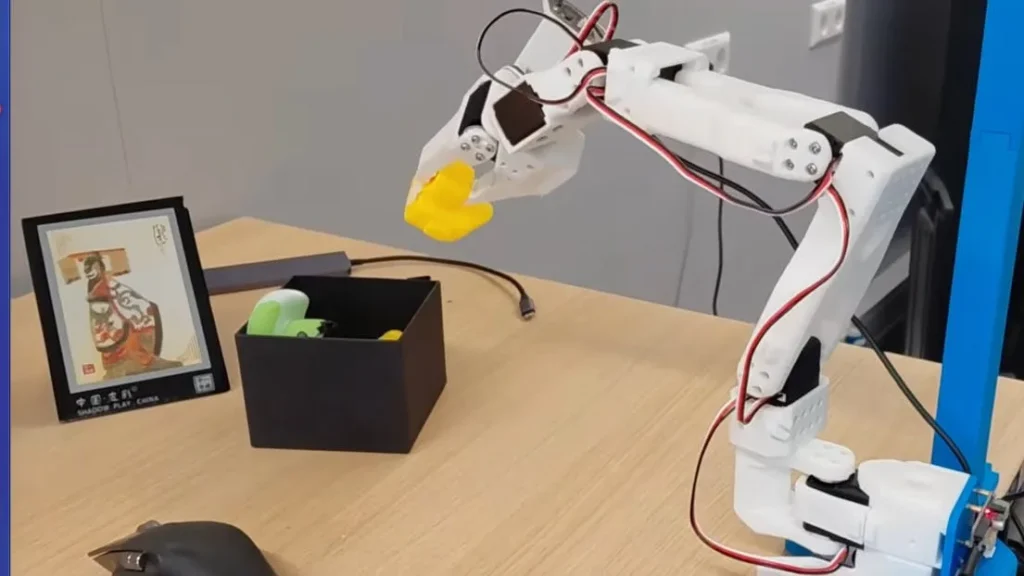
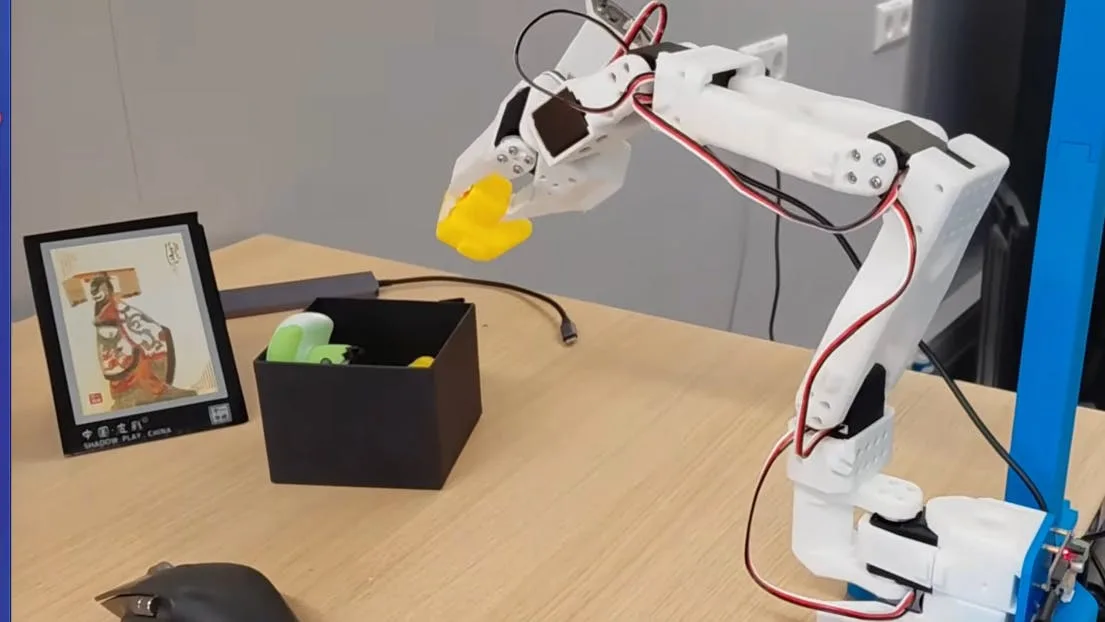
Today, that paradigm is shifting dramatically. In a striking demonstration of edge-AI efficiency, independent developer Dmitry Maslov has successfully transformed an ordinary desktop toy robot arm into an autonomous, reasoning machine. Utilizing the compact, low-cost SO-101 robotic arm, Maslov swapped out its original controller for an Arduino VENTUNO Q board. This $299 development platform now runs Hugging Face’s open-source SmolVLA model entirely locally, enabling the robotic arm to intelligently pick up and place rubber ducks based on visual-spatial reasoning.
The core breakthrough of Maslov’s project is not merely that a toy can sort plastic waterfowl, but how it achieves this feat. By executing a sophisticated VLA model on a single, commercially available board costing less than $300, the project demonstrates that the computational heavy lifting required for embodied AI can now be achieved at the maker level.
The system relies on a dual-processor architecture hosted on the Arduino VENTUNO Q. One side of the board houses a Qualcomm Dragonwing IQ8 processor equipped with an Adreno 623 GPU and a Hexagon Tensor NPU, dedicated entirely to running the neural network. The other side features an STM32H5F5 microcontroller running an Arm Cortex-M33 core at 250 MHz, which handles the real-time, low-level twitch and torque adjustments of the arm’s gearmotors.
Supported by 16 GB of LPDDR5 RAM and 64 GB of integrated eMMC storage, this hardware stack processes real-time feeds from two cameras—one mounted overhead and one situated directly on the gripper—alongside telemetry data concerning the arm’s joint positions. Trained on just 50 demonstrations of the rubber duck sorting task, Hugging Face’s SmolVLA model translates this multi-modal input into fluid, goal-oriented mechanical outputs. Without relying on cloud-based API calls or external server clusters, the setup proves that sophisticated edge robotics are no longer the exclusive domain of institutional budgets.
Chronology: The Evolution of Desktop VLA Integration
To understand the significance of Maslov’s achievement, it is necessary to examine the rapid timeline of convergence between small-scale robotics and large language-vision models over recent years.
Phase One: The Rise of Open-Source Hardware and Toy Arms (2020–2023)
For years, desktop robotic arms like the SO-101 existed primarily as educational novelties or mechanical curiosities. Equipped with basic servo motors and rudimentary control software, these arms could be programmed to repeat predetermined paths using inverse kinematics or manual teaching pendants. However, they lacked situational awareness. If an object shifted by even a few millimeters, the pre-programmed routine failed. Concurrently, the maker community began experimenting with low-cost single-board computers (SBCs), but these systems lacked the neural processing units (NPUs) required to run machine learning models of any meaningful complexity locally.
Phase Two: The VLA Revolution in Enterprise Labs (2023–2024)
As multimodal models advanced, AI research labs began introducing Vision-Language-Action models. These architectures mapped visual tokens and language instructions directly into robot actuation trajectories. While systems like RT-2 by Google DeepMind showcased incredible generalization capabilities—allowing robots to understand commands like "pick up the extinct animal" and execute them—they demanded massive computational infrastructure. Deploying these models typically required workstation-class GPUs like the NVIDIA RTX 6000 Ada or enterprise developer kits priced well north of $1,000 to $2,000, keeping them out of reach for hobbyists, independent researchers, and small-scale automation engineers.
Phase Three: The Hardware Democratization Wave (Late 2024–Early 2025)
The introduction of intermediate hardware platforms bridges the gap between low-power microcontrollers and power-hungry desktop GPUs. The release of advanced developer boards featuring integrated Tensor NPUs and high-speed LPDDR5 memory changed the calculus of edge computing. Concurrently, open-source AI initiatives like Hugging Face began developing parameter-efficient models specifically tailored for resource-constrained environments—culminating in models like SmolVLA.
Phase Four: Dmitry Maslov’s Integration Breakthrough (Present)
In the milestone project highlighted here, Dmitry Maslov brought these disparate threads together. By identifying the Arduino VENTUNO Q as an ideal bridge between high-level AI processing and low-level motor control, Maslov mapped Hugging Face’s SmolVLA model onto the Qualcomm Dragonwing IQ8 processor. Following a concise training phase consisting of just 50 physical demonstrations, the system achieved autonomous pick-and-place capabilities. The milestone was publicly documented via a video demonstration showing the SO-101 reliably sorting rubber ducks, signaling a new chapter in accessible, edge-executed embodied AI.
Supporting Data and Technical Specifications
A rigorous examination of the components used in Maslov’s setup reveals why this configuration succeeds where past desktop projects have stalled. The system’s performance relies on a delicate balance of processing power, sensor feedback, and memory bandwidth.
Hardware Breakdown: The Arduino VENTUNO Q vs. Competitors
Priced at $299, the Arduino VENTUNO Q positions itself aggressively against established development kits, such as the NVIDIA Jetson Orin Nano Super Developer Kit, which retails around $399.
| Metric / Feature | Arduino VENTUNO Q | NVIDIA Jetson Orin Nano Super Dev Kit |
|---|---|---|
| Retail Price | $299 | $399 |
| Primary SoC / Processor | Qualcomm Dragonwing IQ8 | NVIDIA Orin GPU Architecture |
| AI Acceleration | Hexagon Tensor NPU + Adreno 623 GPU | NVIDIA Ampere Architecture GPU w/ Tensor Cores |
| Real-Time Microcontroller | STM32H5F5 (Arm Cortex-M33 @ 250 MHz) | Integrated via software/external interface |
| Memory (RAM) | 16 GB LPDDR5 | 8 GB / 16 GB LPDDR5 (depending on tier) |
| Storage | 64 GB integrated eMMC | External NVMe SSD required for full utilization |
| Target Use Case | Dual-nature edge AI & real-time actuator control | General-purpose high-throughput edge AI vision |
The defining engineering choice of the VENTUNO Q is its dual-nature architecture. In traditional edge robotics setups, developers face a architectural bottleneck: single-board computers running Linux and heavy AI frameworks are notoriously poor at handling deterministic, real-time input/output (I/O) tasks like pulse-width modulation (PWM) for servo motors. Consequently, developers usually have to couple an SBC with an external microcontroller (such as an Arduino or STM32 board via USB/UART).
The VENTUNO Q internalizes this bridge. The Qualcomm Dragonwing IQ8 side runs the Linux-based operating system, loading the SmolVLA model into the 16 GB of LPDDR5 RAM and executing inference on the Hexagon Tensor NPU. Meanwhile, the STM32H5F5 microcontroller operates independently on the same physical board, taking low-level trajectory commands from the Qualcomm processor and translating them into precise microsecond-level timing adjustments for the SO-101 arm’s gearmotors.
Sensor Suite and Data Pipeline
The physical interface of the robot arm consists of:
- Joint Gearmotors: Fitted across every axis of the SO-101 arm, providing closed-loop position feedback.
- Overhead Camera: Provides a macro-level perspective of the workspace, tracking the general position of the target objects (rubber ducks) relative to the arm’s base.
- Gripper Camera: Offers a localized, first-person perspective as the end-effector approaches the target, allowing the VLA model to make micro-adjustments during the final grasping phase.
The data pipeline operates continuously:
- Images from both cameras and current joint telemetry are captured simultaneously.
- This multi-modal package is fed into the Qualcomm Dragonwing IQ8 processor.
- The local instance of Hugging Face’s SmolVLA evaluates the visual scene against its training weights.
- The model outputs predicted joint angle deltas.
- These deltas are transmitted internally to the STM32H5F5 microcontroller, which drives the physical gearmotors to execute the movement.
This entire loop occurs locally with zero latency spikes caused by cloud network bottlenecks.
Official Responses and Community Reactions
The release of Dmitry Maslov’s demonstration video has sent ripples through the global robotics, maker, and open-source AI communities. Engineers, educators, and hobbyists have weighed in on the implications of running a Vision-Language-Action model on sub-$300 hardware.
Open-source AI advocates have praised Hugging Face for the development of SmolVLA. Representatives from the open-source community noted that the democratization of VLA models relies heavily on creating smaller, highly optimized architectures that do not require server farms to execute. By scaling down parameter sizes without sacrificing spatial-reasoning capabilities, models like SmolVLA have become viable candidates for edge deployment.
Hardware enthusiasts have directed considerable attention toward Arduino’s strategy with the VENTUNO Q board. Industry analysts point out that by integrating dedicated AI processing units alongside hard real-time microcontrollers, Arduino is actively targeting a burgeoning market segment: developers who want to move beyond simple sensor-reading scripts and build genuine autonomous physical agents.
Robotics educators have likewise highlighted the pedagogical value of the setup. Traditional university robotics labs often rely on industrial arms costing tens of thousands of dollars, limiting hands-on student access. A system combining a low-cost mechanical arm, an integrated dual-processor board, and an open-source VLA model transforms a standard workbench into a viable workstation for advanced AI robotics education.
However, the community has also engaged in candid technical discussions regarding the challenges of replication. On various developer forums, engineers who have attempted similar integrations point out that the single most demanding hurdle is not training the neural network, but mastering the inter-processor communication layer. Synchronizing the high-level inference output of an SBC operating system with the hard real-time interrupt handling of an STM32 microcontroller requires rigorous optimization to avoid latency jitter, packet loss, or desynchronization between visual perception and physical actuation.
Implications: The Future of Accessible Embodied AI
The successful deployment of a Vision-Language-Action model on a $299 board controlling a desktop toy arm carries profound implications for the future of automation, research, and consumer robotics.
1. The Death of the Cloud Dependency in Low-End Robotics
For years, consumer smart devices and entry-level robotic appliances have relied on cloud infrastructure to process complex sensory data. When a smart home device or voice-controlled robot needed to interpret an environment, video feeds were routinely sent to remote servers, processed by massive language models, and sent back as execution commands.
Maslov’s project demonstrates that edge computing has matured to the point where local execution of multimodal reasoning is not only possible, but practical. Running SmolVLA locally on the VENTUNO Q guarantees data privacy, eliminates cloud subscription costs, removes susceptibility to internet outages, and slashes latency. As hardware continues to shrink in size and drop in price, localized edge AI will likely become the default standard for autonomous physical systems.
2. Democratizing Research and Development
By lowering the financial barrier to entry for VLA research from thousands of dollars to under $300, projects like this foster a massive expansion in the global pool of robotics researchers. Innovation in embodied AI can now occur in dorm rooms, garages, and small independent studios rather than being bottled up inside well-funded corporate facilities.
When thousands of independent developers begin experimenting with fine-tuning VLA models for edge hardware, the velocity of innovation typically accelerates. Crowdsourced datasets, community-contributed fine-tunes, and novel mechanical integrations will likely flourish, mirroring the explosive growth of open-source software development over the past two decades.
3. Practical Hurdles and the Road Ahead
Despite the enthusiasm, significant technical challenges remain before this technology transitions from maker showcases to robust industrial or consumer applications.
- Payload and Durability: The SO-101 is fundamentally a desktop toy. Its gearmotors and plastic linkages are not designed for heavy industrial payloads, continuous industrial duty cycles, or harsh physical environments. Scaling these techniques to durable, torque-heavy robotic manipulators will require more robust mechanical engineering.
- Data Efficiency and Generalization: While training a model on 50 demonstrations is impressive for a single, highly specific task (such as moving rubber ducks), achieving robust zero-shot generalization across unpredictable, unstructured environments remains an ongoing research challenge for small-scale VLA models.
- Inter-Processor Complexity: Bridging the divide between high-level machine learning frameworks and low-level real-time motor control requires specialized systems engineering expertise. Simplifying this integration through standardized software libraries and hardware abstractions will be critical for mass adoption.
Conclusion
Dmitry Maslov’s transformation of a desktop toy arm using an Arduino VENTUNO Q board and Hugging Face’s SmolVLA model is more than a clever weekend project—it is a signpost pointing toward the democratization of robotics. By proving that complex vision-language-action reasoning can be executed locally on accessible, low-cost hardware, the project dismantles the financial and structural barriers that have long partitioned advanced AI from physical automation. As hardware platforms continue to evolve and open-source models grow increasingly efficient, the boundary between a desktop toy and an intelligent autonomous agent will continue to blur, opening the door to an era where intelligent physical robotics are truly accessible to all.