
Advancing M2M and IoT Connectivity: A Deep Dive into the New SIMCom A7682E-Based Compact 4G/LTE Cellular Module
Global Connectivity Shifts Focus
As telecommunications infrastructure undergoes a massive, generational evolution, the global demand for robust, reliable, and widespread machine-to-machine (M2M) and Internet of Things (IoT) connectivity has never been higher. With legacy 3G (UMTS/HSDPA) networks being systematically sunsetted worldwide, developers, engineers, and remote automation specialists are increasingly forced to migrate their hardware ecosystems toward modern, future-proof standards.
Enter a newly released, highly compact cellular breakout and integration board centered around the advanced SIMCom A7682E module. Designed to bridge the gap between traditional cellular telemetry and modern high-speed broadband access, this device delivers quad-band 4G/LTE data capabilities alongside traditional voice calls and SMS functionality. Tailored specifically for remote industrial automation, asset tracking, telemetry, and embedded computing projects, this open-architecture hardware promises to streamline how microcontrollers and single-board computers interface with the cellular world.

Main Facts: Architecture and Specifications of the A7682E Board
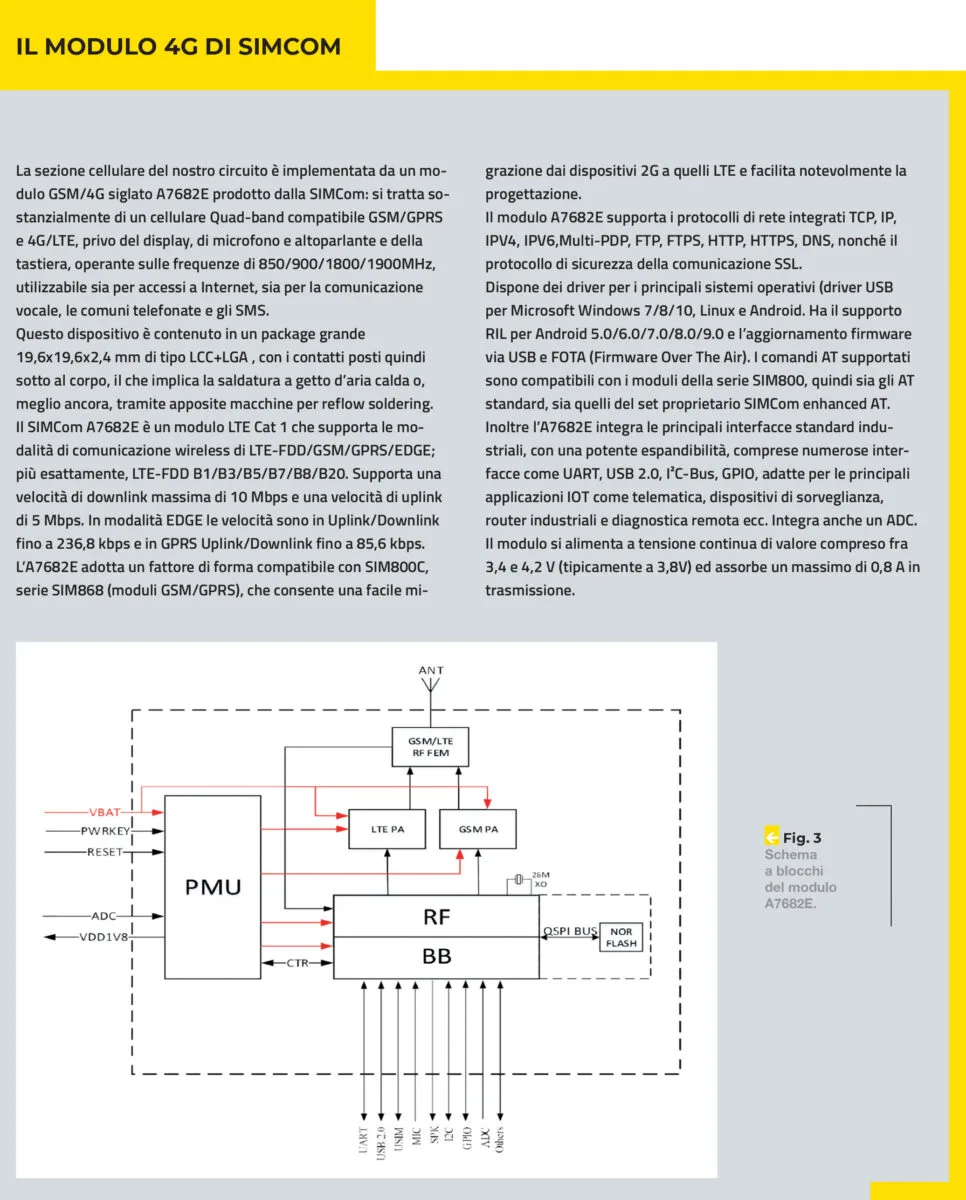
At the core of this engineering design is the SIMCom A7682E, a state-of-the-art quad-band cellular module capable of handling 2G (GSM/GPRS) up to advanced 4G/LTE communication protocols. Despite its miniature footprint, the module acts as the sole active semiconductor component on the custom-designed printed circuit board (PCB), supported by an array of discrete passive components, switching transistors, and protective elements.
Key Technical Specifications:
- Cellular Compatibility: Quad-band coverage supporting global 2G and 4G/LTE frequency bands, ensuring backward compatibility for legacy remote control via SMS/phone calls alongside high-speed data transmission.
- Core Processing & Control: Operates on a standard 3.6V to 4.2V DC supply voltage range, making it natively compatible with single-cell lithium-ion (Li-Ion) batteries or dedicated low-voltage DC mains.
- Connectivity & Expansion: Features a primary 20-pin, double-row header (2mm pitch) carrying power supply lines, control signals, UART interfaces, and analog/digital grounds, alongside a secondary 6-pin UPG connector (1mm pitch) for firmware updates and USB 2.0 debugging (DP, DM, Vbus, and Boot lines).
- SIM Management: Equipped with an onboard microSIM card socket, backed by dedicated clock, reset, data, and power lines.
- Antenna Interface: Features a gold-plated, THT-format MMCX coaxial connector designed to integrate seamlessly with external quad-band whip antennas.
Chronology: The Evolution Toward Modern LTE-Only Integration
The development of this compact 4G module follows a logical timeline driven by shifts in commercial telecommunications policy and industrial requirements:

- The Phase-Out of Legacy Standards: For decades, simple remote control systems relied heavily on 2G (GSM) and basic SMS communication. As carriers worldwide began reallocating radio spectrum for 4G and 5G networks, maintaining purely 2G devices became a growing commercial and technical liability.
- The 4G/5G Pivot: While 5G garners significant consumer attention, its widespread deployment for low-power, wide-area (LPWA) M2M applications remains cost-prohibitive or unnecessary for many industrial use cases. Consequently, the industry settled on LTE as the optimal sweet spot for balancing bandwidth, cost, and power efficiency.
- Hardware Conceptualization & Prototyping: Engineers recognized a distinct lack of miniature, easily integrable LTE modems that could bridge the gap between low-level microcontrollers and modern cellular infrastructure without requiring bulky, power-hungry industrial gateways.
- PCB Layout and Iteration: The design phase focused heavily on spatial efficiency. Designers incorporated level-shifting NPN transistors, robust transient voltage suppression (TVS) arrays for SIM card longevity, and solder-pad jumpers (JP1–JP4) to optimize the board’s routing flexibility.
- Ecosystem Maturation (The FT1427 Base Board): To simplify real-world implementation, accompanying evaluation hardware such as the FT1427 base board was developed, integrating a CH340 USB-to-TTL converter, onboard voltage regulation, and audio jacks for complete telephony testing.
Supporting Data: Circuit Design and Engineering Mechanics
A thorough examination of the circuit schematic reveals meticulous attention to electrical protection, signal integrity, and voltage domain translation.
Power Management and Control Logic
The module is engineered to remain continuously energized via its primary Vcc supply pins (tied to VBAT contacts 34 and 35), drawing power directly from an external 4V source capable of delivering up to 800 mA during peak transmission bursts.

System power-on and reset cycles are handled via discrete NPN bipolar transistors acting as low-side logic switches:
- ON/OFF Control: Pin 1 of the main header interfaces with transistor T2. Pulling this line high drives T2 into saturation, dragging the internal active-low PWR line of the SIMCom module to ground and initiating the boot sequence.
- Reset Control: Similarly, driving pin 16 high activates transistor T3, pulling the active-low RST line of the module low while simultaneously asserting the VDD_EXT status line.
Level Shifting and UART Interfacing
Because the SIMCom A7682E operates internally on 1.8V logic domains (via its VDD_EXT reference), direct connection to standard 5V or 3.3V microcontrollers would result in catastrophic logic mismatch or hardware damage. To solve this, the designers implemented a clever common-base configuration utilizing NPN transistors T4 and T5:

- RXD Line: Configured as an input with an onboard pull-up resistor tied to the collector of T5. When the external signal line is open or driven high, T5 remains off, maintaining a stable high logic state at the module’s receiver pin.
- TXD Line: Driven by the emitter of T4, translating the module’s 1.8V output signals up to standard TTL levels through a pull-up resistor and noise-filtering capacitor (C11).
Additionally, control lines such as RTS, CTS, DTR, and DCD can be independently toggled or isolated using onboard solder-pad jumpers (JP1 through JP4), giving advanced developers granular control over hardware flow control.
Protection and Audio Subsystems
To safeguard sensitive components against electrostatic discharge (ESD) and voltage spikes—particularly along the SIM card data bus—the PCB design accommodates a dedicated TVS diode array (D1) alongside filtering capacitors (C5 through C9). While optional for baseline builds, this protective infrastructure ensures reliability in electrically noisy industrial environments.

For voice applications, the module exposes direct differential analog audio lines:
- Microphone Inputs: MIC1P and MIC1N.
- Loudspeaker Outputs: SPK1P and SPK1N.
These lines can be routed directly or channeled through external base hardware (such as the FT1427) to standard 3.5mm audio jacks for direct voice communication testing.
Official Responses and Practical Implementation Guide
Constructing and deploying this cellular module requires a methodical approach, particularly given its surface-mount technology (SMD) architecture.

Assembly and Soldering Procedures
- SMD Component Placement: Due to the dense pin-out of the SIMCom A7682E module, construction requires a fine-tipped soldering iron, 0.5mm solder wire or paste, flux paste, a magnifying loupe, and precision tweezers.
- Reflow Soldering: For optimal results, the SIMCom module should be soldered first using a hot-air station, heating plate, or specialized reflow oven. Low-density flux and a uniform layer of solder paste must be applied to the pads while strictly respecting component orientation.
- Manual Sub-Components: Discrete resistors, capacitors, transistors, and the LED are subsequently soldered. Technicians must exercise caution when applying heat to the status LED to prevent thermal deformation of its transparent resin housing.
- Antenna Integration: An MMCX-compatible quad-band antenna—such as the 8170-ANTGSMSTL-MMCX magnetic whip antenna covering 850/900/1800/1900 MHz—is attached via the gold-plated onboard connector to ensure optimal signal reception.
Testing and Diagnostic Protocols
Testing the module is streamlined via USB connectivity by pairing the board with a TTL/USB converter or mounting it directly onto the dedicated FT1427 base board.
Once connected to a Windows-based PC (Windows 8, 10, or 11) with the appropriate CH340 serial drivers installed:

- Terminal Emulation: Developers can open standard terminal emulators (such as MobaXterm, PuTTY, or HyperTerminal) and communicate directly with the modem using standard AT command sets (e.g., inputting
ATDT[Phone_Number];to initiate voice calls). - Broadband Setup: By configuring the virtual COM port through the Windows Device Manager, the operating system can establish a direct USB modem network connection, enabling broadband cellular data access for remote IoT deployments.
Implications: The Future of Remote Telemetry and Industrial IoT
The introduction and open documentation of this compact SIMCom A7682E-based module carry profound implications for the embedded systems and industrial automation sectors:
- Democratization of Industrial IoT: By providing clear, accessible schematics, Gerber files, and integration pathways, developers of all scales can bypass the steep learning curves typically associated with cellular hardware certification.
- Longevity in Automation: As telecommunications providers continue phasing out legacy networks, hardware designs utilizing fallback-capable or fully LTE-integrated modules like the A7682E ensure extended operational lifespans for deployed field equipment.
- Cost-Effective Prototyping: The combination of low-cost PCB manufacturing services and readily available evaluation bases (like the FT1427) reduces time-to-market for startups and enterprise engineers alike, transforming cellular integration from an engineering bottleneck into a plug-and-play capability.








