
High-Frequency Portability: Inside the New AVR16EB28-Powered Digital Square Wave Generator
In the ever-evolving landscape of DIY electronics and benchtop instrumentation, precision has traditionally been tethered to bulky, mains-powered laboratory equipment. Function generators capable of pushing into the tens of megahertz typically demand significant desk space and power supplies. However, a groundbreaking new open-source project by renowned microcontroller experimenter David Johnson-Davies is upending this paradigm.
By leveraging the advanced capabilities of the modern AVR16EB28 microcontroller, Johnson-Davies has engineered a fully portable, battery-powered digital square wave generator that spans an astonishing frequency range—from a sluggish 2 Hz all the way up to a staggering 33.5 MHz—while maintaining ultra-fine 2 Hz adjustment steps across the entire spectrum. Housed in a compact enclosure with an intuitive user interface, this instrument bridges the gap between laboratory-grade precision and field-ready accessibility.
Main Facts: Unpacking the AVR16EB28 Instrument
At its technical core, the new signal generator relies on minimalist design principles without sacrificing operational capability.
- The Silicon Heart: The device is built around Microchip’s AVR16EB28 microcontroller. This modern AVR architecture allows for sophisticated clock management and software-driven frequency synthesis, directly outputting a square wave from a single microcontroller pin.
- Frequency Range & Resolution: The generator spans from 2 Hz to approximately 33.5 MHz. What sets it apart from traditional low-cost frequency generators is its consistent 2 Hz resolution across the entire span, allowing for incredibly granular adjustments whether testing sub-audio circuits or high-frequency digital logic.
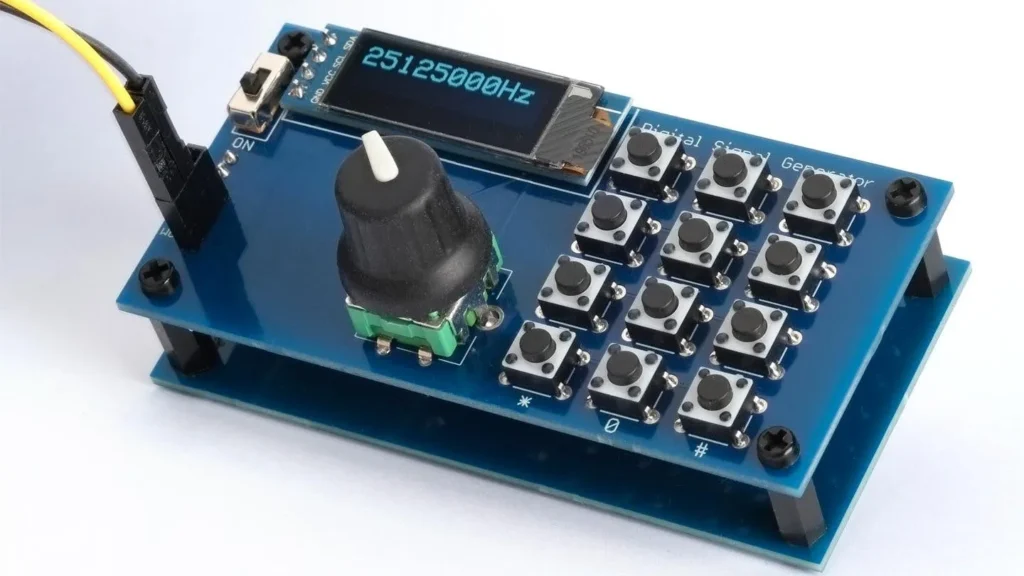
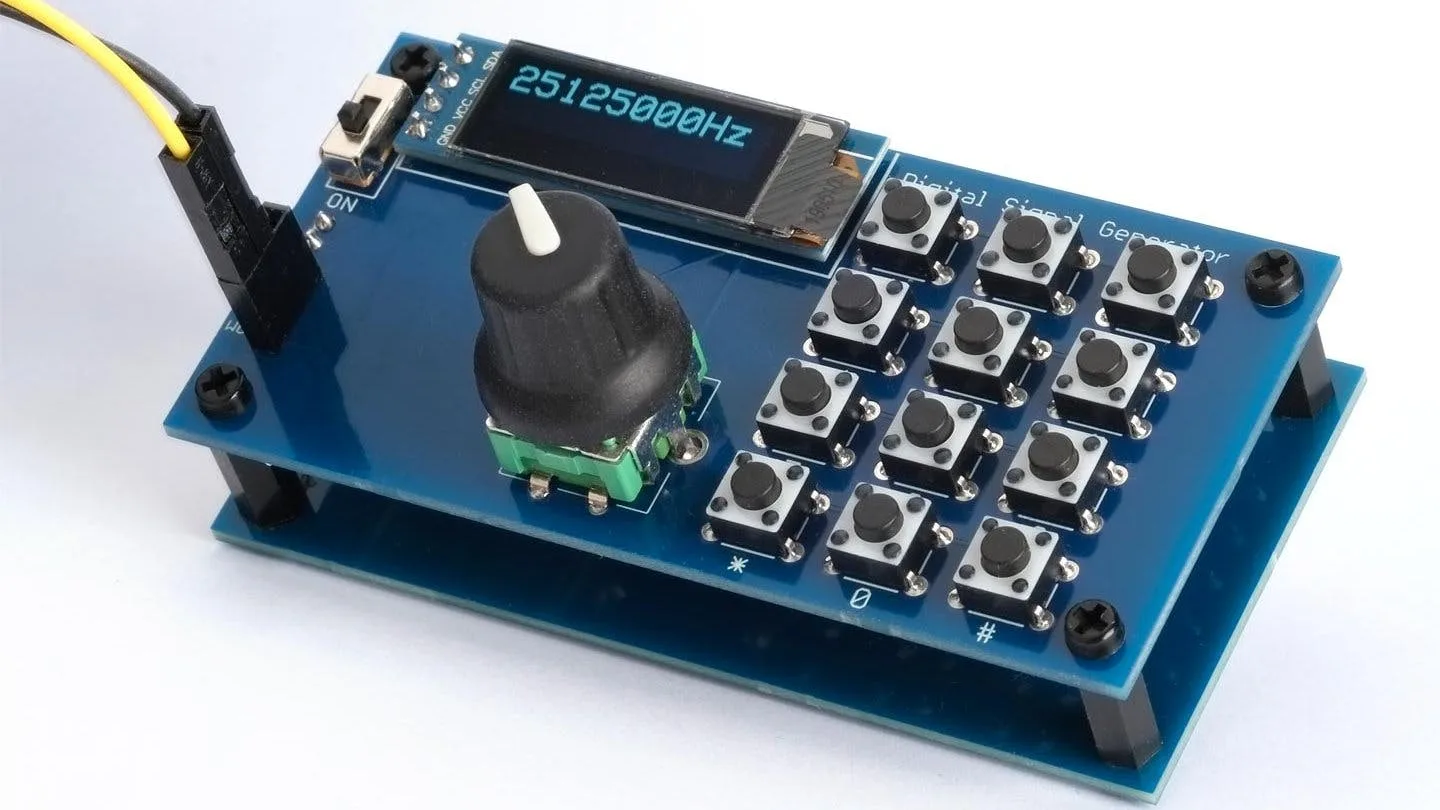
- User Interface: Operators interact with the device via a bright, low-power OLED display. Control is split between a rotary encoder—ideal for sweeping through frequencies rapidly—and a dedicated push-button keypad for punching in exact numerical values.
- Power Architecture: Powered by a rechargeable lithium-polymer (LiPo) battery, the unit includes an onboard voltage regulator to supply a stable 3.3 V to the microcontroller and peripherals. Low current draw ensures extended field operation.
- Form Factor: The entire assembly fits neatly into a handheld, workbench-friendly enclosure, making it an ideal companion for field service technicians, audio engineers, and electronics hobbyists alike.
Chronology: The Evolution of the Project
The journey toward creating a high-frequency, fine-resolution portable signal generator did not happen overnight. It represents the culmination of iterative design breakthroughs in low-cost microcontroller architecture.
Phase 1: Exploring Modern AVR Architectures
Historically, generating high-frequency square waves with fine resolution required complex direct digital synthesis (DDS) chips or expensive FPGA boards. However, the release of Microchip’s newer AVR "EB" family of microcontrollers—featuring advanced peripheral sets, high-speed internal oscillators, and flexible timer/counter structures—opened new possibilities. David Johnson-Davies began experimenting with the AVR16EB28 to test its limits in software-controlled signal generation.
Phase 2: Firmware Development and Frequency Synthesis
The primary challenge in designing the firmware was achieving a consistent 2 Hz step size across a multi-megahertz range without jitter or software bottlenecks. By optimizing the code routines responsible for calculating and updating timer registers, Johnson-Davies successfully enabled real-time frequency adjustments. Concurrently, he integrated libraries to handle the OLED screen and the dual-input control system (rotary encoder and keypad).
Phase 3: Hardware Integration and Power Management
With the software logic proven, the physical layout took shape. The design prioritized compactness and ease of replication. Integrating a LiPo battery with proper voltage regulation ensured that the device could break free from the tether of AC wall power. Surface-mount device (SMD) components were chosen to minimize board real estate, resulting in a dense yet manageable printed circuit board (PCB) layout.

Phase 4: Public Release and Documentation
Following rigorous bench testing—validating signal integrity, waveform rise times, and frequency accuracy—Johnson-Davies published the complete project documentation, schematics, and source code on his technical blog (Technoblogy), opening the design up to the global maker and engineering community.
Supporting Data: Technical Specifications and Performance Metrics
To truly appreciate the engineering achievement behind the AVR16EB28 square wave generator, one must examine the underlying performance metrics and hardware specifications:
| Parameter | Specification |
|---|---|
| Microcontroller | Microchip AVR16EB28 (SMD package) |
| Frequency Range | 2 Hz – 33.5 MHz |
| Step Resolution | 2 Hz (uniform across the entire range) |
| Output Waveform | Square wave (direct pin-driven synthesis) |
| Display | Integrated OLED panel for real-time frequency readouts |
| Control Inputs | Rotary encoder (rapid sweeping) + Push-button keypad (exact entry) |
| Power Source | 3.7 V rechargeable LiPo battery with internal voltage regulation |
| Target Applications | Audio circuit testing, filter characterization, timing checks, and logic analysis |
The device’s ability to deliver a clean square wave up to 33.5 MHz while preserving micro-adjustments at lower frequencies highlights the raw efficiency of modern 8-bit/16-bit hybrid microcontroller architectures. While traditional function generators often suffer from coarse tuning steps at higher frequencies, this software-driven approach maintains absolute control over the output signal parameters.
Official Responses and Creator Insights
While commercial instrument manufacturers focus heavily on high-margin, feature-dense laboratory systems, independent creators like David Johnson-Davies continue to champion accessibility and minimalist design in electronics engineering.
Reflecting on the philosophy of the project, Johnson-Davies emphasizes that modern microcontrollers eliminate the need for complicated external circuitry to achieve professional-grade results. In his published project notes, he highlights that the AVR16EB28’s internal capabilities allow makers to construct a high-performance instrument using only a handful of easily obtainable components.
Feedback from the broader open-source electronics community has been overwhelmingly positive. Early adopters and fellow makers have praised the project for its dual-control mechanism—noting that the combination of a rotary encoder for sweeping and a keypad for precise inputs solves one of the most common ergonomic frustrations found in budget benchtop gear: the tedious scrolling through wide frequency ranges.
Implications: What This Means for Makers and Field Engineers
The introduction of the AVR16EB28 digital square wave generator carries several notable implications for the fields of hobbyist electronics, education, and mobile hardware diagnostics.

Democratization of Instrumentation
Professional function generators capable of generating stable frequencies up to 33.5 MHz can cost hundreds, if not thousands, of dollars. By utilizing a low-cost microcontroller and a handful of supporting passive components, this project drastically lowers the financial barrier to entry for students, hobbyists, and independent repair technicians who need reliable testing tools.
Portability in Diagnostics
Field-service engineers frequently encounter scenarios where troubleshooting requires signal injection or clock verification far away from an AC workbench. The integration of a LiPo power supply transforms the device from a static bench instrument into a truly mobile diagnostic tool that can slip easily into a toolkit.
The Renaissance of 8/16-bit Microcontrollers
There is a common misconception in modern electronics that high-performance tasks exclusively demand powerful 32-bit ARM processors or FPGAs. Projects like this serve as a powerful reminder that optimized firmware running on modern, highly efficient architectures like Microchip’s AVR "EB" series can punch well above their weight class.
Conclusion and Future Outlook
David Johnson-Davies’ AVR16EB28-based square wave generator is a masterclass in elegant engineering. By combining a remarkably wide frequency range (2 Hz to 33.5 MHz) with ultra-fine 2 Hz steps, a dual-mode user interface, and complete battery-powered independence, it redefines what is possible within the realm of DIY benchtop instrumentation.
For those interested in replicating the build, complete construction details, schematics, PCB layout guidelines, and the requisite source code are publicly available on David Johnson-Davies’ Technoblogy website. Whether you are an audio engineer tuning a custom filter, a digital designer checking clock lines in the field, or an electronics enthusiast looking for your next weekend project, this digital signal generator stands out as a worthy and profoundly satisfying addition to any toolkit.








