
Revolutionizing Open-Source Robotics: Maker Kelton Unveils Sub-$100, Support-Free 3D-Printed Robot Arm with Intuitive Scale-Model Control
By Tech & Innovation Desk
Published: September 2026
Main Facts
The landscape of accessible robotics has taken a massive leap forward. Maker and designer Kelton has officially launched the second-generation iteration of his viral open-source robot arm, incorporating three years of iterative design improvements, community feedback, and engineering refinements.
Built to democratize high-level robotics, the newly unveiled project achieves what few desktop robotic platforms can: a complete, fully functional, multi-axis robotic arm paired with a physical scale-model controller, all for a total hardware and component cost of under $100.
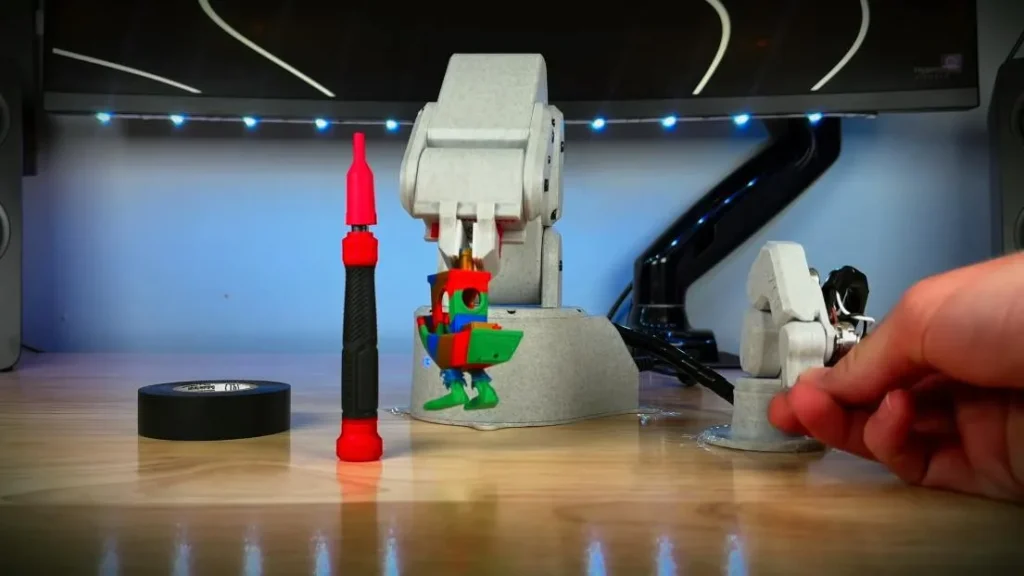
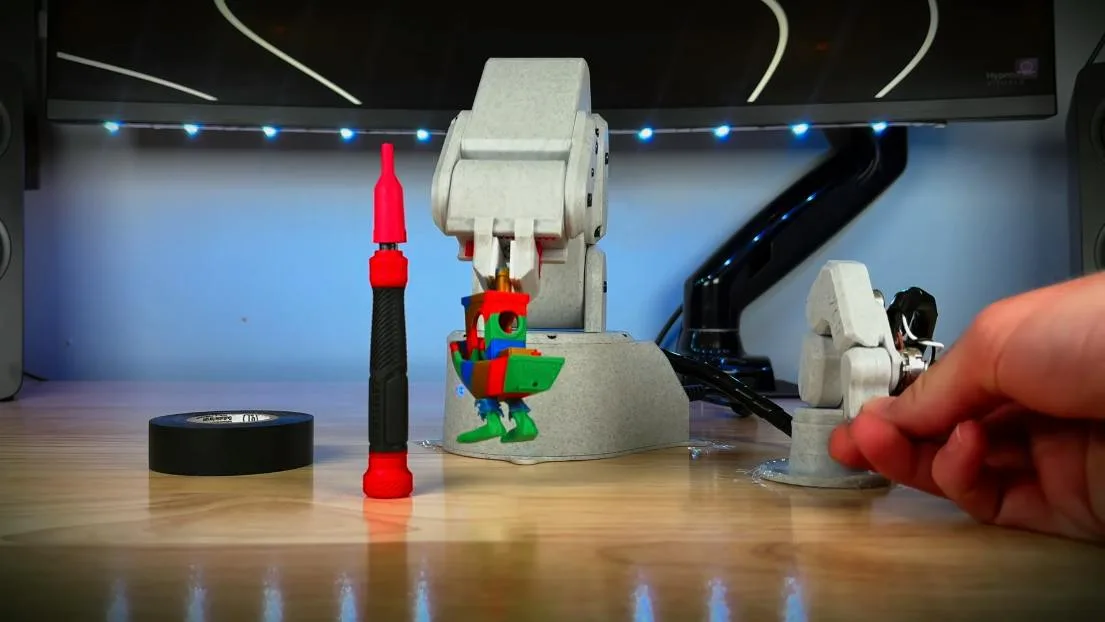
Unlike industrial or high-end educational arms that require complex coding interfaces, kinematics algorithms, or steep learning curves, Kelton’s design utilizes a direct "master-slave" control scheme. By manipulating a miniature physical replica of the arm—the scale-model controller—the user commands the full-sized robotic counterpart in real time.
The project’s standout engineering achievement lies in its manufacturing accessibility. Every structural component has been meticulously designed to be 3D-printed entirely without support material. This optimization eliminates the post-processing nightmare typically associated with complex prints, drastically reduces material waste, and allows makers of all skill levels to go from digital files to a fully assembled machine in just a couple of days.
Driven by an Arduino Nano ESP32 microcontroller and standard hobby servomotors, the architecture has been entirely overhauled. Upgrades include a precision belt-driven wrist joint and a robust rack-and-pinion gripper mechanism, drastically enhancing both mechanical reliability and movement repeatability. All printing files and schematics have been made publicly available via Printables, signaling a major win for the global open-source hardware community.
Chronology
The Genesis: The Viral First Generation (2023)
The journey of this budget-friendly robotic system began three years ago when Kelton published a video documenting his first-generation 3D-printed robot arm and matching controller. At the time, the concept of utilizing a physical scale model to map and actuate a full-sized robotic arm captured the imagination of the maker community.
The YouTube video detailing the build went viral, ultimately amassing over 654,000 views. Hobbyists, educators, and students flooded the comment sections and community forums with praise, but they also provided constructive criticism. While the initial prototype proved the concept, it suffered from structural quirks: certain joints were difficult to assemble, some parts required tedious support removal during 3D printing, and mechanical wear-and-tear exposed vulnerabilities in the drivetrain under heavy continuous use.
The Iterative Phase: Community Feedback and Redesign (2023–2026)
Rather than moving on to an entirely different venture, Kelton spent the subsequent three years analyzing user data, replicating common failure points, and testing alternative mechanical transmissions.
The development of Version 2 was an exercise in minimalist engineering. Every gram of plastic and every mechanical linkage was scrutinized. The goal was twofold: drastically simplify the fabrication process for individuals with entry-level 3D printers, and upgrade the kinematic precision of the arm without inflating its sub-$100 budget.
During this multi-year development window, microcontroller technology also advanced. The integration of modern boards like the Arduino Nano ESP32 provided the necessary processing power and wireless connectivity options to handle sensor inputs from the master controller smoothly, paving the way for the refined architecture released today.
The Launch: Version 2 Release (September 2026)
The culmination of this three-year engineering cycle arrived with the publication of the project files on Printables. The launch marks a transition from a proof-of-concept novelty to a robust, standardized educational platform. The release includes optimized STLs, comprehensive assembly guidelines, and a bill of materials designed to ensure that hobbyists worldwide can source parts easily from local suppliers or online marketplaces without facing supply-chain bottlenecks.
Supporting Data & Technical Architecture
To understand how a fully articulated robotic arm can be produced for under $100 while maintaining high reliability, one must examine the bill of materials, electronics layout, and mechanical innovations that anchor the project.
Cost Breakdown and Economic Efficiency
Keeping the total project cost below the threshold of a standard textbook or consumer gadget required strict fiscal discipline in design choices:
- 3D Printing Filament: Approximately 500 to 700 grams of standard PLA (or equivalent thermoplastic), costing roughly $10 to $15 depending on the brand.
- Microcontroller: An Arduino Nano ESP32 board, serving as the central computing and communication brain, priced around $15 to $18.
- Actuation: A collection of standard hobby servomotors and an accompanying dedicated servo driver board to manage power distribution and signal modulation, totaling approximately $30 to $40.
- Hardware (Fasteners & Bearings): Standard metric nuts, bolts, small timing belts, and gears accounting for the remaining budget, bringing the total to comfortably under $100.
Mechanical Engineering Enhancements
The most critical upgrades in Version 2 occur at the end-effector and wrist assemblies, where precision matters most:
- Support-Free Geometry: By analyzing overhang angles, bridging capabilities, and orientation planes, Kelton redesigned every part so that flat surfaces rest squarely on the print bed. This removes the need for slicer-generated supports, saving hours of scraping, sanding, and post-processing.
- Belt-Driven Wrist: In the previous iteration, direct-drive configurations or simple gear trains on the wrist introduced backlash—slack in the gear teeth that leads to imprecise positioning. The new belt-driven wrist eliminates this slop, translating micro-movements of the controller into smooth, accurate rotations at the end of the arm.
- Rack-and-Pinion Gripper: The original gripper design occasionally struggled with grip strength and alignment under load. The adoption of a rack-and-pinion mechanism distributes clamping force evenly across the two fingers, ensuring a secure hold on objects placed within the workspace.
Electronics and Control Loop
The system relies on an elegant, decentralized master-slave configuration. The control device is a physical scale model outfitted with rotational sensors (such as potentiometers or encoders) embedded in its joints.
When the user physically manipulates the scale model, these sensors record changes in angular position. This analog or digital data is fed instantaneously into the Arduino Nano ESP32. The microcontroller interprets the inputs and sends corresponding PWM (Pulse Width Modulation) signals to the servo driver board, which powers the motors on the main robotic arm. Because the kinematics are direct 1:1 scale replicas, no complex inverse kinematics calculations are required by the end user—what you do with your hand on the model is precisely what the robot mirrors in real time.
Official Responses & Community Reactions
The release of Kelton’s second-generation robot arm has generated immediate waves across maker spaces, educational forums, and digital fabrication communities.
Early responses from beta testers and long-time followers of Kelton’s work highlight the stark contrast between this project and commercial educational robots, which often retail for hundreds or even thousands of dollars.
"When people see an articulated robotic arm, their minds automatically go to industrial automation, heavy programming, and exorbitant price tags," noted one prominent open-source hardware reviewer in a community discussion thread. "What Kelton has done is strip away the intimidation factor. By making it completely support-free, he has removed the number one barrier to entry for novice 3D printing enthusiasts. You don’t need a calibrated, high-end Voron or Bambu Lab machine to print this successfully; an entry-level bed-slinger will do."
Educators have also weighed in enthusiastically. High school STEM instructors and university lab coordinators have pointed out that the lack of mandatory programming makes the arm an ideal pedagogical tool for younger students.
“Programming can sometimes act as a bottleneck when you are trying to teach basic mechanical engineering principles or physics concepts like leverage, torque, and gear ratios,” shared a high school robotics coach in an online forum. “With this master-model setup, students can instantly feel the mechanical feedback and see the cause-and-effect relationship between input and output without getting bogged down in syntax errors or debugging code.”
Furthermore, the creator community on Printables has embraced the modular nature of the design. Several contributors have already begun discussing modifications, such as mounting computer vision cameras to the wrist or integrating wireless Bluetooth control modules to decouple the physical master model from the robot entirely.
Implications
The democratization of advanced robotics hardware carries profound implications across multiple sectors, ranging from education and hobbyist innovation to low-cost prototyping and the broader philosophy of open-source design.
Transforming STEM Education
Access to physical robotics has historically been gated by cost. Schools in underfunded districts often struggle to acquire enough robotic kits for hands-on group work. At a material cost of under $100—and leveraging school-owned 3D printers—institutions can manufacture multiple arms for the price of a single commercial educational kit.
By removing the programming prerequisite, educators can introduce robotics concepts to younger age brackets, fostering spatial reasoning, mechanical intuition, and engineering literacy well before students encounter formal computer science curricula.
The Power of Iterative Open-Source Hardware
Kelton’s three-year journey from a viral prototype to a polished, highly refined second-generation product exemplifies the strength of the open-source hardware model. In software development, continuous integration and community bug-reporting are standard practices. Applying this same agile methodology to physical objects—where physical prototyping is constrained by time and filament—demonstrates how creators can leverage global feedback loops to perfect mechanical designs.
The choice to release all files freely ensures that the barrier to replication remains practically nonexistent, inviting further innovation from a decentralized global workforce.
Redefining Consumer Expectations in Desktop Robotics
As hobbyist 3D printers become faster, cheaper, and more reliable, projects like Kelton’s robot arm challenge the traditional consumer electronics market. Consumers are no longer content with closed ecosystems where hardware repairs are impossible and proprietary replacement parts are artificially expensive.
By designing for modularity, common hardware stores, and support-free printing, Kelton’s work champions a sustainable philosophy: if a part breaks, the user simply fires up their 3D printer, prints a replacement for pennies, and swaps it out in minutes.
Ultimately, this project proves that cutting-edge robotics engineering does not require massive corporate backing or prohibitive budgets. Through clever design, deep consideration of manufacturing limitations, and a commitment to intuitive human-machine interaction, high-tech robotics is increasingly becoming a reality that anyone can build right on their desktop.








