A Timeless Cadence: Alnwlsn’s MIDI Player Piano Redefines the "Restomod"
Main Facts
In a remarkable convergence of antique artistry and modern engineering, a project by an innovator known as Alnwlsn has redefined the concept of "restomod" – typically associated with classic automobiles – by applying it to a 19th-century player piano. This ingenious creation transforms a venerable mechanical instrument, originally dependent on physical paper rolls, into a digitally controlled marvel capable of interpreting the vast library of modern MIDI files. Far from a mere novelty, Alnwlsn’s MIDI-actuated player piano represents a meticulous blend of preservation and innovation, where technological enhancements are seamlessly integrated without compromising the instrument’s historical integrity or original functionality. The project stands as a testament to the enduring appeal of mechanical music and the endless possibilities unlocked by contemporary microcontroller technology, offering a glimpse into a future where historical artifacts can not only be preserved but also revitalized for new generations through thoughtful technological intervention.
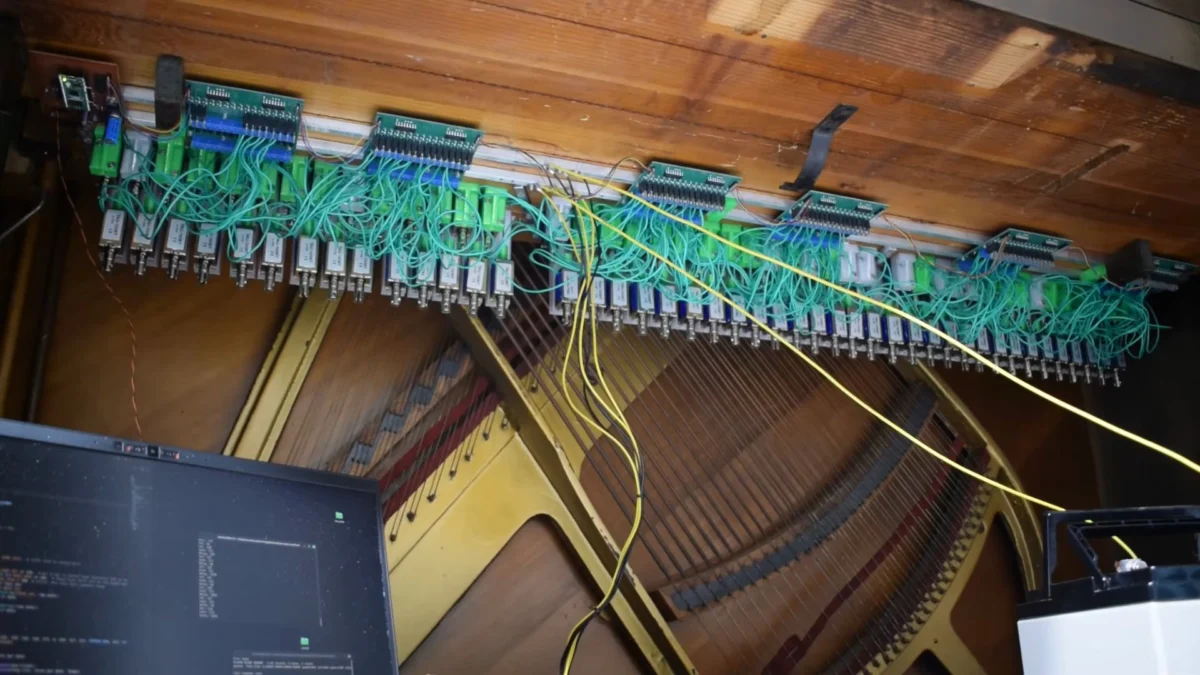
The core of this transformation lies in the integration of a Raspberry Pi Pico, an RP2040 microcontroller, which serves as the brain orchestrating the complex dance of 88 individual solenoids. These solenoids, precisely positioned, mimic the actions of the original pneumatic system, gently "poking" the key paddles from below. Crucially, the design emphasizes reversibility, with only minimal, strategically placed modifications that do not impact the piano’s structural integrity or its ability to function traditionally. This commitment to non-invasive enhancement distinguishes Alnwlsn’s work, allowing the piano to retain its heritage while gaining unparalleled access to a global digital repertoire. The technical ingenuity extends to dynamic expression, with the RP2040’s Programmable I/O (PIO) feature being ingeniously utilized to create a form of Pulse Width Modulation (PWM), enabling nuanced volume control by softening solenoid blows for quieter notes. Furthermore, power management is optimized through staggered pulsing of solenoids, preventing overload when complex chords demand simultaneous key activations. This project is not merely an upgrade; it is a philosophical statement on how technology can serve history, opening up classic instruments to a universe of digital possibilities previously unimaginable.
The Art of the "Restomod" Reimagined
From Automotive Bays to Concert Halls: A Conceptual Leap
The term "restomod," a portmanteau of "restoration" and "modification," has long been entrenched in the lexicon of automotive enthusiasts. It describes the intricate process of taking a classic vehicle, often decades old, and meticulously restoring it to its former glory, while simultaneously integrating modern technological improvements that enhance performance, safety, and comfort. These improvements, ranging from fuel injection and disc brakes to air conditioning and advanced infotainment systems, are chosen for their ability to elevate the driving experience to contemporary standards, all while preserving the iconic aesthetics and spirit of the original design. The underlying philosophy is to create a "better-than-new" classic, an artifact of engineering that respects its heritage but refuses to be bound by the limitations of its era.
Alnwlsn’s MIDI-actuated player piano project brilliantly extrapolates this concept from the realm of roaring engines and polished chrome to the nuanced world of musical instruments. Here, the "classic vehicle" is a grand player piano, a sophisticated mechanical marvel from the 19th century that once represented the pinnacle of automated musical performance. The "technological improvements" are not a more efficient carburetor or a GPS system, but rather the digital precision of MIDI and the computational power of a modern microcontroller. By embedding this digital intelligence, Alnwlsn has bestowed upon the antique instrument capabilities that its original builders could only have dreamed of. The "performance" is no longer limited by the physical availability and condition of brittle paper rolls but by the virtually infinite digital library of MIDI files. This conceptual leap demonstrates that the "restomod" ethos is not confined to any single domain; it is a universal principle applicable wherever the desire to bridge the past and present with innovative engineering takes hold. The project underscores the idea that true innovation often lies in recontextualizing existing ideas and applying them to new challenges, breathing new life into cherished traditions.
Preserving Heritage While Embracing Innovation
A critical aspect of any successful restomod, whether automotive or musical, is the delicate balance between enhancement and preservation. The true art lies in improving functionality and performance without irrevocably altering the core identity or historical value of the original item. For classic cars, this means avoiding modifications that would render the vehicle unrecognizable or diminish its collectibility. For a vintage player piano, the stakes are arguably higher, given its unique historical and cultural significance. The instrument is not just a mechanism; it is a piece of art, a historical document, and a potential heirloom.
Alnwlsn’s project exemplifies this principle with remarkable foresight and respect. Unlike more aggressive modifications that might involve gutting the original mechanism or making irreversible structural changes, this MIDI conversion is designed to be largely reversible. The creator meticulously drilled a few holes and slots in the original wood, but these interventions were strategically placed and minimal, ensuring they do not compromise the integrity or the original pneumatic operation of the player piano mechanism. The MIDI-controlled solenoids are engineered to interact with the existing key paddles from below, effectively mimicking the original pneumatic action without interfering with it. This non-invasive approach is paramount. It means that, should the need or desire arise, the digital augmentation can be carefully removed, allowing the piano to revert to its purely mechanical state. From the listener’s or operator’s perspective, the piano behaves exactly as it should, whether playing from a MIDI file or an original paper roll (if the original mechanism is still engaged), with the only visual tell being the absence of a physical music scroll when in MIDI mode. This commitment to reversibility and minimal intervention is a profound statement of respect for the instrument’s heritage, demonstrating that embracing innovation does not necessitate abandoning tradition. It rather shows that technology, when wielded thoughtfully, can be a tool for preservation, expanding the life and utility of historical objects without erasing their past.
A Symphony of Silicon and Solenoids: The Technical Journey
Bridging the Digital-Analog Divide
The fundamental challenge in converting a mechanical player piano to a MIDI-actuated system lies in bridging the vast chasm between the digital world of MIDI data and the physical reality of hammers striking strings. MIDI, or Musical Instrument Digital Interface, is a protocol that communicates musical performance data – such as note on/off, velocity, pitch bend, and control changes – as digital messages. A player piano, on the other hand, operates through a complex pneumatic system, where vacuum-driven bellows push up on "finger" mechanisms that, in turn, press the piano keys. The task, therefore, is to translate a stream of binary data into precise, physical movements that replicate the touch of a human pianist or the action of the original pneumatic system.
Alnwlsn achieved this by deploying an array of solenoids. A solenoid is an electromagnetically controlled mechanical device that, when energized, produces a linear pushing or pulling motion. In this setup, each of the piano’s 88 keys is assigned its own solenoid. These solenoids are strategically mounted beneath the piano’s action, positioned to gently "poke" the same key paddles from below that the original pneumatic mechanism would have engaged. When a MIDI "note on" message is received for a particular key, the corresponding solenoid is briefly energized, causing it to extend and press the key. When a "note off" message is received, the solenoid retracts, allowing the key to return to its resting position. This direct mechanical actuation is elegant in its simplicity, yet complex in its execution, requiring precise timing, sufficient force, and careful integration to ensure that the solenoid’s action accurately mimics the desired musical input without causing damage to the delicate piano mechanism. The success of this bridge between digital and analog is what ultimately allows the piano to transition from a fixed repertoire of paper rolls to the boundless possibilities of digital music.
The Brain of the Operation: Raspberry Pi Pico and RP2040
At the heart of Alnwlsn’s innovative player piano system lies the Raspberry Pi Pico, powered by the RP2040 microcontroller. The choice of this particular microcontroller is a testament to its remarkable capabilities and versatility, especially for projects requiring precise timing and numerous output controls. The RP2040 is a dual-core ARM Cortex-M0+ processor, known for its high performance, low cost, and a unique feature set that includes the Programmable I/O (PIO) subsystem. These attributes make it an ideal candidate for tasks like interpreting MIDI signals and driving a large number of physical outputs.
The primary role of the Pi Pico is to receive and interpret incoming MIDI data. MIDI messages, which are serial data streams, are processed by the RP2040 to identify "note on" and "note off" events, along with their associated velocity (which dictates how hard a key is pressed). Once a "note on" event is detected for a specific key, the microcontroller must then trigger the corresponding solenoid. With a full 88-key piano, this means the system needs to manage 88 independent outputs. Direct control of 88 outputs from a single microcontroller is a significant challenge, as most microcontrollers have a limited number of general-purpose input/output (GPIO) pins. The RP2040, while capable, would quickly exhaust its native GPIO count if each solenoid required a dedicated pin. This necessitates an intelligent expansion strategy to effectively "fan out" the control signals, ensuring that each of the 88 solenoids can be individually activated or deactivated according to the MIDI data. The Pi Pico’s robust processing power and the flexibility of its PIO are crucial in handling this real-time interpretation and output orchestration with the necessary precision and speed.
Orchestrating the Keys: Shift Registers and MOSFETs
To manage the formidable task of controlling 88 individual solenoids from the relatively limited GPIO pins of a single Raspberry Pi Pico, Alnwlsn employed a classic digital electronics technique: using shift registers. Shift registers are sequential logic circuits that can take a serial input (data sent one bit at a time) and convert it into a parallel output (multiple bits available simultaneously). By daisy-chaining multiple shift registers, a microcontroller can control a large number of outputs using only a few of its own GPIO pins (typically three: data, clock, and latch). For 88 outputs, several shift registers would be linked together, with the Pi Pico sending a stream of 88 bits representing the on/off state of each solenoid. This data is then "shifted" through the registers until each output pin on the shift registers corresponds to a specific solenoid.
However, solenoids are electromechanical devices that draw a significant amount of current, far more than a typical shift register or microcontroller GPIO pin can safely supply. To address this, each solenoid is driven by a MOSFET (Metal-Oxide-Semiconductor Field-Effect Transistor). MOSFETs act as electronic switches: a small voltage applied to their gate terminal can control a much larger current flow between their drain and source terminals. In this setup, the output of each shift register is connected to the gate of a MOSFET, and the solenoid is connected in series with the MOSFET’s main current path to the power supply. When the shift register output goes high, the MOSFET turns on, allowing current to flow through the solenoid and activate it.
Another crucial component in this electrical orchestra is the level shifter. The Raspberry Pi Pico’s RP2040 operates on 3.3V logic, meaning its output signals are typically 3.3V. Many common digital components, including some shift registers and MOSFET driver circuits, are designed to operate optimally with 5V logic. A level shifter is a small circuit that translates digital signals between different voltage domains. In this case, it ensures that the 3.3V signals from the Pi Pico are reliably interpreted as high signals by any 5V components in the chain, preventing miscommunication or unreliable operation. This meticulous layering of components – Pi Pico for MIDI processing, shift registers for output expansion, MOSFETs for power switching, and level shifters for voltage compatibility – forms a robust and efficient system capable of orchestrating the complex mechanical demands of the player piano.
Dynamic Expression: Volume Control and Power Management
One of the most challenging aspects of translating digital MIDI data to a mechanical instrument is replicating dynamic expression, specifically volume or velocity. In MIDI, "velocity" indicates how hard a key is struck, directly correlating to the volume and timbre of a note. A simple on/off solenoid system would result in every note being played at a uniform, maximum volume, leading to a robotic and unexpressive performance. Alnwlsn tackled this critical issue by ingeniously leveraging the RP2040’s powerful Programmable I/O (PIO) system.
The PIO is a unique feature of the RP2040 that allows users to define custom hardware interfaces using small, specialized state machines. Alnwlsn utilized the PIO to create a form of Pulse Width Modulation (PWM) signal that can control the force with which the solenoids strike the keys. Instead of simply turning a solenoid fully on or off, the PIO can rapidly pulse the power to the solenoid. By varying the duty cycle of this pulse (the ratio of on-time to off-time), the effective power delivered to the solenoid can be controlled. A longer "on" pulse would result in a stronger, louder strike, while a shorter "on" pulse would soften the blow, producing a quieter note. This innovative application of PIO allows the system to emulate the nuances of a pianist’s touch, bringing a much-needed layer of musicality and expressiveness to the mechanical piano.
Beyond dynamic control, managing power consumption is a significant concern when dealing with 88 individual solenoids, each drawing current. If all solenoids were to activate simultaneously during a complex chord, the instantaneous current draw could easily overwhelm the power supply, leading to voltage drops, component damage, or system instability. To mitigate this, Alnwlsn implemented a clever power-saving strategy: staggering the pulses. Instead of activating multiple solenoids at the exact same instant when a MIDI file calls for a chord, the system is designed to slightly offset the activation times. This micro-staggering happens so quickly that it is imperceptible to the human ear, but it dramatically reduces the peak current demand on the power supply. By distributing the load over a very short time window, the system prevents sudden spikes in current, ensuring stable operation and protecting the components from excessive strain. This thoughtful approach to both musical expression and electrical engineering underscores the depth of ingenuity behind Alnwlsn’s player piano restomod.
A Chronology of Musical Automation
The Genesis of Automated Music: From Barrel Organs to Player Pianos
The human fascination with automated music predates modern electronics by centuries, rooted in the desire to capture and reproduce musical performances without the direct intervention of a live musician. Early forms include the intricate mechanisms of musical boxes, carillons, and barrel organs, which used pins on rotating cylinders or barrels to trigger hammers, pluck strings, or open air valves. These devices, while rudimentary by today’s standards, laid the conceptual groundwork for encoding musical information into a physical medium.
The 19th century witnessed a significant leap forward with the advent of the player piano. Building on principles developed in earlier pneumatic and mechanical automata, the player piano emerged as a sophisticated instrument that could "play itself." The dominant technology involved perforated paper rolls. Each hole in the paper roll corresponded to a specific note, and as the roll moved across a "tracker bar," air pressure differences (created by a vacuum pump, often foot-pedaled by the operator) would be sensed through these holes. This change in air pressure would then activate a pneumatic mechanism, which in turn would cause a hammer to strike a piano string. The player piano became immensely popular in homes and public spaces during the late 19th and early 20th centuries, offering access to a vast repertoire of music, from classical pieces to popular tunes and ragtime, at a time when live musical performances were the primary source of entertainment. It democratized music, allowing anyone to "play" the piano, regardless of their musical skill. These punched paper rolls, in their ingenious method of encoding musical events (note on/off, duration), can indeed be seen as the "MIDI of the 19th century," a standardized format for musical data exchange that transcended the human performer.
The Dawn of Digital: MIDI’s Revolution
While the player piano flourished in the early 20th century, its mechanical complexity and reliance on physical media eventually gave way to new forms of entertainment and technology. The mid-20th century saw the rise of electronic music and synthesizers, which brought new sounds and performance possibilities. However, the lack of a universal language for these electronic instruments created significant interoperability challenges. Different manufacturers used proprietary communication protocols, making it difficult for instruments from one brand to "talk" to those from another.
This fragmented landscape changed dramatically with the introduction of MIDI (Musical Instrument Digital Interface) in 1983. Developed collaboratively by instrument manufacturers, MIDI provided a standardized digital communication protocol that allowed electronic musical instruments, computers, and other related devices to communicate with each other. MIDI doesn’t transmit audio signals; instead, it transmits event messages like "note on," "note off," pitch, velocity, and control changes. This meant that a keyboard from one manufacturer could control a synthesizer from another, or a computer could sequence an entire orchestra of electronic instruments. MIDI revolutionized music production, live performance, and education. It enabled intricate sequencing, sophisticated sound design, and the creation of complex arrangements that were previously impractical. The impact of MIDI was profound, democratizing access to professional-grade music creation tools and fostering an explosion of creativity across all genres of music. It became, and largely remains, the backbone of digital music production, a testament to its robust and flexible design.
The Modern Synthesis: Alnwlsn’s Vision
Alnwlsn’s MIDI-actuated player piano project stands as a magnificent synthesis of these two distinct eras of musical automation. It is a direct bridge, connecting the mechanical ingenuity of the 19th-century player piano with the digital ubiquity and flexibility of 21st-century MIDI technology. By integrating a modern microcontroller and an array of solenoids into an antique instrument, Alnwlsn has effectively given the player piano a new voice, one that can speak the language of modern digital music.
This project is not just a technical feat; it is a profound historical statement. It demonstrates how the fundamental human desire to automate, control, and reproduce music has evolved, yet maintained a continuous thread. The player piano’s paper rolls were a form of data storage and playback, much like MIDI files are today. Alnwlsn’s work brings this analogy to life in a tangible, audible way. It allows an instrument designed for a world of physical, hand-punched rolls to access a virtually limitless global archive of digital performances, composed and recorded on electronic instruments and computers. This modern synthesis is a powerful reminder that while technology advances, the core principles of music and the desire to experience it in new and exciting ways remain constant. It positions Alnwlsn’s creation not merely as a hack or a modification, but as a thoughtful evolution of an enduring musical tradition.
Supporting Data and Analogies
The Digital Library vs. The Physical Scroll
One of the most compelling advantages of Alnwlsn’s MIDI player piano, and indeed a significant piece of supporting data for the project’s utility, lies in the stark contrast between the limitations of physical piano rolls and the boundless possibilities of digital MIDI files. Historically, player pianos relied entirely on paper rolls, which presented numerous practical challenges. Each roll contained a single piece of music, meaning a substantial physical library was required to offer a diverse repertoire. These rolls were also susceptible to wear and tear, humidity, and the ravages of time, making them fragile and expensive to preserve. Finding specific rolls, especially for lesser-known pieces or obscure arrangements, could be a painstaking and costly endeavor for collectors and enthusiasts. Furthermore, the creation of new rolls was a specialized and laborious process, limiting the expansion of the available repertoire.
In stark contrast, MIDI files offer unparalleled accessibility, durability, and breadth. A single digital device, such as the Raspberry Pi Pico, can store and access a practically infinite library of MIDI files, encompassing every genre, era, and arrangement imaginable. These files are digital, immune to physical degradation, and can be shared, copied, and archived with ease. The internet hosts a vast, ever-growing repository of free and commercial MIDI files, making the acquisition of new music instantaneous and often free. This shift from the "physical scroll" to the "digital library" dramatically expands the functional life and artistic potential of the player piano. It transforms a niche antique with a limited, deteriorating repertoire into a versatile instrument capable of playing virtually any piece of music ever conceived and digitized, opening it up to new audiences and ensuring its relevance in the modern musical landscape.
Historical Parallels: Apple ][ and Piano Rolls
The idea of using digital technology to create or control piano rolls is not as recent as one might assume, adding another layer of historical context and supporting data to Alnwlsn’s innovative project. A fascinating "Retrotechtacular" presentation, highlighted by Hackaday, showcased an Apple ][ computer being used to create piano rolls in the 1980s. This historical anecdote reveals a significant parallel: the desire to digitally manipulate and generate mechanical music has been present since the early days of personal computing.
In the 1980s, the Apple ][ was a pioneering personal computer, and its application in generating piano rolls was a groundbreaking endeavor. The process involved writing software that could translate musical notation or input into the specific perforation patterns required for player piano rolls. This output would then be fed to a specialized punching machine. This early example vividly illustrates the inherent connection between digital information and mechanical music, long before MIDI became universally adopted. It showed that the fundamental concept of encoding musical events as discrete data points, which could then drive a mechanical instrument, was fertile ground for innovation even with the relatively primitive computing power of the era.
This historical parallel reinforces the notion that Alnwlsn’s project is not an isolated curiosity but rather a continuation of a long-standing quest to bridge the digital and mechanical worlds in music. The Apple ][ project of the 1980s used early computing to create the physical "MIDI of the 19th century," while Alnwlsn’s project uses modern computing to interpret the "MIDI of the 21st century" and apply it to the 19th-century instrument directly. Both endeavors highlight the enduring human ingenuity in seeking to automate, control, and expand the capabilities of musical instruments through technological means. It solidifies the idea that the player piano, even in its antique form, was inherently receptive to digital control, and that innovators have been exploring this potential for decades, culminating in sophisticated projects like Alnwlsn’s.
Implications and Future Horizons
Democratizing Classic Instruments
Alnwlsn’s MIDI player piano has profound implications for the democratization of classic instruments. Vintage player pianos, while historically significant and aesthetically beautiful, often present barriers to modern enjoyment and accessibility. Their reliance on fragile, often rare, paper rolls limits their repertoire and usability. Maintenance can be complex and expensive, requiring specialized skills to keep the pneumatic system in working order. As a result, many such instruments either sit silent or become static display pieces, their musical potential largely untapped.
By integrating modern MIDI control, projects like Alnwlsn’s breathe new life into these dormant instruments. They transform them from niche collectibles into versatile, playable instruments accessible to a wider audience. Musicians, educators, and enthusiasts who might not have the skills to play a traditional piano, or who lack access to a library of piano rolls, can now experience the unique charm and sound of a player piano with ease. This opens up opportunities for:
- Education: Students can study historical performances or learn about the mechanics of the piano through active playback.
- Performance: The instrument can be used in contemporary musical compositions, installations, or as part of digital art projects, blending vintage aesthetics with modern soundscapes.
- Preservation: By making these instruments more usable and enjoyable, it incentivizes their restoration and ongoing maintenance, ensuring that these pieces of musical history are not forgotten but actively engaged with.
This democratization ensures that classic instruments are not just relics of the past but vibrant, functional parts of the present and future musical landscape, fostering a deeper appreciation for both historical craftsmanship and modern technological ingenuity.
The DIY Ethos and Open-Source Innovation
The Alnwlsn project is a shining example of the "DIY" (Do-It-Yourself) ethos and the power of open-source innovation that characterizes the modern maker community. It underscores the spirit of individuals who, driven by curiosity, passion, and a problem-solving mindset, undertake complex engineering challenges outside traditional commercial frameworks. Projects like this are often meticulously documented and shared on platforms like Hackaday and YouTube, creating a virtuous cycle of inspiration, learning, and further development.
The detailed explanation of the project’s technical aspects – from the choice of the Raspberry Pi Pico and the use of shift registers to the ingenious PIO-based volume control and power management strategies – serves as an invaluable resource for others. This open sharing of knowledge and methodology:
- Inspires future projects: It encourages other makers to tackle similar challenges, perhaps applying MIDI control to other antique instruments, automatons, or mechanical devices.
- Fosters learning: It provides practical, real-world examples of electronics, programming, and mechanical integration, serving as an educational tool for aspiring engineers and hobbyists.
- Promotes collaboration: The open nature of these projects often leads to community feedback, suggestions for improvement, and even collaborative efforts, accelerating innovation.
Alnwlsn’s work is not just about a single player piano; it’s about validating a culture where technical solutions are shared, iterated upon, and collectively advanced, proving that some of the most profound innovations can emerge from individual passion projects.
A Harmonious Blend of Art and Engineering
Ultimately, Alnwlsn’s MIDI-actuated player piano project represents a harmonious and compelling blend of art and engineering. On one hand, it is a testament to the aesthetic and historical value of the player piano as a piece of musical art and a marvel of mechanical engineering from its own era. On the other, it showcases the precision, problem-solving, and creative application of modern electronics and software engineering.
The project highlights the symbiotic relationship between these two disciplines:
- Engineering serving Art: The technical ingenuity (Pi Pico, solenoids, PIO, power management) is entirely in service of enhancing the artistic output and accessibility of the musical instrument. The goal is to make music more widely available and dynamically expressive.
- Art inspiring Engineering: The beauty and challenge of working with an antique instrument likely fueled the engineering creativity required to integrate modern technology seamlessly and respectfully. The unique demands of a player piano necessitated innovative solutions beyond off-the-shelf components.
The result is a device that is both technologically sophisticated and aesthetically pleasing, preserving the vintage charm while offering contemporary functionality. It speaks to the universal appeal of music and the human drive to create, innovate, and connect across different eras and technological paradigms. The project reminds us that the pursuit of beauty and the advancement of technology are not mutually exclusive but can, in fact, be deeply intertwined, leading to creations that enrich our understanding of both art and science.
Conclusion
Alnwlsn’s MIDI-actuated player piano stands