Beyond Prompt Engineering: How Spring AI 2.0 Reclaims Software Engineering Principles for LLMs
Every developer who has integrated Large Language Models (LLMs) into a production application has faced the same silent dread. You write the code, define your Java records, and carefully construct your prompt: "You are a strict JSON generator. Respond only with valid JSON matching this schema. Do not include markdown formatting. Do not write conversational text."
For nine out of ten requests, the application works flawlessly. Then, inevitably, a request arrives that triggers a subtle edge case. The model returns a string where a strict integer was expected, wraps its JSON payload in markdown code blocks (```json ... ```), or omits a required field entirely. In a strongly-typed, deterministic environment like the Java Virtual Machine (JVM), this minor non-determinism translates to a catastrophic failure: a Jackson deserialization exception, a broken promise, and a 500 Internal Server Error returned to the user.
Historically, the industry’s response to this problem has been prompt engineering—a practice of endless tweaking, adding examples, and, as critics point out, hoping for the best.
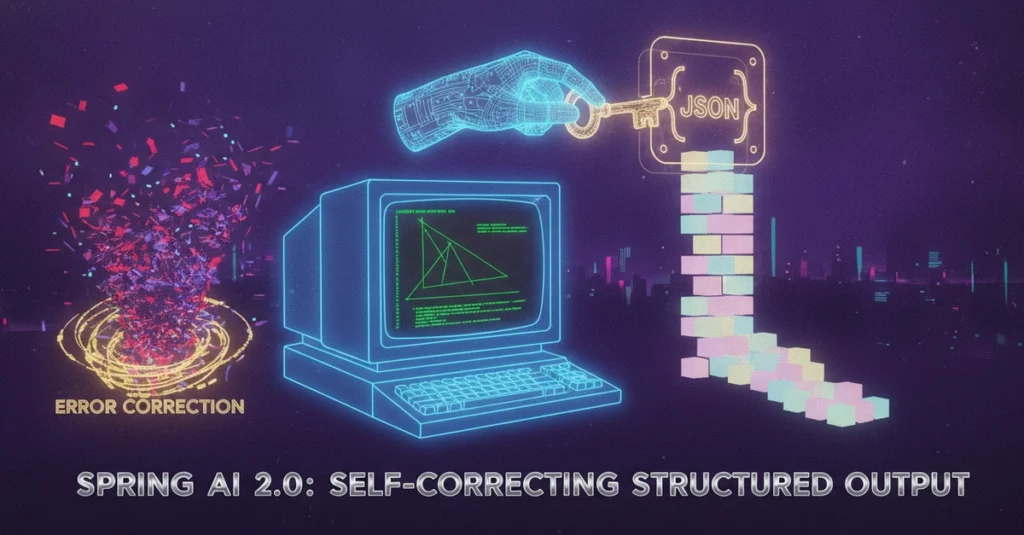
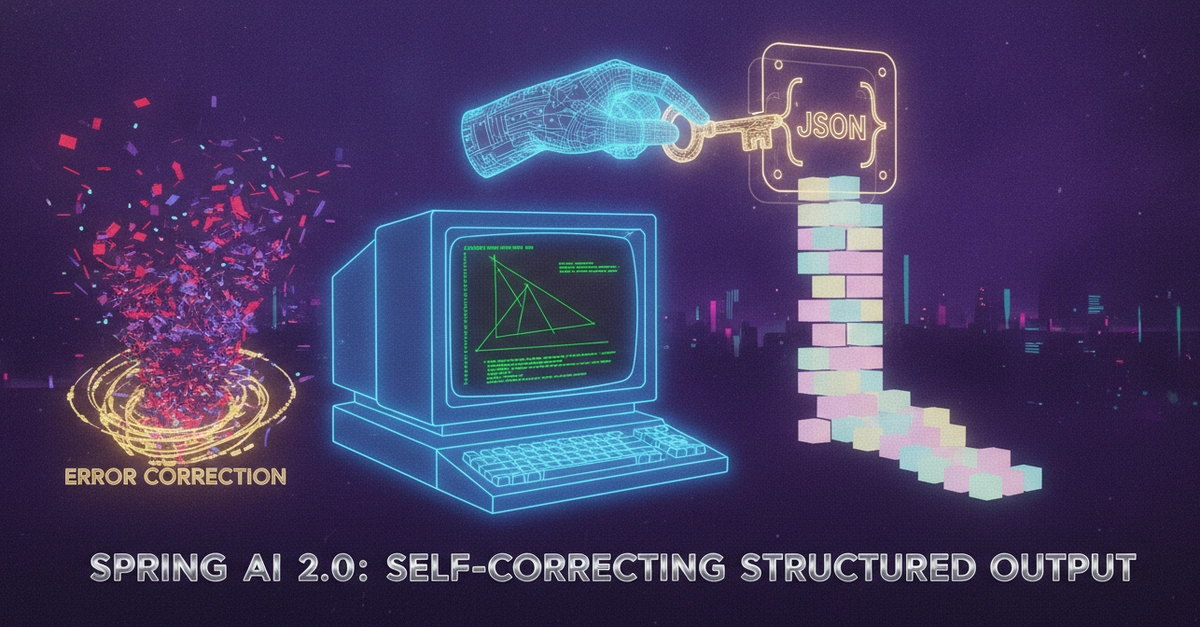
With the release of Spring AI 2.0, the Spring team at Broadcom is attempting to shift this paradigm. By introducing native self-correcting schema validation via the validateSchema() API, Spring AI 2.0 treats LLM unreliability not as a prompt engineering puzzle, but as a classic systems engineering problem.
1. Main Facts: The Deterministic Dilemma of Generative AI
At the core of the integration challenge is a fundamental clash of paradigms. Modern enterprise software is built on determinism—given the same input, a system must produce the same output, adhering strictly to type definitions, database constraints, and API contracts. LLMs, by contrast, are probabilistic engines designed to predict the next most likely token. They have no native concept of a Java class, a JSON schema, or compile-time safety.
When developers use structured outputs in Java frameworks, the underlying framework typically performs a multi-step dance:
- Introspection: The framework analyzes a Java class or record to generate a corresponding JSON Schema.
- Injection: The framework appends this schema to the developer’s prompt, instructing the LLM to conform to it.
- Execution: The LLM processes the prompt and returns a text response.
- Parsing: The framework attempts to deserialize the raw text into a Java object using libraries like Jackson.
[Java Record] ---> (Spring AI Generates Schema) ---> [Appended to Prompt]
                                                           |
                                                           v
[Jackson Parser] <--- (Raw Text Response) <--- [Probabilistic LLM]
       |
       +---> Success (Valid JSON)
       +---> 500 Error / Deserialization Exception (Malformed JSON)
While frontier models like Anthropic’s Claude 3.5 Sonnet or OpenAI’s GPT-4o have become highly adept at adhering to schemas, they are not infallible. The failure rate rises exponentially when developers deploy smaller, open-source models—such as Llama 3.2 (1B or 3B parameters) or Mistral—locally via tools like Ollama. These lightweight models frequently emit malformed JSON, return null for primitive types, or leave out critical fields.
Prior to Spring AI 2.0, when these failures occurred, the application had no built-in recovery mechanism. The thread simply threw an exception, leaving developers to write complex, boilerplate retry logic manually.
2. Chronology: The Evolution of Structured LLM Outputs
To understand why Spring AI 2.0’s solution is a milestone, it is helpful to trace the chronological evolution of how developers have forced LLMs to speak in structured data.
+-------------------------------------------------------------------------+
| CHRONOLOGY OF STRUCTURED LLM OUTPUTS                                    |
+-------------------------------------------------------------------------+
| Phase 1: Raw Prompting & Regex (The Early Days)                         |
|   - Developers write manual rules in prompts.                           |
|   - Brittle regex patterns parse raw strings.                           |
|                                                                         |
| Phase 2: Parser-Driven Generation (The "Hope" Era)                      |
|   - Frameworks auto-generate JSON schemas from code.                     |
|   - Prompts are automatically enriched with formatting instructions.    |
|   - Failures still result in unhandled deserialization exceptions.       |
|                                                                         |
| Phase 3: Provider-Native Constraints (API-Level Enforcement)             |
|   - Cloud providers restrict model output tokens to valid JSON tokens.  |
|   - Limited by provider support; unavailable on many local/OS models.   |
|                                                                         |
| Phase 4: Self-Correcting Runtime Loops (Spring AI 2.0)                  |
|   - Schema validation is performed automatically at the framework level.|
|   - Failures trigger recursive feedback loops to correct errors.        |
+-------------------------------------------------------------------------+
Phase 1: Raw Prompting and Regex (2022–2023)
In the early days of the generative AI boom, developers manually appended JSON templates to their prompts. Parsing was handled via brittle regular expressions or manual string manipulation to strip out conversational filler like "Sure, here is the JSON you requested:".
Phase 2: Parser-Driven Generation (Early Spring AI & LangChain)
Frameworks introduced structured output parsers. Developers defined their target POJOs or records, and the framework automatically generated the JSON Schema and handled the deserialization. However, if the model deviated from the schema, the framework could only throw an exception. The system relied entirely on the model’s instruction-following capabilities.
Phase 3: Provider-Native Constraints (Late 2023–Present)
Large cloud providers recognized the structured output pain point and introduced native API-level constraints (e.g., OpenAI’s Structured Outputs). By forcing the model’s decoding process to select only tokens that satisfy a grammar or schema, providers guaranteed 100% schema compliance. However, this approach is highly vendor-dependent and often unsupported by local or niche open-source models.
Phase 4: Self-Correcting Runtime Loops (Spring AI 2.0)
Recognizing that enterprise applications must remain model-agnostic and resilient, the Spring AI team introduced runtime schema validation. If a model fails to conform to a schema—regardless of whether it is GPT-4o or a 1-billion-parameter local model—the framework intercepts the failure, compiles the validation errors, and programmatically asks the model to repair its own output.
3. Deep Dive & Supporting Data: Under the Hood of validateSchema()
To demonstrate the real-world utility of Spring AI 2.0’s self-correcting engine, let us analyze a typical enterprise scenario: a conference talk submission pipeline.
The Target Domain Model
Consider an unstructured conference abstract submitted by a speaker. The application must parse this messy text into a highly structured Java record:
public record TalkSubmission(
    String title,
    String abstractText,
    Level level,        // Enum: BEGINNER, INTERMEDIATE, ADVANCED
    Track track,        // Enum: ARCHITECTURE, JAVA, AI_ML, CLOUD
    int duration,       // Integer representation in minutes
    List<String> tags,
    String speakerHandle
)
The Old Approach: "Hope-Based" Engineering
Using previous iterations of structured output, a developer would configure a endpoint like this:
@PostMapping("/typed")
public TalkSubmission typed(@RequestBody String rawSubmission)
    return chatClient.prompt()
        .system(systemPrompt)
        .user(spec -> spec.text("Extract the talk submission: submission")
            .param("submission", rawSubmission))
        .call()
        .entity(TalkSubmission.class);
If rawSubmission is highly chaotic, a smaller model might write "duration": "45 minutes" (a string) instead of 45 (an integer), or write "level": "Novice" instead of the required enum value BEGINNER. The moment Jackson tries to parse this payload, the thread terminates with a MismatchedInputException or an InvalidFormatException.
The New Approach: Self-Correcting Validation
In Spring AI 2.0, enabling a resilient, self-healing loop requires appending a single method call inside the .entity() block:
@PostMapping("/validated")
public TalkSubmission validated(@RequestBody String rawSubmission)
    return chatClient.prompt()
        .system(systemPrompt)
        .user(spec -> spec.text("Extract the talk submission: submission")
            .param("submission", rawSubmission))
        .call()
        .entity(TalkSubmission.class, spec -> spec.validateSchema()); // The game changer
The Execution Flow of the Validation Loop
When .validateSchema() is invoked, Spring AI registers a StructuredOutputValidationAdvisor. This advisor intercepts the execution flow and implements a recursive feedback loop:
[User Request]
      │
      ▼
[Call LLM] ◄─────────────────────────────────────────┐
      │                                              │
      ▼                                              │
[Receive Raw Text]                                   │
      │                                              │
      ├─► [Parse & Validate JSON Schema]             │ (If invalid,
      │         │                                    │  retry up to
      │         ├──► [Success] ──► Return Java Object│  max attempts)
      │         │                                    │
      │         └──► [Failure]                       │
      │                  │                           │
      │                  ▼                           │
      │            [Construct Feedback Prompt] ──────┘
      │            "The output was invalid:
      │             - Field 'duration' must be an integer.
│ Please correct it."- Initial Call: Spring AI calls the LLM with the prompt and the schema.
- Schema Validation: The raw string returned by the model is parsed. Instead of blindly passing it to Jackson, Spring AI validates the JSON against the generated JSON Schema.
- Error Interception: If validation fails (e.g., missing fields, type mismatches), Spring AI does not throw an exception. Instead, it captures the precise validation error messages.
- The Corrective Prompt: The advisor automatically generates a new prompt segment, such as:
"The previous response failed schema validation with the following errors: [Field ‘duration’ expected integer, got string ’45 minutes’]. Please correct the JSON output and try again."
- Re-evaluation: The model processes this feedback. Because LLMs are highly responsive to immediate context and error logs, they almost always correct the mistake on the second attempt.
- Fallback: The loop repeats. By default, Spring AI will attempt this correction loop 3 times before finally throwing a validation exception to the application context.
Customizing the Retry Loop
For highly complex domain models or exceptionally small LLMs, developers can customize the behavior of the validation advisor, adjusting the maximum repeat attempts:
var validationAdvisor = StructuredOutputValidationAdvisor.builder()
    .outputType(TalkSubmission.class)
    .maxRepeatAttempts(5) // Increase tolerance for smaller models
    .build();

ChatClient chatClient = ChatClient.builder(chatModel)
    .defaultAdvisors(validationAdvisor)
    .build();
4. Provider-Native Structured Output
While the runtime validation loop is an excellent catch-all, some cloud providers have built schema enforcement directly into their model-serving engines. When using these native APIs, the LLM is constrained at the token-generation level—meaning it is mathematically impossible for the model to emit a token that violates the JSON Schema.
Spring AI 2.0 exposes this native capability through the useProviderStructuredOutput() method:
TalkSubmission result = chatClient.prompt()
    .system(systemPrompt)
    .user(spec -> spec.text("Extract the talk submission: submission")
        .param("submission", rawSubmission))
    .call()
    .entity(TalkSubmission.class, spec -> spec
        .useProviderStructuredOutput()
        .validateSchema()); // Layering both for maximum safety
Provider Compatibility Matrix
| Provider | Native Structured Output Support | Fallback to Prompt-Based Schema | Recommended Configuration |
|---|---|---|---|
| OpenAI (GPT-4o, GPT-4o-mini) | Yes | Yes | Native + Validation |
| Anthropic (Claude 3.5 Sonnet) | Yes | Yes | Native + Validation |
| Google Gemini (1.5 Pro/Flash) | Yes | Yes | Native + Validation |
| Mistral AI | Yes | Yes | Native + Validation |
| Ollama (Local Models) | Model Dependent | Yes | Schema Validation Loop Only |
Note: If a model or provider does not support native structured outputs, Spring AI silently ignores the useProviderStructuredOutput() flag and falls back to the prompt-based JSON schema injection.
Crucial Architectural Limitations
While these new features dramatically improve reliability, developers must be aware of two critical limitations:
1. Streaming is Incompatible with Structured Parsing
The .entity() method is exclusively available on .call(), not on .stream(). Because JSON is a hierarchical, closed data structure, a parser cannot safely deserialize a typed Java object until the entire text payload has been received and closed. Streaming responses cannot be dynamically parsed into POJOs in real time.
2. OpenAI Top-Level Array Limitations
OpenAI’s native structured output engine does not accept top-level JSON arrays. If you attempt to deserialize a list of objects directly, the native call will fail:
// This will FAIL with OpenAI native structured output:
List<TalkSubmission> list = chatClient.prompt()
    .call()
    .entity(new ParameterizedTypeReference<List<TalkSubmission>>() ,
            spec -> spec.useProviderStructuredOutput());
To bypass this limitation, developers must wrap the collection in a container record:
// This WORKS: Wrapper container record
public record SubmissionList(List<TalkSubmission> submissions)

SubmissionList result = chatClient.prompt()
    .call()
    .entity(SubmissionList.class, spec -> spec.useProviderStructuredOutput());
3. Ollama and Reasoning Models (e.g., DeepSeek-R1, Qwen-2.5-Instruct)
When utilizing local reasoning models, the model may output its internal chain-of-thought processing (e.g., <think> ... </think> tags) as plain text before emitting the JSON payload. This extra text breaks standard JSON parsers. In these cases, combining validateSchema() is essential, as the self-correcting loop will explicitly tell the model to strip out non-JSON reasoning tags on the second pass.
5. Official Responses and Industry Perspectives
The introduction of self-correcting validation has sparked a broader conversation in the Java and AI development communities.
Dan Vega, a prominent Spring Developer Advocate at Broadcom, addressed the historical shortcuts of AI integration in a recent video demonstration. He highlighted the fragility of relying solely on prompt engineering:
"For a long time, we were just writing these elaborate system prompts saying, ‘Please, I beg you, only return JSON.’ And then we crossed our fingers. That’s not engineering. That’s hoping."
Vega’s commentary strikes at a core truth: software engineers cannot treat non-deterministic systems as black boxes that will eventually behave if asked politely.
This philosophy is echoed by Christian Tzolov, a core member of the Spring AI development team. In his technical documentation outlining the release, Tzolov emphasized that LLM interactions must be bound by the same structural constraints as legacy enterprise systems:
"The
StructuredOutputValidationAdvisorbridges the gap between probabilistic AI and deterministic enterprise Java. By programmatically resolving parsing failures at the framework level, we allow developers to build resilient applications that can confidently run on local, cost-effective open-source models."
6. Implications: Elevating LLM Integration to Software Engineering
The structural enhancements introduced in Spring AI 2.0 point to a maturation of the AI engineering landscape. We are moving away from the "novelty phase" of generative AI—where simply getting a model to respond was considered a success—and entering an era of rigorous production standards.
The Death of the "Hope" Pattern
For years, the industry treated LLM integration as a unique discipline exempt from traditional software engineering patterns. If an API call failed, developers wrote try-catch blocks; if an LLM failed, they rewrote the prompt.
Spring AI 2.0 rejects this dichotomy. By treating the LLM as an unreliable third-party network service, the framework applies standard systems patterns:
- Validation: Checking data integrity at the boundary.
- Retries with Backoff/Context: Re-querying the service with specific error payloads.
- Degradation/Graceful Failures: Throwing clear, typed exceptions when recovery limits are exceeded.
Empowering Edge and Local AI
The business implications of this shift are significant. Running frontier models like GPT-4o in production is expensive and raises data privacy concerns. Many enterprises want to run smaller, open-source models (like Llama 3.2 or Mistral) on local, on-premise hardware.
Previously, the higher error rates of these smaller models made them a risky choice for structured data extraction. By utilizing the self-correcting validateSchema() loop, developers can close the reliability gap. A 3-billion-parameter model running locally might fail its first JSON generation attempt, but with precise feedback from the schema validation advisor, it can successfully self-correct on the second attempt—providing a highly reliable, cost-effective, and private alternative to cloud-hosted APIs.
+-----------------------------------------------------------------------------+
| ENTERPRISE AI BEST PRACTICES                                                |
+-----------------------------------------------------------------------------+
| 1. For Frontier Models (GPT-4o, Claude 3.5):                                |
|    Use `.useProviderStructuredOutput()` to minimize latency, but keep        |
|    `.validateSchema()` active as a secondary runtime safety net.            |
|                                                                             |
| 2. For Local/Open-Source Models (Llama, Mistral):                           |
|    Always enable `.validateSchema()`. Expect occasional first-pass failures  |
|    and rely on the feedback loop to secure a valid payload.                 |
|                                                                             |
| 3. For Mission-Critical Production Pipelines:                               |
|    Explicitly define a custom `StructuredOutputValidationAdvisor` with       |
|    monitored retry metrics to log how often your models require self-        |
|    correction.                                                              |
+-----------------------------------------------------------------------------+
Conclusion
With Spring AI 2.0, the framework developers have made a clear statement: generative AI must fit into our engineering practices, not the other way around. By introducing self-correcting schema validation, Spring AI transforms LLM outputs from a game of chance into a reliable, enterprise-ready software component.
Sources & Further Reading
- Spring AI Reference Documentation: Self-Correcting Structured Output by Christian Tzolov (Spring AI Team, Broadcom).
- Spring AI 2.0: Self-Correcting JSON Schema Validation – Video Demonstration by Dan Vega (Spring Developer Advocate).
- Enterprise Integration Patterns for Large Language Models – Spring IO Engineering Blog.