Blender 5.2: A New Era for Open-Source 3D Simulations
Main Facts
Blender stands as an enduring testament to the power and potential of open-source software. Born from the ashes of a defunct corporate entity, this robust 3D creation suite has transcended its humble beginnings to become a formidable competitor to industry-standard commercial applications. Its journey from a niche tool "hacked together by enthusiasts" to a comprehensive platform for 3D modeling, animation, rendering, sculpting, VFX, and motion graphics is a narrative often cited as a benchmark for community-driven development. Blender’s success story is built upon a philosophy of accessibility and continuous innovation, driven by a global network of developers and artists. This collaborative ecosystem has fostered a feature set that, once users navigate its initially steep learning curve, rivals the capabilities found in software costing thousands of dollars annually. For years, Blender has empowered independent creators, small studios, and large production houses alike, democratizing access to high-end 3D tools. Its influence extends across various creative industries, from game development and architectural visualization to film production and scientific research.
The Simulation Hurdle
Despite its widespread acclaim and versatile feature set, Blender has traditionally faced a persistent challenge in the realm of physics simulations. While adept at many facets of 3D creation, its native simulation capabilities were often perceived as a weaker link compared to specialized commercial alternatives. This limitation frequently compelled professional Blender users to adopt a hybrid workflow, offloading complex simulation tasks—such as realistic fluid dynamics, intricate cloth behavior, or natural hair movement—to dedicated external software like Houdini. Houdini, developed by SideFX, has long been revered for its unparalleled procedural capabilities and robust simulation engines, making it the de facto choice for high-fidelity physics-based effects in VFX pipelines. This reliance on external tools introduced additional layers of complexity, increased production costs (due to extra software licenses), and fragmented workflows, thereby impeding Blender’s aspiration to be a truly all-in-one solution for advanced 3D production. The need for a seamless, integrated, and powerful simulation system within Blender itself became an increasingly vocal demand from its growing professional user base.
Blender 5.2: A Game Changer
The landscape of 3D simulations within Blender is poised for a significant transformation with the imminent release of version 5.2. Following a rigorous beta phase, the update is slated for public availability in July, promising to fundamentally redefine Blender’s capabilities in this critical area. This release marks a pivotal moment, as it directly addresses one of the software’s long-standing "weak points" by integrating a sophisticated and optimized simulation framework directly into its core architecture. The developers have invested substantial effort into not just improving existing functionalities but rather reimagining the entire approach to simulations, aiming for a system that is both powerful and intuitively integrated into Blender’s modern workflow. This ambitious update signals a clear intent from the Blender Foundation to bridge the gap with specialized simulation software, making Blender an even more comprehensive and self-sufficient tool for demanding 3D productions.
Core Improvements
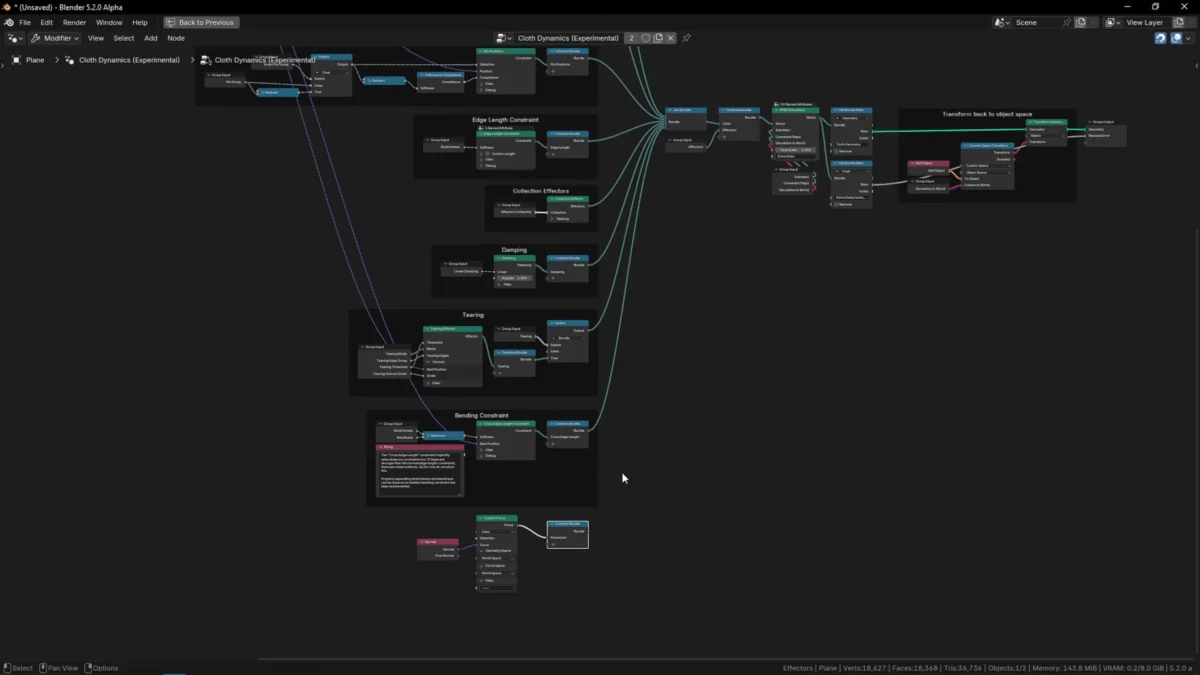
Blender 5.2 introduces a suite of core improvements designed to elevate its simulation capabilities to a professional standard. Central to these enhancements are significantly optimized algorithms that dramatically boost performance. Early demonstrations, such as the classic "drop cloth on a monkey head" test, reveal a twofold increase in processing speed, indicating substantial under-the-hood efficiencies. Beyond raw speed, a major architectural shift comes with the integration of simulations directly into Blender’s Geometry Nodes system. This novel node-based workflow transforms how users interact with physics, offering unparalleled control, modularity, and visual clarity. Instead of relying on disparate, often cumbersome, legacy systems, artists can now construct complex simulation setups using intuitive simulation nodes, allowing for procedural generation and manipulation of dynamic effects. This unification not only streamlines the creative process but also aligns Blender with the industry’s trend towards node-based proceduralism, making advanced effects like tearing cloth or custom environmental interactions remarkably straightforward to implement.
Chronology
Early Days of Blender and Simulations
In its nascent stages, and for many years thereafter, Blender’s simulation capabilities were rudimentary at best, reflecting the software’s evolutionary journey and the immense computational challenges inherent in physics-based effects. Early versions offered basic rigid body dynamics, fluid simulations (often resource-intensive and prone to instability), and simple cloth physics. These tools, while functional for less demanding applications or basic visual effects, lacked the robustness, flexibility, and performance required for high-fidelity, production-grade simulations. Artists frequently encountered limitations in terms of control, stability, and the ability to handle complex interactions or high-resolution meshes. The underlying algorithms were often less optimized compared to specialized solvers, leading to longer bake times and less predictable results. This necessitated a pragmatic approach from users, often resorting to creative workarounds or accepting lower levels of realism, particularly for projects with tight deadlines or demanding visual standards.
The Rise of External Solutions
As Blender matured and its user base expanded into professional realms, the disparity in simulation capabilities became more pronounced. Studios and individual artists working on feature films, animated series, or high-end commercials found themselves increasingly constrained by Blender’s native simulation tools. This led to the widespread adoption of a "best-of-breed" strategy, where Blender would serve as the primary hub for modeling, animation, and rendering, while specialized tasks like complex fluid simulations, detailed destruction effects, or highly realistic cloth dynamics were delegated to dedicated software packages. Houdini emerged as the dominant choice in this context. Its procedural nature, powerful particle systems, Vellum solver for cloth and soft bodies, and extensive FLIP (Fluid Implicit Particle) solver for liquids offered a level of control, scalability, and realism that Blender simply could not match. The integration of Houdini into Blender pipelines, often through Alembic exports, became a common practice, albeit one that introduced friction, increased software costs, and required artists to master multiple complex applications. This workflow, while effective, underscored a significant gap in Blender’s otherwise comprehensive toolkit.
The Geometry Nodes Revolution
The groundwork for Blender’s current simulation renaissance was laid with the introduction of Geometry Nodes. First unveiled in Blender 2.92 (February 2021), Geometry Nodes marked a fundamental shift in how procedural content creation was approached within the software. Initially designed for scatter effects, procedural modeling, and modifying existing geometry, this node-based system provided artists with a powerful, non-destructive way to manipulate and generate 3D data. Its visual programming interface allowed for complex operations to be built from modular components, offering unprecedented flexibility and iterative design capabilities. The success and rapid adoption of Geometry Nodes quickly demonstrated the immense potential of a unified, node-centric approach for various aspects of Blender’s functionality. This paradigm shift was not merely an incremental update; it represented a strategic move towards a more flexible, scalable, and future-proof architecture, paving the way for the integration of other complex systems, including physics simulations, into this powerful procedural framework.
Project "Simulation Nodes" and Blender 5.2
Building upon the robust foundation established by Geometry Nodes, the Blender development team embarked on an ambitious initiative internally referred to as "Simulation Nodes." The goal was clear: to integrate a comprehensive, performant, and user-friendly simulation system directly into the Geometry Nodes environment. This project aimed to leverage the modularity and procedural advantages of nodes to create a simulation workflow that was both powerful and intuitive, moving away from disparate, often rigid, legacy systems. Development began with a focus on core solvers for cloth, soft bodies, and particles, with a strong emphasis on performance optimization and robust collision detection. Throughout its development, the team prioritized creating a system that could handle complex scenarios while maintaining real-time feedback where possible. The beta phase for Blender 5.2 served as a crucial testing ground, allowing developers to gather feedback, identify bottlenecks, and refine the new simulation framework. The culmination of this multi-year effort is the Blender 5.2 release, which, come July, will make these advanced, integrated simulation capabilities accessible to the entire Blender community, fulfilling a long-held desire for a truly capable, in-house physics engine.
Supporting Data
The Technical Deep Dive: Why Simulations Matter
The creation of realistic dynamic effects in 3D animation is an incredibly complex computational challenge, making robust simulation capabilities an indispensable component of any professional-grade software. Take, for example, the simulation of cloth: a simple piece of fabric can exhibit an almost infinite number of deformations based on gravity, wind, collisions with other objects, and its own material properties (stiffness, elasticity, friction). Manually animating these "degrees of freedom" through traditional keyframing is an arduous, if not impossible, task to achieve believable results. The same applies to fluids, where millions of particles interact, generating intricate splashes, ripples, and currents, or hair, which responds to gravity, motion, and wind in a highly nuanced manner.
Physics simulations alleviate this burden by offloading the complex calculations to specialized algorithms that approximate real-world physics. These algorithms must accurately model forces (gravity, wind, pressure), material properties (density, viscosity, elasticity), and collision detection and response between numerous interacting objects. The computational intensity arises from the sheer number of calculations required per frame, often involving solving complex partial differential equations and managing vast amounts of data for particle systems or deformable meshes. For artists, this means that instead of painstakingly defining every wrinkle or splash, they can set up physical parameters and let the software calculate the natural behavior, ensuring a level of realism that is unattainable through manual animation alone. This not only enhances visual quality but also significantly improves efficiency and artistic freedom, allowing for rapid iteration and experimentation with different physical scenarios.
Performance Benchmarks
The promise of a twofold speed increase in the "drop cloth on a monkey head" demo is more than just a superficial improvement; it represents a significant leap in efficiency that directly impacts an artist’s workflow and iteration cycles. In simulation-heavy productions, bake times can often be the most time-consuming part of the process, tying up computing resources and stalling creative momentum. A 100% increase in speed means that a simulation that once took an hour can now be completed in 30 minutes, or a five-minute test can be done in two and a half.
This kind of performance gain is critical for several reasons:
- Faster Iteration: Artists can experiment with different parameters (material properties, forces, collision settings) much more rapidly, leading to more refined and aesthetically pleasing results without the frustration of long waiting periods.
- Increased Complexity: Improved performance allows for more complex simulations with higher resolution meshes, more particles, or more intricate interactions, pushing the boundaries of visual fidelity.
- Real-Time Feedback (Closer): While not full real-time for all simulations, significant speed improvements bring artists closer to real-time previews, making the creative process more fluid and interactive.
- Resource Optimization: Faster simulations free up computing resources sooner, allowing artists to move on to other tasks or render frames more quickly, optimizing overall production timelines.
This performance boost indicates deep-seated algorithmic optimizations and efficient code implementation, which are foundational for a robust simulation system capable of handling production-level demands.
The Node-Based Paradigm Shift
Blender’s adoption of a node-based workflow for simulations, integrated within Geometry Nodes, is a significant paradigm shift that brings it squarely in line with modern professional software practices. Geometry Nodes itself is a powerful visual programming environment where users connect "nodes" (individual operations or data types) to create complex procedural effects. This modularity offers several distinct advantages:
- Non-Destructive Workflow: Changes can be made at any point in the node tree without permanently altering the base geometry, allowing for endless experimentation and easy revisions.
- Modularity and Reusability: Complex setups can be encapsulated into reusable "node groups," promoting efficiency and consistency across projects.
- Visual Clarity: The node graph provides a clear, visual representation of the data flow and logical operations, making complex systems easier to understand, debug, and share.
- Unparalleled Control: By chaining together various simulation nodes (e.g., "Collide," "Cloth Solver," "Apply Force"), artists gain granular control over every aspect of the simulation, from initial conditions to post-processing effects.
This approach mirrors the procedural workflows found in software like Houdini, where nodes are fundamental to building everything from modeling to complex VFX. For example, tasks like creating "tearing cloth" that once required "byzantine workarounds" (likely involving complex manual rigging, shape keys, and scripting) now become "quite straightforward." Artists can define tear patterns, apply stress thresholds, and control the tearing behavior directly within the node graph, achieving realistic and controllable destruction effects with relative ease. This convergence with industry best practices not only makes Blender more appealing to seasoned professionals but also provides a more intuitive and powerful learning path for newcomers.
Real-World Demonstrations
The demonstrations by [3Dan] (a prominent Blender educator and enthusiast) vividly illustrate the practical power of Blender 5.2’s new simulation capabilities. His examples of adding air pressure to a cloth simulation, resulting in an inflating and popping fabric sphere, and animating realistic foliage using cloth physics, highlight the versatility and artistic potential unlocked by these updates.
- Air Pressure on Cloth: This specific demonstration showcases the ability to create complex internal and external forces acting on deformable objects. The dynamic inflation and subsequent popping of the fabric sphere require accurate modeling of pressure differentials, material elasticity, and collision detection at high speeds. Such effects are crucial for realistic fabric balloons, soft body deformations, or even subtle clothing inflation due to wind. The fact that this can now be achieved with custom nodes within Blender signifies a new level of physical accuracy and artistic control previously difficult to attain.
- Realistic Foliage Animation: Using cloth simulation for foliage animation is a clever and highly effective application. Traditional methods often involve complex rigging, bone physics, or particle systems that can be difficult to control for organic, natural movement. By applying cloth physics to leaves or branches, artists can simulate wind interaction, subtle swaying, and the ripple effect of air currents, resulting in incredibly lifelike environmental animations. This capability is invaluable for creating believable outdoor scenes in games, architectural visualizations, or animated films, where static foliage can instantly break immersion.
These demonstrations are not merely technical showcases; they are practical examples of how artists can now achieve highly complex and realistic dynamic effects directly within Blender, saving time, reducing reliance on external software, and ultimately elevating the quality of their creative output.
Official Responses and Community Reception
The Blender Foundation’s Vision
While no direct official quotes regarding the 5.2 simulation updates are provided in the original text, the initiative aligns perfectly with the Blender Foundation’s long-standing vision and strategic roadmap. The Foundation’s core mission is to provide powerful, open-source 3D creation tools that empower artists globally, fostering creativity without financial barriers. Addressing a significant weakness like simulation capabilities is a natural progression for a project committed to rivaling commercial offerings. This update reflects a deliberate effort to achieve feature parity with high-end proprietary software, not by mimicking them, but by innovating within Blender’s open-source framework. The emphasis on integrating simulations into Geometry Nodes also underscores the Foundation’s commitment to a unified, modern, and procedural workflow, which has been a key developmental direction for several years. By investing heavily in this area, Blender solidifies its position as a comprehensive solution, reducing the need for artists to fragment their workflows across multiple applications and strengthening the argument for a fully open-source production pipeline.
Developer Insights
The development of sophisticated simulation systems is an enormous undertaking, requiring deep expertise in computational physics, numerical methods, and software architecture. The work behind the scenes to optimize algorithms and integrate a new node-based workflow for simulations in Blender 5.2 speaks volumes about the dedication and skill of the Blender development team. Developers likely faced significant challenges in ensuring stability, performance, and user-friendliness across a wide range of hardware and use cases. The decision to integrate simulations directly into Geometry Nodes was a strategic one, aiming to leverage an existing robust framework rather than building a separate, potentially disparate, system. This involved designing new node types, refining existing ones to interact with dynamic data, and ensuring efficient data transfer and processing within the node graph. The focus on making tasks like "tearing cloth" straightforward suggests a user-centric design philosophy, aiming to abstract away much of the underlying complexity for the artist while retaining powerful control for those who need it. This continuous push for both technical excellence and user experience is a hallmark of Blender’s development philosophy.
Community Buzz
The anticipation within the Blender community for these simulation enhancements is palpable. Forums, social media, and early beta testing channels have likely been buzzing with excitement and eager discussions. For years, the desire for more robust, integrated simulation tools has been one of the most frequently requested features. Many professional users, who have long relied on external solutions like Houdini, view this update as a potential watershed moment that could significantly streamline their workflows and reduce licensing costs. Indie artists and smaller studios, who often operate on limited budgets, are particularly enthusiastic about gaining access to high-end simulation capabilities without the prohibitive price tag of commercial alternatives. The integration with Geometry Nodes is also a major draw, as the community has already embraced this powerful procedural system. This update is not just about adding features; it’s about validating Blender’s ability to tackle increasingly complex and demanding aspects of 3D production, further cementing its reputation as a serious contender in the professional creative software market.
Impact on Open-Source Ecosystem
Blender 5.2’s simulation advancements have a profound impact extending beyond its immediate user base, significantly strengthening the broader open-source creative software ecosystem. By closing a major feature gap with proprietary software, Blender reinforces the viability and competitiveness of open-source alternatives. This success can inspire and provide a blueprint for other open-source projects in various creative fields, demonstrating that community-driven development can indeed produce tools capable of challenging established commercial giants. Furthermore, as Blender becomes more self-sufficient, it reduces the reliance on proprietary middleware or plugins, fostering a more independent and resilient open-source pipeline. This contributes to a healthier and more diverse software landscape, promoting innovation and ensuring that cutting-edge tools are accessible to everyone, regardless of their financial resources.
Implications
Empowering the Open-Source Artist
The implications of Blender 5.2’s enhanced simulation capabilities for artists, particularly those committed to an open-source workflow, are transformative. The ability for animators to "go fully open-source" is now more realistic than ever before. Considering that a perpetual license for Houdini FX can cost upwards of $4,500, or an annual subscription around $2,000, the potential cost savings for individuals and small studios are immense. This democratizes access to high-end simulation tools, previously restricted by prohibitive licensing fees, allowing indie artists, students, educators, and studios in developing regions to produce work of a quality that was once out of reach. It levels the playing field, fostering greater creative freedom and economic viability for a wider demographic of 3D artists. By removing the financial and workflow barriers associated with external software, Blender 5.2 empowers artists to focus purely on their creative vision, fostering a more vibrant and diverse ecosystem of 3D content creators.
Competitive Landscape Shift
While the original article aptly notes that this update "probably doesn’t have Houdini developer SideFX shaking in their boots," it undeniably narrows the competitive gap. Houdini remains the industry gold standard for highly specialized and complex VFX simulations, particularly for large-scale destruction, volumetric effects, and highly customized procedural workflows. Its depth and breadth in these areas are still unmatched. However, Blender 5.2 significantly raises the bar for common simulation tasks like cloth, soft bodies, and basic fluid interactions, which constitute a large portion of animation and VFX needs.
This update means:
- Reduced Reliance on Houdini: Many animators and studios who previously used Houdini primarily for cloth or basic soft-body simulations may now find Blender’s native tools sufficient, potentially reducing their Houdini license count or eliminating the need for it entirely for certain projects.
- Attracting New Users: Professionals who were hesitant to adopt Blender due to its simulation limitations might now reconsider, especially those seeking a more unified and cost-effective solution.
- Increased Blender Market Share: As Blender becomes more capable, it will naturally attract a larger segment of the 3D market, from individual freelancers to mid-sized animation studios.
- Innovation Push: The competition from Blender might indirectly spur further innovation from commercial software developers, benefiting the entire industry.
Blender is not aiming to replace Houdini entirely but to provide a robust, accessible alternative for a significant portion of simulation work, making it a more formidable and versatile player in the 3D software arena.
Broader Blender Ecosystem Enhancements
Beyond simulations, Blender 5.2 is poised to deliver a multitude of improvements across its vast feature set. While specific details outside of simulations are not elaborated in the original text, Blender updates typically encompass advancements in rendering performance, modeling tools, sculpting capabilities, user interface refinements, and overall stability. Each new release reinforces Blender’s commitment to continuous improvement, ensuring that the software remains at the cutting edge of 3D technology.
The strengthening of simulation capabilities also has a ripple effect on the broader Blender ecosystem:
- Addon Development: A more robust core simulation engine will undoubtedly inspire addon developers to create even more specialized and powerful tools that leverage these new capabilities, further extending Blender’s functionality.
- Tutorials and Education: The availability of high-quality, integrated simulations will lead to a proliferation of new educational content, making these complex topics more accessible to a wider audience.
- Community Collaboration: The excitement generated by such a significant update often invigorates the community, leading to increased collaboration, sharing of techniques, and overall growth of the Blender knowledge base.
Beyond Animation: Versatility and Future Prospects
Blender’s utility extends far beyond traditional animation and VFX, and the improved simulation capabilities will indirectly benefit these diverse applications as well. For users who "add texture to 3D prints" or "make fancy resin-print miniature models FEM-friendly," more realistic physics simulations can enhance product visualization, material testing (even if conceptual), and the creation of visually compelling renders for technical designs. The article also highlights Blender’s adaptability, noting how addons can enable "parametric CAD" functionality, offering an open-source alternative for engineers and product designers who might not "stand FreeCAD" (though FreeCAD itself is also continuously improving).
Looking ahead, the success of the integrated simulation nodes opens doors for even more advanced functionalities within Blender. One could foresee future developments in areas such as:
- Real-time Physics in Viewport: Further performance optimizations could lead to even more interactive and real-time simulation previews, crucial for game development and virtual production.
- Advanced Solver Integration: Expansion to more specialized solvers for smoke, fire, and complex destruction, perhaps leveraging GPU acceleration even more aggressively.
- AI/Machine Learning Integration: The use of AI to enhance simulation accuracy, optimize parameters, or even generate realistic dynamics based on learned behaviors.
- Deeper Interoperability: Continued focus on seamless integration with other software through standardized formats, ensuring Blender remains a central hub in diverse pipelines.
Blender 5.2 represents not just an incremental update but a pivotal moment in the software’s journey, solidifying its position as a truly comprehensive, open-source 3D creation powerhouse ready to tackle the most demanding creative challenges.