Bridging the Gap: How Google’s AI-Powered Ultrasound is Transforming Maternal Healthcare
In the quiet corners of rural clinics across the globe, the difference between a healthy pregnancy and a medical crisis often comes down to a single, missing diagnostic tool: the ultrasound. For millions of expectant parents in low-resource settings, the inability to access prenatal imaging contributes to a staggering global statistic—287,000 maternal deaths and 2.4 million neonatal deaths each year, according to the World Health Organization (WHO).
A dedicated team of researchers at Google, led by Angelica Willis and Akib Uddin, is working to rewrite this narrative. By leveraging the power of mobile-optimized Artificial Intelligence (AI) and TensorFlow Lite, Google is developing technology that enables non-specialized health workers to perform life-saving ultrasound assessments. This innovation represents a paradigm shift in global health, potentially democratizing access to prenatal care that was previously reserved for those near urban hospitals.
The Core Problem: A Shortage of Expertise and Infrastructure
The disparity in maternal healthcare is not merely a matter of technology; it is a matter of accessibility. While the advent of portable, smartphone-integrated ultrasound devices has made the hardware more affordable, the human barrier remains high. Interpreting an ultrasound scan is a complex skill that requires years of rigorous clinical training. In many underserved regions, there simply are not enough trained sonographers to meet the demand.
Research suggests that as many as two-thirds of pregnant individuals in these regions go their entire pregnancy without a single ultrasound screening. Without these images, health workers cannot determine gestational age or identify fetal malpresentation—the abnormal positioning of the fetus that can lead to life-threatening complications during childbirth. When these conditions are detected early, they are often manageable. When they go undetected until the moment of delivery, the consequences are frequently tragic.

Chronology: From Concept to Clinical Collaboration
The journey toward this AI-driven solution began with a clear objective: to create an intelligent system that could "see" what an untrained eye might miss.
- Initial Research and Design: Google Research identified the need for a robust, offline-capable AI model that could function on mobile devices. The team focused on a "blind sweep" protocol—a simplified scanning technique that requires minimal training compared to traditional standardized procedures.
- Model Architecture Development: The team utilized a grouped convolutional LSTM (Long Short-Term Memory) architecture. By integrating MobileNetV2 for feature extraction, they ensured the model could process video frames efficiently without requiring cloud connectivity.
- Optimization with TensorFlow Lite: Recognizing the limitations of infrastructure in rural environments, the team transitioned to TensorFlow Lite. This allowed for on-device inference, ensuring that patient data remains private and that the tool functions even in areas with no internet access.
- Validation and Peer Review: In their landmark study published in Nature Communications Medicine, researchers demonstrated that AI-guided non-experts could match the performance of seasoned sonographers in identifying critical diagnostic markers.
- Current Phase (Partnerships): Having proven the model’s efficacy, the team is currently collaborating with Northwestern Medicine in the United States and Jacaranda Health in Kenya to conduct field evaluations and further refine the technology for diverse clinical environments.
The Science Behind the Sweep: Supporting Data
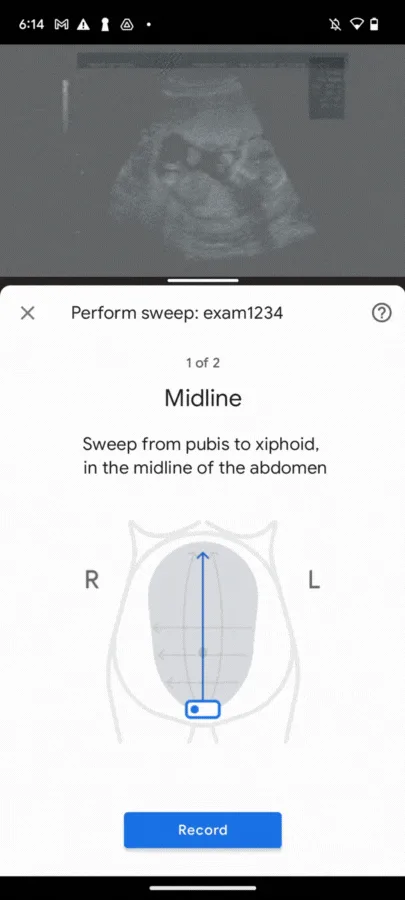
The effectiveness of this system relies on the "blind sweep" method. In this procedure, a user slowly moves the ultrasound probe across the patient’s abdomen in a systematic, yet straightforward, pattern. The AI model then ingests the resulting video data to calculate gestational age and fetal presentation.
Technical Performance Metrics
The data is compelling. In performance benchmarks, the gestational age model showed remarkable accuracy compared to clinical standards. When analyzing the absolute error in days, the AI-powered system operated within the expected clinical margins, with whiskers on performance charts indicating that even in varied real-world conditions, the AI remains highly reliable.
Furthermore, the Receiver Operating Characteristic (ROC) curves for fetal malpresentation—a classification task—demonstrated that the AI performed with high sensitivity and specificity. Crucially, the system performed with comparable results regardless of whether the scan was captured by an expert or a novice, effectively "leveling the playing field" of diagnostic quality.

Optimization: The Role of TensorFlow Lite
The selection of TensorFlow Lite was a strategic decision driven by the specific constraints of the deployment environment. For an AI to be useful in a remote village in Sub-Saharan Africa or rural Southeast Asia, it must be fast, lightweight, and offline.
"On-device ML has many advantages," the research team noted. By processing data locally, the application ensures sensitive maternal health information never leaves the device, providing a layer of security that is essential for patient trust.
By applying post-training quantization and leveraging the TensorFlow Lite GPU delegate, the team achieved a 2x increase in execution speed. This allowed the system to perform real-time inference at over 30 frames per second. This speed is not just a technical vanity metric; it is functional. Because the model runs in real-time, the device can provide immediate, live feedback to the operator. If the scan is of poor quality—perhaps because the probe was moved too quickly or lacked sufficient contact—the AI alerts the user instantly, allowing them to adjust their technique and re-scan, significantly reducing the margin for error.
Implications for Global Maternal Health
The implications of this technology extend far beyond the laboratory. If successful, this AI-driven ultrasound could serve as a "force multiplier" for frontline health workers. By empowering midwives, nurses, and community health officers to perform diagnostic-grade scans, health systems can prioritize high-risk pregnancies for referral to better-equipped facilities.

A Responsible Path Forward
Google has emphasized that this work is guided by its AI Principles, prioritizing safety and social benefit. The research team is acutely aware of the ethical responsibilities that come with medical AI. They have been transparent about the fact that TensorFlow Lite itself is not a medical device; rather, it is the underlying architecture. The diagnostic outputs must be validated by clinical partners and integrated into broader healthcare ecosystems.
This is why the ongoing collaboration with organizations like Jacaranda Health in Kenya is so vital. It shifts the project from a technological proof-of-concept to a real-world public health intervention. By working within the local context, the researchers are learning how to better design user interfaces that are intuitive for users who may have never touched an ultrasound machine before.
Official Stance and Future Outlook
The team at Google Research remains cautious yet optimistic. They acknowledge that this work is in its early stages. Scaling this technology will require not only continued technical refinement but also regulatory engagement, clinical integration, and sustained support for the health workers who will actually use the tools.
"We are excited about our partnerships… to further develop and evaluate these models," the researchers stated in their report. "With more automated and accurate evaluations of maternal and fetal health risks, we hope to lower barriers and help people get timely care."

As the project moves forward, the focus will likely shift toward larger-scale clinical trials and the development of more accessible, user-friendly mobile applications that can house these models. The dream is a future where a smartphone, a portable probe, and a piece of software can bridge the gap between a high-risk pregnancy and a safe, healthy delivery, regardless of the patient’s geography.
By choosing to focus on the intersection of mobile computing and maternal medicine, the Google Research team is demonstrating that the most impactful applications of AI are not necessarily the ones that create new content or automate office tasks, but those that bring fundamental, life-saving medical care to the people who need it most.
Disclaimer: TensorFlow Lite has not been certified or validated for clinical, medical, or diagnostic purposes. TensorFlow Lite users are solely responsible for their use of the framework and independently validating any outputs generated by their project.