Bridging the Gap: How ‘Prop For That’ is Revolutionizing Dynamic CSS
In the ever-evolving landscape of front-end development, the boundary between static styling and dynamic interactivity has historically been defined by the friction between CSS and JavaScript. For years, developers have relied on complex, often bloated, event listeners to bridge this gap. However, a new paradigm is emerging, spearheaded by Adam Argyle—a developer whose name has become synonymous with pushing the boundaries of what CSS can achieve. With the launch of Prop For That, Argyle is offering a sophisticated, declarative way to bring browser-level data directly into the CSS cascade, effectively turning the browser’s "invisible" metrics into usable design tokens.
The Main Facts: What is Prop For That?
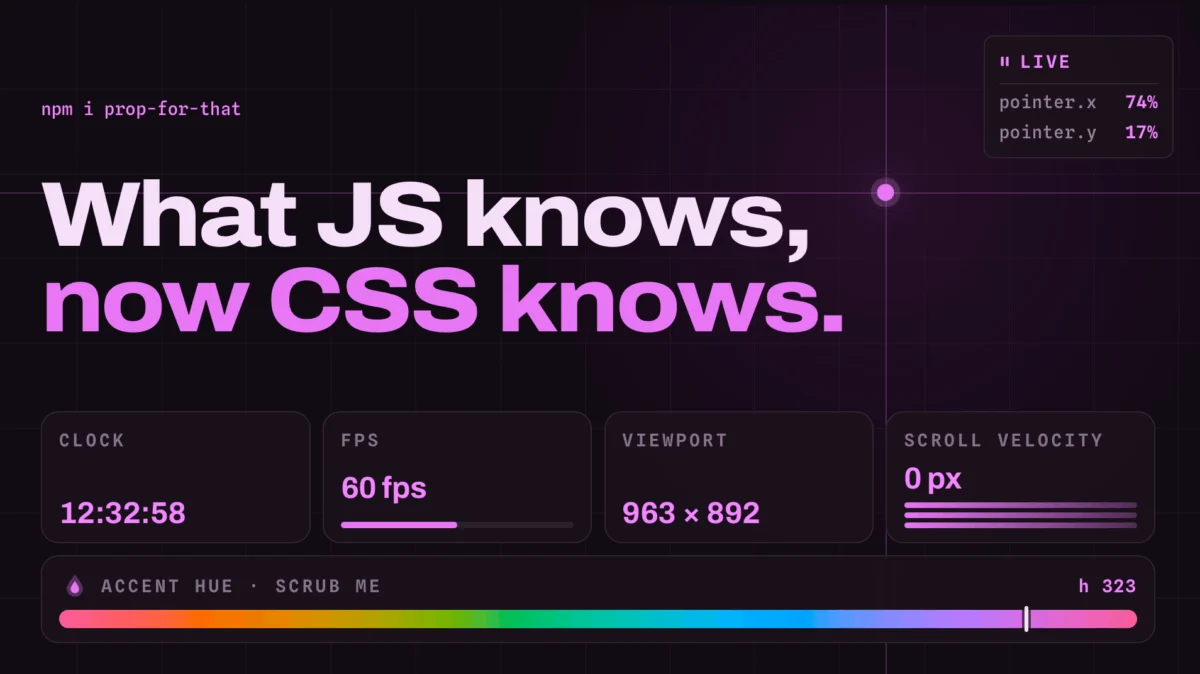
At its core, Prop For That is a lightweight library designed to act as a conduit between the browser’s internal state and the CSS Custom Properties (variables) that style our web components. While many developers are already familiar with Argyle’s previous contribution, Open Props—a library providing a robust suite of preconfigured design tokens—Prop For That serves a fundamentally different purpose. It does not provide design tokens; it provides live data streams.
The library allows developers to tap into browser metrics that were previously locked behind JavaScript’s event-loop curtain. These include:
- Cursor Position: Real-time tracking of X and Y coordinates.
- Scroll Velocity: Monitoring how fast or slow a user is scrolling.
- Progress Values: Tracking scroll depth or input completion.
- Time: Injecting the current time directly into the stylesheet.
- Form States: Detecting specific UI interactions without manual JavaScript polling.
By simply adding a data-props-for attribute to an HTML element, the library initializes the necessary background scripts, mapping these metrics to --live-* CSS variables. This creates a reactive environment where the DOM is updated at the speed of the browser’s own rendering pipeline.
Chronology: The Evolution of CSS Interactivity
To understand the significance of Prop For That, one must look at the historical trajectory of CSS-JavaScript interaction.
The Era of Manual DOM Manipulation (2010–2015)
In the early days of modern web development, if you wanted an element to follow the mouse, you had to write a JavaScript function that attached an onmousemove listener to the window object. Every time the mouse moved, JavaScript would calculate the position, update the element’s style.left and style.top properties, and trigger a browser repaint. This was notoriously performance-heavy and often resulted in "jank" or laggy animations.
The CSS Variable Revolution (2016–2020)
The introduction of CSS Custom Properties changed the game. Suddenly, developers could update a variable via JavaScript (element.style.setProperty('--x', event.clientX)) and let the CSS engine handle the rest. This was the era of the "JS-as-a-bridge" pattern, championed by CSS-Tricks and other educational platforms. However, this still required developers to write significant "boilerplate" code—initializing observers, managing window resizing, and cleaning up listeners.
The Emergence of Declarative Interactivity (2021–Present)
As browser APIs grew more powerful (Intersection Observer, Resize Observer, etc.), the complexity of managing these states increased. Open Props (2021) solved the "styling" problem by providing high-quality defaults. Prop For That (2024) solves the "state" problem by automating the orchestration of these observers. It represents the maturation of front-end engineering: moving away from imperative "do this, then that" coding toward declarative "describe the state" programming.
Supporting Data: Performance and Implementation
One might wonder: if this library is running background scripts to observe the browser, does it destroy performance? The architecture of Prop For That is built with modern performance standards in mind.
The Mechanics
The library utilizes efficient observers—specifically requestAnimationFrame and high-performance event listeners—to update variables only when necessary. By tying data to specific data-props-for attributes, the scope of the tracking is localized. If you are not tracking scroll velocity on a component, the library does not execute the code to calculate it.
The Implementation Workflow
The simplicity of the implementation is the library’s greatest strength. Consider the following code structure:
HTML Implementation:
<div class="tracker" data-props-for="pointer">
  <!-- The data is now mapped to --live-pointer-x and --live-pointer-y -->
</div>
CSS Integration:
.tracker
  position: absolute;
  /* The browser handles the mapping automatically */
  left: calc(var(--live-pointer-x, 0) * 1px);
  top: calc(var(--live-pointer-y, 0) * 1px);
  transition: transform 0.1s ease-out;
This approach shifts the burden of logic from the developer’s application code to the browser’s rendering engine, which is optimized for these types of paint operations.
Official Perspectives and Community Response
While the library is primarily an independent project by Adam Argyle, the community reception has been overwhelmingly positive. Within the web standards community, Argyle is viewed as an advocate for "CSS-first" solutions.
In his documentation and accompanying demos, Argyle emphasizes that the goal is not to replace JavaScript, but to "outsource the triviality." Many developers have expressed that the library fills a "missing middle" in web development—it is too simple to require a full framework like React or Vue, but too complex to build from scratch for every single project.
"The beauty of this approach," one senior engineer noted on social media, "is that it makes CSS feel alive without having to write a single addEventListener in your main business logic. It keeps the view layer pure."
Implications: The Future of Web Design
The release of Prop For That has profound implications for the future of UI/UX design.
1. The Decline of "Janky" Animations
By abstracting state updates into a standardized, high-performance library, the industry may see a decline in stuttering animations. When the state management is handled by a battle-tested library rather than a developer’s custom onscroll function, the overall quality of web interactions improves.
2. Democratizing Advanced Interactions
Features like scroll-linked animations, which were once the domain of specialized agencies or high-end animation developers, are now accessible to junior developers. If you can define an HTML attribute and a CSS variable, you can now build a highly dynamic, interactive interface.
3. A Shift in Tooling Paradigms
This library suggests a shift toward "Plugin-based CSS." Instead of building everything from scratch, developers are likely to adopt a modular approach to interactivity. We may see a rise in "micro-libraries" that focus on singular, high-utility tasks—one for pointer tracking, one for viewport detection, and one for time-based styling.
4. Preparation for Native Browser Features
It is worth noting that the W3C is constantly exploring new CSS features (such as Scroll-Linked Animations/CSS Scroll-Driven Animations). Prop For That serves as a "poly-fill" for the future. By using a library that abstracts these states, developers are effectively future-proofing their codebases. When browsers eventually support these metrics natively in CSS, moving from this library to native syntax will be a trivial refactoring task.
Conclusion
Prop For That is more than just a utility library; it is a philosophy of development. It argues that the browser should be a reactive playground where data is as accessible as color or typography. By removing the friction between the browser’s internal state and the visual layer, Adam Argyle has provided a tool that empowers developers to create richer, more immersive web experiences with a fraction of the traditional overhead.
As we look toward the next generation of web design, the tools that thrive will be those that minimize complexity while maximizing expressive potential. Prop For That hits that mark with precision, reminding us that with the right abstractions, CSS can be just as dynamic as the data that drives it. Whether you are building a simple landing page or a complex interactive application, the ability to effortlessly bind the cursor, the scroll, and the time to your styles is a game-changer that is likely to set the standard for years to come.