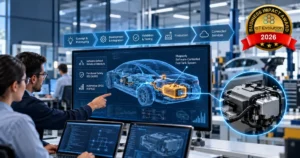
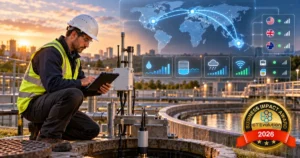
From Silent Observers to Industrial Architects: The Evolution of Displacement Sensing
For decades, the displacement sensor was the humble "blue-collar" worker of the engineering world. Viewed primarily as a utilitarian tool—a simple device designed to quantify the distance between two points—it performed its duties in the background of factories, laboratories, and assembly lines. These sensors were the quiet sentinels of industrial operations, ensuring that mechanical parts remained within tolerance levels, yet they rarely garnered the attention afforded to more complex computing hardware.
However, in the current landscape of Industry 4.0, that perception has undergone a radical transformation. As the global economy pivots toward hyper-connected systems, deep automation, and "smart" infrastructure, the displacement sensor has evolved from a passive measurement tool into a foundational pillar of modern industrial intelligence. Today, these devices are the sensory nerves of the digital age, feeding critical data into complex architectures that enable predictive maintenance, autonomous safety protocols, and the creation of high-fidelity digital twins.
Main Facts: The New Anatomy of Sensing
At its core, a displacement sensor is designed to detect changes in position—whether linear or angular—and convert those physical shifts into measurable, actionable electrical signals. While the fundamental physics remains consistent, the underlying technology has diversified significantly. Modern sensors utilize a sophisticated array of methods, including laser triangulation, capacitive sensing, inductive coupling, and ultrasonic waves. Each method is meticulously engineered to thrive in specific environmental constraints, from the sterile, high-precision atmosphere of a semiconductor cleanroom to the grit and thermal volatility of a heavy-duty steel mill.
The pivot from "simple measurement" to "intelligent monitoring" is the defining narrative of this evolution. In legacy systems, a sensor might have triggered a simple "stop" command if a mechanical arm moved outside its intended boundary. In the current paradigm, that same sensor acts as a continuous data stream, feeding into centralized AI models that interpret movement patterns, identify subtle deviations indicative of long-term fatigue, and communicate with other components of the industrial ecosystem.
Chronology: The Trajectory of Integration
To understand how we arrived at this era of pervasive sensing, it is necessary to view the evolution through a chronological lens:
- The Era of Analog Isolation (1950s–1980s): Displacement sensors were primarily mechanical or simple electronic potentiometers. Data was local, often displayed on analog gauges or used for rudimentary on/off logic in relay-based control systems.
- The Digitization Phase (1990s–2000s): With the advent of Programmable Logic Controllers (PLCs), displacement data became digital. Sensors gained better accuracy, but the data remained confined to the "silo" of a single machine or production cell.
- The IoT Convergence (2010s–2020s): The rise of the Internet of Things (IoT) shattered the silos. Sensors were integrated with wireless communication protocols (LoRaWAN, 5G, Industrial Ethernet), allowing data to move from the factory floor to the cloud.
- The Intelligent Autonomy Era (Present Day): Sensors are now "edge-aware." They perform on-device processing, filtering noise and providing high-level diagnostics rather than just raw distance values, feeding directly into predictive AI models and Digital Twin simulations.
Supporting Data: Why Precision Matters
The economic and safety implications of this transition are supported by significant data trends. In manufacturing, unplanned downtime is estimated to cost the global industry billions of dollars annually. Studies from industrial analytics firms indicate that factories leveraging IoT-integrated displacement sensors for predictive maintenance can reduce unexpected equipment failures by up to 30% and extend the operational lifespan of critical machinery by 15–20%.
In the realm of infrastructure, the data is equally compelling. For a large-scale suspension bridge, the cost of a catastrophic failure is immeasurable. By installing high-precision displacement sensors at critical structural joints, engineers gain access to real-time data regarding thermal expansion, wind-induced sway, and traffic-load deformation. This shift allows municipal authorities to move away from expensive, periodic manual inspections toward "condition-based" maintenance, optimizing the allocation of infrastructure budgets while significantly enhancing public safety.
Official Industry Perspectives
Industry leaders and systems architects increasingly view the displacement sensor as an "enabler" rather than a "component."
"We no longer look at sensors as peripheral devices," notes one lead automation architect from a global manufacturing consultancy. "When you integrate a displacement sensor into a Digital Twin, you aren’t just measuring movement; you are quantifying the ‘health’ of the asset. The sensor becomes the bridge between the physical reality and the virtual model. Without that accurate, high-frequency bridge, the Digital Twin is just a hollow simulation."
Engineers working in the aerospace sector highlight that the push for "zero-defect" manufacturing is entirely dependent on this sensory evolution. In the production of turbine blades, for instance, sensors must measure displacements at the micron level in real-time. Official internal reports from major aerospace manufacturers emphasize that the transition to sensor-driven, automated feedback loops has not only reduced scrap rates but has allowed for the mass customization of parts that were previously too complex to manufacture at scale.
Implications: Building the Smart Infrastructure of Tomorrow
The implications of this technological maturation extend far beyond the factory floor. We are witnessing the birth of the "Self-Monitoring Environment."
Structural Health and Urban Planning
In smart city initiatives, displacement sensors are being embedded into the very foundations of urban design. From skyscrapers that detect wind-induced oscillation to smart tunnels that monitor geological shifts in real-time, the data provided by these sensors is helping architects design more resilient cities. This move toward autonomous, adaptive infrastructure means that buildings and bridges of the future may one day "warn" authorities of structural fatigue before a human ever notices a crack or a misalignment.
The Rise of Digital Twins
The Digital Twin represents the apex of current industrial data integration. A digital twin is a living, breathing virtual replica of a physical system. Displacement sensors are the "eyes" of these models. When a physical conveyor belt experiences a microscopic misalignment due to bearing wear, the displacement sensor captures this movement, the cloud platform updates the Digital Twin, and the system automatically flags a maintenance request, orders the spare part, and schedules the repair—all without human intervention. This is the hallmark of the modern, autonomous, and self-optimizing facility.
Challenges in Scaling
Despite the rapid adoption, the path forward is not without hurdles. The integration of high-density sensor networks requires significant investment in cybersecurity, as these sensors become potential entry points for malicious actors. Furthermore, the volume of data generated by modern, high-speed displacement sensors requires robust edge computing power to ensure that "data noise" does not overwhelm the network. Organizations are increasingly looking toward machine learning algorithms to automate the process of sifting through this massive data stream to find the "signals" that truly matter.
Conclusion: The Quiet Revolution
Displacement sensors may never achieve the fame of high-profile innovations like artificial intelligence or robotics, but they are the silent engines powering these revolutions. By converting the fundamental physical act of movement into the digital language of modern intelligence, these sensors have transcended their original purpose.
As we look toward a future defined by autonomous systems and self-healing infrastructure, the displacement sensor stands as a testament to the power of precision. We are no longer just measuring the world; we are creating a digital feedback loop that understands, predicts, and preserves it. In the final analysis, the displacement sensor is no longer a tool of the past—it is the indispensable link to our digital future, turning the simple measurement of distance into the profound insight of smarter, safer, and more efficient outcomes.