Navigating the Future of Enterprise IoT: KORE and Kaleido Host Definitive Webinar on Global Connectivity and SGP.32
As enterprise Internet of Things (IoT) deployments continue to scale rapidly across international borders, continents, and complex regulatory domains, organizations are discovering that technological innovation alone is not a silver bullet. While the sheer volume of connected endpoints—ranging from thousands to millions of devices—testifies to the maturation of the IoT market, it also exposes a harsh operational reality: maintaining reliable, secure, and compliant global connectivity is one of the most formidable challenges modern enterprises face.
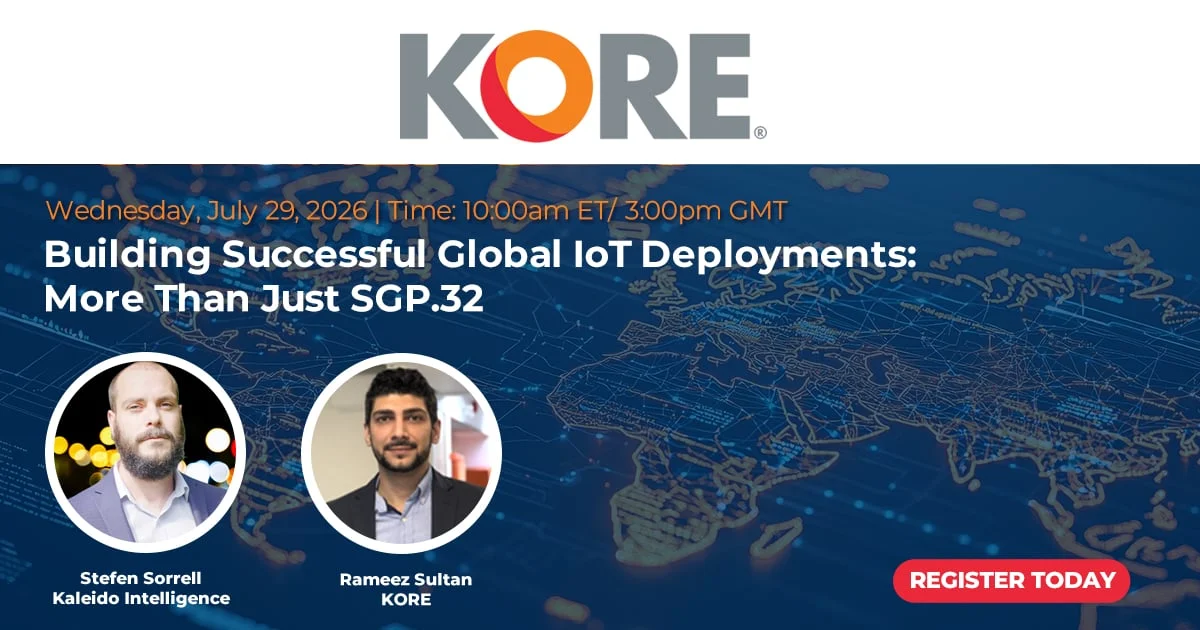
To address these escalating complexities, industry leaders KORE and Kaleido have announced an upcoming, high-level webinar titled "Building Successful Global IoT Deployments: More Than Just SGP.32." Scheduled for Wednesday, July 29, 2026, at 10:00 a.m. ET / 3:00 p.m. GMT, this virtual event is designed to move past the industry hype surrounding new technical specifications and deliver a holistic, strategic framework for international IoT rollouts.
Whether an enterprise is in the nascent stages of planning its first cross-border deployment or actively managing a sprawling, legacy-laden global fleet, the session promises to offer actionable insights to ensure devices remain online, compliant, and operationally viable regardless of geographical boundaries.
Main Facts: The Anatomy of Modern IoT Expansion
The global enterprise IoT landscape is undergoing a massive transformation. No longer confined to localized or single-country architectures, modern IoT solutions are expected to function seamlessly across diverse telecommunications ecosystems. However, this borderless ambition introduces a maze of technical, regulatory, and logistical hurdles.
- The Event: "Building Successful Global IoT Deployments: More Than Just SGP.32"
- Hosts: KORE, a pioneer in IoT solutions and global connectivity services, and Kaleido Intelligence, a market-leading connectivity research and consulting firm.
- Date & Time: Wednesday, July 29, 2026, at 10:00 a.m. ET / 3:00 p.m. GMT.
- Core Thesis: While modern remote SIM provisioning (RSP) standards like SGP.32 represent significant technological leaps, they must be integrated into a broader, multi-faceted connectivity strategy to achieve true global resilience.
- Target Audience: IoT product managers, chief technology officers, operations directors, enterprise architects, and telecommunications strategists.
The primary objective of the July 29 webinar is to deconstruct the myths surrounding single-standard solutions and provide enterprises with a comprehensive blueprint for long-term operational success.
Chronology: The Evolution of Global IoT and Remote SIM Provisioning
To understand why events like the KORE and Kaleido webinar are critically timed, it is essential to trace the historical trajectory of IoT connectivity management and the incremental steps that led to the introduction of modern standards.
Phase 1: The Era of Fixed Physical SIMs (Pre-2016)
In the early days of enterprise IoT, deploying devices internationally meant dealing with the logistical nightmare of physical SIM cards. Enterprises had to source local network operators in every target country, manually swap SIM cards if a carrier relationship soured, or rely on costly permanent roaming agreements that frequently ran afoul of local regulatory mandates. Scaling past a few thousand devices was labor-intensive and economically unsustainable.
Phase 2: The Advent of M2M and Consumer eSIMs (2016–2023)
The introduction of the GSMA’s Remote SIM Provisioning (RSP) architecture—specifically SGP.01/SGP.02 for Machine-to-Machine (M2M) and SGP.21/SGP.22 for consumer devices—revolutionized how profiles were downloaded over the air. Enterprises could finally manage profiles without physical access. However, M2M specifications required complex SMS-based triggers and server-managed architectures, while consumer specifications were ill-fitted for headless IoT devices lacking screens or user interfaces.
Phase 3: The Promise and Limitations of SGP.32 (2024–Present)
Recognizing the limitations of its predecessors, the GSMA developed SGP.32 (often referred to as the IoT eSIM standard). Designed specifically for cellular IoT, SGP.32 bridges the gap by enabling remote profile management on headless devices via IP-based download mechanisms, offering unprecedented flexibility.
Yet, as enterprises rushed to adopt SGP.32, a dangerous misconception took root: the belief that implementing SGP.32 automatically solved all global connectivity challenges. This brings the industry to the current juncture, where KORE and Kaleido are stepping in to clarify that a standard is merely a tool, not an entire strategy.
Supporting Data: The Hidden Complexities of Cross-Border Connectivity
Market research consistently highlights a disconnect between enterprise deployment ambitions and operational outcomes. According to recent data from Kaleido Intelligence, over 60% of global IoT deployments encounter unexpected connectivity roadblocks within their first 24 months of operation. These failures rarely stem from hardware malfunctions; instead, they are rooted in strategic oversight.
Key Factors Threatening Enterprise IoT Lifecycles:
- Regulatory Fragmentation: Different nations enforce strict, divergent data sovereignty and permanent roaming laws. For instance, countries within the European Union, India, and parts of the Middle East have unique mandates regarding how long a foreign-issued SIM can remain on a local network before it must be localized.
- Carrier Fragmentation and Coverage Gaps: No single Mobile Network Operator (MNO) possesses a truly ubiquitous global network. Enterprises must manage multi-operator relationships to ensure indoor penetration, deep rural coverage, and high-availability failovers.
- Lifecycle Management Costs: Provisioning a device is only day zero. Managing firmware updates, security patches, profile switches, and billing reconciliations across dozens of carriers creates massive administrative overhead.
- Security Vulnerabilities: As IoT devices proliferate across critical infrastructure, healthcare, supply chains, and industrial automation, they present expanding attack surfaces. A weak link in the connectivity chain can compromise an entire enterprise network.
Official Perspectives: Industry Experts Weigh In
The collaboration between KORE and Kaleido brings together deep market intelligence and hands-on deployment expertise. While specific quotes from the upcoming webinar panelists remain under embargo prior to the live broadcast, leadership from both organizations has consistently emphasized the necessity of a holistic approach to connectivity.
Industry analysts note that while SGP.32 simplifies the technical mechanism of switching carrier profiles on remote IoT assets, it does not negotiate carrier rates, solve regional compliance audits, or automatically optimize data routing paths to minimize latency.
"Enterprises are looking for silver bullets when it comes to global IoT rollouts," notes enterprise mobility analysts. "The reality is that standards like SGP.32 are critical enablers, but they are akin to having a high-performance engine without a steering wheel if they aren’t backed by a robust operational strategy, solid carrier partnerships, and meticulous compliance planning."

By hosting this joint session, KORE and Kaleido aim to bridge the gap between abstract technical standards and boardroom execution, empowering organizations to ask the right questions of their connectivity vendors before committing capital expenditure to large-scale rollouts.
Implications: What This Means for Enterprise IoT Strategists
The outcomes of the July 29 webinar will have far-reaching implications for organizations designing, deploying, and maintaining connected products across multiple verticals, including logistics, healthcare, smart cities, automotive, and industrial automation.
1. Shift from Tactical Implementation to Strategic Architecture
Organizations will be forced to re-evaluate their procurement and deployment pipelines. Rather than choosing a connectivity partner based solely on support for the latest standard, enterprises must evaluate vendors on their global footprint, local regulatory expertise, automation capabilities, and lifecycle management tooling.
2. De-risking Regulatory Compliance
With tightening data privacy and localization laws worldwide, mismanaged connectivity can lead to hefty regulatory fines, device blacklisting, or sudden service terminations. The insights shared by KORE and Kaleido will help compliance officers future-proof their operations against shifting geopolitical landscapes.
3. Total Cost of Ownership (TCO) Optimization
A well-designed connectivity strategy reduces hidden operational costs—such as truck rolls to manually service disconnected devices, expensive data overages, and administrative overhead associated with multi-vendor billing reconciliation. Understanding where SGP.32 fits allows enterprises to streamline their technical stack and maximize ROI.
How to Register and Attend
For organizations seeking to navigate the complexities of international IoT deployment and unlock the true potential of connected devices, attending the upcoming webinar is an essential step.
- Event Building Successful Global IoT Deployments: More Than Just SGP.32
- Date: Wednesday, July 29, 2026
- Time: 10:00 a.m. ET / 3:00 p.m. GMT
- Registration Link: Reserve Your Spot via GoToWebinar
Space is limited, and early registration is strongly recommended for technology leaders, product managers, and enterprise architects looking to stay ahead of the curve in the rapidly evolving IoT ecosystem. Join KORE and Kaleido on July 29 to ensure your enterprise connectivity strategy is built not just for today’s standards, but for tomorrow’s global scale.