The Alchemist’s Bench: Desktop Oil Cracking Unveils the Secrets of Industrial Chemistry
In a remarkable demonstration of ingenuity and chemical prowess, engineer and hobbyist Markus Bindhammer has successfully replicated a cornerstone of the petroleum industry – catalytic cracking – on a compact tabletop setup. This audacious experiment, transforming common paraffin oil into more volatile, commercially valuable hydrocarbons, not only demystifies a complex industrial process but also highlights the foundational chemical principles at play in our modern energy landscape. Bindhammer’s work offers a fascinating glimpse into the possibilities of sophisticated chemistry performed outside the confines of a multi-billion-dollar refinery, sparking discussions on education, safety, and the hacker spirit in science.
Bridging the Supply-Demand Gap: The Industrial Imperative of Cracking
Crude oil, extracted from the Earth’s depths, is a complex mixture of thousands of different hydrocarbon molecules, varying widely in size and structure. From light gases like methane to heavy, tar-like bitumens, this "black gold" represents a vast chemical reservoir. However, global energy and petrochemical markets exhibit a significant mismatch with crude oil’s natural composition. The overwhelming demand is for lighter, shorter-carbon-chain molecules – the gasoline, diesel, and jet fuels that power transportation, and the fundamental building blocks (like ethylene and propylene) for plastics, pharmaceuticals, and countless other industrial products.
Historically, the heavier, longer-chain hydrocarbons in crude oil were less desirable, often relegated to residual fuel oils or asphalt. This presented a formidable challenge to the nascent petroleum industry: how to efficiently convert these less-valued, abundant heavy fractions into the highly sought-after lighter products? The answer emerged in the form of "cracking" – a chemical process that breaks down large, complex hydrocarbon molecules into smaller, simpler ones. This transformative technology, pioneered in the early 20th century, is nothing short of revolutionary, enabling refiners to maximize the yield of valuable products from every barrel of crude and shaping the very fabric of our industrialized world. Without cracking, modern transportation and the vast petrochemical industry as we know it would simply not exist. It is the economic linchpin of petroleum refining, converting low-value feedstock into high-demand commodities and ensuring a flexible supply chain capable of adapting to fluctuating market needs.
Markus Bindhammer’s Pioneering Experiment: Cracking at Tabletop Scale
It is against this backdrop of immense industrial importance that Markus Bindhammer’s desktop experiment takes on particular significance. Eschewing the colossal reactors and intricate control systems of a modern refinery, Bindhammer embarked on a project to perform catalytic cracking using readily available laboratory equipment, turning a humble tabletop into a miniature petrochemical plant. His goal was not to compete with industrial giants, but rather to demonstrate the fundamental chemistry behind this critical process in an accessible and tangible way.
Using common paraffin oil – a mixture primarily of long-chain alkanes – as his feedstock, Bindhammer successfully orchestrated its breakdown into lighter, more volatile hydrocarbons. The most compelling evidence of his success was the stark difference in flammability: while the original paraffin oil resisted ignition, the cracked product ignited with ease, a clear indication of its transformation into shorter, more combustible molecules akin to gasoline or lighter fuel oils. This remarkable achievement underscores the power of chemical principles and the ingenuity of individual explorers, proving that even the most complex industrial transformations are rooted in fundamental reactions that can, with careful planning and execution, be replicated on a far smaller scale. Bindhammer’s project serves as a testament to the "hacker" ethos in science – the drive to understand, deconstruct, and re-engineer complex systems, often with surprising and insightful results.
A Journey Through the Reactor: The Chronology of Desktop Cracking
The success of Bindhammer’s tabletop cracking experiment lies in the meticulous application of established chemical principles and a well-designed, albeit scaled-down, experimental setup. The process, while conceptually simple, required precise control of conditions and careful observation of chemical indicators.
Catalytic Fluid Cracking: The Chosen Method
Among the various methods of hydrocarbon cracking, Bindhammer opted for catalytic fluid cracking (FCC), a method widely favored in industry for its efficiency and selectivity. Unlike thermal cracking, which relies solely on high temperatures to break bonds and often produces a broad range of less desirable byproducts (like coke), catalytic cracking employs a catalyst to facilitate the reaction at lower temperatures and with greater control over product distribution. The term "fluid" in FCC typically refers to the use of finely powdered catalyst particles that behave like a fluid when aerated, circulating between reactor and regenerator units in industrial settings. While Bindhammer’s setup did not feature a circulating fluid bed, the core principle of using a solid catalyst in contact with a liquid/vapor feedstock remained.
The catalyst of choice for Bindhammer, mirroring industrial practice, was amorphous silica-alumina. This material possesses a unique porous structure and, critically, Brønsted and Lewis acid sites that are crucial for initiating the cracking reactions. These acidic sites act as proton donors or electron acceptors, respectively, creating carbocations (positively charged carbon intermediates) from the alkane molecules. These carbocations are inherently unstable and readily undergo fragmentation, leading to the desired breaking of carbon-carbon bonds. This catalytic pathway is significantly more efficient than purely thermal cracking, allowing for lower reaction temperatures and a more controlled breakdown of the long-chain hydrocarbons. Other cracking methods, such as hydrocracking (which uses hydrogen to saturate products and reduce coke formation) or steam cracking (primarily for producing light olefins), exist, but catalytic cracking remains paramount for gasoline production.
Assembling the Mini-Refinery: The Experimental Setup
Bindhammer’s experimental setup was a testament to functional design, prioritizing safety and efficacy within a compact footprint. Each component played a critical role in the overall process:
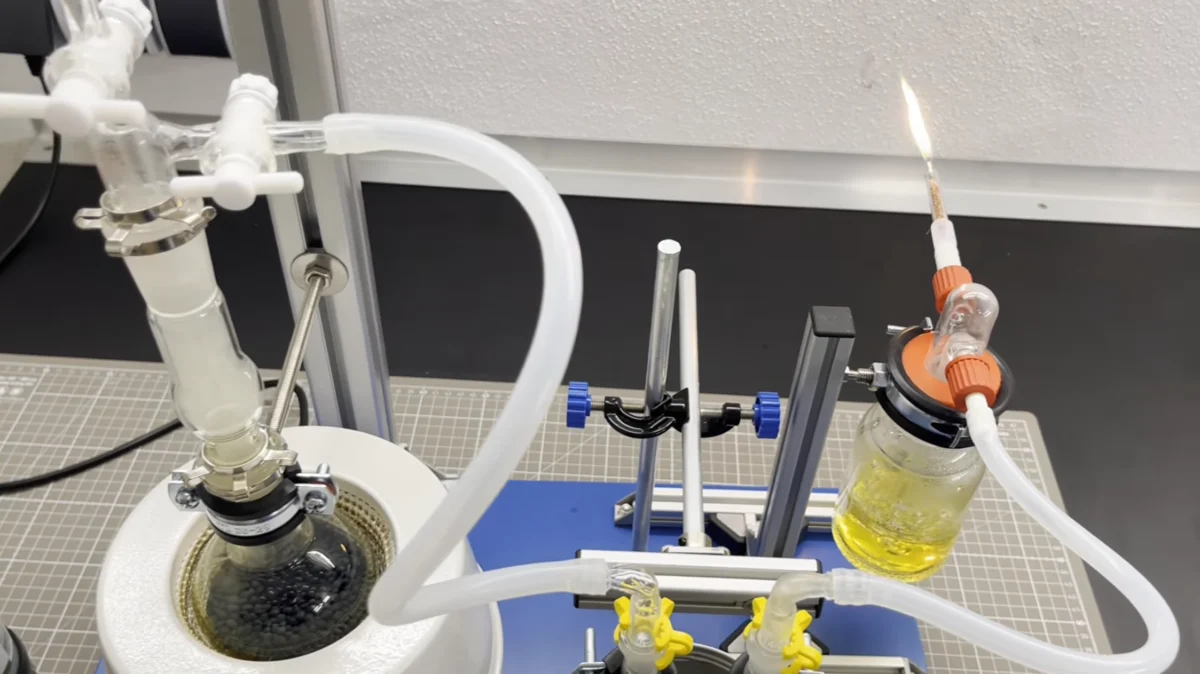
- Heating Mantle & Boiling Flask: The heart of the reactor consisted of a boiling flask, specifically chosen for its heat resistance and ability to contain the reactants. This flask held the paraffin oil feedstock and the amorphous silica-alumina catalyst. A heating mantle surrounded the flask, providing uniform and controlled heat necessary to vaporize the paraffin oil and initiate the catalytic cracking process. Maintaining a precise temperature was crucial for optimal reaction rates without excessive thermal degradation.
- Condenser Tube: Connected to the boiling flask, the condenser served to cool the hot gaseous products emerging from the reaction chamber. As the cracked hydrocarbon vapors, along with hydrogen gas, passed through the chilled condenser, heavier fractions would condense back into liquid form, while lighter, more volatile gases continued their journey. This separation mechanism is vital for isolating the desired light hydrocarbons.
- Bromine Water Bottle: Following the condenser, the gaseous stream was bubbled through a bottle containing bromine water. This component was ingeniously designed as a real-time chemical indicator. Bromine (Br₂) in aqueous solution imparts a characteristic yellow-orange color. Its primary purpose here was to visually confirm the production of alkenes – hydrocarbons containing carbon-carbon double bonds – which are key products of catalytic cracking. Bromine reacts rapidly and readily with alkenes via an electrophilic addition mechanism, causing the disappearance of its distinct color.
- Flashback Arrestor: A critical safety device, the flashback arrestor was positioned at the very end of the gas path, just before the gases were vented or flared. When dealing with flammable gases like hydrogen and light hydrocarbons, there is a significant risk of a flame traveling back into the apparatus, potentially causing an explosion. The flashback arrestor is designed to extinguish any flame propagating upstream, thereby preventing catastrophic accidents. Its inclusion underscored Bindhammer’s commitment to safety in an inherently hazardous experiment.
The careful assembly of these components, ensuring airtight seals and proper flow, was essential for the integrity and safety of the entire cracking operation.
The Process Unfolds: From Paraffin to Petrochemical
With the apparatus meticulously assembled, Bindhammer initiated the cracking process, following a carefully orchestrated sequence of steps:
- Pre-reaction Purge: Before heating commenced, the entire system was purged with argon, an inert gas. This crucial step served two primary purposes: firstly, to remove any oxygen from the apparatus, thereby preventing unwanted oxidation reactions (combustion) that could pose a safety hazard or contaminate the desired products; and secondly, to ensure that the reaction environment was free of other atmospheric gases, allowing for a purer study of the cracking process.
- Heating and Vaporization: Once purged, the heating mantle was activated, gradually raising the temperature of the paraffin oil and catalyst mixture in the boiling flask. As the temperature increased, the paraffin oil began to vaporize, creating a gaseous phase that came into intimate contact with the heated catalyst.
- Catalytic Action: At elevated temperatures, the long-chain alkane molecules in the paraffin oil vapor encountered the acidic sites of the silica-alumina catalyst. This interaction initiated the cracking process, breaking the strong carbon-carbon bonds within the alkane chains. This scission yielded a mixture of shorter-chain alkanes, alkenes, and hydrogen gas.
- Product Flow and Condensation: The hot gaseous mixture of cracked products, unreacted paraffin vapor, and hydrogen then flowed out of the boiling flask and into the condenser. Here, the heavier, higher-boiling point components condensed back into a liquid, while the lighter, more volatile gases, including hydrogen and lighter alkenes, continued their journey through the system.
- Visual Indicators: The most immediate and compelling evidence of successful cracking came from the bromine water bottle. As the gaseous products bubbled through the yellow bromine solution, the characteristic color rapidly disappeared. This visually striking change confirmed the presence of alkenes, which reacted with the bromine, consuming it and rendering the solution colorless.
- Gaseous Escape: The remaining non-condensable gases, primarily hydrogen and very light hydrocarbons, safely escaped through the flashback arrestor, likely vented to a fume hood or flared off under controlled conditions.
This chronological progression, from initial setup to the visual confirmation of reaction, demonstrated a sophisticated understanding of chemical engineering principles applied on a miniature scale.
Unveiling the Chemistry: Supporting Data and Scientific Principles
The success of Bindhammer’s desktop cracker is deeply rooted in fundamental chemical principles. Understanding these underpins the observations and validates the transformation of paraffin oil.
The Science of Cracking: Breaking Bonds for Value
At its core, catalytic cracking is a process of molecular rearrangement and fragmentation. The long-chain alkanes in paraffin oil (e.g., C₂₀H₄₂ to C₃₀H₆₂) are relatively inert due to their saturated carbon-carbon and carbon-hydrogen bonds. The silica-alumina catalyst provides the necessary activation energy and reaction pathways.
- Initiation: A paraffin molecule adsorbs onto an acidic site of the catalyst. A hydride ion (H⁻) can be abstracted from the alkane by a Lewis acid site, or a proton (H⁺) can be added by a Brønsted acid site, forming a highly reactive carbocation intermediate.
- Example (simplified): R-CH₂-CH₂-CH₂-R’ + Catalyst-H⁺ → R-CH₂-CH⁺-CH₂-R’ + Catalyst
- Beta-Scission: The carbocation, being unstable, undergoes rapid fragmentation via a process called beta-scission. This involves the breaking of a carbon-carbon bond located beta (two carbons away) to the positively charged carbon. This scission produces a smaller alkene and another, more stable carbocation.
- Example: R-CH₂-CH⁺-CH₂-R’ → R-CH=CH₂ (alkene) + ⁺CH₂-R’ (new carbocation)
- Hydrogen Transfer and Isomerization: The newly formed carbocation can undergo further beta-scission, or it can abstract a hydride ion from another alkane molecule, regenerating the original alkane and forming a new carbocation. Isomerization (rearrangement of the carbon skeleton) can also occur, producing branched hydrocarbons that improve gasoline octane ratings.
- Product Diversity: The continuous cycle of carbocation formation and fragmentation leads to a diverse mixture of products:
- Alkenes: Hydrocarbons with at least one carbon-carbon double bond (e.g., ethene, propene, butene). These are highly valuable as petrochemical feedstocks.
- Lighter Alkanes: Shorter-chain saturated hydrocarbons (e.g., propane, butane, pentane, hexane) suitable for LPG and gasoline.
- Hydrogen Gas: Formed as a byproduct during various disproportionation and dehydrogenation steps.
- Coke: A carbonaceous residue that deposits on the catalyst surface, eventually deactivating it. This is a common side reaction in cracking.
The overall transformation can be generalized as:
Long-chain alkane → Shorter-chain alkane + Alkene + H₂
The Bromine Water Test: A Visual Confirmation of Alkenes
The disappearance of the yellow color of bromine water served as the primary visual confirmation of alkene production. This is due to a well-known organic reaction: electrophilic addition.
Bromine (Br₂) is a nonpolar molecule, but its electron cloud can be temporarily distorted by the presence of a nearby electron-rich region, such as the pi (π) bond of an alkene. The π bond in alkenes is a region of high electron density. As the bromine molecule approaches the alkene, one bromine atom becomes slightly positive (electrophilic) and attacks the double bond.
The reaction proceeds in two main steps:
- Formation of a Bromonium Ion: The alkene’s π electrons attack the electrophilic bromine atom, forming a cyclic bromonium ion intermediate and releasing a bromide ion (Br⁻).
- Nucleophilic Attack: The bromide ion then attacks one of the carbons of the cyclic bromonium ion from the opposite side, opening the ring and forming a vicinal dibromide (a compound with two bromine atoms on adjacent carbons).
The key point is that the bromine molecule (yellow-orange) is consumed in this reaction, converting into colorless brominated products. Alkanes, lacking the reactive carbon-carbon double bond, do not react with bromine water under these mild conditions. Thus, the observed color change was an unequivocal indicator of the successful cracking of paraffin oil into alkenes.
Beyond the Bromine: Physical Evidence of Transformation
While the bromine water test provided chemical confirmation, other observations offered compelling physical evidence of the transformation:
- Phase Separation: After the reaction, the liquid collected in the bromine water bottle typically separated into two distinct phases. One was the aqueous phase, containing the water-soluble brominated products and any remaining unreacted bromine. The other was a lighter, immiscible organic phase, comprising unreacted hydrocarbons and the newly formed, lighter cracked hydrocarbons. This phase separation highlighted the production of new organic compounds with different solubilities and densities than the original paraffin oil.
- The Ignition Test: The most dramatic and intuitive proof of successful cracking was the ignition test. A pool of the original paraffin oil would typically resist ignition, requiring high temperatures or a wick to burn. In contrast, a sample of the cracked oil ignited easily and burned readily. This is because the cracking process generated a significant proportion of shorter-chain hydrocarbons, which have lower boiling points, higher vapor pressures, and lower flash points than the original long-chain paraffin. These lighter molecules vaporize more readily at room temperature, forming a flammable air-vapor mixture that ignites with minimal effort. This physical characteristic is precisely why cracking is so vital for producing fuels like gasoline and diesel.
- Coke Formation: A common, though undesirable, side effect observed was the blackening of the catalyst with coke. Coke is a carbonaceous deposit formed from the over-cracking or dehydrogenation of hydrocarbons on the catalyst surface. While inevitable in FCC, excessive coke buildup deactivates the catalyst by blocking its active sites. In industrial units, catalysts are continuously regenerated by burning off the coke. Bindhammer’s observation of coke highlights the challenges of catalyst management, even at a small scale. Furthermore, the heating mantle’s cover fusing to the boiling flask points to the intense heat generated and the corrosive nature of the reaction environment over time, demonstrating the harsh conditions involved.
Expert Perspectives and Safety Considerations: Official Responses (or lack thereof)
While Bindhammer’s experiment was a private endeavor, its nature inevitably invites comparison with industrial practices and prompts critical discussions on safety and educational value. Given the absence of official "responses" to a personal project, we can infer expert commentary from the broader scientific and industrial communities.
Contrasting Scales: From Benchtop to Billion-Dollar Plants
The most striking contrast lies in scale. Bindhammer’s tabletop setup is a testament to the fundamental chemistry, but it pales in comparison to industrial Fluid Catalytic Cracking (FCC) units, which are gargantuan structures capable of processing tens of thousands of barrels of crude oil per day. These industrial plants operate continuously, incorporating sophisticated engineering for:
- Yield Optimization: Precise control of temperature, pressure, and catalyst-to-oil ratio to maximize desired products and minimize unwanted byproducts.
- Energy Efficiency: Complex heat exchangers and energy recovery systems to make the process economically viable.
- Catalyst Regeneration: Continuous cycling of the catalyst between reactor and regenerator to burn off coke and restore activity.
- Product Separation: Fractional distillation columns, scrubbers, and other units to separate the cracked products into various streams (LPG, gasoline, diesel, fuel oil).
- Environmental Control: Extensive systems for managing emissions, wastewater, and solid waste to meet stringent environmental regulations.
A petroleum engineer observing Bindhammer’s work would likely appreciate the educational value but emphasize that scaling up such a process involves orders of magnitude more complexity in terms of thermodynamics, fluid dynamics, materials science, and process control. The "hacker" ethos prioritizes demonstration and understanding, whereas corporate R&D focuses on economic viability, safety at scale, and long-term sustainability.
The Critical Importance of Safety Protocols in DIY Chemistry
Bindhammer’s inclusion of an argon purge and a flashback arrestor demonstrates a commendable awareness of safety, which is paramount when dealing with flammable hydrocarbons and hydrogen. However, any expert in chemical safety would issue a strong cautionary note regarding the replication of such experiments by untrained individuals. The inherent dangers are significant:
- Flammable Gases and Vapors: The production of hydrogen and light hydrocarbons creates a highly explosive atmosphere. A single spark, static discharge, or even a hot surface could trigger a fire or explosion.
- High Temperatures: The boiling flask and heating mantle operate at temperatures sufficient to cause severe burns and, as Bindhammer noted, can lead to equipment failure (e.g., fusing of parts).
- Pressure Build-up: If the system were to become blocked, pressure could rapidly build up, leading to an uncontrolled release of hot, flammable materials.
- Chemical Exposure: The chemicals involved, including hydrocarbons and bromine, can be irritants, toxins, or carcinogens. Proper ventilation (e.g., a fume hood), personal protective equipment (gloves, eye protection), and spill containment are essential.
- Coke Formation and Blockages: The buildup of coke can lead to blockages within the system, potentially causing pressure increases and unsafe operation.
A chemical safety expert would unequivocally state that such experiments should only be undertaken in a properly equipped laboratory setting by individuals with extensive training in chemical handling, reaction safety, and emergency procedures. The risks to personal safety and property are too high for casual experimentation. While educational, the direct replication by hobbyists without professional guidance is strongly discouraged.
Educational Value and Citizen Science
Despite the safety warnings, there is undeniable educational merit in projects like Bindhammer’s. For students of chemistry and engineering, witnessing (or even understanding conceptually) how a complex industrial process can be broken down into its fundamental chemical steps offers invaluable insight. It moves chemistry beyond theoretical equations on a blackboard and into the realm of tangible, observable transformation.
This project embodies the spirit of "citizen science" or "hacker science" – the idea that scientific inquiry and experimentation are not exclusive to professional researchers. It inspires curiosity, promotes hands-on learning, and demystifies technologies that underpin our daily lives. Such demonstrations can be powerful tools for sparking interest in STEM fields and fostering a deeper appreciation for the chemical processes that shape our world.
Implications: The Future of Fuel, Education, and Experimentation
Markus Bindhammer’s tabletop cracking experiment is more than just a chemical parlor trick; it carries broader implications for our understanding of energy, the role of education, and the future of scientific exploration.
Beyond the Barrel: The Broader Context of Hydrocarbon Chemistry
While the world increasingly shifts towards renewable energy sources, hydrocarbon chemistry remains an indispensable pillar of modern society. Fuels for transportation, feedstocks for plastics, lubricants, and countless other materials still rely heavily on petroleum. Cracking, therefore, remains a vital technology, not just for fuel production but also for maximizing the value extracted from every barrel of oil, ensuring the efficient use of a finite resource.
Bindhammer’s work highlights that even as we transition away from fossil fuels, the underlying chemical principles of transforming matter remain critically important. The ability to break down complex molecules or build them up from simpler ones is a fundamental skill that will continue to be relevant in fields like biomass conversion, waste valorization, and the synthesis of new materials. Understanding how hydrocarbons behave and react is a cornerstone of chemical engineering, irrespective of their origin.
The Fischer-Tropsch Link: Building vs. Breaking
Intriguingly, Bindhammer has also explored the reverse process: the Fischer-Tropsch synthesis. This process, which he also demonstrated on a desktop scale, converts synthesis gas (a mixture of carbon monoxide and hydrogen) into liquid hydrocarbons. Where cracking breaks long chains into shorter ones, Fischer-Tropsch builds shorter molecules into longer ones. This versatility in demonstrating both "breaking" (cracking) and "building" (Fischer-Tropsch) processes showcases a profound grasp of hydrocarbon chemistry and the elegant reversibility (or complementarity) of chemical transformations.
The ability to control hydrocarbon chain length, whether by breaking or building, is a powerful tool. It speaks to the potential for custom fuel or chemical production, albeit currently only economically viable at a large industrial scale. It also reminds us that the energy challenge is not just about finding new sources, but also about efficiently converting and utilizing existing ones.
The Spirit of Scientific Exploration: Democratizing Chemistry
Markus Bindhammer’s project is a powerful example of the spirit of scientific exploration that thrives outside traditional academic or industrial institutions. It underscores the value of hands-on experimentation, the pursuit of understanding for its own sake, and the democratizing power of readily available information and tools. Platforms like Hackaday, where Bindhammer’s work was featured, play a crucial role in disseminating such knowledge, inspiring a new generation of scientists and engineers.
However, this spirit must always be balanced with immense responsibility. The accessibility of information and equipment does not negate the inherent dangers of chemical reactions. For every inspiring desktop experiment, there must be an accompanying message of caution, emphasizing the rigorous training, safety protocols, and ethical considerations that are non-negotiable in the practice of chemistry.
A Glimpse into the Future: Personalized Chemistry and Resourcefulness
Could small-scale chemical synthesis, inspired by projects like Bindhammer’s, have a future beyond education? While unlikely to replace industrial refineries, niche applications might emerge. Imagine remote communities with access to local feedstocks (e.g., agricultural waste) capable of producing small batches of specialized chemicals or fuels, facilitated by compact, safe, and robust processing units. This remains speculative, but the underlying principle of resourcefulness and localized production is compelling.
Ultimately, Bindhammer’s desktop oil cracker serves as a potent reminder of the incredible transformations possible through chemistry. It allows us to peek behind the curtain of a colossal industry and appreciate the elegance of the molecular dance that underpins our energy-intensive world. It challenges us to ponder not just how we fuel our present, but also how we educate future generations about the fundamental sciences that will shape our collective tomorrow.