The Digital Frontier: How Virtual Cell Models Are Rewriting the Rules of Drug Discovery
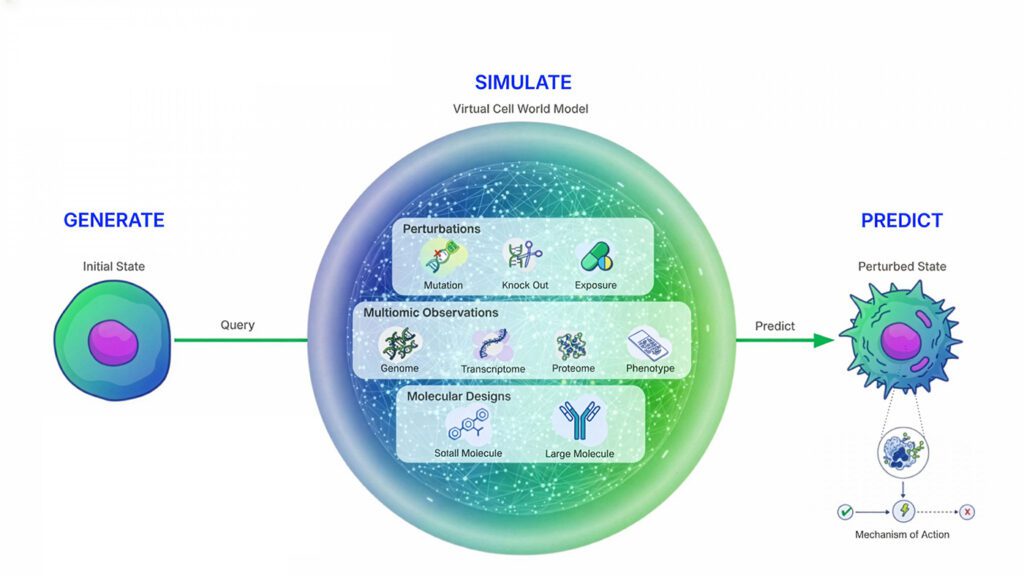
The landscape of modern medicine is currently undergoing a paradigm shift, one that is moving away from the slow, iterative process of laboratory trial-and-error toward a future governed by computational prediction. At the heart of this transformation is the "virtual cell"—a sophisticated, AI-driven model capable of simulating biological behavior across scales, contexts, and stressors. By creating a digital replica of cellular machinery, researchers are unlocking unprecedented insights into disease mechanics, therapeutic targets, and the very architecture of human life.
The Quest for a Biological "PDB"
The concept of the virtual cell is not merely a theoretical exercise; it is an ambitious infrastructure project. Tom Sercu, PhD, Vice President of AI and Engineering at Biohub, draws a direct parallel between the current state of cellular biology and the foundational era of structural biology.
"We do not yet have the equivalent of the Protein Data Bank (PDB) for cells," Sercu notes. For five decades, the PDB has served as the bedrock for modern structural biology, housing over 253,000 experimentally determined molecular structures. These data were the essential fuel for breakthroughs like AlphaFold. Sercu and his colleagues believe that if the industry can curate a similar, standardized, and high-quality repository for cellular behavior—spanning diverse organisms, interventional methods, and environmental states—the predictive power of AI will reach a tipping point.
To catalyze this, Biohub announced a $500 million commitment to the Virtual Biology Initiative this past April. This five-year campaign is designed to build the necessary technological scaffolding and generate the multi-modal datasets required to power the next generation of virtual cell models.
Chronology: The Evolution of Digital Biology
The journey toward the virtual cell has accelerated rapidly over the last several years, transitioning from niche academic interest to the center of multibillion-dollar biopharmaceutical strategies.
- Pre-2020: The era of basic transcriptomic profiling. Researchers relied on small-scale, often isolated studies to map gene expression changes under specific conditions.
- 2021–2023: The rise of "Perturb-seq" and high-throughput CRISPR screening. This period saw the industry shift toward capturing causal relationships at the single-cell level, allowing models to learn how specific genetic tweaks alter cell behavior.
- March 2026: A landmark month for the field. Xaira Therapeutics unveiled "X-Cell," a 4.9-billion-parameter model representing the first true "scaling law" demonstrator in the virtual cell space. Simultaneously, Ginkgo Datapoints released the first data from its Virtual Cell Pharmacology Initiative (VCPI).
- May 2026: GenBio AI introduced "ProtiCelli," a model capable of mapping the spatial organization of the proteome, while Cellular Intelligence announced a strategic partnership with Novo Nordisk, signaling the entry of virtual cell models into the clinical manufacturing space.
The Great Debate: Single-Cell vs. Bulk Transcriptomics
A significant point of contention—and innovation—in the field is the question of scale and resolution. How does one best capture the "truth" of a cell?

The Single-Cell Precision Approach
Companies like the Arc Institute and Xaira Therapeutics are doubling down on single-cell RNA sequencing (scRNA-seq). Arc’s "STATE" model focuses on how stem, cancer, and immune cells respond to complex stimuli. Xaira’s X-Cell, trained on the massive 25.6-million-cell "X-Atlas/Pisces" dataset, is designed to generalize across biological contexts, essentially creating a "foundation model" for cell behavior. The goal here is high-resolution granularity: understanding how individual cells differ within a population.
The Pharmacological Bulk Approach
Conversely, Ginkgo Datapoints argues that "more" is not always "better" if the signal-to-noise ratio is compromised. Their approach favors bulk transcriptomics via DRUG-seq. By profiling thousands of small molecules across full dose responses in the THP-1 cell line, Ginkgo captures approximately 10,000 genes per condition—far exceeding the 1,500 genes typically captured by scRNA-seq. John Androsavich, PhD, General Manager at Ginkgo Datapoints, emphasizes the value of diversity: "Just like how models benefit from diversity in training data, we as an industry benefit from having diversity of approaches."
Beyond RNA: The Spatial and Temporal Dimensions
"A cell is not only its RNA," says Hani Goodarzi, PhD, a core investigator at the Arc Institute. This sentiment is shared by a growing cohort of researchers who believe that current models are suffering from the "streetlight effect"—focusing only on what is easy to measure (sequences) rather than what is biologically critical (proteins, metabolism, and structure).
The Spatial Challenge
Emma Lundberg, PhD, co-founder and CSO at GenBio AI, points out that 60% of human genes encode proteins that localize to multiple compartments, each performing distinct, context-dependent functions. Her model, ProtiCelli, leverages 1.23 million images from the Human Protein Atlas to simulate the spatial organization of the proteome. By incorporating these biological priors, GenBio AI is moving toward a "digital organism" that understands the 3D architecture of life, not just the code.
The Temporal Challenge
Cellular Intelligence is tackling the problem of "time." According to CEO Micha Breakstone, we have mastered the ability to observe cells, but we are still far from mastering the ability to engineer them. With less than 1% of human cell types currently reliable for clinical therapy, the "grammar" of cell differentiation—the sequences of signaling cues that drive a cell from a stem state to a specialized state—remains a black box. Their platform uses semi-permeable capsule technology to test millions of signal combinations in parallel, essentially building a "GPS" for cell development.
Implications for Drug Discovery and Clinical Translation
The implications of these initiatives are profound, particularly for translational medicine.
Precision Patient Stratification
Imagine a clinician-scientist working with a rare autoimmune disease. By inputting a patient’s unique genome into a virtual cell model, they could theoretically predict how that patient’s specific immune cells will react to a suite of different therapeutic interventions. This moves the field from "one-size-fits-all" medicine to hyper-personalized therapeutic design.
Overcoming the "Search Space" Problem
The search space for drug discovery is virtually infinite. By using models like those developed by Cellular Intelligence, researchers can simulate the outcome of cell-state transitions in hours rather than the years of trial-and-error required by traditional lab-based methods. This is particularly vital for cell therapies, where manufacturing scale-up, comparability, and clinical logistics have historically served as the primary bottlenecks to market entry.
The Future of Manufacturing
The partnership between Cellular Intelligence and Novo Nordisk is perhaps the most significant indicator of the industry’s trajectory. It suggests that virtual cells are no longer just tools for discovery; they are becoming essential components of the clinical pipeline. As Breakstone notes, the next frontier isn’t just understanding the biology—it is solving the complex logistical and manufacturing challenges that keep life-saving therapies from reaching the bedside.
Conclusion: A Collaborative Future
The virtual cell is not the product of a single algorithm or a solitary company. It is a collective endeavor that requires the standardization of data, the integration of multiple biological modalities—RNA, protein, spatial organization, and temporal signaling—and a commitment to open, high-quality datasets.
As the industry continues to iterate, the "virtual cell" is poised to become the ultimate laboratory. By bridging the gap between theoretical computation and clinical reality, these models promise to compress the timeline of drug discovery, reduce the cost of clinical failure, and, most importantly, provide a clearer map for navigating the immense complexity of human health. Whether through bulk pharmacology or single-cell precision, the path forward is clear: the future of medicine will be written in code, simulated in silicon, and verified in the clinic.