The Unveiling of Hidden Complexity: Nagy Krisztián’s Journey Through Digital Counter Design
FOR IMMEDIATE RELEASE
Budapest, Hungary – July 9, 2026 – In an age dominated by highly integrated electronic modules, where complex functions are often encapsulated within minuscule chips, it’s remarkably easy to overlook the intricate engineering that underpins even the most commonplace digital devices. From the humble stopwatch to the sophisticated industrial control panel, digital counters and their associated displays are ubiquitous, yet their internal workings rarely warrant a second thought. This prevailing complacency is precisely what Hungarian electronics enthusiast and hacker, Nagy Krisztián, sought to challenge with his latest personal project.
Published on June 22, 2026, Krisztián’s ambitious endeavor, detailed on his platform deadlime.hu, involved the meticulous construction of three distinct digital counter designs, each paired with a 7-segment LED display. His goal was not merely to build functional counters, but to provide a compelling, hands-on demonstration of the evolution of digital logic implementation, revealing how complexity, rather than disappearing, merely transforms and shifts its locus within modern electronic systems. The project, titled "The Great Count-Up," has since garnered significant attention within the maker and engineering communities for its profound educational insights and a timely reminder of the foundations upon which contemporary technology is built.
The Genesis of Appreciation: Nagy Krisztián’s Educational Endeavor
Nagy Krisztián, a name already familiar to those who follow sophisticated hardware hacking, embarked on this project with a clear pedagogical intent. He recognized that while modern integrated circuits (ICs) offer unparalleled convenience and space efficiency, they inadvertently foster a disconnect between users and the fundamental principles of digital electronics. By constructing three progressively more integrated versions of a simple push-button incrementing counter, Krisztián aimed to peel back the layers of abstraction and expose the underlying mechanisms that make these devices function.
The project began as a personal exploration but quickly evolved into a valuable educational resource, vividly illustrating the trade-offs inherent in different design philosophies. Each iteration, meticulously breadboarded and documented, showcases a distinct approach to achieving the same outcome: incrementing a displayed number with each button press. This comparative analysis serves as a powerful testament to how advancements in semiconductor technology have profoundly reshaped the landscape of electronic design, pushing visible hardware complexity into the realm of invisible software and sophisticated manufacturing processes.
Design 1: The Foundations of Digital Logic – Discrete Components and Dedicated ICs
The first iteration of Krisztián’s digital counter stands as a robust homage to the origins of digital electronics, representing a design philosophy prevalent in earlier eras. This version is characterized by its reliance on discrete components, augmented by purpose-built integrated circuits that, while offering some level of integration, still demand extensive external wiring and a deep understanding of fundamental logic gates and signal flow.
The CD4026B: A Glimpse into Early Integration
At the heart of this initial design lies the CD4026B decade counter/7-segment display driver IC. Part of the venerable CD4000 series of CMOS logic chips, the CD4026B was a staple in many early digital applications. Its genius lies in its dual functionality: it not only counts incoming clock pulses in a decimal fashion (0-9) but also internally decodes this count into the appropriate segment drive signals for a common-cathode 7-segment LED display. This integration, revolutionary for its time, significantly reduced the external logic gates required compared to building a counter and decoder from scratch using only NAND or NOR gates.
However, despite the CD4026B’s inherent integration, its implementation still necessitates a substantial number of external components and intricate wiring. Each digit of the display requires its own CD4026B, along with current-limiting resistors for each of the seven segments of the LED display. Input debouncing for the push-button (to prevent multiple counts from a single press) typically requires additional discrete logic gates or an RC network, further contributing to the component count. Power supply decoupling capacitors are also essential for stable operation.
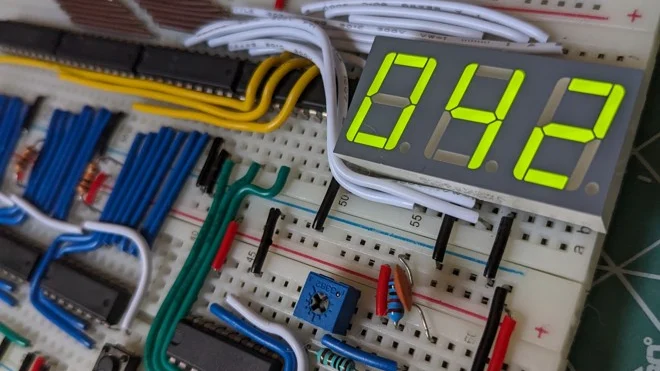
The challenges of this approach are immediately apparent. The physical footprint on a breadboard is substantial, demanding considerable space for the ICs, resistors, the display itself, and the veritable spaghetti of jumper wires connecting everything. Troubleshooting can be a time-consuming affair, as a single misplaced wire or faulty connection can render the entire circuit non-functional. Moreover, the power consumption, while modest by today’s standards for simple logic, is higher than more integrated solutions. Yet, the educational value is immense: working with this design forces an understanding of signal paths, current flow, logic levels, and the tangible interaction between individual components. It provides a direct, unadulterated view of how digital counting and display logic are physically realized.
The Breadboard Landscape: A Web of Connections
The visual impact of this first design is striking. Spread across a large breadboard, a dense array of integrated circuits, individual resistors, and a complex lattice of jumper wires create a tangible representation of digital logic. Each connection, from the clock input of a counter to the segment line of a display, is visible and traceable. This "hardware-centric" approach means that any modification to the circuit’s behavior — for instance, changing the counting sequence or the display pattern — would necessitate a physical alteration of the wiring or the replacement of specific ICs. It’s a design philosophy deeply rooted in the days when custom logic was built from standard building blocks, where the engineer’s skill was as much in logical design as it was in efficient and reliable physical implementation.
This stark contrast to modern, compact devices underscores Krisztián’s core message: the complexity doesn’t disappear; it simply moves. In this initial design, the complexity is overtly visible, a testament to the effort required to achieve even a seemingly simple function with foundational electronic components.
Design 2: Bridging Hardware and Firmware – The EEPROM as a Logic Gateway
The second iteration of Nagy Krisztián’s counter project represents a significant step towards greater integration and a clever bridge between dedicated hardware logic and programmable firmware. This design introduces an Electrically Erasable Programmable Read-Only Memory (EEPROM) chip, specifically an AT28C64B, to streamline a crucial aspect of the digital counter: driving the 7-segment display.
The AT28C64B: A Custom Truth Table on a Chip
The AT28C64B is an 8K x 8-bit EEPROM, meaning it can store 8,192 bytes of data. In Krisztián’s application, this EEPROM acts as a custom lookup table or a "hardware truth table." Instead of relying on the internal decoding logic of a CD4026B or discrete logic gates to translate a binary count into 7-segment display patterns, the EEPROM is pre-programmed with these patterns.
Here’s how it works: the binary output of a counter (which could still be implemented with a simpler counter IC like a 74LS90 or a basic ripple counter built from flip-flops) is fed into the address lines of the EEPROM. For example, if the counter outputs ‘0000’ (binary for 0), this address points to a specific memory location in the EEPROM. Stored at that location is the 8-bit pattern required to illuminate the segments for the digit ‘0’ on the 7-segment display. Similarly, ‘0001’ would point to the pattern for ‘1’, and so on, up to ‘1001’ for ‘9’. The 8 data output lines of the EEPROM are then connected directly (via current-limiting resistors) to the 7 segments (plus a decimal point, if desired) of the display.
The advantages of this approach are multi-fold. Firstly, it significantly reduces the wiring complexity associated with display driving compared to the fully discrete approach. Instead of individual logic gates or a dedicated display driver IC for each digit, a single EEPROM chip can handle the decoding for all digits, provided the counter logic is appropriately multiplexed or separate EEPROMs are used per digit. Secondly, it offers immense flexibility. If one wished to display custom characters, hexadecimal digits (A-F), or even entirely different symbols, only the EEPROM’s contents would need to be reprogrammed; the hardware wiring for the display would remain largely unchanged. This ability to easily alter functionality through software (or firmware, in this case) marks a crucial evolutionary step in digital design.
The Evolution of Display Driving
The use of an EEPROM for display decoding represents a transitional phase in digital electronics. It marries the fixed, reliable nature of hardware with the flexibility of programmable memory. Historically, this role was often filled by Read-Only Memory (ROM) or Programmable Read-Only Memory (PROM) chips, which, once programmed, could not be easily altered. The advent of EEPROMs, which can be erased and reprogrammed electrically, provided a more development-friendly platform. This design neatly illustrates how designers began to offload repetitive or customizable logic functions from dedicated gates into programmable memory, paving the way for the ultimate abstraction offered by microcontrollers.
While the EEPROM handles the display logic, the actual counting mechanism still requires separate hardware. This could be another dedicated counter IC or even discrete flip-flops, illustrating that while one aspect of complexity has been streamlined, the overall system still necessitates a combination of hardware components working in concert. The breadboard footprint is noticeably smaller than the first design, demonstrating a clear reduction in component count and physical interconnections for the display driving section.
Design 3: The Era of Abstraction – Microcontrollers and Software Dominance
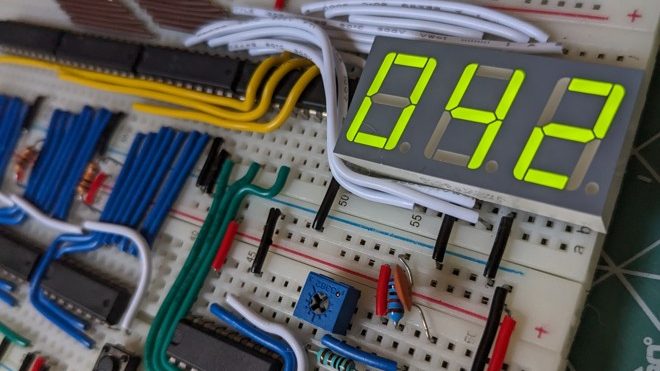
The third and most integrated iteration of Nagy Krisztián’s digital counter project embodies the pinnacle of modern embedded system design. Utilizing a compact microcontroller, the ATtiny24A, this version showcases how virtually all the logic, from counting to display driving and input processing, is consolidated into a single, highly versatile chip, with complexity largely migrating from tangible hardware to intangible software.
The ATtiny24A: All-in-One Digital Powerhouse
The ATtiny24A is a member of Microchip’s popular AVR family of microcontrollers. Despite its small size, this 8-bit microcontroller is a complete computing system on a chip, featuring a central processing unit (CPU), various types of memory (Flash for program storage, SRAM for data, EEPROM for non-volatile data), and a rich set of peripheral interfaces (digital I/O, timers, analog-to-digital converters, etc.).
In this design, the ATtiny24A handles every aspect of the counter’s operation. When the push-button is pressed, an interrupt or polling routine within the microcontroller’s firmware detects the input. The firmware then increments an internal variable representing the count. Simultaneously, the microcontroller’s software is responsible for debouncing the button press, ensuring that a single physical press registers as only one increment, a task that would require additional hardware in the previous designs.
Crucially, the ATtiny24A also manages the 7-segment LED display. Instead of relying on external decoding chips or EEPROMs, the microcontroller’s firmware contains the logic to translate the internal count variable into the correct segment patterns. These patterns are then sent out to the display segments via the microcontroller’s general-purpose input/output (GPIO) pins, often in a multiplexed fashion to save pins and further reduce component count for multi-digit displays. Current-limiting resistors are still necessary, but the control logic is entirely within the chip.
The benefits of this approach are profound. The hardware footprint is dramatically reduced, often requiring little more than the microcontroller itself, the display, a few resistors, and the push-button. This compactness makes it ideal for embedded applications where space is at a premium. Furthermore, the flexibility is unparalleled. Want to change the counting direction? Modify the firmware. Need to add a reset function, a timer, or even communicate with other devices? It’s all achievable through software updates, often without altering the physical circuit. This reconfigurability is the hallmark of microcontroller-based design.
The Hidden Complexity: Compilers, Programmers, and Firmware
While the physical component count and wiring complexity shrink dramatically with the ATtiny24A, the overall system complexity does not vanish. Instead, it undergoes a fundamental transformation, relocating from the visible world of wires and discrete chips to the invisible realm of software and its supporting infrastructure.
Developing for a microcontroller requires a new set of tools and skills. Engineers must write code (typically in C or Assembly), which then needs to be compiled into machine-executable instructions. This process requires a compiler, a sophisticated software program that translates human-readable code into the microcontroller’s native language. Once compiled, the resulting firmware must be loaded onto the ATtiny24A’s Flash memory using a specialized hardware programmer. Debugging, a critical part of development, shifts from probing physical connections with an oscilloscope to using in-circuit debuggers and software-based tracing tools to understand the program’s execution flow.
This shift means that the "complexity" now resides in:
- Software Design: Crafting efficient, bug-free algorithms for counting, debouncing, and display management.
- Development Environment: Setting up and mastering compilers, Integrated Development Environments (IDEs), and programming tools.
- System Integration: Ensuring the software correctly interacts with the microcontroller’s peripherals and external hardware.
Nagy Krisztián’s third design powerfully illustrates that modern electronics is as much about software engineering as it is about hardware design. The seemingly simple counter, when implemented with a microcontroller, becomes a testament to the layers of abstraction that define contemporary technology, where the elegance of a minimal hardware design belies the intricate software running beneath.
The Enduring Lessons: Complexity’s Transmutation, Not Disappearance
The "Great Count-Up" project by Nagy Krisztián offers a compelling narrative on the evolution of digital electronics. His three distinct counter designs serve as a powerful pedagogical tool, illustrating a fundamental truth: complexity in electronic systems does not simply disappear with technological advancement; rather, it transmutes. What was once overtly visible in a sprawling network of discrete components and wires in the first design, gradually recedes into the intricate programming of an EEPROM in the second, and finally becomes almost entirely encapsulated within the software and firmware of a tiny microcontroller in the third.
This journey from the tangible to the abstract is a defining characteristic of modern engineering. For aspiring engineers and hobbyists, Krisztián’s project is an invaluable reminder that understanding the foundational principles of digital logic remains crucial, even when working with highly integrated solutions. It fosters an appreciation for the "black boxes" we often take for granted, encouraging a deeper inquiry into their inner workings. Without this foundational knowledge, the elegant simplicity of a microcontroller-based solution might be perceived as magic, rather than the result of decades of cumulative engineering innovation.
The project highlights how much the "average hardware hacker has it good today." The availability of low-cost, powerful microcontrollers and integrated modules has democratized electronics, making complex projects accessible to a wider audience. However, this accessibility often comes at the cost of understanding the underlying complexity. Krisztián’s work bridges this gap, providing a much-needed historical and functional context.
A Master of Digital Ingenuity: Nagy Krisztián’s Track Record
Nagy Krisztián’s "Great Count-Up" project is not an isolated endeavor but rather a continuation of his consistent efforts to demystify and explore the intricacies of hardware. His previous work has also demonstrated a profound understanding of legacy systems and a knack for innovative problem-solving.
Earlier this year, in a project widely reported on Hackaday on March 1, 2026, Krisztián captivated the retro-computing community by "fooling a 286 processor into thinking it was plugged into a functioning vintage motherboard." This ambitious undertaking involved meticulously reverse-engineering the bus interface of an Intel 80286 CPU and constructing a custom circuit that emulated the necessary signals and responses from a motherboard. His custom hardware provided the 286 processor with the clock signals, memory access, and peripheral interactions it expected, effectively bringing a bare CPU back to life outside its original context.
This prior project, much like the digital counter exploration, showcases Krisztián’s deep expertise in fundamental electronics, his patience for meticulous detail, and his passion for understanding how systems truly operate at their lowest levels. Whether it’s recreating a virtual motherboard for a vintage CPU or illustrating the evolution of digital counters, Nagy Krisztián consistently demonstrates that true mastery lies not just in using advanced tools, but in understanding the principles that govern them.
Implications for Future Hardware Hacking and Education
Nagy Krisztián’s work provides several key implications for the future of hardware hacking and electronics education. Firstly, it underscores the enduring value of foundational knowledge. While high-level programming and modular design are increasingly dominant, a solid grasp of digital logic, circuit theory, and component characteristics remains indispensable for debugging, optimization, and truly innovative design. Projects like "The Great Count-Up" should be integrated into educational curricula to provide students with a tangible understanding of these concepts.
Secondly, it encourages a holistic view of electronic systems. Engineers and hobbyists are increasingly expected to be proficient across both hardware and software domains. Krisztián’s project beautifully illustrates the interdependencies and the natural progression from one domain to the other, encouraging a broader skill set.
Finally, it reinforces the spirit of curiosity and exploration that defines the hacker community. By dissecting and rebuilding fundamental components, Krisztián inspires others to look beyond the surface, to question how things work, and to engage in the rewarding process of discovery. In a world saturated with complex, opaque technologies, projects like these are vital for maintaining a critical understanding and appreciation for the engineering marvels that power our daily lives.
Conclusion
Nagy Krisztián’s "The Great Count-Up" is more than just a series of digital counters; it is a meticulously crafted educational journey through the landscape of modern electronics. From the sprawling, wire-laden breadboard of discrete components to the compact, software-driven elegance of a microcontroller, his project vividly demonstrates how technological advancement has reshaped the very nature of complexity. It serves as a timely reminder that while integrated modules offer unparalleled convenience, the underlying engineering principles remain constant, merely shifting their manifestation. For anyone involved in electronics, from the novice hobbyist to the seasoned engineer, Krisztián’s work offers invaluable insights, fostering a renewed appreciation for the often-unseen ingenuity that makes our digital world tick.