Yserver Emerges: A Rust-Powered Challenge to the Display Server Duopoly
London, UK – [Date of Article Generation] – In the ever-evolving landscape of Linux and Unix-like operating systems, the choice of a display server has long been a binary one: the venerable X.Org Server, a stalwart of desktop computing for decades, or the modern, increasingly dominant Wayland protocol. However, a new contender has emerged from the vibrant Rust programming ecosystem, promising a fresh perspective and a potential third path for users and developers alike. Named "yserver" – a placeholder that cleverly alludes to its ambition as the successor to "X" – this MIT-licensed project, spearheaded by the developer known as [joske], aims to provide a lean, modern, and secure display server, offering a crucial alternative for those not yet ready or willing to embrace Wayland.
The announcement of yserver comes at a pivotal time. X.Org’s development has slowed to a crawl, and while various forks exist, many are fraught with the very complexities and legacy baggage that modern systems seek to shed. Wayland, despite its technical advantages and growing adoption by major desktop environments like GNOME and KDE, still faces hurdles for specific use cases and a segment of the user base. yserver, by leveraging the safety and performance guarantees of Rust and the modern graphics capabilities of Vulkan, positions itself as a clean break, a "heavily oxidized bucket of crabs" – a humorous nod to Rust’s mascot – offering a compelling vision for the future of display management.
Main Facts: A New Dawn for Display Management
yserver is a nascent display server project written entirely in Rust, a language celebrated for its memory safety, performance, and concurrency features. Released under the permissive MIT license, it represents a deliberate effort to move beyond the architectural constraints and historical baggage of the X.Org Server, while also offering an alternative to the Wayland paradigm for users who find its design principles or current implementation lacking for their specific needs.
The project’s name, "yserver," while a placeholder, carries significant symbolic weight. The developer’s rationale, "Y comes after X," subtly communicates a desire for a successor that offers a clean slate rather than mere incremental improvements or an iterative version like "X12." This nomenclature underscores its foundational design philosophy: to build a display server from the ground up, unburdened by decades of accumulated features, protocols, and compatibility layers that have rendered X.Org a sprawling and complex entity.
Currently, yserver is not a full-featured reimplementation of X.Org. This deliberate choice allows it to maintain a leaner codebase and focus on modern hardware and APIs. A key limitation in its current iteration is the lack of comprehensive multi-monitor support; it primarily operates as a single-screen display manager. While this might make it too bare-bones for some users’ immediate needs, it highlights the project’s focus on core functionality and stability before expanding its scope.
One of yserver’s defining technical characteristics is its reliance on Vulkan for rendering. This modern, low-overhead graphics API ensures optimal performance and efficiency but also dictates a requirement for relatively modern hardware. The project has undergone testing on a range of contemporary systems, demonstrating compatibility with Intel, AMD, Nvidia, and even Apple silicon, indicating a broad reach within the modern hardware ecosystem. Its primary target operating system is Linux, where it leverages the Direct Rendering Manager/Kernel Mode Setting (DRM/KMS) interfaces for direct hardware interaction. Although FreeBSD is mentioned as a secondary target, its support is less mature, a reality that long-time FreeBSD users are likely accustomed to.
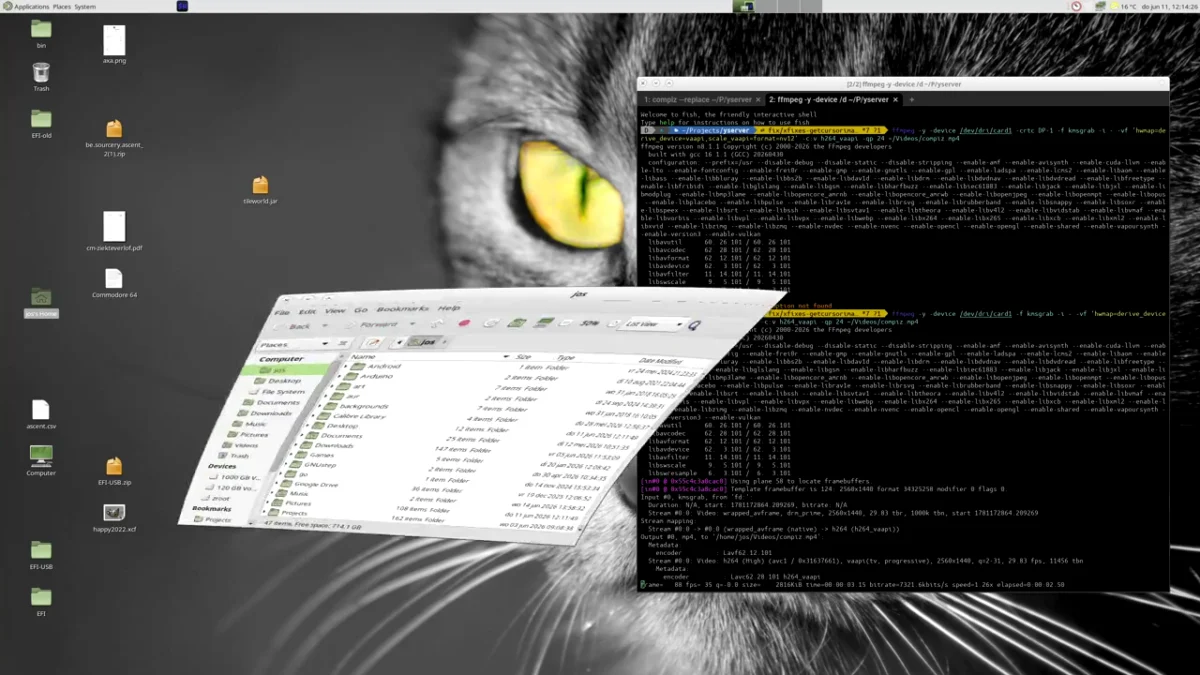
Remarkably, yserver, even in its early stages, can successfully run not only various window managers but also full-fledged desktop environments that have traditionally eschewed Wayland. Specifically, MATE, Cinnamon, and XFCE have been confirmed to run atop yserver. Furthermore, it surprisingly supports Compiz, the iconic compositing window manager known for its flashy 3D desktop effects like the spinning cube and wobbly windows, a feature that will undoubtedly appeal to users nostalgic for that era of desktop customization. yserver’s versatility is further demonstrated by its ability to operate via Xwayland or even as a nested server within an existing Xorg session, showcasing a degree of interoperability with the very systems it seeks to complement or replace.
The project’s technical robustness is hinted at by its performance in the X.Org X Test Suite (xts5), where it achieved a score of 66.2%. For a project that explicitly avoids replicating all of X.Org’s extensive and often archaic functionality, this score is remarkably strong, suggesting a solid foundation for core display server operations and a promising path forward for expanding compatibility where it matters most.
Chronology: The Winding Road to a New Display Server
The journey to yserver’s emergence is best understood within the broader historical context of display server development on Unix-like systems. For nearly four decades, the X Window System, commonly known as X11 or Xorg (referring to the most prevalent implementation), has been the undisputed standard. Conceived at MIT in the mid-1980s, X11 provided the fundamental graphical user interface (GUI) for workstations, establishing a client-server architecture where applications (clients) communicate with a display server to render graphics. This design, revolutionary for its time, allowed for networked transparency, enabling users to run applications on one machine and display them on another.
However, X11’s architecture, designed for a different era of hardware and networking, began to show its age. Its extensive feature set, built up over decades, became a source of complexity, security vulnerabilities, and maintenance overhead. Features like drawing primitives, font rendering, and keyboard/mouse input handling, once core to X11, are now often handled more efficiently by modern libraries and the kernel itself. The X.Org Server, the dominant open-source implementation, has seen its core development activity dwindle significantly in recent years, leading to concerns about its long-term viability and security patching. While forks like XFree86 (which X.Org itself forked from) and more specialized projects like Xephyr exist, they often address specific needs or carry their own historical baggage, failing to provide a truly modern, ground-up alternative. The original article’s reference to a "political lightning rod" fork likely alludes to historical disagreements and project schisms that have sometimes characterized the open-source display server landscape.
The growing dissatisfaction with X11’s complexity and limitations spurred the development of Wayland in 2008. Wayland aimed to simplify the display server stack by eliminating much of X11’s network transparency and focusing on a direct rendering model where applications render directly to a buffer shared with the compositor. This approach promised better performance, reduced latency, and enhanced security by isolating applications more effectively. Major desktop environments like GNOME and KDE have progressively adopted Wayland as their default, and many Linux distributions are following suit.
However, Wayland’s adoption has not been without its challenges. Its architectural shift means that many legacy X11 applications require an compatibility layer (Xwayland) to run, which can introduce its own issues. Furthermore, Wayland’s more rigid security model and direct rendering approach have created difficulties for certain power-user workflows, such as advanced screenshot tools, remote desktop solutions, and applications that rely on deep introspection or manipulation of other application windows. The statement that "Wayland Will Never Be Ready For Every X11 User" encapsulates a sentiment shared by a segment of the Linux community who find Wayland’s design principles incompatible with their specific needs or who rely on functionalities not yet fully replicated or adequately supported in the Wayland ecosystem.
It is against this backdrop of X.Org’s stagnation and Wayland’s incomplete universality that yserver finds its niche. While the exact date of yserver’s inception by [joske] is not specified in the original announcement, its public release marks a conscious decision to address the growing void between these two established paradigms. The project likely began as an exploration of how a display server could be built using modern programming practices and technologies (Rust, Vulkan, DRM/KMS) to overcome the perceived shortcomings of existing solutions. Its very existence implies a recognition that neither X.Org nor Wayland fully caters to all user requirements, particularly for those seeking a modern, secure, and performant alternative that offers a cleaner break from legacy systems. The project’s current feature set, focusing on single-monitor desktops and specific environments, suggests a phased approach, tackling core display functionality before addressing more complex scenarios.
Supporting Data: Technical Foundations and Market Context
yserver’s appeal lies deeply in its technical underpinnings and its strategic positioning within the broader display server market.
The Rust Advantage
At the core of yserver is the Rust programming language. Rust has rapidly gained popularity in system-level programming due to its unique combination of performance comparable to C++ and strong memory safety guarantees, achieved without a garbage collector. This is particularly crucial for a display server, which operates at a privileged level, directly interacting with hardware and managing critical system resources. Memory safety issues, such as buffer overflows or use-after-free bugs, are a common source of security vulnerabilities in C/C++ applications. Rust’s strict compile-time checks eliminate entire classes of these bugs, making yserver inherently more robust and less prone to security exploits compared to X.Org’s vast C codebase. Furthermore, Rust’s modern concurrency model allows for more efficient utilization of multi-core processors, potentially leading to a more responsive and performant display server. The phrase "heavily oxidized bucket of crabs" playfully refers to the growing trend of rewriting core system components in Rust, from Linux kernel modules to user-space utilities, a movement yserver proudly joins.
Vulkan for Modern Rendering
yserver’s choice of Vulkan as its graphics API is another defining technical characteristic. Developed by the Khronos Group, Vulkan is a low-overhead, explicit graphics and compute API that offers developers direct control over the GPU. This contrasts sharply with older APIs like OpenGL (used extensively by X.Org), which are higher-level and often involve more driver-side overhead. By using Vulkan, yserver can achieve greater performance, lower latency, and more efficient resource utilization. This decision, however, comes with a trade-off: Vulkan requires modern graphics hardware and up-to-date drivers. The project’s successful testing on Intel, AMD, Nvidia, and Apple chips confirms that it functions across the major hardware vendors supporting Vulkan, but it implicitly excludes very old or niche hardware that might still be running X.Org.
Direct Hardware Interaction with DRM/KMS
On Linux, yserver operates as a standalone DRM/KMS server. DRM (Direct Rendering Manager) is a kernel interface that allows user-space programs to manage graphics hardware. KMS (Kernel Mode Setting) is a feature within DRM that enables the kernel to directly set display modes and manage graphics output, rather than relying on the display server to do so. By utilizing DRM/KMS directly, yserver streamlines the display pipeline, eliminating layers of abstraction and potentially reducing latency and complexity. This approach is similar to how Wayland compositors interact with the hardware, showcasing a modern, efficient design choice.
Measured Compatibility: The X.Org X Test Suite (xts5) Score
The reported score of 66.2% on the X.Org X Test Suite (xts5) is a crucial piece of supporting data. This test suite is designed to validate the functionality and compliance of X servers. For a project that explicitly states it "does not plan to copy all of Xorg’s functionality," a score over two-thirds is highly impressive. It suggests that yserver has successfully implemented a substantial portion of the core X protocol required for basic graphical operations and application compatibility. The missing percentage likely corresponds to features that yserver deliberately omits (e.g., complex legacy extensions, network transparency features that are no longer considered essential for a modern, local display server) or functionalities that are still under development. This focused approach allows yserver to avoid the "huge, sprawling mess that Xorg has become," as described in the original article.
Desktop Environment and Application Support
The ability to run MATE, Cinnamon, and XFCE desktops natively on yserver is a significant achievement. These desktop environments are notable for their continued reliance on X.Org or their more cautious approach to Wayland migration compared to GNOME and KDE. This compatibility directly targets the "holdout" user base who prefer these environments and might be resistant to Wayland. The inclusion of Compiz support is particularly noteworthy, demonstrating a level of X-compatibility that extends to advanced compositing features, which often pose challenges for new display server implementations. The flexibility to run yserver via Xwayland or even nested within Xorg further enhances its utility, allowing users to experiment with it without fully committing to a new display stack.
The Ecosystem Gap: Xorg Stagnation vs. Wayland Challenges
The market context for yserver is defined by the contrasting states of Xorg and Wayland. Xorg, while still widely used, is effectively in maintenance mode. Its core development team is small, and significant new feature development is rare. This stagnation creates a vacuum for innovation and leaves open security concerns that might not be addressed promptly. On the other hand, Wayland, despite its technical merits, has faced resistance from segments of the community due to:
- Application compatibility: While Xwayland bridges many gaps, some applications behave differently or lose functionality.
- Remote desktop: Wayland’s design makes traditional remote desktop solutions more complex.
- Specific workflows: Users relying on global hotkeys, highly customized window management scripts, or certain accessibility tools sometimes encounter difficulties.
- Driver support: While improving, some older or niche GPU drivers might have better Xorg support.
yserver positions itself as a potential solution for these "holdouts," offering a modern foundation that avoids Xorg’s legacy issues while potentially being more adaptable to certain X11-like behaviors than Wayland.
Official Responses: [joske]’s Vision and Project Intent
The primary "official response" concerning yserver comes from its creator, [joske], as conveyed through the project’s documentation and the initial announcement. [joske]’s vision for yserver is clear: to create a display server that is a "clean break" from X.Org, avoiding a full reimplementation of its "huge, sprawling mess." This indicates a strategic decision to prioritize a lean, modern codebase over comprehensive backward compatibility with every arcane feature of X.Org.
The developer’s choice of the name "yserver," while a placeholder, reflects this forward-looking mindset. The simple logic of "Y comes after X" isn’t merely sequential; it signifies a new generation, an evolution rather than a mere iteration. This choice also circumvents any implications of direct continuity with X.Org, which might otherwise suggest inheriting its architectural baggage.
[joske]’s stated goals for yserver can be inferred from its current design and capabilities:
- Modernity: Leveraging Rust and Vulkan to create a display server optimized for contemporary hardware and software development practices.
- Simplicity: Avoiding the excessive complexity of X.Org by focusing on essential display server functionality.
- Performance and Security: Harnessing Rust’s safety features and Vulkan’s low-level control to deliver a robust and efficient user experience.
- Linux-first: Prioritizing the Linux kernel’s DRM/KMS interfaces for direct and efficient hardware interaction, while keeping FreeBSD as a secondary, albeit less supported, target.
- User Choice: Providing a viable alternative for users who are not satisfied with X.Org’s stagnation or Wayland’s current state of readiness for their specific needs.
Regarding the current limitations, [joske] openly acknowledges the project’s nascent stage, particularly the lack of full multi-monitor support. This transparency suggests a pragmatic development approach, focusing on solidifying core single-screen functionality before tackling more complex scenarios. The testing on various hardware platforms (Intel, AMD, Nvidia, Apple) and the positive xts5 score further reinforce [joske]’s commitment to building a functional and reliable system.
While direct "official responses" from the X.Org or Wayland communities are not available in the provided text, the mere existence and growing visibility of projects like yserver implicitly serve as a response to the ongoing discourse about the future of graphical environments. The X.Org community might view yserver as a fresh perspective or even a potential successor for certain use cases, given X.Org’s own limited development. The Wayland community might see it as another piece of evidence for the need for modern display protocols, even if yserver doesn’t strictly adhere to the Wayland protocol itself but rather offers an alternative to both. Ultimately, [joske]’s initiative with yserver underscores a broader community desire for innovation and diverse solutions in a critical component of the desktop computing experience.
Implications: Shaping the Future of the Desktop
The emergence of yserver carries significant implications for the future of the display server ecosystem, affecting users, developers, and the broader open-source community.
For the Display Server Ecosystem
yserver introduces a crucial element of competition into a landscape that has, for a long time, been dominated by two primary contenders. This "third option" can act as a catalyst for innovation.
- Increased Competition: A strong, modern alternative could spur further development in both X.Org (perhaps revitalizing interest in its maintenance or specialized forks) and Wayland (encouraging broader compatibility and feature development).
- Diversity of Architecture: yserver represents a distinct architectural approach – a lean, modern, Rust-based server directly leveraging kernel features – different from X.Org’s monolithic design and Wayland’s compositor-centric protocol. This diversity offers more choices and allows for experimentation with different paradigms.
- Validation of Rust for System Programming: Its success would further validate Rust’s capabilities for building critical system components, potentially encouraging more projects to adopt Rust for infrastructure-level software.
For Developers
For developers, yserver presents both opportunities and challenges.
- New Contribution Opportunities: The project is young, offering a fertile ground for developers interested in low-level graphics, kernel interaction, and Rust. Contributing to yserver means shaping a foundational piece of future desktop computing.
- Learning Rust: Developers accustomed to C/C++ or other languages might need to invest in learning Rust, but the benefits in terms of safety and modern tooling are significant.
- Focused Development: Its clean break from X.Org means developers can work with a less encumbered codebase, potentially leading to faster development cycles and fewer legacy compatibility headaches.
- Integration with Rust-native Stacks: The mention of potential support for the "Asterinas rust-based Linux-compatible kernel" is particularly exciting. If projects like Asterinas achieve full Linux compatibility, yserver could become part of an entirely Rust-native operating system stack, from kernel to display server to applications, promising unprecedented levels of safety and performance.
For Users
For end-users, yserver offers a compelling proposition, albeit with current limitations.
- A Viable Xorg Alternative: For the segment of users who are "X11 holdouts" – those with specific workflows, legacy applications, or preferences that Wayland doesn’t yet fully accommodate – yserver could provide a modern, secure bridge. It might offer the familiar feel of Xorg (especially with desktop environments like MATE, Cinnamon, XFCE, and even Compiz) without its inherent security and performance drawbacks.
- Enhanced Security and Stability: The use of Rust promises a display server with fewer memory-related bugs, leading to a more stable and secure desktop experience.
- Performance Potential: Vulkan and DRM/KMS integration suggest potentially higher performance and lower latency, especially on modern hardware.
- Hardware Requirements: The reliance on Vulkan means older hardware might not be supported, which could limit its immediate adoption for users with legacy systems.
- Current Limitations: The lack of full multi-monitor support is a significant hurdle for many users. Its future success will depend heavily on addressing this and other core missing features.
Future Outlook
The trajectory of yserver will largely depend on several factors:
- Community Growth and Contributions: Like any open-source project, its long-term viability hinges on attracting a vibrant community of developers and users.
- Feature Parity with Core Xorg Functionality: While a full reimplementation is not the goal, addressing key missing features like comprehensive multi-monitor support will be critical for broader adoption.
- Desktop Environment Support: Continued collaboration with MATE, Cinnamon, XFCE, and potentially other desktop environments will ensure its relevance to a wider user base.
- Performance and Stability Benchmarks: As it matures, rigorous testing and benchmarking against X.Org and Wayland will be essential to prove its claims of superior performance and stability.
- Ecosystem Integration: Its ability to integrate seamlessly with other system components, including input devices, window managers, and graphical toolkits, will define its usability.
In conclusion, yserver is more than just another display server; it represents a philosophical stance on how modern graphical environments should be built. By embracing Rust and Vulkan, and by deliberately shedding the weight of X.Org’s past, [joske] has opened a new front in the ongoing evolution of the Linux desktop. While it’s still in its early days and faces significant challenges, yserver offers a compelling vision for a secure, performant, and flexible display server, potentially filling a crucial gap for the "X11 holdouts" and shaping the future of open-source desktop computing for years to come.