Enhancing Resiliency: AWS Unveils Multi-Region Replication and Enhanced Encryption for Amazon Cognito
In an era where digital continuity is synonymous with business viability, the ability to withstand regional service disruptions has transitioned from a "best practice" to a mandatory operational requirement. As modern architectures increasingly rely on agentic AI, complex microservices, and automated machine-to-machine (M2M) authentication, the fragility of centralized identity management has become a focal point for engineering teams. Addressing these critical pain points, Amazon Web Services (AWS) has officially announced two pivotal updates to Amazon Cognito: native multi-Region replication and support for customer managed keys (CMKs).
These enhancements represent a significant shift in how developers handle identity at scale, effectively offloading the burden of manual data synchronization and providing granular control over data encryption—a move likely to be welcomed by organizations in highly regulated sectors such as finance and healthcare.
The Core Challenge: The Cost of Manual Resiliency
For years, maintaining high availability for user authentication required Herculean efforts from engineering departments. To achieve regional redundancy, developers were forced to architect bespoke replication pipelines, manually exporting and importing user data between AWS Regions. This approach was not only labor-intensive but fraught with systemic risks.
The Risks of Traditional Workarounds
Manual synchronization often resulted in data fragmentation. If a primary region experienced an outage, shifting to a secondary region frequently forced end-users to undergo disruptive password resets or re-authentication flows. Furthermore, from an M2M perspective, teams had to provision new app clients in secondary regions, update OAuth-protected resources to recognize new token issuers, and reconfigure entire CI/CD pipelines. These manual interventions introduced significant "time-to-recovery" delays and increased the potential for security vulnerabilities arising from inconsistent data states.

By integrating multi-Region replication directly into the Cognito service, AWS is effectively commoditizing what was previously a high-cost, high-maintenance architectural pattern.
How It Works: A Chronology of Implementation
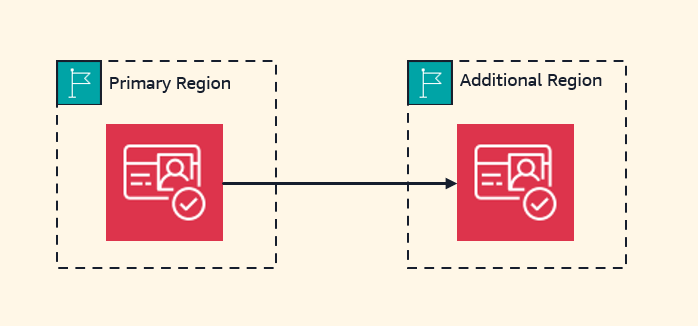
The new replication feature allows for a one-way, automated synchronization from a primary AWS Region to a designated secondary Region. This process encompasses user profiles, credentials, and complex pool configurations. The secondary region is designed to operate in a "hot-standby" read-only mode, ensuring that authentication capabilities remain live without the risk of conflicting writes.

Step-by-Step Configuration
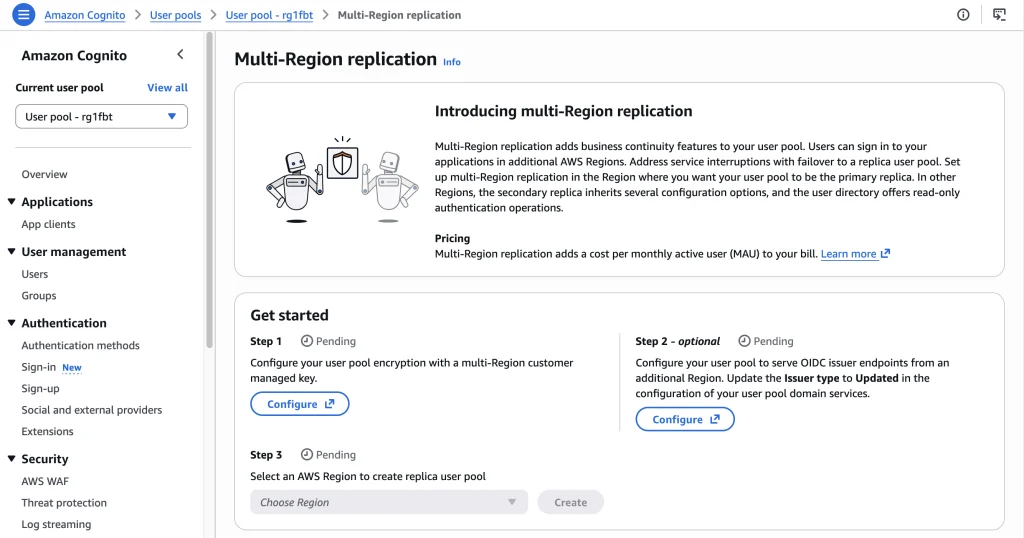
The implementation process has been streamlined into a three-phased workflow accessible via the AWS Management Console:
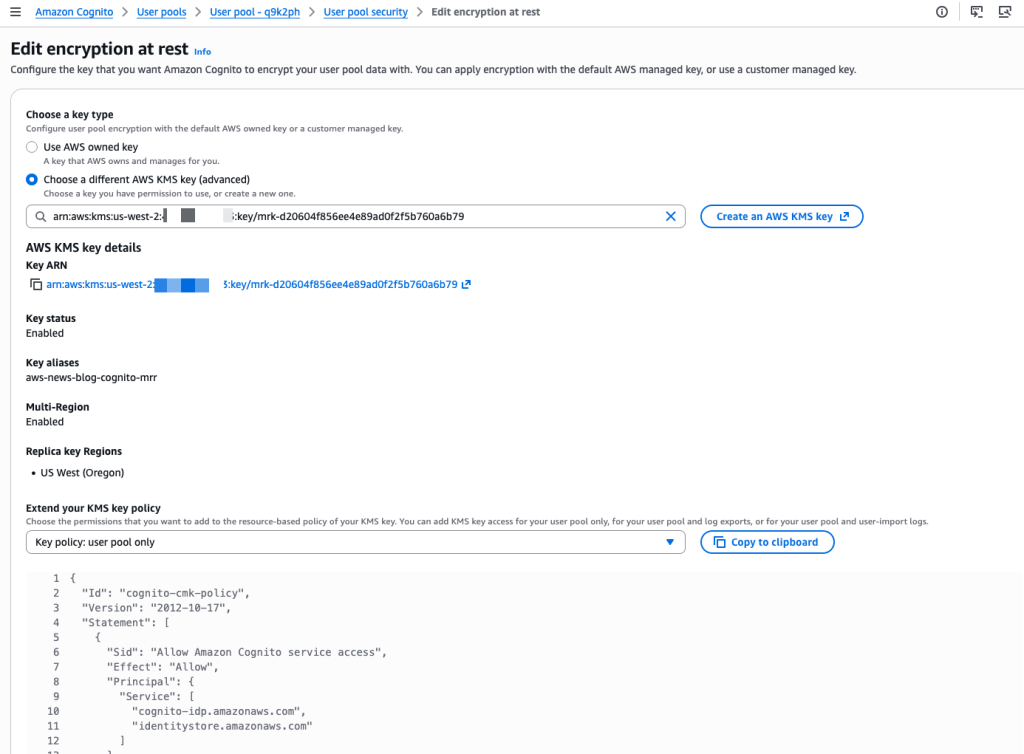
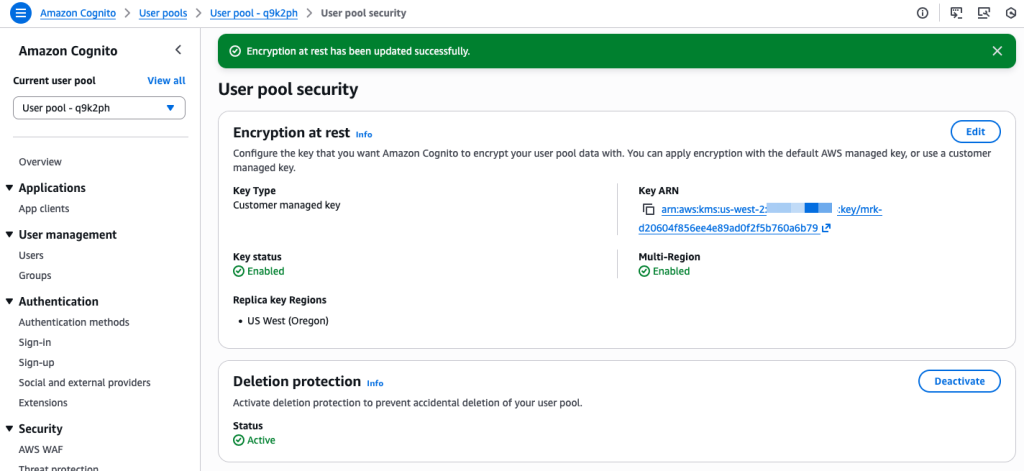
- Encryption Foundation: Before replication can commence, users must configure a multi-Region customer managed key (CMK) via AWS Key Management Service (KMS). This ensures that data at rest is encrypted with a key that the user controls, providing a consistent security posture across both regions.
- OIDC Issuer Alignment: Developers must configure the OIDC issuer type. This step is critical; it involves updating client applications to recognize the new regional endpoints. While this requires a redeployment of server-side applications and potentially updated mobile builds, it eliminates the need for future manual intervention during a failover event.
- Initiating Replication: Once the CMK is active and the issuer endpoints are configured, the console enables the selection of a target region. The service then orchestrates the data migration. Upon completion, the secondary user pool is set to "Active," ready to serve traffic.
Managing Failover and Health Checks
AWS emphasizes that while authentication remains uninterrupted, administrative actions—such as registering new users or modifying profile attributes—are restricted to the primary region. Monitoring remains a user-managed responsibility. Engineering teams are advised to implement health checks that monitor latency and error rates. When the primary region fails to meet these health criteria, traffic is redirected via DNS updates (e.g., through Route 53).
Supporting Data: Security and Scalability
The inclusion of customer managed keys is a direct response to the compliance requirements of enterprise-level clients. By allowing the use of AWS KMS, Cognito now empowers organizations to adhere to strict encryption standards, including the ability to audit key usage and rotate keys on their own schedules.
Operational Scope and Availability
The multi-Region replication feature is available across a vast footprint of global AWS Regions, including:
- North America: US East (Ohio, N. Virginia), US West (N. California, Oregon), Canada (Central).
- Asia-Pacific: Mumbai, Seoul, Singapore, Sydney, Tokyo.
- Europe: Frankfurt, Ireland, London, Paris, Stockholm.
- South America: São Paulo.
Support for customer managed keys is even more expansive, covering over 30 regions, including Africa (Cape Town), Israel (Tel Aviv), and AWS GovCloud, catering to the needs of the public sector and international conglomerates.
Financial Implications
The pricing model for these features is structured to align with usage, ensuring that high-availability architectures remain cost-effective.

- User Authentication: For Essentials and Plus tier customers, the add-on costs $0.0045 and $0.006 per monthly active user (MAU) per replica region, respectively.
- M2M Authentication: A 30% surcharge is applied to the standard volume-based pricing for successful tokens issued.
This "pay-as-you-grow" model ensures that organizations only incur additional costs for the regions where they actively maintain standby capacity, rather than paying for idle, static infrastructure.
Implications for Modern Software Architecture
The introduction of these features marks a fundamental shift in the responsibilities of a developer advocate or a cloud architect. By moving the complexity of replication into the platform layer, AWS is lowering the barrier to entry for building "globally resilient" applications.

Reducing Operational Overhead
The primary implication is the dramatic reduction in "undifferentiated heavy lifting." Previously, maintaining a secondary region required a dedicated team to write, test, and maintain scripts for data synchronization. Now, that time can be reallocated toward product innovation.
Enhancing Security for Regulated Industries
The ability to use CMKs within Cognito is a game-changer for financial services and healthcare organizations. These sectors often struggle to adopt cloud identity providers because they cannot meet the "bring your own key" (BYOK) requirements imposed by auditors. With this update, Cognito becomes a viable candidate for these high-security environments, as it allows for centralized encryption control that satisfies the most stringent compliance audits.

The "Agentic" Future
As the industry moves toward agentic AI—where autonomous systems perform actions on behalf of users—the stability of machine-to-machine authentication is paramount. If a system’s ability to verify its own identity across regions fluctuates, the entire chain of AI-driven automation collapses. By ensuring that authentication tokens are recognized across regional boundaries, AWS is providing the foundational trust layer necessary for the next generation of automated, distributed services.
Conclusion
The updates to Amazon Cognito demonstrate a maturing understanding of the challenges inherent in large-scale cloud-native applications. By automating the replication of user pools and empowering customers with granular encryption controls, AWS has significantly bolstered the resilience and security of its identity stack.

For developers, the call to action is clear: review existing disaster recovery plans. While the console makes the setup process intuitive, the success of a multi-region strategy still hinges on a well-designed failover strategy and the diligent configuration of auxiliary resources like Lambda triggers, SMS notifications, and WAF rules. In a digital landscape where downtime is no longer an option, these tools provide the necessary infrastructure to keep users—and machines—authenticated, connected, and secure.