Unlocking Latent Power: A Groundbreaking Graphics Mod for the Nintendo Entertainment System
FOR IMMEDIATE RELEASE
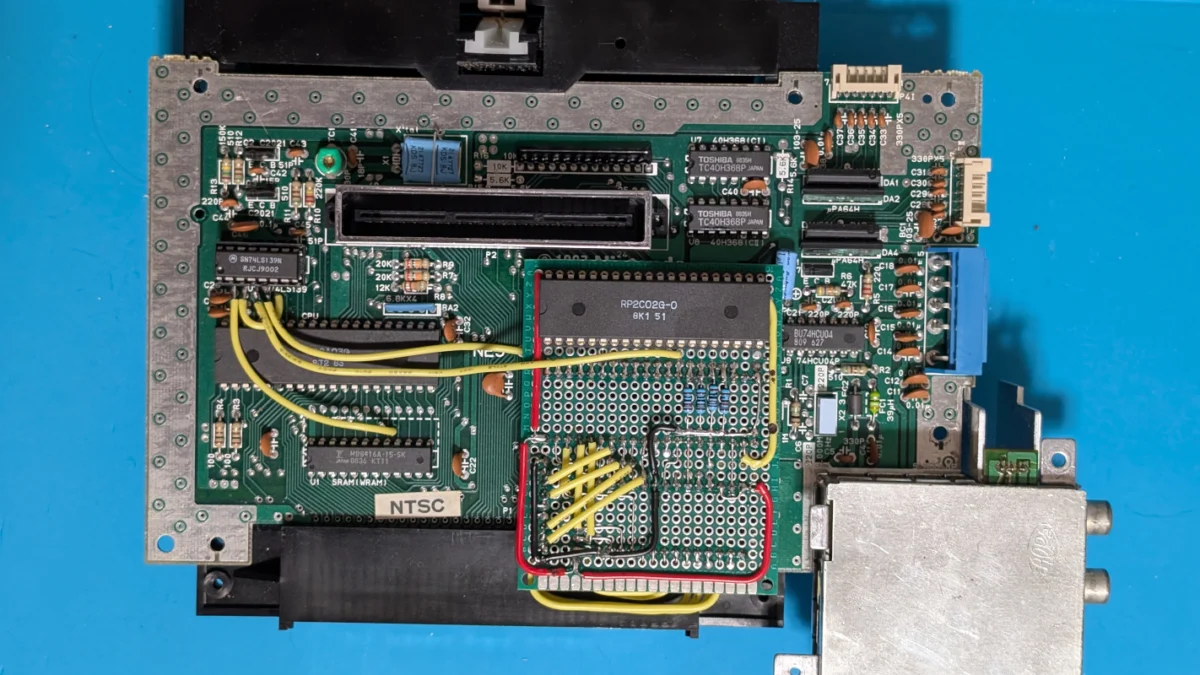
A revolutionary hardware modification for the original Nintendo Entertainment System (NES) has emerged, promising to dramatically enhance the console’s graphical capabilities by ingeniously repurposing previously grounded pins on its Picture Processing Unit (PPU). This innovative technique, spearheaded by a developer known as [decrazyo], leverages a second PPU to introduce advanced visual effects such as dynamic parallax scrolling, increased sprite counts, and an expanded color palette, fundamentally altering the visual potential of the 8-bit console.
In an era where modern gaming consoles are sealed units, designed with little to no user-expandability, the golden age of 8-bit and 16-bit systems frequently featured expansion ports. These were built-in mechanisms to extend a console’s lifespan and capabilities as hardware technology rapidly evolved. Iconic examples include the Nintendo 64’s memory port, which could house the Expansion Pak, or Sega’s ambitious add-ons for the Genesis, like the Sega CD and 32X. Yet, many consoles also harbored unused ports or latent architectural features that never saw official implementation. The port under the Super Nintendo, for instance, remained largely dormant. Now, a recent discovery by [decrazyo] has revealed an "interesting way" to unlock the dormant graphical potential within the venerable Nintendo Entertainment System, transforming what was once a limitation into an avenue for unparalleled visual enrichment.
The core of this audacious upgrade lies in exploiting a hitherto overlooked aspect of the NES’s Picture Processing Unit (PPU). The PPU, the dedicated chip responsible for rendering all graphics on the NES, possesses four specific pins that are factory-grounded. Historically, these pins dictated that if a pixel was transparent, the NES would simply display the background color. This design choice inherently limited the complexity and dynamism of background imagery. However, [decrazyo]’s breakthrough demonstrates that these pins are not immutably tethered to ground. By meticulously wiring a second PPU, configured to output additional graphics information, to these four critical pins on the primary PPU, the NES gains a suite of previously unimaginable capabilities. This includes the ability to generate sophisticated parallax effects for backgrounds, render a significantly higher number of sprites simultaneously, and display a richer, more diverse spectrum of colors within its background layers. This development heralds a new dawn for homebrew developers and retro gaming enthusiasts, offering a fresh canvas for creativity on a console once thought to have exhausted its potential.
The Core Revelation: Repurposing Grounded Pins
The essence of [decrazyo]’s modification revolves around a profound understanding of the NES PPU’s internal workings. The PPU, a custom Ricoh 2C02 chip, is the heart of the NES’s graphical output. It handles everything from fetching tile data and sprite attributes to generating the final video signal. Its design, while ingenious for its time, imposed strict limitations on resolution, color palette (54 colors available, 25 simultaneous on-screen), and sprite count (64 sprites, 8 per scanline). The four grounded pins, traditionally responsible for dictating background color display for transparent pixels, were a fundamental part of this architecture. [decrazyo]’s insight was that these pins, rather than being passive ground connections, could be re-routed to receive data from an external source – specifically, a second PPU.
This revelation isn’t merely about adding more hardware; it’s about fundamentally altering the data pathways and interpretation within the existing system. By feeding new graphic information into these specific pins, the primary PPU is effectively "tricked" into displaying additional layers of visual data, processed by the secondary PPU. This method avoids direct manipulation of the PPU’s core functions in a way that might introduce instability, instead, it cleverly augments its input, expanding its perceived capabilities without altering its fundamental operation. The result is a seamless integration of advanced graphical features that were previously beyond the NES’s reach, opening doors for effects commonly associated with 16-bit consoles.
A Nod to the Past: Console Expansion Ports
The concept of expanding a console’s capabilities through add-ons or hidden ports is deeply rooted in the history of video game hardware. In the rapidly evolving technological landscape of the 1980s and 90s, manufacturers sought ways to future-proof their systems or introduce new features without necessitating entirely new console purchases.
The Sega Genesis, for example, was a prime candidate for expansion, leading to the Sega CD and Sega 32X. The Sega CD added CD-ROM capabilities, enabling full-motion video and higher-quality audio, while the 32X was designed to bridge the gap to the 32-bit era, providing additional processors and graphical power. These, however, were external, bulky, and often expensive additions that required separate power supplies and complex setups.
Nintendo also explored expansion. The Nintendo 64’s Expansion Pak, which plugged into a front-facing port, doubled the console’s RAM from 4MB to 8MB. This enabled higher resolutions, richer textures, and more complex game worlds in titles like Majora’s Mask and Perfect Dark. Similarly, the Famicom Disk System in Japan added a disk drive for cheaper, larger games, and battery backup.
However, some ports remained unutilized or became the subject of speculation. The Super Nintendo Entertainment System (SNES), for instance, has a mysterious port on its underside, often speculated to be for a CD-ROM add-on (the ill-fated "Nintendo Play Station" project with Sony) or a network modem. While no official product ever materialized, the presence of such a port underscores the design philosophy of the era: prepare for future advancements. [decrazyo]’s discovery for the NES, while not utilizing an official expansion port, taps into a similar spirit of uncovering latent potential, but from within the console’s core architecture itself. It transforms a grounded electrical connection into a conduit for graphical innovation, a testament to the enduring ingenuity of hardware hackers and reverse engineers.
A Journey Through Technological Evolution: The NES PPU Enhancement
The journey from the NES’s initial design to this sophisticated PPU modification is a fascinating narrative, intertwining the original technological constraints with decades of community-driven innovation. Understanding the NES’s inherent limitations is crucial to appreciating the magnitude of [decrazyo]’s achievement.
The NES’s Original Canvas: PPU Limitations and Design Philosophy
When Nintendo released the Famicom (NES) in 1983, its hardware was cutting-edge for a home console. The Ricoh 2C02 PPU was designed to render 256×240 pixels at a 60Hz refresh rate (NTSC). Its capabilities, however, were constrained by the technology and cost considerations of the time.
Key limitations included:
- Color Palette: While the PPU could access 54 distinct colors, only 25 (including a universal transparent color) could be displayed simultaneously. Furthermore, backgrounds were typically limited to four colors per 16×16 pixel "attribute block," severely restricting color diversity.
- Sprite Limits: The NES could display a maximum of 64 sprites on screen, but critically, only 8 sprites could be rendered per horizontal scanline. Exceeding this limit resulted in "sprite flicker," where sprites would rapidly appear and disappear as the PPU cycled through them.
- Lack of Parallax Scrolling: Parallax scrolling, a technique that creates an illusion of depth by moving background layers at different speeds, was not natively supported by the NES hardware. Backgrounds typically scrolled as a single, monolithic layer. Games often faked parallax using sprite-based tricks or clever tile manipulation, but true hardware-driven multi-layered parallax was absent.
- Memory Constraints: The limited amount of VRAM (Video RAM) directly influenced the complexity of backgrounds and sprite sheets that could be loaded simultaneously.
These limitations forced developers to be incredibly creative, leading to the development of numerous programming tricks and mapper chips (memory controllers) that extended the console’s capabilities, such as allowing for larger ROMs or bank switching. Yet, fundamental PPU functions like color output and sprite rendering remained largely fixed.
A History of Pushing Boundaries: Homebrew and Hardware Hacks
The retro gaming community has a rich history of pushing the boundaries of classic hardware. From the earliest days of emulation and ROM hacking to sophisticated hardware modifications, enthusiasts have consistently sought to uncover hidden potential or bypass original limitations.
- Mapper Chips: Long before modern hardware mods, game developers themselves extended the NES’s capabilities through custom mapper chips integrated into game cartridges. These chips could add features like battery-backed save RAM, more sophisticated bank switching for larger ROMs, or even extra sound channels. Some, like the MMC5, added rudimentary enhancements to background rendering, such as allowing more varied color palettes in certain areas.
- RGB Mods: A popular hardware mod involves extracting an RGB video signal from the NES PPU, offering a significantly cleaner and sharper image than the composite video output. This requires intricate soldering and custom circuitry but is widely embraced by retro enthusiasts for visual fidelity.
- Overclocking: Some modders experiment with increasing the clock speed of the NES CPU or PPU, though this often introduces instability and compatibility issues.
- Sound Expansion: External sound chips, sometimes built into cartridges, provided additional audio channels, expanding the NES’s already iconic soundscape.
These efforts demonstrate a persistent drive within the community to understand, improve, and innovate upon the foundations laid by original hardware engineers. [decrazyo]’s PPU mod is a direct continuation of this spirit, but it stands out due to its direct manipulation and enhancement of the core graphical output engine in a novel way.
[decrazyo]’s Breakthrough: From Concept to Demonstration
While the exact chronology of [decrazyo]’s development process isn’t fully detailed in public accounts, the nature of the discovery suggests a deep dive into the NES’s PPU schematics and a meticulous process of experimentation. The identification of the four grounded pins as potential data conduits would have required not just knowledge of the PPU’s pinout but also an understanding of how its internal logic processes input signals.
The theoretical concept would have been followed by practical implementation:
- Sourcing Components: Acquiring a second PPU (likely from a donor NES or a reproduction board) and the necessary support circuitry (memory chips for the second PPU).
- Circuit Design: Designing a circuit to interface the second PPU with the first, ensuring proper power, clocking, and data synchronization. This would involve careful routing of signals to the four critical pins.
- Software Development: Crucially, simply connecting the hardware isn’t enough. Custom software (firmware for the secondary PPU and modifications to NES game code) would be required to utilize these new graphical capabilities. This would involve developing routines to offload rendering tasks or generate specific data streams for the secondary PPU.
- Prototyping and Testing: Iterative testing with various graphical effects (parallax, sprites, colors) to validate the concept and refine the implementation, ensuring stability and compatibility.
The demonstration video, "I Unlocked Unused NES Features," serves as the public culmination of this extensive research and development. It showcases the mod’s capabilities in real-time, providing tangible proof of concept and igniting excitement within the retro gaming community. This transition from a highly technical, abstract idea to a visually compelling demonstration is what truly elevates [decrazyo]’s work from a mere hack to a significant contribution to retro hardware innovation.
Deeper Dive into the Architecture: How the Dual-PPU System Functions
To fully grasp the ingenuity of [decrazyo]’s PPU enhancement, it’s essential to delve into the technical specifics of the NES’s Picture Processing Unit and how the integration of a second PPU fundamentally alters its operational paradigm. This isn’t just an addition of processing power; it’s a sophisticated re-routing and re-interpretation of existing signals.
The Anatomy of the PPU: Understanding the Four Grounded Pins
The Ricoh 2C02 PPU, a marvel of 8-bit engineering, orchestrates the entire visual output of the NES. It contains internal logic for reading tile data, color palettes, and sprite attributes from VRAM, assembling them into the final video signal. The chip has numerous pins for power, clock, data buses, address buses, and control signals. Among these are the four specific pins identified by [decrazyo] that are typically grounded.
In the original NES design, these grounded pins essentially served as passive indicators. When a pixel was being rendered as "transparent" (meaning no sprite or foreground tile was occupying that space), the PPU’s internal logic would consult these pins. Being grounded, they would signal the PPU to simply display the background color defined in the palette. This was a straightforward and efficient way to handle blank spaces, ensuring a consistent backdrop.
[decrazyo]’s critical insight was to realize that "grounded" does not necessarily mean "permanently inactive" or "unusable for input." Instead, these pins could be re-envisioned as potential input lines. If these pins could receive varying voltage levels or data signals instead of a constant ground, the PPU’s internal logic might interpret these signals in a way that allows for additional graphical information to be displayed. This effectively transforms a "dead end" in the PPU’s signal flow into a new pathway for data.
Orchestrating Two PPUs: Data Flow and Synchronization
The dual-PPU system is not merely about plugging in another PPU. It requires a carefully orchestrated dance between the two chips, managed by custom control logic and software.
- Primary PPU (Master): This remains the main PPU, responsible for generating the final video signal sent to the TV. It still handles the primary background layer, sprites, and overall video timing.
- Secondary PPU (Slave/Auxiliary): This PPU is configured to act as a graphics information generator. It would have its own dedicated VRAM (likely requiring a separate memory chip, as noted in the original article) and would process its own set of graphical data, independent of the primary PPU.
- Interconnection: The key is how the secondary PPU’s output is routed to the four previously grounded pins of the primary PPU. This connection is not a simple data bus. Instead, the secondary PPU likely generates specific control signals or pixel data that the primary PPU interprets as additional color or transparency information. This could involve the secondary PPU outputting a specific palette index or even a binary code that the primary PPU uses to modify its rendering of transparent pixels.
- Synchronization: Critical to the success of this mod is the precise synchronization between the two PPUs. Both PPUs must operate in lockstep, receiving their clock signals and frame synchronization from the NES’s main CPU or a dedicated timing circuit. Any desynchronization would lead to visual artifacts or a corrupted image. Custom firmware or a small microcontroller might be necessary to manage this synchronization and the data flow, translating the secondary PPU’s output into a format digestible by the primary PPU’s "new" input pins.
- Software Control: The NES’s CPU (or a custom mapper chip in a game cartridge) would need to be programmed to manage both PPUs. This involves writing data to the secondary PPU’s VRAM, configuring its registers, and coordinating its rendering process with the primary PPU. This implies that new homebrew games or modified existing games would be necessary to fully leverage the mod’s capabilities.
This intricate setup allows the primary PPU to effectively layer additional graphical information onto its existing output, particularly in areas that would have previously displayed only a static background color.
Visual Transformations: Parallax, Sprites, and Expanded Color Palettes
The practical benefits of this dual-PPU architecture are profound, addressing some of the NES’s most significant graphical limitations:
- Dynamic Parallax Effects: By using the secondary PPU to render additional background layers, moving independently from the primary background, the mod can create genuine multi-layered parallax scrolling. This adds a sense of depth and immersion previously unattainable, making games feel more dynamic and visually rich, akin to 16-bit titles. Imagine a game where clouds drift slowly in the background, while mountains move at a medium pace, and the foreground scrolls rapidly – all rendered seamlessly.
- Increased Sprite Counts: While the primary PPU still has its 8-sprites-per-scanline limit, the secondary PPU can be used to render additional "sprite-like" objects or portions of sprites. These could be interpreted by the primary PPU as part of the background, effectively bypassing the sprite limit and reducing flicker. This allows for more on-screen enemies, projectiles, or detailed characters without visual degradation. The demonstration video shows the ability to render "more sprites," indicating this clever workaround.
- Expanded Background Color Palettes: The most visually striking improvement is the ability to display "more colors in the backgrounds." By feeding additional color data through the four pins, the primary PPU can effectively expand its palette per attribute block or even per pixel in specific areas. This can lead to richer, more vibrant, and more detailed background art, moving beyond the traditional four-color limitations and offering a broader spectrum of shades and hues. This could transform the visual aesthetics of a game, making it look less "8-bit" in its background complexity.
The Craft of Modification: Hardware Requirements and Challenges
Implementing this mod is no trivial task. It requires significant technical expertise, precision soldering, and access to specific components.
- Donor NES for PPU: The primary hardware requirement is a second PPU. These chips are not readily available new, necessitating the acquisition of a "donor NES" console. This raises ethical considerations for retro gaming preservationists, as it involves disassembling a working or salvageable vintage console.
- Memory Chip: The secondary PPU will require its own dedicated Video RAM (VRAM) chip, as it needs a separate buffer for its graphical data.
- Support Circuitry: Additional components like resistors, capacitors, logic gates, and potentially a small microcontroller would be needed to manage the power, clock, and data flow between the two PPUs and the rest of the NES hardware.
- Soldering and Wiring: The modification involves intricate soldering, likely to very small pins on the PPU chip, and careful routing of numerous wires. This is a task for experienced modders with specialized tools.
- Custom Software: As mentioned, new software, either entirely new homebrew games or patched versions of existing titles, would be necessary to take advantage of the expanded capabilities. This requires assembly language programming for the NES CPU and a deep understanding of PPU registers.
The Role of Open-Source Alternatives in Preservation and Innovation
Recognizing the challenges and ethical implications of cannibalizing original hardware, the article wisely suggests an alternative: "Presumably, you could use this open-source NES hardware alternative instead." This refers to projects like the "open-source NES motherboard" which are entirely new, modern reproductions of the NES hardware.
These open-source alternatives offer several advantages:
- Ethical Sourcing: They provide new, readily available components, eliminating the need to sacrifice original consoles.
- Modern Manufacturing: They can incorporate modern manufacturing techniques, potentially leading to more reliable or feature-rich boards.
- Experimentation Platform: They serve as ideal platforms for hardware experimentation and development, as users are not risking valuable vintage hardware.
- Educational Value: They allow enthusiasts to build and understand the NES from the ground up, fostering a deeper appreciation for its engineering.
By leveraging such alternatives, modders can pursue innovations like [decrazyo]’s PPU enhancement without contributing to the depletion of the dwindling supply of original, functional NES consoles. This approach aligns with the dual goals of technological advancement and historical preservation within the retro computing community.
Community Resonance and Future Prospects: Reactions and Implications
The unveiling of [decrazyo]’s NES PPU mod has sent ripples of excitement and inspiration throughout the retro gaming and homebrew development communities. It’s a testament to the enduring fascination with classic hardware and the boundless creativity of its enthusiasts.
The Retro Gaming Community’s Acclaim: A New Frontier for Homebrew
The immediate reaction from retro gaming forums, social media, and dedicated hardware hacking communities has been overwhelmingly positive. The mod is seen as a significant breakthrough, offering a tangible path to enhancing the visual fidelity of an iconic console.
- Inspiration for Homebrew Developers: For developers creating new games for the NES, this mod represents a new frontier. It liberates them from some of the most restrictive graphical limitations, allowing for more ambitious visual designs, more complex animations, and richer environments. Imagine new NES games with fluid parallax scrolling, detailed bosses with more "sprite" parts, and vibrant, multi-tonal backgrounds – effects previously relegated to the realm of 16-bit consoles. This could spark a new wave of highly advanced homebrew titles.
- Renewed Interest in Classic Games: While the mod primarily benefits new homebrew, there’s also the tantalizing possibility of patching existing classic NES titles to take advantage of these new capabilities. While a full graphical overhaul of every game is unlikely due to the extensive programming required, select titles could potentially receive "enhanced editions" with subtle parallax or expanded background colors, offering a fresh perspective on beloved classics.
- Validation of Reverse Engineering: The mod underscores the value and impact of reverse engineering and hardware hacking. It demonstrates that even decades after a console’s release, there are still undiscovered potentials waiting to be unearthed by dedicated enthusiasts. This encourages further exploration and deeper understanding of classic systems.
- Educational Value: The detailed technical explanation and the eventual open-sourcing of the mod’s principles (implied by the Hackaday link) will serve as an invaluable educational resource for aspiring hardware hackers and retro developers, providing a practical case study in low-level hardware manipulation.
Ethical Considerations and the Preservation Debate
The discussion surrounding such a significant hardware mod inevitably brings forth ethical considerations, particularly regarding the preservation of original retro consoles.
- Donor Consoles vs. Reproduction Hardware: As highlighted, the need for a donor NES to acquire a second PPU is a point of contention. Purists argue against dismantling original consoles, especially those that are still functional, citing the finite and diminishing supply of vintage hardware. The suggestion to use open-source NES hardware alternatives directly addresses this concern, providing a guilt-free platform for experimentation. This creates a dichotomy: those who prioritize authentic, unmodified hardware versus those who prioritize pushing technological boundaries, even if it means altering originals.
- Authenticity vs. Enhancement: For some, the appeal of retro gaming lies in experiencing games exactly as they were originally designed, on authentic hardware. Modifications, even beneficial ones, can be seen as compromising this authenticity. For others, the ability to enhance and improve the experience, especially for homebrew, outweighs strict adherence to original specifications. The mod thus sits at the intersection of these two philosophies.
- Long-Term Impact: If such mods become widespread, how might they influence the perception of "authentic" NES gameplay? Will future generations view modified consoles as the definitive experience, or will the original, unmodded console remain the gold standard for historical accuracy?
These are ongoing debates within the retro community, and [decrazyo]’s mod adds another fascinating layer to the conversation.
Speculative Futures: What if Nintendo Had…
The ingenuity of [decrazyo]’s mod naturally leads to a speculative "what if" scenario: What if Nintendo had discovered and implemented such a feature during the NES’s active lifespan?
- Competitive Advantage: The ability to offer advanced graphical effects like parallax and expanded colors could have given the NES a significant competitive edge against systems like the Sega Master System, potentially extending its dominance further into the late 80s and early 90s.
- Evolution of Game Design: Game developers would have been freed from some of the most frustrating graphical constraints, potentially leading to more visually ambitious titles. The visual gap between NES and SNES might have been less pronounced.
- Cost Implications: Implementing a dual-PPU system (or a single, more advanced PPU with similar capabilities) at the time of the NES’s release would have undoubtedly increased manufacturing costs, potentially making the console less affordable. Nintendo’s design choices were always a careful balance of cost, performance, and reliability.
- Mapper Chip Integration: Perhaps such a feature could have been integrated into a sophisticated mapper chip within game cartridges, similar to how the Super FX chip enhanced SNES games. This would have allowed for incremental graphical improvements without a full console redesign.
Ultimately, Nintendo made the design choices it did based on the technological and economic realities of its time. [decrazyo]’s mod, however, allows us a glimpse into an alternate history, showcasing what was technically possible, even if not practically feasible for mass production decades ago.
Conclusion: A Testament to Ingenuity and Enduring Passion
[decrazyo]’s groundbreaking modification for the Nintendo Entertainment System stands as a powerful testament to the enduring appeal of retro technology and the relentless ingenuity of its dedicated community. By identifying and repurposing four seemingly innocuous grounded pins on the NES’s Picture Processing Unit, this innovation has unlocked a dormant potential for advanced graphical effects – parallax scrolling, increased sprite density, and expanded color palettes – that were previously considered beyond the 8-bit console’s capabilities.
This discovery is more than just a technical feat; it is a catalyst for renewed creativity in the homebrew development scene, offering a fresh canvas for aspiring game designers to push the boundaries of an iconic platform. While the hardware requirements, necessitating a donor PPU and intricate soldering, present a challenge, the availability of open-source NES hardware alternatives provides an ethical pathway for enthusiasts to explore this exciting new frontier without compromising original console preservation.
In an age of rapidly obsolescing technology, the NES continues to captivate and inspire. [decrazyo]’s work underscores that even decades-old hardware can harbor secrets, waiting to be unearthed by curious minds. It reaffirms the vibrant culture of reverse engineering, hardware hacking, and community-driven innovation that keeps the spirit of retro gaming alive, demonstrating that the pursuit of technological enhancement and creative expression knows no chronological bounds. The NES, it seems, still has new stories to tell, and now, new ways to visually tell them.